Record Information
Version1.0
Creation Date2009-07-21 20:27:42 UTC
Update Date2026-05-14 16:49:39 UTC
Accession NumberCHEM002278
Identification
Common NameFentanyl
ClassSmall Molecule
DescriptionA potent narcotic analgesic, abuse of which leads to habituation or addiction. It is primarily a mu-opioid agonist. Fentanyl is also used as an adjunct to general anesthetics, and as an anesthetic for induction and maintenance. (From Martindale, The Extra Pharmacopoeia, 30th ed, p1078)
Contaminant Sources
  • HMDB Contaminants - Urine
  • STOFF IDENT Compounds
  • Suspected Compounds
  • T3DB toxins
  • ToxCast & Tox21 Chemicals
Contaminant Type
  • Adjuvant
  • Adjuvant, Anesthesia
  • Amide
  • Amine
  • Analgesic
  • Analgesic, Opioid
  • Anesthetic
  • Anesthetic, Intravenous
  • Drug
  • Metabolite
  • Narcotic
  • Opiate Agonist
  • Organic Compound
  • Synthetic Compound
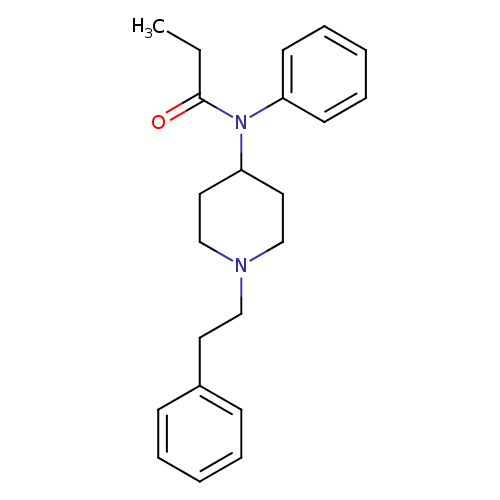
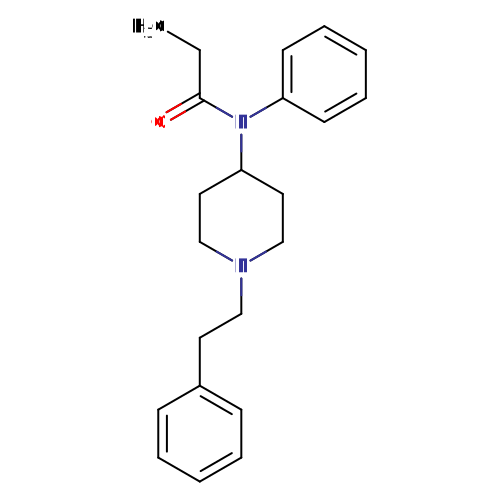
Chemical Structure
Thumb
Synonyms
ValueSource
1-Phenethyl-4-(N-phenylpropionamido)piperidineChEBI
1-Phenethyl-4-N-propionylanilinopiperidineChEBI
DuragesicChEBI
FentaniloChEBI
FentanylumChEBI
N-(1-Phenethyl-4-piperidinyl)-N-phenylpropionamideChEBI
N-(1-Phenethyl-4-piperidyl)propionanilideChEBI
N-(1-Phenethyl-piperidin-4-yl)-N-phenyl-propionamideChEBI
N-(1-Phenethylpiperidin-4-yl)-N-phenylpropionamideChEBI
N-Phenethyl-4-(N-propionylanilino)piperidineChEBI
N-Phenyl-N-(1-(2-phenylethyl)-4-piperidinyl)propanamideChEBI
PhentanylChEBI
SubsysKegg
FentanilaHMDB
Fentanyl citrateHMDB
FentanestHMDB
Transmucosal oral fentanyl citrateHMDB
DurogesicHMDB
FentoraHMDB
Cephalon brand OF fentanyl buccal oravescentHMDB
Janssen pharmaceutica brand OF fentanylHMDB
SublimazeHMDB
Chemical FormulaC22H28N2O
Average Molecular Mass336.471 g/mol
Monoisotopic Mass336.220 g/mol
CAS Registry Number437-38-7
IUPAC NameN-phenyl-N-[1-(2-phenylethyl)piperidin-4-yl]propanamide
Traditional Namefentanyl
SMILESCCC(=O)N(C1CCN(CCC2=CC=CC=C2)CC1)C1=CC=CC=C1
InChI IdentifierInChI=1S/C22H28N2O/c1-2-22(25)24(20-11-7-4-8-12-20)21-14-17-23(18-15-21)16-13-19-9-5-3-6-10-19/h3-12,21H,2,13-18H2,1H3
InChI KeyPJMPHNIQZUBGLI-UHFFFAOYSA-N
Chemical Taxonomy
Description belongs to the class of organic compounds known as fentanyls. Fentanyls are compounds containing the fentanyl moiety or a derivative, which is based on a N-(1-(2-phenylethyl)-4-piperidinyl)-N-phenylpropanamide skeleton.
KingdomOrganic compounds
Super ClassOrganoheterocyclic compounds
ClassPiperidines
Sub ClassFentanyls
Direct ParentFentanyls
Alternative Parents
Substituents
  • Fentanyl
  • Phenethylamine
  • Anilide
  • Aralkylamine
  • Monocyclic benzene moiety
  • Benzenoid
  • Tertiary carboxylic acid amide
  • Amino acid or derivatives
  • Carboxamide group
  • Tertiary amine
  • Tertiary aliphatic amine
  • Carboxylic acid derivative
  • Azacycle
  • Organopnictogen compound
  • Organooxygen compound
  • Organonitrogen compound
  • Organic oxygen compound
  • Amine
  • Carbonyl group
  • Organic oxide
  • Organic nitrogen compound
  • Hydrocarbon derivative
  • Aromatic heteromonocyclic compound
Molecular FrameworkAromatic heteromonocyclic compounds
External Descriptors
Biological Properties
StatusDetected and Not Quantified
OriginExogenous
Cellular Locations
  • Membrane
Biofluid LocationsNot Available
Tissue LocationsNot Available
PathwaysNot Available
Applications
Biological Roles
Chemical RolesNot Available
Physical Properties
StateSolid
AppearanceWhite powder.
Experimental Properties
PropertyValue
Melting Point87.5°C
Boiling PointNot Available
Solubility200 mg/L (at 25°C)
Predicted Properties
PropertyValueSource
Water Solubility0.024 g/LALOGPS
logP4.12ALOGPS
logP3.82ChemAxon
logS-4.2ALOGPS
pKa (Strongest Basic)8.77ChemAxon
Physiological Charge1ChemAxon
Hydrogen Acceptor Count2ChemAxon
Hydrogen Donor Count0ChemAxon
Polar Surface Area23.55 ŲChemAxon
Rotatable Bond Count6ChemAxon
Refractivity103.48 m³·mol⁻¹ChemAxon
Polarizability40.03 ųChemAxon
Number of Rings3ChemAxon
Bioavailability1ChemAxon
Rule of FiveYesChemAxon
Ghose FilterYesChemAxon
Veber's RuleYesChemAxon
MDDR-like RuleYesChemAxon
Spectra
Spectra
Spectrum TypeDescriptionSplash KeyView
Predicted GC-MSPredicted GC-MS Spectrum - GC-MS (Non-derivatized) - 70eV, Positivesplash10-000i-5930000000-f7e6ba23728816e17e78Spectrum
Predicted GC-MSPredicted GC-MS Spectrum - GC-MS (Non-derivatized) - 70eV, PositiveNot AvailableSpectrum
LC-MS/MSLC-MS/MS Spectrum - LC-ESI-QTOF , positivesplash10-000i-0009000000-62593b54c6285a566893Spectrum
LC-MS/MSLC-MS/MS Spectrum - LC-ESI-QTOF , positivesplash10-000i-0209000000-d550d803c25d31570227Spectrum
LC-MS/MSLC-MS/MS Spectrum - LC-ESI-QTOF , positivesplash10-000i-0901000000-09bd125eea134f8811a4Spectrum
LC-MS/MSLC-MS/MS Spectrum - LC-ESI-QTOF , positivesplash10-000i-0900000000-2c34993eade063cb426fSpectrum
LC-MS/MSLC-MS/MS Spectrum - LC-ESI-QTOF , positivesplash10-001r-0900000000-beb72ea99dc9c125d29bSpectrum
LC-MS/MSLC-MS/MS Spectrum - LC-ESI-QFT , positivesplash10-000i-0009000000-bf70e4d857c26d30032fSpectrum
LC-MS/MSLC-MS/MS Spectrum - LC-ESI-QFT , positivesplash10-000i-0907000000-a9f5d0c422eff1474d38Spectrum
LC-MS/MSLC-MS/MS Spectrum - LC-ESI-QFT , positivesplash10-000i-0900000000-0c03ba9ef576114a9503Spectrum
LC-MS/MSLC-MS/MS Spectrum - LC-ESI-QFT , positivesplash10-0a4i-0900000000-d2a36b402c3a7424fab6Spectrum
LC-MS/MSLC-MS/MS Spectrum - LC-ESI-QFT , positivesplash10-0a4i-1900000000-e0cbdfad80c306baabc1Spectrum
LC-MS/MSLC-MS/MS Spectrum - LC-ESI-QFT , positivesplash10-0a4i-2900000000-ea551550ac6cbe6d3960Spectrum
LC-MS/MSLC-MS/MS Spectrum - LC-ESI-QFT , positivesplash10-0pdi-8900000000-89b1a77e558ec74cf3acSpectrum
LC-MS/MSLC-MS/MS Spectrum - LC-ESI-QFT , positivesplash10-0kdj-9400000000-358833c028a079789d0bSpectrum
LC-MS/MSLC-MS/MS Spectrum - LC-ESI-QFT , positivesplash10-0ufs-9200000000-ff2c211a084a5f124781Spectrum
LC-MS/MSLC-MS/MS Spectrum - 40V, Positivesplash10-000i-0900000000-da874163fadaa39d25adSpectrum
LC-MS/MSLC-MS/MS Spectrum - 30V, Positivesplash10-000i-0901000000-09bd125eea134f8811a4Spectrum
LC-MS/MSLC-MS/MS Spectrum - 10V, Positivesplash10-000i-0009000000-e126a8d88c9106409cacSpectrum
LC-MS/MSLC-MS/MS Spectrum - 20V, Positivesplash10-000i-0209000000-d550d803c25d31570227Spectrum
LC-MS/MSLC-MS/MS Spectrum - 50V, Positivesplash10-001r-0900000000-2ed12cf85c72a16b8cdbSpectrum
Predicted LC-MS/MSPredicted LC-MS/MS Spectrum - 10V, Positivesplash10-000i-1239000000-6f316602b5d12ff1b1b9Spectrum
Predicted LC-MS/MSPredicted LC-MS/MS Spectrum - 20V, Positivesplash10-0a4r-4942000000-703ee8a328127a82245cSpectrum
Predicted LC-MS/MSPredicted LC-MS/MS Spectrum - 40V, Positivesplash10-0a4i-4900000000-c38eaa80ecf3e4334782Spectrum
Predicted LC-MS/MSPredicted LC-MS/MS Spectrum - 10V, Negativesplash10-000i-0009000000-303253b936dc7fea5dd0Spectrum
Predicted LC-MS/MSPredicted LC-MS/MS Spectrum - 20V, Negativesplash10-0550-3498000000-cbae1ca8da3e5b395fa4Spectrum
Predicted LC-MS/MSPredicted LC-MS/MS Spectrum - 40V, Negativesplash10-05dl-6930000000-8603b3c4374827ab0621Spectrum
MSMass Spectrum (Electron Ionization)splash10-0002-9850000000-7ce3a6f35f5dee98185fSpectrum
Toxicity Profile
Route of ExposureEpidural; parental (transdermal, intramuscular).
Mechanism of ToxicityOpiate receptors are coupled with G-protein receptors and function as both positive and negative regulators of synaptic transmission via G-proteins that activate effector proteins. Binding of the opiate stimulates the exchange of GTP for GDP on the G-protein complex. As the effector system is adenylate cyclase and cAMP located at the inner surface of the plasma membrane, opioids decrease intracellular cAMP by inhibiting adenylate cyclase. Subsequently, the release of nociceptive neurotransmitters such as substance P, GABA, dopamine, acetylcholine and noradrenaline is inhibited. Opioids also inhibit the release of vasopressin, somatostatin, insulin and glucagon. Fentanyl's analgesic activity is, most likely, due to its conversion to morphine. Opioids close N-type voltage-operated calcium channels (OP2-receptor agonist) and open calcium-dependent inwardly rectifying potassium channels (OP3 and OP1 receptor agonist). This results in hypopolarization and reduced neuronal excitability.
MetabolismFentanyl is metabolized primarily via human cytochrome P450 3A4 isoenzyme system. Route of Elimination: Fentanyl is metabolized primarily via human cytochrome P450 3A4 isoenzyme system and mostly eliminated in urine. Within 72 hours of IV fentanyl administration, approximately 75% of the dose is excreted in urine, mostly as metabolites with less than 10% representing unchanged drug. Half Life: 7 hours (range 3-12)
Toxicity ValuesLD50: 3.1 mg/kg (rat) LD50: 0.03 mg/kg (monkeys)
Lethal DoseNot Available
Carcinogenicity (IARC Classification)No indication of carcinogenicity to humans (not listed by IARC).
Uses/SourcesFor the treatment of cancer patients with severe pain that breaks through their regular narcotic therapy. Used as an inhalation anesthetic. (6)
Minimum Risk LevelNot Available
Health EffectsMedical problems can include congested lungs, liver disease, tetanus, infection of the heart valves, skin abscesses, anemia and pneumonia. Death can occur from overdose.
SymptomsMore common symptoms are dizziness, light-headedness, or feeling faint; drowsiness; nausea or vomiting; unusual tiredness or weakness. Less common or rare ones are blurred or double vision or other vision problems; confusion; constipation; convulsions (seizures); difficult or painful urination; mental depression; shortness of breath, trouble in breathing, tightness in the chest, or wheezing; skin rash, hives, or itching; unusual excitement (6)
TreatmentFor the management of hypoventilation, immediate countermeasures include removing the Fentanyl and physically or verbally stimulating the patient. These actions can be followed by administration of a specific narcotic antagonist such as naloxone. The duration of hypoventilation following an overdose may be longer than the effects of the narcotic antagonist's action (the half-life of naloxone ranges from 30 to 81 minutes). The interval between IV antagonist doses should be carefully chosen because of the possibility of re-narcotization after system removal; repeated administration of naloxone may be necessary. Reversal of the narcotic effect may result in acute onset of pain and the release of catecholamines. Always ensure a patent airway is established and maintained, administer oxygen and assist or control respiration as indicated and use an oropharyngeal airway or endotracheal tube if necessary. Adequate body temperature and fluid intake should be maintained. (7)
Concentrations
Not Available
DrugBank IDDB00813
HMDB IDHMDB0014951
FooDB IDNot Available
Phenol Explorer IDNot Available
KNApSAcK IDNot Available
BiGG IDNot Available
BioCyc IDNot Available
METLIN IDNot Available
PDB IDNot Available
Wikipedia LinkFentanyl
Chemspider ID3228
ChEBI ID119915
PubChem Compound ID3345
Kegg Compound IDNot Available
YMDB IDNot Available
ECMDB IDNot Available
References
Synthesis Reference

Mark Rubino, “Process of making fentanyl intermediates.” U.S. Patent US20060100438, issued May 11, 2006.

MSDSLink
General References
1. Van Bever WF, Niemegeers CJ, Janssen PA: Synthetic analgesics. Synthesis and pharmacology of the diastereoisomers of N-(3-methyl-1-(2-phenylethyl)-4-piperidyl)-N-phenylpropanamide and N-(3-methyl-1-(1-methyl-2-phenylethyl)-4-piperidyl)-N-phenylpropanamide. J Med Chem. 1974 Oct;17(10):1047-51.
2. Simpson DM, Messina J, Xie F, Hale M: Fentanyl buccal tablet for the relief of breakthrough pain in opioid-tolerant adult patients with chronic neuropathic pain: a multicenter, randomized, double-blind, placebo-controlled study. Clin Ther. 2007 Apr;29(4):588-601.
3. Taylor DR: Fentanyl buccal tablet: rapid relief from breakthrough pain. Expert Opin Pharmacother. 2007 Dec;8(17):3043-51.
4. Messina J, Darwish M, Fine PG: Fentanyl buccal tablet. Drugs Today (Barc). 2008 Jan;44(1):41-54. doi: 10.1358/dot.2008.44.1.1178469.
5. https://www.ncbi.nlm.nih.gov/pubmed/?term=10669565
6. https://www.ncbi.nlm.nih.gov/pubmed/?term=10987438
7. https://www.ncbi.nlm.nih.gov/pubmed/?term=11585443
8. https://www.ncbi.nlm.nih.gov/pubmed/?term=14698188
9. https://www.ncbi.nlm.nih.gov/pubmed/?term=16621415
10. https://www.ncbi.nlm.nih.gov/pubmed/?term=18462178
11. https://www.ncbi.nlm.nih.gov/pubmed/?term=18728103
12. https://www.ncbi.nlm.nih.gov/pubmed/?term=30176422
13. https://www.ncbi.nlm.nih.gov/pubmed/?term=30305277