Record Information
Version1.0
Creation Date2009-07-21 20:27:38 UTC
Update Date2026-05-14 16:48:41 UTC
Accession NumberCHEM002272
Identification
Common NamePhenelzine
ClassSmall Molecule
DescriptionPhenelzine is only found in individuals that have used or taken this drug. It is an irreversible non-selective inhibitor of monoamine oxidase. May be used to treat major depressive disorder.Although the exact mechanism of action has not been determined, it appears that the irreversible, nonselective inhibition of MAO by phenelzine relieves depressive symptoms by causing an increase in the levels of serotonin, norepinephrine, and dopamine in the neuron.
Contaminant Sources
  • HMDB Contaminants - Urine
  • IARC Carcinogens Group 3
  • T3DB toxins
Contaminant Type
  • Amine
  • Antidepressant
  • Antidepressive Agent
  • Drug
  • Human Neurotoxin
  • Hydrazine
  • Metabolite
  • Monoamine Oxidase Inhibitor
  • Organic Compound
  • Synthetic Compound
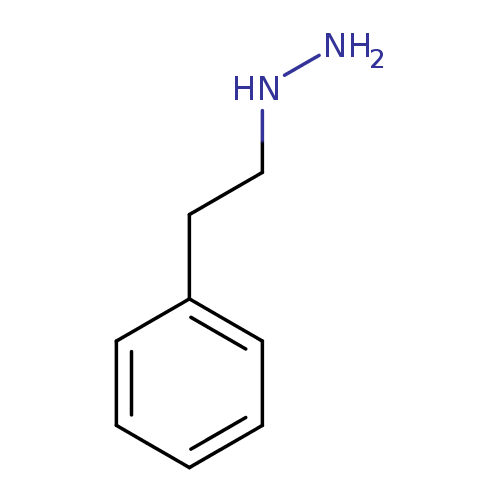
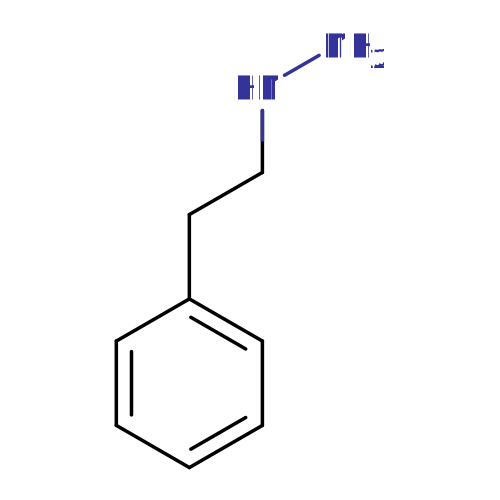
Chemical Structure
Thumb
Synonyms
ValueSource
NardilHMDB
2 PhenethylhydrazineHMDB
2-PhenethylhydrazineHMDB
NardelzineHMDB
beta PhenylethylhydrazineHMDB
Phenelzine sulfateHMDB
Parke davis brand OF phenelzine sulfateHMDB
PhenethylhydrazineHMDB
beta-PhenylethylhydrazineHMDB
FenelzinHMDB
Pfizer brand OF phenelzine sulfateHMDB
Sulfate, phenelzineHMDB
United drug brand OF phenelzine sulfateHMDB
Warner chilcott brand OF phenelzine sulfateHMDB
Chemical FormulaC8H12N2
Average Molecular Mass136.194 g/mol
Monoisotopic Mass136.100 g/mol
CAS Registry Number51-71-8
IUPAC Name(2-phenylethyl)hydrazine
Traditional Namephenelzine
SMILESNNCCC1=CC=CC=C1
InChI IdentifierInChI=1S/C8H12N2/c9-10-7-6-8-4-2-1-3-5-8/h1-5,10H,6-7,9H2
InChI KeyRMUCZJUITONUFY-UHFFFAOYSA-N
Chemical Taxonomy
Description belongs to the class of organic compounds known as benzene and substituted derivatives. These are aromatic compounds containing one monocyclic ring system consisting of benzene.
KingdomOrganic compounds
Super ClassBenzenoids
ClassBenzene and substituted derivatives
Sub ClassNot Available
Direct ParentBenzene and substituted derivatives
Alternative Parents
Substituents
  • Monocyclic benzene moiety
  • Alkylhydrazine
  • Organic nitrogen compound
  • Organopnictogen compound
  • Hydrocarbon derivative
  • Organonitrogen compound
  • Hydrazine derivative
  • Aromatic homomonocyclic compound
Molecular FrameworkAromatic homomonocyclic compounds
External Descriptors
Biological Properties
StatusDetected and Not Quantified
OriginExogenous
Cellular Locations
  • Cytoplasm
  • Extracellular
  • Membrane
Biofluid LocationsNot Available
Tissue LocationsNot Available
PathwaysNot Available
ApplicationsNot Available
Biological RolesNot Available
Chemical RolesNot Available
Physical Properties
StateLiquid
AppearanceNot Available
Experimental Properties
PropertyValue
Melting Point< 25°C
Boiling Point74°C at 1.00E-01 mm Hg
Solubility29.1 g/L
Predicted Properties
PropertyValueSource
Water Solubility11.1 g/LALOGPS
logP1.2ALOGPS
logP1.2ChemAxon
logS-1.1ALOGPS
pKa (Strongest Basic)5.55ChemAxon
Physiological Charge0ChemAxon
Hydrogen Acceptor Count2ChemAxon
Hydrogen Donor Count2ChemAxon
Polar Surface Area38.05 ŲChemAxon
Rotatable Bond Count3ChemAxon
Refractivity54.26 m³·mol⁻¹ChemAxon
Polarizability15.8 ųChemAxon
Number of Rings1ChemAxon
Bioavailability1ChemAxon
Rule of FiveYesChemAxon
Ghose FilterNoChemAxon
Veber's RuleYesChemAxon
MDDR-like RuleNoChemAxon
Spectra
Spectra
Spectrum TypeDescriptionSplash KeyView
GC-MSGC-MS Spectrum - EI-B (Non-derivatized)splash10-0a4l-9800000000-fec970db2245559d8531Spectrum
Predicted GC-MSPredicted GC-MS Spectrum - GC-MS (Non-derivatized) - 70eV, Positivesplash10-0007-9200000000-b2c57d1368223a96c523Spectrum
Predicted GC-MSPredicted GC-MS Spectrum - GC-MS (Non-derivatized) - 70eV, PositiveNot AvailableSpectrum
LC-MS/MSLC-MS/MS Spectrum - LC-ESI-qTof , Positivesplash10-01t9-0592000000-92a48c620c961fdb430fSpectrum
LC-MS/MSLC-MS/MS Spectrum - , positivesplash10-0a4i-0900000000-cf09dbe619ab21f16ce0Spectrum
LC-MS/MSLC-MS/MS Spectrum - 35V, Positivesplash10-0a4i-2900000000-fcb3587623714354e760Spectrum
Predicted LC-MS/MSPredicted LC-MS/MS Spectrum - 10V, Positivesplash10-000i-0900000000-6c9dda205486ea199582Spectrum
Predicted LC-MS/MSPredicted LC-MS/MS Spectrum - 20V, Positivesplash10-0a4i-1900000000-d6caecbd05b28ce80778Spectrum
Predicted LC-MS/MSPredicted LC-MS/MS Spectrum - 40V, Positivesplash10-052f-9200000000-e6be767f746d7eec77baSpectrum
Predicted LC-MS/MSPredicted LC-MS/MS Spectrum - 10V, Negativesplash10-000i-1900000000-97c518b056fc3f0c5992Spectrum
Predicted LC-MS/MSPredicted LC-MS/MS Spectrum - 20V, Negativesplash10-000i-4900000000-6d2d5af23910f83be107Spectrum
Predicted LC-MS/MSPredicted LC-MS/MS Spectrum - 40V, Negativesplash10-0kx3-9600000000-9577503e15a41993941bSpectrum
Predicted LC-MS/MSPredicted LC-MS/MS Spectrum - 10V, Positivesplash10-0a4i-0900000000-5ca1a374df7ceed01896Spectrum
Predicted LC-MS/MSPredicted LC-MS/MS Spectrum - 20V, Positivesplash10-0a4i-3900000000-9f4b820ee530441e453fSpectrum
Predicted LC-MS/MSPredicted LC-MS/MS Spectrum - 40V, Positivesplash10-004l-9100000000-40882216bbd046d0ab4eSpectrum
Predicted LC-MS/MSPredicted LC-MS/MS Spectrum - 10V, Negativesplash10-000i-0900000000-e9776c924504e8fd7ea8Spectrum
Predicted LC-MS/MSPredicted LC-MS/MS Spectrum - 20V, Negativesplash10-052f-6900000000-27086fbc61d9efcf4d5aSpectrum
Predicted LC-MS/MSPredicted LC-MS/MS Spectrum - 40V, Negativesplash10-004i-9100000000-f3ed866d0f02ae18d439Spectrum
MSMass Spectrum (Electron Ionization)splash10-0002-9000000000-833e467e14c48ae4f6b3Spectrum
1D NMR13C NMR SpectrumNot AvailableSpectrum
1D NMR1H NMR SpectrumNot AvailableSpectrum
1D NMR13C NMR SpectrumNot AvailableSpectrum
1D NMR1H NMR SpectrumNot AvailableSpectrum
1D NMR13C NMR SpectrumNot AvailableSpectrum
1D NMR1H NMR SpectrumNot AvailableSpectrum
1D NMR13C NMR SpectrumNot AvailableSpectrum
1D NMR1H NMR SpectrumNot AvailableSpectrum
1D NMR13C NMR SpectrumNot AvailableSpectrum
1D NMR1H NMR SpectrumNot AvailableSpectrum
1D NMR13C NMR SpectrumNot AvailableSpectrum
1D NMR1H NMR SpectrumNot AvailableSpectrum
1D NMR13C NMR SpectrumNot AvailableSpectrum
1D NMR1H NMR SpectrumNot AvailableSpectrum
1D NMR13C NMR SpectrumNot AvailableSpectrum
1D NMR1H NMR SpectrumNot AvailableSpectrum
1D NMR13C NMR SpectrumNot AvailableSpectrum
1D NMR1H NMR SpectrumNot AvailableSpectrum
1D NMR13C NMR SpectrumNot AvailableSpectrum
1D NMR1H NMR SpectrumNot AvailableSpectrum
Toxicity Profile
Route of ExposureReadily absorbed after oral administration.
Mechanism of ToxicityAlthough the exact mechanism of action has not been determined, it appears that the irreversible, nonselective inhibition of MAO by phenelzine relieves depressive symptoms by causing an increase in the levels of serotonin, norepinephrine, and dopamine in the neuron.
MetabolismHepatic. Acetylation of phenelzine appears to be a minor metabolic pathway. Beta-phenylethylamine is a metabolite of phenelzine, and there is indirect evidence that phenelzine may also be ring-hydroxylated and N-methylated. Route of Elimination: NARDIL® is extensively metabolized, primarily by oxidation via monoamine oxidase. Half Life: 1.2-11.6 hours following single dose administration. Multiple-dose pharmacokinetics have not been studied.
Toxicity ValuesNot Available
Lethal DoseNot Available
Carcinogenicity (IARC Classification)3, not classifiable as to its carcinogenicity to humans. (3)
Uses/SourcesFor the treatment of major depressive disorder. Has also been used with some success in the management of bulimia nervosa.
Minimum Risk LevelNot Available
Health EffectsNot Available
SymptomsSymptoms of overdose include drowsiness, dizziness, faintness, irritability, hyperactivity, agitation, severe headache, hallucinations, trismus, opisthotonos, convulsions and coma, rapid and irregular pulse, hypertension, hypotension and vascular collapse, precordial pain, respiratory depression and failure, hyperpyrexia, diaphoresis, and cool, clammy skin.
TreatmentIntensive symptomatic and supportive treatment may be required. Induction of emesis or gastric lavage with instillation of charcoal slurry may be helpful in early poisoning, provided the airway has been protected against aspiration. Signs and symptoms of central nervous system stimulation, including convulsions, should be treated with diazepam, given slowly intravenously. Phenothiazine derivatives and central nervous system stimulants should be avoided. Hypotension and vascular collapse should be treated with intravenous fluids and, if necessary, blood pressure titration with an intravenous infusion of dilute pressor agent. It should be noted that adrenergic agents may produce a markedly increased pressor response. Respiration should be supported by appropriate measures, including management of the airway, use of supplemental oxygen, and mechanical ventilatory assistance, as required. Body temperature should be monitored closely. Intensive management of hyperpyrexia may be required. Maintenance of fluid and electrolyte balance is essential. (5)
Concentrations
Not Available
DrugBank IDDB00780
HMDB IDHMDB0014918
FooDB IDNot Available
Phenol Explorer IDNot Available
KNApSAcK IDNot Available
BiGG IDNot Available
BioCyc IDNot Available
METLIN IDNot Available
PDB IDNot Available
Wikipedia LinkPhenelzine
Chemspider ID3547
ChEBI ID248018
PubChem Compound ID3675
Kegg Compound IDC07430
YMDB IDNot Available
ECMDB IDNot Available
References
Synthesis ReferenceNot Available
MSDSNot Available
General References
1. Nolen WA: [Classical monoamine oxidase inhibitor: not registered for, but still a place in the treatment of depression]. Ned Tijdschr Geneeskd. 2003 Oct 4;147(40):1940-3.
2. Sowa BN, Holt A, Todd KG, Baker GB: Monoamine oxidase inhibitors, their structural analogues, and neuroprotection. Indian J Exp Biol. 2004 Sep;42(9):851-7.