Record Information
Version1.0
Creation Date2009-07-21 20:27:33 UTC
Update Date2026-05-14 16:47:46 UTC
Accession NumberCHEM002264
Identification
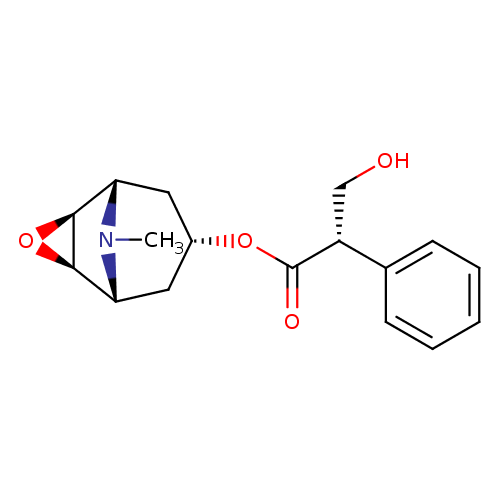
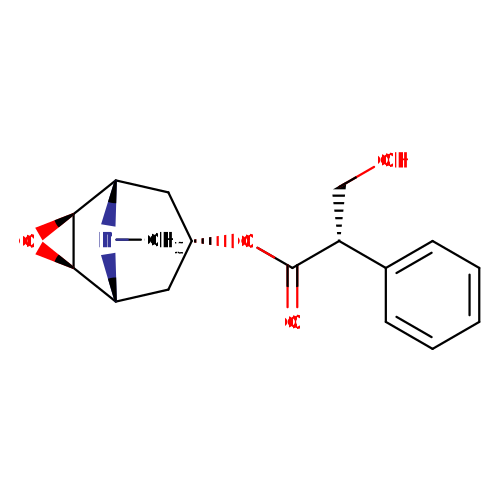
Common NameScopolamine
ClassSmall Molecule
DescriptionScopolamine, also known as hyoscine, is a tropane alkaloid drug obtained from plants of the family Solanaceae (nightshades), such as henbane or jimson weed (Datura species). It is part of the secondary metabolites of plants. Scopolamine is used criminally as a date rape drug and as an aid to robbery, the most common act being the clandestine drugging of a victim's drink. It is preferred because it induces retrograde amnesia, or an inability to recall events prior to its administration. Victims of this crime are often admitted to a hospital in police custody, under the assumption that the patient is experiencing a psychotic episode. A telltale sign is a fever accompanied by a lack of sweat. An alkaloid from Solanaceae, especially Datura metel L. and Scopola carniolica. Scopolamine and its quaternary derivatives act as antimuscarinics like atropine, but may have more central nervous system effects. Among the many uses are as an anesthetic premedication, in urinary incontinence, in motion sickness, as an antispasmodic, and as a mydriatic and cycloplegic.
Contaminant Sources
  • FooDB Chemicals
  • STOFF IDENT Compounds
  • T3DB toxins
Contaminant Type
  • Adjuvant
  • Adjuvant, Anesthesia
  • Amine
  • Antimuscarinic
  • Antispasmodic
  • Cholinergic Antagonist
  • Drug
  • Ester
  • Ether
  • Food Toxin
  • Metabolite
  • Muscarinic Antagonist
  • Mydriatic
  • Natural Compound
  • Organic Compound
  • PFAS
  • Phytotoxin
  • Plant Toxin
Chemical Structure
Thumb
Synonyms
ValueSource
(-)-HyoscineChEBI
(-)-ScopolamineChEBI
(1S,3S,5R,6R,7S)-6,7-Epoxytropan-3-yl (2S)-3-hydroxy-2-phenylpropanoateChEBI
6,7-Epoxytropine tropateChEBI
6-beta,7-beta-Epoxy-3-alpha-tropanyl S-(-)-tropateChEBI
alpha-(Hydroxymethyl)benzeneacetic acid 9-methyl-3-oxa-9-azatricyclo(3.3.1.0(2.4))non-7-yl esterChEBI
HyoscineChEBI
Scopine (-)-tropateChEBI
Transderm-scopChEBI
(1S,3S,5R,6R,7S)-6,7-Epoxytropan-3-yl (2S)-3-hydroxy-2-phenylpropanoic acidGenerator
6,7-Epoxytropine tropic acidGenerator
6-b,7-b-Epoxy-3-a-tropanyl S-(-)-tropateGenerator
6-b,7-b-Epoxy-3-a-tropanyl S-(-)-tropic acidGenerator
6-beta,7-beta-Epoxy-3-alpha-tropanyl S-(-)-tropic acidGenerator
6-Β,7-β-epoxy-3-α-tropanyl S-(-)-tropateGenerator
6-Β,7-β-epoxy-3-α-tropanyl S-(-)-tropic acidGenerator
a-(Hydroxymethyl)benzeneacetate 9-methyl-3-oxa-9-azatricyclo(3.3.1.0(2.4))non-7-yl esterGenerator
a-(Hydroxymethyl)benzeneacetic acid 9-methyl-3-oxa-9-azatricyclo(3.3.1.0(2.4))non-7-yl esterGenerator
alpha-(Hydroxymethyl)benzeneacetate 9-methyl-3-oxa-9-azatricyclo(3.3.1.0(2.4))non-7-yl esterGenerator
Α-(hydroxymethyl)benzeneacetate 9-methyl-3-oxa-9-azatricyclo(3.3.1.0(2.4))non-7-yl esterGenerator
Α-(hydroxymethyl)benzeneacetic acid 9-methyl-3-oxa-9-azatricyclo(3.3.1.0(2.4))non-7-yl esterGenerator
Scopine (-)-tropic acidGenerator
(+)-HyoscineHMDB
(+)-ScopolamineHMDB
(-)-Hyoscine hydrobromideHMDB
(-)-Scopolamine bromideHMDB
(-)-Scopolamine hydrobromideHMDB
AtrochinHMDB
AtroquinHMDB
BeldavrinHMDB
BuscopanHMDB
Epoxytropine tropateHMDB
EuscopolHMDB
Hydroscine hydrobromideHMDB
HyosceineHMDB
Hyoscine bromideHMDB
Hyoscine hydrobromideHMDB
Hyoscyine hydrobromideHMDB
HyosolHMDB
HyscoHMDB
Isopto hyoscineHMDB
IsoscopilHMDB
KwellsHMDB
L-Hyoscine hydrobromideHMDB
L-Scopolamine-hydrobromideHMDB
Methscopolamine bromideHMDB
OscineHMDB
PamineHMDB
S-(-)-TropateHMDB
ScopHMDB
ScopaminHMDB
Scopine tropateHMDB
Scopolamine bromideHMDB
Scopolamine hydrobromideHMDB
Scopolaminium bromideHMDB
Scopolammonium bromideHMDB
SEEHMDB
TranaxineHMDB
NorhyoscineHMDB
6beta,7beta-Epoxy-3alpha-tropanyl S-(-)-tropatePhytoBank
6β,7β-Epoxy-3α-tropanyl S-(-)-tropatePhytoBank
9-Methyl-3-oxa-9-azatricyclo[3.3.1.02,4]nonan-7-ol (-)-tropatePhytoBank
l-ScopolaminePhytoBank
(-)-AtropinePhytoBank
(-)-HyoscyaminePhytoBank
(S)-(-)-HyoscyaminePhytoBank
(S)-AtropinePhytoBank
1alphaH,5alphaH-Tropan-3alpha-yl (-)-tropatePhytoBank
1αH,5αH-Tropan-3α-yl (-)-tropatePhytoBank
CystospazPhytoBank
DaturinePhytoBank
DuboisinePhytoBank
HyoscyaminePhytoBank
L-HyoscyaminPhytoBank
l-HyoscyaminePhytoBank
l-AtropinePhytoBank
l-Tropine tropatePhytoBank
(±)-AtropinePhytoBank
(±)-HyoscyaminePhytoBank
AtropinPhytoBank
AtropinePhytoBank
Atropinum sulfuricumPhytoBank
Atropinum sulphuricumPhytoBank
dl-HyoscyaminePhytoBank
Tropine (±)-tropatePhytoBank
Tropine tropatePhytoBank
dl-Tropyl tropatePhytoBank
Chemical FormulaC17H21NO4
Average Molecular Mass303.353 g/mol
Monoisotopic Mass303.147 g/mol
CAS Registry Number51-34-3
IUPAC Name(1R,2R,4S,5S,7S)-9-methyl-3-oxa-9-azatricyclo[3.3.1.0^{2,4}]nonan-7-yl (2S)-3-hydroxy-2-phenylpropanoate
Traditional Name(1R,2R,4S,5S,7S)-9-methyl-3-oxa-9-azatricyclo[3.3.1.0^{2,4}]nonan-7-yl (2S)-3-hydroxy-2-phenylpropanoate
SMILESCN1[C@H]2C[C@@H](C[C@@H]1[C@H]1O[C@@H]21)OC(=O)[C@H](CO)C1=CC=CC=C1
InChI IdentifierInChI=1S/C17H21NO4/c1-18-13-7-11(8-14(18)16-15(13)22-16)21-17(20)12(9-19)10-5-3-2-4-6-10/h2-6,11-16,19H,7-9H2,1H3/t11-,12-,13-,14+,15-,16+/m1/s1
InChI KeySTECJAGHUSJQJN-FWXGHANASA-N
Chemical Taxonomy
Description belongs to the class of organic compounds known as beta hydroxy acids and derivatives. Beta hydroxy acids and derivatives are compounds containing a carboxylic acid substituted with a hydroxyl group on the C3 carbon atom.
KingdomOrganic compounds
Super ClassOrganic acids and derivatives
ClassHydroxy acids and derivatives
Sub ClassBeta hydroxy acids and derivatives
Direct ParentBeta hydroxy acids and derivatives
Alternative Parents
Substituents
  • Beta-hydroxy acid
  • Monocyclic benzene moiety
  • Morpholine
  • Oxazinane
  • Piperidine
  • N-alkylpyrrolidine
  • Benzenoid
  • Pyrrolidine
  • Amino acid or derivatives
  • Carboxylic acid ester
  • Tertiary amine
  • Tertiary aliphatic amine
  • Oxacycle
  • Organoheterocyclic compound
  • Azacycle
  • Carboxylic acid derivative
  • Dialkyl ether
  • Oxirane
  • Ether
  • Monocarboxylic acid or derivatives
  • Primary alcohol
  • Organopnictogen compound
  • Organonitrogen compound
  • Organooxygen compound
  • Amine
  • Organic oxide
  • Carbonyl group
  • Organic oxygen compound
  • Organic nitrogen compound
  • Alcohol
  • Hydrocarbon derivative
  • Aromatic heteropolycyclic compound
Molecular FrameworkAromatic heteropolycyclic compounds
External Descriptors
Biological Properties
StatusDetected and Not Quantified
OriginExogenous
Cellular Locations
  • Cytoplasm
  • Extracellular
  • Membrane
Biofluid LocationsNot Available
Tissue Locations
  • Adipose Tissue
  • Brain
  • Nerve Cells
  • Neuron
  • Stratum Corneum
PathwaysNot Available
Applications
Biological Roles
Chemical RolesNot Available
Physical Properties
StateSolid
AppearanceWhite powder.
Experimental Properties
PropertyValue
Melting Point59°C
Boiling PointNot Available
Solubility1E+005 mg/L
Predicted Properties
PropertyValueSource
Water Solubility6.61 g/LALOGPS
logP1.4ALOGPS
logP0.89ChemAxon
logS-1.7ALOGPS
pKa (Strongest Acidic)15.15ChemAxon
pKa (Strongest Basic)6.95ChemAxon
Physiological Charge1ChemAxon
Hydrogen Acceptor Count4ChemAxon
Hydrogen Donor Count1ChemAxon
Polar Surface Area62.3 ŲChemAxon
Rotatable Bond Count5ChemAxon
Refractivity79.72 m³·mol⁻¹ChemAxon
Polarizability31.24 ųChemAxon
Number of Rings4ChemAxon
Bioavailability1ChemAxon
Rule of FiveYesChemAxon
Ghose FilterYesChemAxon
Veber's RuleNoChemAxon
MDDR-like RuleNoChemAxon
Spectra
Spectra
Spectrum TypeDescriptionSplash KeyView
GC-MSGC-MS Spectrum - GC-MS (1 TMS)splash10-0f7c-7900000000-28f924e821203772c1adSpectrum
Predicted GC-MSPredicted GC-MS Spectrum - GC-MS (Non-derivatized) - 70eV, Positivesplash10-00di-4910000000-24c90e50ab88ad57e82cSpectrum
Predicted GC-MSPredicted GC-MS Spectrum - GC-MS (1 TMS) - 70eV, Positivesplash10-0006-4900000000-596180a39c76ec0fe1aeSpectrum
Predicted GC-MSPredicted GC-MS Spectrum - GC-MS (Non-derivatized) - 70eV, PositiveNot AvailableSpectrum
LC-MS/MSLC-MS/MS Spectrum - LC-ESI-QQ , positivesplash10-0udi-0009000000-9733effdc3262b114ed6Spectrum
LC-MS/MSLC-MS/MS Spectrum - LC-ESI-QQ , positivesplash10-0udi-0809000000-a686e4c768aedb57cf8eSpectrum
LC-MS/MSLC-MS/MS Spectrum - LC-ESI-QQ , positivesplash10-000i-1901000000-f66f538c7db471e86fd5Spectrum
LC-MS/MSLC-MS/MS Spectrum - LC-ESI-QQ , positivesplash10-000i-3900000000-5eedeba4bedea55de9adSpectrum
LC-MS/MSLC-MS/MS Spectrum - LC-ESI-QQ , positivesplash10-0udr-7900000000-1309364bbca3810a6afaSpectrum
LC-MS/MSLC-MS/MS Spectrum - LC-ESI-IT , positivesplash10-000i-0900000000-1c1d2f52fb7a5d745e1eSpectrum
LC-MS/MSLC-MS/MS Spectrum - 90V, Positivesplash10-0udi-9700000000-80887cb9e3f0d05c8bf5Spectrum
LC-MS/MSLC-MS/MS Spectrum - 90V, Positivesplash10-0udi-9800000000-80887cb9e3f0d05c8bf5Spectrum
LC-MS/MSLC-MS/MS Spectrum - 75V, Positivesplash10-0udi-6900000000-010e6e0ca9f0d9f3618bSpectrum
LC-MS/MSLC-MS/MS Spectrum - 60V, Positivesplash10-0f79-4900000000-a0695c5add6db92de8b2Spectrum
LC-MS/MSLC-MS/MS Spectrum - 45V, Positivesplash10-000i-2900000000-887570e409db5eca481cSpectrum
LC-MS/MSLC-MS/MS Spectrum - 60V, Positivesplash10-0f79-4900000000-5e1feadfe643a530d956Spectrum
LC-MS/MSLC-MS/MS Spectrum - 45V, Positivesplash10-000i-2900000000-9556767e32b410cf8d73Spectrum
LC-MS/MSLC-MS/MS Spectrum - 15V, Positivesplash10-0udi-0309000000-fda2d2422fa0a3b4172eSpectrum
LC-MS/MSLC-MS/MS Spectrum - 30V, Positivesplash10-0k9i-0903000000-cc938997b1c67e020c14Spectrum
Predicted LC-MS/MSPredicted LC-MS/MS Spectrum - 10V, Positivesplash10-0f79-0955000000-64498c50c4e2afb15c32Spectrum
Predicted LC-MS/MSPredicted LC-MS/MS Spectrum - 20V, Positivesplash10-000i-1930000000-5d768d7bc9f10614fd97Spectrum
Predicted LC-MS/MSPredicted LC-MS/MS Spectrum - 40V, Positivesplash10-0lxt-4900000000-f39cfd7374383b7b1aafSpectrum
Predicted LC-MS/MSPredicted LC-MS/MS Spectrum - 10V, Negativesplash10-0udi-0549000000-2102ba2525a572e05e74Spectrum
Predicted LC-MS/MSPredicted LC-MS/MS Spectrum - 20V, Negativesplash10-0uk9-1952000000-23caf7102d633b0031b2Spectrum
Predicted LC-MS/MSPredicted LC-MS/MS Spectrum - 40V, Negativesplash10-0hr0-4900000000-854ad2f78678cc2d4db3Spectrum
Predicted LC-MS/MSPredicted LC-MS/MS Spectrum - 10V, Negativesplash10-0f6t-0904000000-0366209ad3f767f88736Spectrum
Predicted LC-MS/MSPredicted LC-MS/MS Spectrum - 20V, Negativesplash10-0f79-1900000000-bd791764fd2502fdc39dSpectrum
Predicted LC-MS/MSPredicted LC-MS/MS Spectrum - 40V, Negativesplash10-0gb9-2910000000-c7c4ffc22c1425ab3dbdSpectrum
Predicted LC-MS/MSPredicted LC-MS/MS Spectrum - 10V, Positivesplash10-0udi-0019000000-cc4ab81a673ee149c93eSpectrum
1D NMR1H NMR SpectrumNot AvailableSpectrum
1D NMR13C NMR SpectrumNot AvailableSpectrum
1D NMR1H NMR SpectrumNot AvailableSpectrum
1D NMR13C NMR SpectrumNot AvailableSpectrum
1D NMR1H NMR SpectrumNot AvailableSpectrum
1D NMR13C NMR SpectrumNot AvailableSpectrum
1D NMR1H NMR SpectrumNot AvailableSpectrum
1D NMR13C NMR SpectrumNot AvailableSpectrum
1D NMR1H NMR SpectrumNot AvailableSpectrum
1D NMR13C NMR SpectrumNot AvailableSpectrum
1D NMR1H NMR SpectrumNot AvailableSpectrum
1D NMR13C NMR SpectrumNot AvailableSpectrum
1D NMR1H NMR SpectrumNot AvailableSpectrum
1D NMR13C NMR SpectrumNot AvailableSpectrum
1D NMR1H NMR SpectrumNot AvailableSpectrum
1D NMR13C NMR SpectrumNot AvailableSpectrum
1D NMR1H NMR SpectrumNot AvailableSpectrum
1D NMR13C NMR SpectrumNot AvailableSpectrum
1D NMR1H NMR SpectrumNot AvailableSpectrum
1D NMR13C NMR SpectrumNot AvailableSpectrum
2D NMR[1H,13C] 2D NMR SpectrumNot AvailableSpectrum
Toxicity Profile
Route of ExposureParental (intravenous, intramuscular, and transdermal); oral
Mechanism of ToxicityScopolamine acts by interfering with the transmission of nerve impulses by acetylcholine in the parasympathetic nervous system (specifically the vomiting center).
Metabolism Route of Elimination: Less than 10% of the total dose is excreted in the urine as parent and metabolites over 108 hours. Half Life: 4.5 hours
Toxicity ValuesNot Available
Lethal DoseNot Available
Carcinogenicity (IARC Classification)No indication of carcinogenicity to humans (not listed by IARC).
Uses/SourcesFor the treatment of excessive salivation, colicky abdominal pain, bradycardia, sialorrhoea, diverticulitis, irritable bowel syndrome and motion sickness.
Minimum Risk LevelNot Available
Health EffectsNot Available
SymptomsNot Available
TreatmentNot Available
Concentrations
Not Available
DrugBank IDDB00747
HMDB IDHMDB0003573
FooDB IDFDB023199
Phenol Explorer IDNot Available
KNApSAcK IDC00002292
BiGG IDNot Available
BioCyc IDSCOPOLAMINE
METLIN ID3433
PDB IDNot Available
Wikipedia LinkScopolamine
Chemspider ID10194106
ChEBI ID16794
PubChem Compound IDNot Available
Kegg Compound IDC01851
YMDB IDNot Available
ECMDB IDNot Available
References
Synthesis Reference

Yang Guodong, “Preparation and application of scopolamine and chlorpromazine as a drug-withdrawal agent.” U.S. Patent US5543407, issued February, 1993.

MSDSLink
General References
1. https://www.ncbi.nlm.nih.gov/pubmed/?term=11718188
2. https://www.ncbi.nlm.nih.gov/pubmed/?term=23334071
3. Chemnitius, F. Method for the technical preparation of scopolamine. Journal fuer Praktische Chemie (Leipzig) (1928), 120 221-4.
4. Lee HW, Park WS, Kim YW, Cho SH, Kim SS, Seo JH, Lee KT: A rapid and sensitive liquid chromatography/positive ion tandem mass spectrometry method for the determination of cimetropium in human plasma by liquid-liquid extraction. J Mass Spectrom. 2006 Jul;41(7):855-60.
5. Blin J, Piercey MF, Giuffra ME, Mouradian MM, Chase TN: Metabolic effects of scopolamine and physostigmine in human brain measured by positron emission tomography. J Neurol Sci. 1994 May;123(1-2):44-51.
6. Frey KA, Koeppe RA, Mulholland GK, Jewett D, Hichwa R, Ehrenkaufer RL, Carey JE, Wieland DM, Kuhl DE, Agranoff BW: In vivo muscarinic cholinergic receptor imaging in human brain with [11C]scopolamine and positron emission tomography. J Cereb Blood Flow Metab. 1992 Jan;12(1):147-54.
7. Kranke P, Morin AM, Roewer N, Wulf H, Eberhart LH: The efficacy and safety of transdermal scopolamine for the prevention of postoperative nausea and vomiting: a quantitative systematic review. Anesth Analg. 2002 Jul;95(1):133-43, table of contents.
8. Hagemann K, Piek K, Stockigt J, Weiler EW: Monoclonal antibody-based enzyme immunoassay for the quantitative determination of the tropane alkaloid, scopolamine. Planta Med. 1992 Feb;58(1):68-72.
9. Boumba VA, Mitselou A, Vougiouklakis T: Fatal poisoning from ingestion of Datura stramonium seeds. Vet Hum Toxicol. 2004 Apr;46(2):81-2.
10. Rosier A, Cornette L, Orban GA: Scopolamine-induced impairment of delayed recognition of abstract visual shapes. Neuropsychobiology. 1998;37(2):98-103.
11. Smith AM, Cadoret G, St-Amour D: Scopolamine increases prehensile force during object manipulation by reducing palmar sweating and decreasing skin friction. Exp Brain Res. 1997 May;114(3):578-83.
12. Ebert U, Grossmann M, Oertel R, Gramatte T, Kirch W: Pharmacokinetic-pharmacodynamic modeling of the electroencephalogram effects of scopolamine in healthy volunteers. J Clin Pharmacol. 2001 Jan;41(1):51-60.
13. Renner UD, Oertel R, Kirch W: Pharmacokinetics and pharmacodynamics in clinical use of scopolamine. Ther Drug Monit. 2005 Oct;27(5):655-65.
14. Gordon C, Ben-Aryeh H, Attias J, Szargel R, Gutman D: Effect of transdermal scopolamine on salivation. J Clin Pharmacol. 1985 Sep;25(6):407-12.
15. Fan Y, Hu J, Li J, Yang Z, Xin X, Wang J, Ding J, Geng M: Effect of acidic oligosaccharide sugar chain on scopolamine-induced memory impairment in rats and its related mechanisms. Neurosci Lett. 2005 Feb 21;374(3):222-6. Epub 2004 Dec 10.
16. Stetina PM, Madai B, Kulemann V, Kirch W, Joukhadar C: Pharmacokinetics of scopolamine in serum and subcutaneous adipose tissue in healthy volunteers. Int J Clin Pharmacol Ther. 2005 Mar;43(3):134-9.
17. Schwarz RD, Callahan MJ, Coughenour LL, Dickerson MR, Kinsora JJ, Lipinski WJ, Raby CA, Spencer CJ, Tecle H: Milameline (CI-979/RU35926): a muscarinic receptor agonist with cognition-activating properties: biochemical and in vivo characterization. J Pharmacol Exp Ther. 1999 Nov;291(2):812-22.
18. Suojaranta-Ylinen R, Hendolin H, Tuomisto L: The effects of morphine, morphine plus scopolamine, midazolam and promethazine on cerebrospinal fluid histamine concentration and postoperative analgesic consumption. Agents Actions. 1991 May;33(1-2):212-4.
19. Dreyfuss P, Vogel D, Walsh N: The use of transdermal scopolamine to control drooling. A case report. Am J Phys Med Rehabil. 1991 Aug;70(4):220-2.
20. Putcha L, Cintron NM, Tsui J, Vanderploeg JM, Kramer WG: Pharmacokinetics and oral bioavailability of scopolamine in normal subjects. Pharm Res. 1989 Jun;6(6):481-5.