Record Information
Version1.0
Creation Date2009-07-21 20:27:28 UTC
Update Date2026-05-14 16:46:53 UTC
Accession NumberCHEM002255
Identification
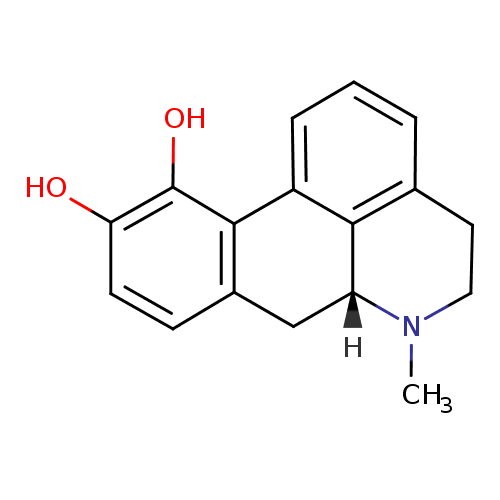
Common NameApomorphine
ClassSmall Molecule
DescriptionA derivative of morphine that is a dopamine D2 agonist. It is a powerful emetic and has been used for that effect in acute poisoning. It has also been used in the diagnosis and treatment of parkinsonism, but its adverse effects limit its use. [PubChem]
Contaminant Sources
  • HMDB Contaminants - Urine
  • STOFF IDENT Compounds
  • T3DB toxins
  • ToxCast & Tox21 Chemicals
Contaminant Type
  • Amine
  • Antidyskinetic
  • Antiparkinson Agent
  • Dopamine Agonist
  • Drug
  • Metabolite
  • Organic Compound
  • Synthetic Compound
Chemical Structure
Thumb
Synonyms
ValueSource
(-)-10,11-DihydroxyaporphineChEBI
(6AR)-6-methyl-5,6,6a,7-tetrahydro-4H-dibenzo[de,g]quinoline-10,11-diolChEBI
(R)-5,6,6a,7-Tetrahydro-6-methyl-4H-dibenzo[de,g]quinoline-10,11-diolChEBI
ApomorphinChEBI
R-(-)-ApomorphineChEBI
UprimaKegg
ApomorfinHMDB
Apomorphine hydrochloride hemihydrateHMDB
Apomorphinium chloride hemihydrateHMDB
ApormorphineHMDB
L-ApomorphineHMDB
VR-040HMDB
VR-400HMDB
VR004HMDB
Anhydrous apomorphine hydrochlorideHMDB
Apomorphin-teclapharmHMDB
Britannia brand OF apomorphine hydrochlorideHMDB
Hemihydrate apomorphine hydrochlorideHMDB
Apomorphine hydrochloride, hemihydrateHMDB
BritajectHMDB
Chloride, apomorphineHMDB
Hydrochloride, apomorphineHMDB
Aguettant brand OF apomorphine hydrochlorideHMDB
ApokinonHMDB
Apomorphine hydrochloride, anhydrousHMDB
Hydrochloride, anhydrous apomorphineHMDB
Teclapharm brand OF apomorphine hydrochlorideHMDB
Anhydrous, apomorphine hydrochlorideHMDB
Apomorphin teclapharmHMDB
ApomorphinTeclapharmHMDB
Apomorphine chlorideHMDB
Apomorphine hydrochlorideHMDB
Apomorphine hydrochloride anhydrousHMDB
Hydrochloride anhydrous, apomorphineHMDB
Hydrochloride, hemihydrate apomorphineHMDB
Chemical FormulaC17H17NO2
Average Molecular Mass267.322 g/mol
Monoisotopic Mass267.126 g/mol
CAS Registry Number41372-20-7
IUPAC Name(9R)-10-methyl-10-azatetracyclo[7.7.1.0^{2,7}.0^{13,17}]heptadeca-1(16),2(7),3,5,13(17),14-hexaene-3,4-diol
Traditional Nameapomorphine
SMILES[H][C@]12CC3=C(C(O)=C(O)C=C3)C3=CC=CC(CCN1C)=C23
InChI IdentifierInChI=1S/C17H17NO2/c1-18-8-7-10-3-2-4-12-15(10)13(18)9-11-5-6-14(19)17(20)16(11)12/h2-6,13,19-20H,7-9H2,1H3/t13-/m1/s1
InChI KeyVMWNQDUVQKEIOC-CYBMUJFWSA-N
Chemical Taxonomy
Description belongs to the class of organic compounds known as aporphines. These are quinoline alkaloids containing the dibenzo[de,g]quinoline ring system or a dehydrogenated derivative thereof.
KingdomOrganic compounds
Super ClassAlkaloids and derivatives
ClassAporphines
Sub ClassNot Available
Direct ParentAporphines
Alternative Parents
Substituents
  • Aporphine
  • Benzoquinoline
  • Phenanthrene
  • 2-naphthol
  • 1-naphthol
  • Naphthalene
  • Quinoline
  • Tetrahydroisoquinoline
  • 1-hydroxy-2-unsubstituted benzenoid
  • 1-hydroxy-4-unsubstituted benzenoid
  • Aralkylamine
  • Benzenoid
  • Tertiary aliphatic amine
  • Tertiary amine
  • Organoheterocyclic compound
  • Azacycle
  • Organic nitrogen compound
  • Organopnictogen compound
  • Organooxygen compound
  • Organonitrogen compound
  • Organic oxygen compound
  • Amine
  • Hydrocarbon derivative
  • Aromatic heteropolycyclic compound
Molecular FrameworkAromatic heteropolycyclic compounds
External Descriptors
Biological Properties
StatusDetected and Not Quantified
OriginExogenous
Cellular Locations
  • Membrane
Biofluid LocationsNot Available
Tissue LocationsNot Available
PathwaysNot Available
ApplicationsNot Available
Biological RolesNot Available
Chemical RolesNot Available
Physical Properties
StateSolid
AppearanceWhite powder.
Experimental Properties
PropertyValue
Melting PointNot Available
Boiling PointNot Available
Solubility1.66E+004 mg/L
Predicted Properties
PropertyValueSource
Water Solubility0.51 g/LALOGPS
logP2.51ALOGPS
logP2.87ChemAxon
logS-2.7ALOGPS
pKa (Strongest Acidic)6.58ChemAxon
pKa (Strongest Basic)13.25ChemAxon
Physiological Charge0ChemAxon
Hydrogen Acceptor Count3ChemAxon
Hydrogen Donor Count2ChemAxon
Polar Surface Area43.7 ŲChemAxon
Rotatable Bond Count0ChemAxon
Refractivity79.99 m³·mol⁻¹ChemAxon
Polarizability29.7 ųChemAxon
Number of Rings4ChemAxon
Bioavailability1ChemAxon
Rule of FiveYesChemAxon
Ghose FilterYesChemAxon
Veber's RuleNoChemAxon
MDDR-like RuleNoChemAxon
Spectra
Spectra
Spectrum TypeDescriptionSplash KeyView
Predicted GC-MSPredicted GC-MS Spectrum - GC-MS (Non-derivatized) - 70eV, Positivesplash10-0gb9-0190000000-4a508d96ec3f544ad0a5Spectrum
Predicted GC-MSPredicted GC-MS Spectrum - GC-MS (2 TMS) - 70eV, Positivesplash10-01vt-1119000000-110790047aaa5266ec7dSpectrum
Predicted GC-MSPredicted GC-MS Spectrum - GC-MS (Non-derivatized) - 70eV, PositiveNot AvailableSpectrum
LC-MS/MSLC-MS/MS Spectrum - LC-ESI-QTOF , positivesplash10-014r-0090000000-29608efdadd8efd375a6Spectrum
LC-MS/MSLC-MS/MS Spectrum - LC-ESI-QTOF , positivesplash10-000i-0090000000-052772c02bbf103a3ef5Spectrum
LC-MS/MSLC-MS/MS Spectrum - LC-ESI-QTOF , positivesplash10-00kr-0290000000-1e831a8078d43cfbdb51Spectrum
LC-MS/MSLC-MS/MS Spectrum - LC-ESI-ITFT , positivesplash10-000i-0090000000-49baaafc781fbd1a40eaSpectrum
LC-MS/MSLC-MS/MS Spectrum - LC-ESI-ITFT , positivesplash10-000i-0090000000-b2abd157ce4880c73d0bSpectrum
LC-MS/MSLC-MS/MS Spectrum - LC-ESI-ITFT , positivesplash10-000i-0090000000-b747e9bb748f801c3f50Spectrum
LC-MS/MSLC-MS/MS Spectrum - LC-ESI-ITFT , positivesplash10-000i-0090000000-1a55345a571167f3fca6Spectrum
LC-MS/MSLC-MS/MS Spectrum - 70V, Positivesplash10-000i-0090000000-ed5921a3fdc051a624bbSpectrum
LC-MS/MSLC-MS/MS Spectrum - 55V, Positivesplash10-000i-0090000000-50fac0317064f1a8e998Spectrum
LC-MS/MSLC-MS/MS Spectrum - 35V, Positivesplash10-000i-0090000000-d6d6335388339cbc130cSpectrum
LC-MS/MSLC-MS/MS Spectrum - 45V, Positivesplash10-000i-0090000000-d32f4b1b32d737f2a537Spectrum
LC-MS/MSLC-MS/MS Spectrum - 20V, Positivesplash10-00kr-0190000000-17116473412ddf117f0eSpectrum
LC-MS/MSLC-MS/MS Spectrum - 10V, Positivesplash10-014i-0090000000-eacc7753be54416bffbcSpectrum
LC-MS/MSLC-MS/MS Spectrum - 30V, Positivesplash10-0006-0940000000-2986f1c61e42342e1607Spectrum
LC-MS/MSLC-MS/MS Spectrum - 40V, Positivesplash10-0006-0900000000-ea1c772d74d365c17997Spectrum
LC-MS/MSLC-MS/MS Spectrum - 75V, Positivesplash10-0006-0900000000-2ba14c246f29623c1b82Spectrum
LC-MS/MSLC-MS/MS Spectrum - 75V, Positivesplash10-0006-0910000000-2ba14c246f29623c1b82Spectrum
LC-MS/MSLC-MS/MS Spectrum - 60V, Positivesplash10-0006-0930000000-bdce5d0ee1156f3d6711Spectrum
LC-MS/MSLC-MS/MS Spectrum - 30V, Positivesplash10-00kr-0090000000-01bd77f545e298f9d50eSpectrum
Predicted LC-MS/MSPredicted LC-MS/MS Spectrum - 10V, Positivesplash10-014i-0090000000-0329e43d2073db5426bbSpectrum
Predicted LC-MS/MSPredicted LC-MS/MS Spectrum - 20V, Positivesplash10-014r-0190000000-4dc4f5ea615d9b0a78e2Spectrum
Predicted LC-MS/MSPredicted LC-MS/MS Spectrum - 40V, Positivesplash10-05xu-1950000000-298a2d8a85a241732677Spectrum
Predicted LC-MS/MSPredicted LC-MS/MS Spectrum - 10V, Negativesplash10-014i-0090000000-8dcf24a32f1f7baba7c2Spectrum
Predicted LC-MS/MSPredicted LC-MS/MS Spectrum - 20V, Negativesplash10-014i-0090000000-734acff31070eb2a5a84Spectrum
Predicted LC-MS/MSPredicted LC-MS/MS Spectrum - 40V, Negativesplash10-0udl-2190000000-5a6e0c712dad2d12eaa9Spectrum
Toxicity Profile
Route of Exposure100% following subcutaneous administration
Mechanism of ToxicityThe precise mechanism of action of apomorphine as a treatment for Parkinson's disease is unknown, although it is believed to be due to stimulation of post-synaptic dopamine D2-type receptors within the brain. Apomorphine has been shown to improve motor function in an animal model of Parkinson's disease. In particular, apomorphine attenuates the motor deficits induced by lesions in the ascending nigrostriatal dopaminergic pathway with the neurotoxin 1-methyl-4-phenyl-1,2,3,6-tetrahydropyridine (MPTP) in primates.
MetabolismHepatic Half Life: 40 minutes (range 30 - 60 minutes)
Toxicity ValuesLD50: 0.6 mmoles/kg (Intraperitoneal, Mouse) (1)
Lethal DoseNot Available
Carcinogenicity (IARC Classification)No indication of carcinogenicity to humans (not listed by IARC).
Uses/SourcesFor the acute, intermittent treatment of hypomobility, off episodes (end-of-dose wearing off and unpredictable on/off episodes) associated with advanced Parkinson's disease.
Minimum Risk LevelNot Available
Health EffectsNot Available
SymptomsNot Available
TreatmentNot Available
Concentrations
Not Available
DrugBank IDDB00714
HMDB IDHMDB0014852
FooDB IDNot Available
Phenol Explorer IDNot Available
KNApSAcK IDNot Available
BiGG IDNot Available
BioCyc IDNot Available
METLIN IDNot Available
PDB IDNot Available
Wikipedia LinkApomorphine
Chemspider ID5783
ChEBI ID48538
PubChem Compound ID6005
Kegg Compound IDNot Available
YMDB IDNot Available
ECMDB IDNot Available
References
Synthesis Reference

Narayanasamy Gurusamy, “Process for Making Apomorphine and Apocodeine.” U.S. Patent US20100228032, issued September 09, 2010.

MSDSLink
General References
1. Corsini GU, Del Zompo M, Gessa GL, Mangoni A: Therapeutic efficacy of apomorphine combined with an extracerebral inhibitor of dopamine receptors in Parkinson's disease. Lancet. 1979 May 5;1(8123):954-6.
2. Cotzias GC, Papavasiliou PS, Fehling C, Kaufman B, Mena I: Similarities between neurologic effects of L-dopa and of apomorphine. N Engl J Med. 1970 Jan 1;282(1):31-3.
3. Chaudhuri KR, Clough C: Subcutaneous apomorphine in Parkinson's disease. BMJ. 1998 Feb 28;316(7132):641.
4. SCHWAB RS, AMADOR LV, LETTVIN JY: Apomorphine in Parkinson's disease. Trans Am Neurol Assoc. 1951;56:251-3.
5. Matsumoto K, Yoshida M, Andersson KE, Hedlund P: Effects in vitro and in vivo by apomorphine in the rat corpus cavernosum. Br J Pharmacol. 2005 Sep;146(2):259-67.