Record Information
Version1.0
Creation Date2009-07-21 20:27:27 UTC
Update Date2026-05-14 16:46:35 UTC
Accession NumberCHEM002252
Identification
Common NameNaltrexone
ClassSmall Molecule
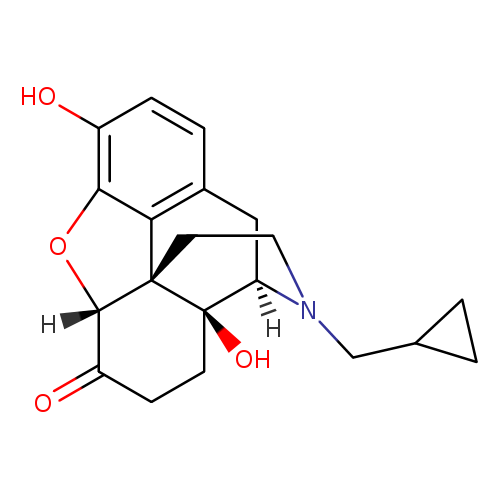
DescriptionDerivative of noroxymorphone that is the N-cyclopropylmethyl congener of naloxone. It is a narcotic antagonist that is effective orally, longer lasting and more potent than naloxone, and has been proposed for the treatment of heroin addiction. The FDA has approved naltrexone for the treatment of alcohol dependence. [PubChem]
Contaminant Sources
  • HMDB Contaminants - Urine
  • STOFF IDENT Compounds
  • T3DB toxins
  • ToxCast & Tox21 Chemicals
Contaminant Type
  • Alcohol Antagonist
  • Amine
  • Anti-Craving Agent
  • Appetite Depressant
  • Central Nervous System Depressant
  • Depressant
  • Drug
  • Ether
  • Human Neurotoxin
  • Metabolite
  • Narcotic Antagonist
  • Opiate Antagonist
  • Organic Compound
  • Synthetic Compound
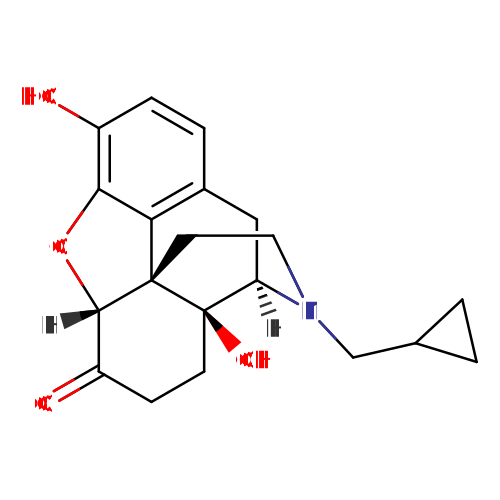
Chemical Structure
Thumb
Synonyms
ValueSource
17-(Cyclopropylmethyl)-4,5-epoxy-3,14-dihydroxymorphinan-6-oneChEBI
17-(Cyclopropylmethyl)-4,5alpha-epoxy-3,14-dihydroxymorphinan-6-oneChEBI
N-Cyclopropylmethyl-14-hydroxydihydromorphinoneChEBI
N-CyclopropylmethylnoroxymorphoneChEBI
VivitrolKegg
17-(Cyclopropylmethyl)-4,5a-epoxy-3,14-dihydroxymorphinan-6-oneGenerator
17-(Cyclopropylmethyl)-4,5α-epoxy-3,14-dihydroxymorphinan-6-oneGenerator
PTI-555HMDB
Du pont brand OF naltrexone hydrochlorideHMDB
ReViaHMDB
Schering plough brand OF naltrexone hydrochlorideHMDB
AntaxoneHMDB
Bristol-myers squibb brand OF naltrexone hydrochlorideHMDB
Lacer brand OF naltrexone hydrochlorideHMDB
Lamepro brand OF naltrexone hydrochlorideHMDB
Naltrexone hydrochlorideHMDB
Pharmazam brand OF naltrexone hydrochlorideHMDB
United drug brand OF naltrexone hydrochlorideHMDB
CelupanHMDB
NemexinHMDB
Orphan brand OF naltrexone hydrochlorideHMDB
Schering-plough brand OF naltrexone hydrochlorideHMDB
TrexanHMDB
Bristol myers squibb brand OF naltrexone hydrochlorideHMDB
Hydrochloride, naltrexoneHMDB
NalorexHMDB
Chemical FormulaC20H23NO4
Average Molecular Mass341.401 g/mol
Monoisotopic Mass341.163 g/mol
CAS Registry Number16590-41-3
IUPAC Name(1S,5R,13R,17S)-4-(cyclopropylmethyl)-10,17-dihydroxy-12-oxa-4-azapentacyclo[9.6.1.0^{1,13}.0^{5,17}.0^{7,18}]octadeca-7(18),8,10-trien-14-one
Traditional Namenaltrexone
SMILES[H][C@@]12OC3=C(O)C=CC4=C3[C@@]11CCN(CC3CC3)[C@]([H])(C4)[C@]1(O)CCC2=O
InChI IdentifierInChI=1S/C20H23NO4/c22-13-4-3-12-9-15-20(24)6-5-14(23)18-19(20,16(12)17(13)25-18)7-8-21(15)10-11-1-2-11/h3-4,11,15,18,22,24H,1-2,5-10H2/t15-,18+,19+,20-/m1/s1
InChI KeyDQCKKXVULJGBQN-XFWGSAIBSA-N
Chemical Taxonomy
Description belongs to the class of organic compounds known as phenanthrenes and derivatives. These are polycyclic compounds containing a phenanthrene moiety, which is a tricyclic aromatic compound with three non-linearly fused benzene.
KingdomOrganic compounds
Super ClassBenzenoids
ClassPhenanthrenes and derivatives
Sub ClassNot Available
Direct ParentPhenanthrenes and derivatives
Alternative Parents
Substituents
  • Phenanthrene
  • Isoquinolone
  • Tetralin
  • Coumaran
  • 1-hydroxy-2-unsubstituted benzenoid
  • Alkyl aryl ether
  • Aralkylamine
  • Piperidine
  • Cyclic alcohol
  • Tertiary alcohol
  • 1,2-aminoalcohol
  • Ketone
  • Tertiary aliphatic amine
  • Tertiary amine
  • Ether
  • Oxacycle
  • Azacycle
  • Organoheterocyclic compound
  • Organonitrogen compound
  • Hydrocarbon derivative
  • Organic oxide
  • Organic nitrogen compound
  • Organopnictogen compound
  • Carbonyl group
  • Organooxygen compound
  • Alcohol
  • Organic oxygen compound
  • Amine
  • Aromatic heteropolycyclic compound
Molecular FrameworkAromatic heteropolycyclic compounds
External Descriptors
Biological Properties
StatusDetected and Not Quantified
OriginExogenous
Cellular Locations
  • Cytoplasm
  • Extracellular
  • Membrane
Biofluid LocationsNot Available
Tissue LocationsNot Available
PathwaysNot Available
Applications
Biological Roles
Chemical RolesNot Available
Physical Properties
StateSolid
AppearanceWhite powder.
Experimental Properties
PropertyValue
Melting Point168-170°C
Boiling PointNot Available
Solubility100 mg/mL (as hydrochloride salt)
Predicted Properties
PropertyValueSource
Water Solubility3.07 g/LALOGPS
logP2.07ALOGPS
logP1.36ChemAxon
logS-2ALOGPS
pKa (Strongest Acidic)7.39ChemAxon
pKa (Strongest Basic)11.54ChemAxon
Physiological Charge1ChemAxon
Hydrogen Acceptor Count5ChemAxon
Hydrogen Donor Count2ChemAxon
Polar Surface Area70 ŲChemAxon
Rotatable Bond Count2ChemAxon
Refractivity91.5 m³·mol⁻¹ChemAxon
Polarizability35.97 ųChemAxon
Number of Rings6ChemAxon
Bioavailability1ChemAxon
Rule of FiveYesChemAxon
Ghose FilterYesChemAxon
Veber's RuleNoChemAxon
MDDR-like RuleNoChemAxon
Spectra
Spectra
Spectrum TypeDescriptionSplash KeyView
Predicted GC-MSPredicted GC-MS Spectrum - GC-MS (Non-derivatized) - 70eV, Positivesplash10-0a4l-9032000000-f869731a6a6d2ba21fc9Spectrum
Predicted GC-MSPredicted GC-MS Spectrum - GC-MS (2 TMS) - 70eV, Positivesplash10-00bc-9601600000-928a74224d18c2ec3c94Spectrum
Predicted GC-MSPredicted GC-MS Spectrum - GC-MS (TBDMS_2_1) - 70eV, PositiveNot AvailableSpectrum
Predicted GC-MSPredicted GC-MS Spectrum - GC-MS (Non-derivatized) - 70eV, PositiveNot AvailableSpectrum
Predicted GC-MSPredicted GC-MS Spectrum - GC-MS ("Naltrexone,2TMS,#1" TMS) - 70eV, PositiveNot AvailableSpectrum
LC-MS/MSLC-MS/MS Spectrum - LC-ESI-ITFT , positivesplash10-00di-0009000000-e30316dd5784a7100d38Spectrum
LC-MS/MSLC-MS/MS Spectrum - LC-ESI-ITFT , positivesplash10-0006-0009000000-2218214724e56047d52bSpectrum
LC-MS/MSLC-MS/MS Spectrum - LC-ESI-ITFT , positivesplash10-0006-0009000000-bb047c719f3429eb4410Spectrum
LC-MS/MSLC-MS/MS Spectrum - LC-ESI-ITFT , positivesplash10-00di-0049000000-de9a717563978f22f02fSpectrum
LC-MS/MSLC-MS/MS Spectrum - LC-ESI-ITFT , positivesplash10-00xr-0191000000-d2f2ff1e4eb93db46b5eSpectrum
LC-MS/MSLC-MS/MS Spectrum - LC-ESI-ITFT , positivesplash10-03di-1390000000-091705f6f42bc0f1c209Spectrum
LC-MS/MSLC-MS/MS Spectrum - LC-ESI-ITFT , positivesplash10-03di-1890000000-148c5608ef92c1dcaac4Spectrum
LC-MS/MSLC-MS/MS Spectrum - LC-ESI-ITFT , positivesplash10-0006-0009000000-6df03abdbdb7461f2945Spectrum
LC-MS/MSLC-MS/MS Spectrum - LC-ESI-ITFT , positivesplash10-0006-0009000000-059b1dffee7ef15b9e95Spectrum
LC-MS/MSLC-MS/MS Spectrum - LC-ESI-ITFT , positivesplash10-00di-0049000000-a20ede951b350fa97a31Spectrum
LC-MS/MSLC-MS/MS Spectrum - LC-ESI-ITFT , positivesplash10-00xr-0191000000-8a66ac92b4a1eadcc405Spectrum
LC-MS/MSLC-MS/MS Spectrum - LC-ESI-ITFT , positivesplash10-03di-1490000000-0cfb621f77295ff438f2Spectrum
LC-MS/MSLC-MS/MS Spectrum - LC-ESI-ITFT , positivesplash10-03di-1980000000-63edda852273619df16cSpectrum
LC-MS/MSLC-MS/MS Spectrum - LC-ESI-ITFT , positivesplash10-00di-0009000000-59ab0ef68d6e13a7d085Spectrum
LC-MS/MSLC-MS/MS Spectrum - 60V, Positivesplash10-00xr-0191000000-8a66ac92b4a1eadcc405Spectrum
LC-MS/MSLC-MS/MS Spectrum - 45V, Positivesplash10-00di-0049000000-02654ed4a592aa3f1d77Spectrum
LC-MS/MSLC-MS/MS Spectrum - 35V, Positivesplash10-00di-0009000000-5c4b68f88d13143d13c8Spectrum
LC-MS/MSLC-MS/MS Spectrum - 75V, Positivesplash10-03di-1490000000-0cfb621f77295ff438f2Spectrum
LC-MS/MSLC-MS/MS Spectrum - 75V, Positivesplash10-03di-1390000000-091705f6f42bc0f1c209Spectrum
Predicted LC-MS/MSPredicted LC-MS/MS Spectrum - 10V, Positivesplash10-05fu-2009000000-0922bce7a8eb5f33ce53Spectrum
Predicted LC-MS/MSPredicted LC-MS/MS Spectrum - 20V, Positivesplash10-0a4i-9016000000-2d32afb0b23d74c8267bSpectrum
Predicted LC-MS/MSPredicted LC-MS/MS Spectrum - 40V, Positivesplash10-0a4i-9000000000-2fb0ae567a7b9fc291d7Spectrum
Predicted LC-MS/MSPredicted LC-MS/MS Spectrum - 10V, Negativesplash10-0006-0019000000-fa732c8c50c28496a983Spectrum
Predicted LC-MS/MSPredicted LC-MS/MS Spectrum - 20V, Negativesplash10-006x-1049000000-ad083164dfddedbd64d3Spectrum
Predicted LC-MS/MSPredicted LC-MS/MS Spectrum - 40V, Negativesplash10-000f-4090000000-a84ca353819c1033f1e6Spectrum
Toxicity Profile
Route of ExposureAlthough well absorbed orally, naltrexone is subject to significant first pass metabolism with oral bioavailability estimates ranging from 5 to 40%.
Mechanism of ToxicityNaltrexone is a pure opiate antagonist and has little or no agonist activity. The mechanism of action of naltrexone in alcoholism is not understood; however, involvement of the endogenous opioid system is suggested by preclinical data. Naltrexone is thought to act as a competitive antagonist at mc, kappa, and delta receptors in the CNS, with the highest affintiy for the mu receptor. Naltrexone competitively binds to such receptors and may block the effects of endogenous opioids. This leads to the antagonization of most of the subjective and objective effects of opiates, including respiratory depression, miosis, euphoria, and drug craving. The major metabolite of naltrexone, 6-beta-naltrexol, is also an opiate antagonist and may contribute to the antagonistic activity of the drug.
MetabolismHepatic. When administered orally, naltrexone undergoes extensive biotransformation and is metabolized to 6 beta-naltrexol (which may contribute to the therapeutic effect) and other minor metabolites. Route of Elimination: Both parent drug and metabolites are excreted primarily by the kidney (53% to 79% of the dose), however, urinary excretion of unchanged naltrexone accounts for less than 2% of an oral dose and fecal excretion is a minor elimination pathway. The renal clearance for naltrexone ranges from 30 to 127 mL/min and suggests that renal elimination is primarily by glomerular filtration. Half Life: 4 hours for naltrexone and 13 hours for the active metabolite 6 beta-naltrexol.
Toxicity ValuesLD50: 1,100-1,550 mg/kg (oral, mouse) LD50: 1,450 mg/kg (oral, rat) LD50: 1,490 mg/kg (oral, guinea pig)
Lethal DoseNot Available
Carcinogenicity (IARC Classification)No indication of carcinogenicity to humans (not listed by IARC).
Uses/SourcesUsed as an adjunct to a medically supervised behaviour modification program in the maintenance of opiate cessation in individuals who were formerly physically dependent on opiates and who have successfully undergone detoxification. Also used for the management of alcohol dependence in conjunction with a behavioural modification program.
Minimum Risk LevelNot Available
Health EffectsTolerance can develop, in which the person needs larger doses to achieve the desired effect; this can lead to overdose and death. Accidents or injury can also occur due to the side effects of loss of coordination, slowed reaction time, sleepiness and impaired judgment. Drugs in this category have a high potential for physical and psychological dependence.
SymptomsHigh doses of naltrexone (generally ≥1,000 mg/kg) produce salivation, depression/reduced activity, tremors, and convulsions.
TreatmentPatients should be treated symptomatically in a closely supervised environment. (5)
Concentrations
Not Available
DrugBank IDDB00704
HMDB IDHMDB0014842
FooDB IDNot Available
Phenol Explorer IDNot Available
KNApSAcK IDNot Available
BiGG IDNot Available
BioCyc IDNot Available
METLIN IDNot Available
PDB IDNot Available
Wikipedia LinkNaltrexone
Chemspider ID4514524
ChEBI ID7465
PubChem Compound ID5360515
Kegg Compound IDC07253
YMDB IDNot Available
ECMDB IDNot Available
References
Synthesis Reference

Bao-Shan Huang, Yansong Lu, Ben-Yi Ji, Aris P Christodoulou, “Preparation of naltrexone from codeine and 3-benzylmorphine.” U.S. Patent US6013796, issued March, 1990.

MSDSLink
General References
1. Schmitz JM, Stotts AL, Rhoades HM, Grabowski J: Naltrexone and relapse prevention treatment for cocaine-dependent patients. Addict Behav. 2001 Mar-Apr;26(2):167-80.
2. Krystal JH, Gueorguieva R, Cramer J, Collins J, Rosenheck R: Naltrexone is associated with reduced drinking by alcohol dependent patients receiving antidepressants for mood and anxiety symptoms: results from VA Cooperative Study No. 425, "Naltrexone in the treatment of alcoholism". Alcohol Clin Exp Res. 2008 Jan;32(1):85-91. Epub 2007 Dec 7.
3. Ray LA, Chin PF, Miotto K: Naltrexone for the treatment of alcoholism: clinical findings, mechanisms of action, and pharmacogenetics. CNS Neurol Disord Drug Targets. 2010 Mar;9(1):13-22.
4. https://www.ncbi.nlm.nih.gov/pubmed/?term=17023477
5. https://www.ncbi.nlm.nih.gov/pubmed/?term=24107112
6. https://www.ncbi.nlm.nih.gov/pubmed/?term=24659754
7. https://www.ncbi.nlm.nih.gov/pubmed/?term=27690505
8. https://www.ncbi.nlm.nih.gov/pubmed/?term=27700187
9. https://www.ncbi.nlm.nih.gov/pubmed/?term=27787292
10. https://www.ncbi.nlm.nih.gov/pubmed/?term=27813192
11. https://www.ncbi.nlm.nih.gov/pubmed/?term=27875802
12. https://www.ncbi.nlm.nih.gov/pubmed/?term=27922226
13. https://www.ncbi.nlm.nih.gov/pubmed/?term=27936293
14. https://www.ncbi.nlm.nih.gov/pubmed/?term=27987236
15. https://www.ncbi.nlm.nih.gov/pubmed/?term=28011389
16. https://www.ncbi.nlm.nih.gov/pubmed/?term=28029718
17. https://www.ncbi.nlm.nih.gov/pubmed/?term=28044452
18. https://www.ncbi.nlm.nih.gov/pubmed/?term=28061017
19. https://www.ncbi.nlm.nih.gov/pubmed/?term=28068780
20. https://www.ncbi.nlm.nih.gov/pubmed/?term=28106937
21. https://www.ncbi.nlm.nih.gov/pubmed/?term=28118565
22. https://www.ncbi.nlm.nih.gov/pubmed/?term=28130024
23. https://www.ncbi.nlm.nih.gov/pubmed/?term=28144772
24. https://www.ncbi.nlm.nih.gov/pubmed/?term=28153651
25. https://www.ncbi.nlm.nih.gov/pubmed/?term=28161142
26. https://www.ncbi.nlm.nih.gov/pubmed/?term=28168894
27. https://www.ncbi.nlm.nih.gov/pubmed/?term=28184294