Record Information
Version1.0
Creation Date2009-07-21 20:27:25 UTC
Update Date2026-03-31 19:09:22 UTC
Accession NumberCHEM002248
Identification
Common NameFlurazepam
ClassSmall Molecule
DescriptionFlurazepam is only found in individuals that have used or taken this drug. It is a benzodiazepine derivative used mainly as a hypnotic. [PubChem]Flurazepam binds to an allosteric site on GABA-A receptors. Binding potentiates the action of GABA on GABA-A receptors by opening the chloride channel within the receptor, causing chloride influx and hyperpolarization.
Contaminant Sources
  • HMDB Contaminants - Urine
  • STOFF IDENT Compounds
  • Suspected Compounds
  • T3DB toxins
  • ToxCast & Tox21 Chemicals
Contaminant Type
  • Amide
  • Amine
  • Anti-Anxiety Agent
  • Drug
  • GABA Modulator
  • Hypnotic and Sedative
  • Metabolite
  • Organic Compound
  • Organochloride
  • Organofluoride
  • Synthetic Compound
Chemical Structure
Thumb
Synonyms
ValueSource
FlurazepamumChEBI
InsuminChEBI
Ro 5-6901ChEBI
Flurazepam HCLHMDB
Apo-flurazepamHMDB
DalmadormHMDB
Flurazepam hydrochlorideHMDB
Hydrochloride, flurazepamHMDB
Monohydrochloride, flurazepamHMDB
Allphar brand OF flurazepam monohydrochlorideHMDB
DalmaneHMDB
Dihydrochloride, flurazepamHMDB
DormodorHMDB
mono-Perchlorate, flurazepamHMDB
Dolorgiet brand OF flurazepamHMDB
Flurazepam mono perchlorateHMDB
Flurazepam monohydrochlorideHMDB
Apo flurazepamHMDB
Apotex brand OF flurazepam monohydrochlorideHMDB
Flurazepam dihydrochlorideHMDB
Flurazepam mono-perchlorateHMDB
ICN brand OF flurazepam monohydrochlorideHMDB
StaurodormHMDB
Chemical FormulaC21H23ClFN3O
Average Molecular Mass387.878 g/mol
Monoisotopic Mass387.151 g/mol
CAS Registry Number17617-23-1
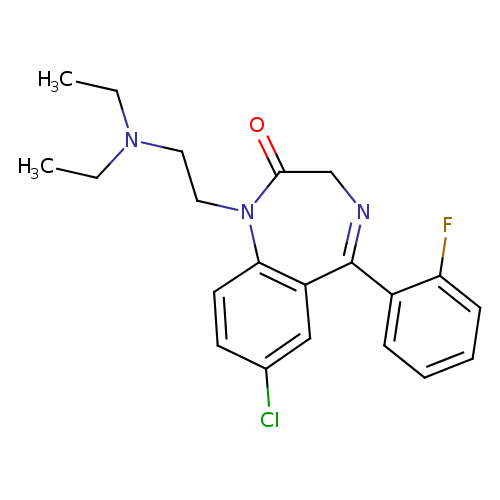
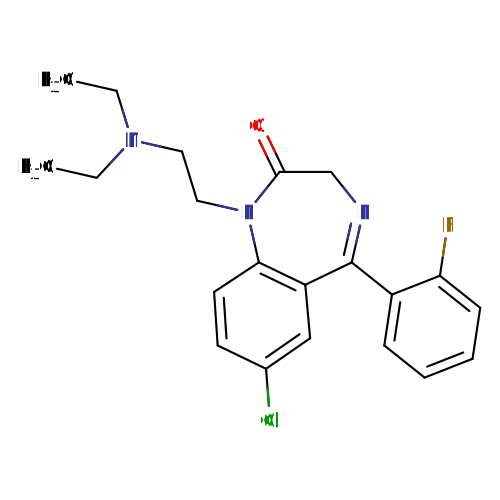
IUPAC Name7-chloro-1-[2-(diethylamino)ethyl]-5-(2-fluorophenyl)-2,3-dihydro-1H-1,4-benzodiazepin-2-one
Traditional Nameflurazepam
SMILESCCN(CC)CCN1C2=C(C=C(Cl)C=C2)C(=NCC1=O)C1=CC=CC=C1F
InChI IdentifierInChI=1S/C21H23ClFN3O/c1-3-25(4-2)11-12-26-19-10-9-15(22)13-17(19)21(24-14-20(26)27)16-7-5-6-8-18(16)23/h5-10,13H,3-4,11-12,14H2,1-2H3
InChI KeySAADBVWGJQAEFS-UHFFFAOYSA-N
Chemical Taxonomy
Description belongs to the class of organic compounds known as 1,4-benzodiazepines. These are organic compounds containing a benzene ring fused to a 1,4-azepine.
KingdomOrganic compounds
Super ClassOrganoheterocyclic compounds
ClassBenzodiazepines
Sub Class1,4-benzodiazepines
Direct Parent1,4-benzodiazepines
Alternative Parents
Substituents
  • 1,4-benzodiazepine
  • Alpha-amino acid or derivatives
  • Halobenzene
  • Fluorobenzene
  • Aryl chloride
  • Monocyclic benzene moiety
  • Benzenoid
  • Aryl fluoride
  • Aryl halide
  • Tertiary carboxylic acid amide
  • Amino acid or derivatives
  • Tertiary aliphatic amine
  • Tertiary amine
  • Lactam
  • Carboxamide group
  • Ketimine
  • Propargyl-type 1,3-dipolar organic compound
  • Organic 1,3-dipolar compound
  • Azacycle
  • Carboxylic acid derivative
  • Organic nitrogen compound
  • Imine
  • Organohalogen compound
  • Organochloride
  • Organofluoride
  • Organonitrogen compound
  • Carbonyl group
  • Organooxygen compound
  • Hydrocarbon derivative
  • Organic oxide
  • Organopnictogen compound
  • Organic oxygen compound
  • Amine
  • Aromatic heteropolycyclic compound
Molecular FrameworkAromatic heteropolycyclic compounds
External DescriptorsNot Available
Biological Properties
StatusDetected and Not Quantified
OriginExogenous
Cellular Locations
  • Membrane
Biofluid LocationsNot Available
Tissue LocationsNot Available
PathwaysNot Available
ApplicationsNot Available
Biological RolesNot Available
Chemical RolesNot Available
Physical Properties
StateSolid
AppearanceWhite powder.
Experimental Properties
PropertyValue
Melting Point190-220°C
Boiling PointNot Available
Solubility500 mg/mL (HCl salt)
Predicted Properties
PropertyValueSource
Water Solubility0.01 g/LALOGPS
logP3.81ALOGPS
logP3.95ChemAxon
logS-4.6ALOGPS
pKa (Strongest Basic)8.71ChemAxon
Physiological Charge1ChemAxon
Hydrogen Acceptor Count3ChemAxon
Hydrogen Donor Count0ChemAxon
Polar Surface Area35.91 ŲChemAxon
Rotatable Bond Count6ChemAxon
Refractivity107.54 m³·mol⁻¹ChemAxon
Polarizability41.22 ųChemAxon
Number of Rings3ChemAxon
Bioavailability1ChemAxon
Rule of FiveYesChemAxon
Ghose FilterYesChemAxon
Veber's RuleYesChemAxon
MDDR-like RuleYesChemAxon
Spectra
Spectra
Spectrum TypeDescriptionSplash KeyView
Predicted GC-MSPredicted GC-MS Spectrum - GC-MS (Non-derivatized) - 70eV, Positivesplash10-059i-9025000000-1b62ce2349d2235158efSpectrum
Predicted GC-MSPredicted GC-MS Spectrum - GC-MS (Non-derivatized) - 70eV, PositiveNot AvailableSpectrum
LC-MS/MSLC-MS/MS Spectrum - LC-ESI-QTOF , positivesplash10-000i-0009000000-c0e65a54e856d501ed8cSpectrum
LC-MS/MSLC-MS/MS Spectrum - LC-ESI-QTOF , positivesplash10-014r-0009000000-5a2839fdce5817956437Spectrum
LC-MS/MSLC-MS/MS Spectrum - LC-ESI-QTOF , positivesplash10-014i-0009000000-ef2f40465f355c7e04c0Spectrum
LC-MS/MSLC-MS/MS Spectrum - LC-ESI-QTOF , positivesplash10-014i-0049000000-aeef40f08b145e9212fbSpectrum
LC-MS/MSLC-MS/MS Spectrum - LC-ESI-QTOF , positivesplash10-014i-0392000000-706f2398b20890152e43Spectrum
LC-MS/MSLC-MS/MS Spectrum - 35V, Positivesplash10-014i-0019000000-836d40a1a33eaeaaa580Spectrum
LC-MS/MSLC-MS/MS Spectrum - 50V, Positivesplash10-014i-0293000000-a92d04cc87b08ceb161fSpectrum
LC-MS/MSLC-MS/MS Spectrum - 50V, Positivesplash10-014i-0293000000-9b01e06cd516417f5f40Spectrum
LC-MS/MSLC-MS/MS Spectrum - 50V, Positivesplash10-014i-0292000000-f326367febc968ad2522Spectrum
LC-MS/MSLC-MS/MS Spectrum - 50V, Positivesplash10-014i-0292000000-8cd3ddd8803bd6f359a0Spectrum
LC-MS/MSLC-MS/MS Spectrum - 10V, Positivesplash10-000i-0009000000-5945a4f0ce3357b3e503Spectrum
LC-MS/MSLC-MS/MS Spectrum - 20V, Positivesplash10-014r-0009000000-b3cb3c42e37c875ac9f7Spectrum
LC-MS/MSLC-MS/MS Spectrum - 40V, Positivesplash10-014i-0039000000-1e5e483d7d97a9c53e2aSpectrum
LC-MS/MSLC-MS/MS Spectrum - 50V, Positivesplash10-014i-0292000000-3880af53808065081b74Spectrum
LC-MS/MSLC-MS/MS Spectrum - 30V, Positivesplash10-014i-0009000000-548b9f2cbace88e110e6Spectrum
LC-MS/MSLC-MS/MS Spectrum - 10V, Positivesplash10-000i-0009000000-22a64bb9f4d7b30a7c25Spectrum
LC-MS/MSLC-MS/MS Spectrum - 20V, Positivesplash10-014r-0009000000-fa78c3dd0c1c33184b24Spectrum
LC-MS/MSLC-MS/MS Spectrum - 40V, Positivesplash10-014i-0039000000-b38e1cf8b25b08bffcd6Spectrum
LC-MS/MSLC-MS/MS Spectrum - 30V, Positivesplash10-014i-0009000000-af48919d1fb01be29794Spectrum
Predicted LC-MS/MSPredicted LC-MS/MS Spectrum - 10V, Positivesplash10-000i-0219000000-1fb97b7ae98d96c45152Spectrum
Predicted LC-MS/MSPredicted LC-MS/MS Spectrum - 20V, Positivesplash10-0gb9-2629000000-7417538c28537c7c1bbcSpectrum
Predicted LC-MS/MSPredicted LC-MS/MS Spectrum - 40V, Positivesplash10-0fk9-9530000000-a39c1290a2af1bf3ef3cSpectrum
Predicted LC-MS/MSPredicted LC-MS/MS Spectrum - 10V, Negativesplash10-000i-0009000000-74869eabef799c5c2e78Spectrum
Predicted LC-MS/MSPredicted LC-MS/MS Spectrum - 20V, Negativesplash10-000i-3029000000-d75103db384d94c7c554Spectrum
Predicted LC-MS/MSPredicted LC-MS/MS Spectrum - 40V, Negativesplash10-0kmu-9352000000-ec693fb8979b23ef4774Spectrum
Toxicity Profile
Route of ExposureOral. Flurazepam hydrochloride is rapidly (30 minutes) absorbed from the gastrointestinal tract
Mechanism of ToxicityBenzodiazepines bind nonspecifically to bezodiazepine receptors BNZ1, which mediates sleep, and BNZ2, which affects affects muscle relaxation, anticonvulsant activity, motor coordination, and memory. As benzodiazepine receptors are thought to be coupled to gamma-aminobutyric acid-A (GABAA) receptors, this enhances the effects of GABA by increasing GABA affinity for the GABA receptor. Binding of GABA to the site opens the chloride channel, resulting in a hyperpolarized cell membrane that prevents further excitation of the cell.
MetabolismFlurazepam is rapidly metabolized and is excreted primarily in the urine. Both hydroxyethyl flurazepam (the major metabolite) and N-desalkyl flurazepam are active. The N-desalkyl metabolite is slowly excreted in the urine as the conjugated form Route of Elimination: Flurazepam is rapidly metabolized and is excreted primarily in the urine. Less than 1% of the dose is excreted in the urine as N1-desalkyl-flurazepam. Half Life: The mean apparent half-life of flurazepam is 2.3 hours. The half life of elimination of N1-des-alkyl- flurazepam ranged from 47 to 100 hours
Toxicity ValuesNot Available
Lethal DoseNot Available
Carcinogenicity (IARC Classification)No indication of carcinogenicity to humans (not listed by IARC).
Uses/SourcesFor short-term and intermittent use in patients with recurring insomnia and poor sleeping habits
Minimum Risk LevelNot Available
Health EffectsThey cause slurred speech, disorientation and "drunken" behavior. They are physically and psychologically addictive.
SymptomsComa, confusion, low blood pressure, sleepiness
TreatmentGeneral supportive measures should be employed, along with immediate gastric lavage. Intravenous fluids should be administered and an adequate airway maintained. Hypotension and CNS depression may be combated by judicious use of appropriate therapeutic agents. If excitation occurs in patients following Flurazepam overdosage, barbiturates should not be used. Flumazenil, a specific benzodiazepine-receptor antagonist, is indicated for the complete or partial reversal of the sedative effects of benzodiazepines and may be useful in situations when an overdose with a benzodiazepine is known or suspected. (7)
Concentrations
Not Available
DrugBank IDDB00690
HMDB IDHMDB0014828
FooDB IDNot Available
Phenol Explorer IDNot Available
KNApSAcK IDNot Available
BiGG IDNot Available
BioCyc IDNot Available
METLIN IDNot Available
PDB IDNot Available
Wikipedia LinkFlurazepam
Chemspider ID3276
ChEBI ID5128
PubChem Compound ID3393
Kegg Compound IDNot Available
YMDB IDNot Available
ECMDB IDNot Available
References
Synthesis Reference

Fryer, R. and Sternbach, L.H.; U.S. Patent 3,567,710; March 2, 1971; assigned to Hoffman-La Roche, Inc.

MSDSLink
General References
1. Rooke KC: The use of flurazepam (dalmane) as a substitute for barbiturates and methaqualone/diphenhydramine (mandrax) in general practice. J Int Med Res. 1976;4(5):355-9.
2. Olive G, Dreux C: [Pharmacologic bases of use of benzodiazepines in pereinatal medicine]. Arch Fr Pediatr. 1977 Jan;34(1):74-89.
3. Oelschlager H: [Chemical and pharmacologic aspects of benzodiazepines]. Schweiz Rundsch Med Prax. 1989 Jul 4;78(27-28):766-72.
4. Rickels K: The clinical use of hypnotics: indications for use and the need for a variety of hypnotics. Acta Psychiatr Scand Suppl. 1986;332:132-41.
5. Vermeeren A: Residual effects of hypnotics: epidemiology and clinical implications. CNS Drugs. 2004;18(5):297-328.
6. InChem Data Sheet: http://www.inchem.org/documents/pims/pharm/pim640.htm
7. https://www.ncbi.nlm.nih.gov/pubmed/?term=16501350
8. https://www.ncbi.nlm.nih.gov/pubmed/?term=20002022
9. https://www.ncbi.nlm.nih.gov/pubmed/?term=23035248
10. https://www.ncbi.nlm.nih.gov/pubmed/?term=2863335