Record Information
Version1.0
Creation Date2009-07-21 20:27:24 UTC
Update Date2026-05-14 16:45:43 UTC
Accession NumberCHEM002245
Identification
Common NameGalantamine
ClassSmall Molecule
DescriptionA benzazepine derived from norbelladine. It is found in galanthus and other amaryllidaceae. Galantamine is a cholinesterase inhibitor that has been used to reverse the muscular effects of gallamine triethiodide and tubocurarine, and has been studied as a treatment for Alzheimer's disease and other central nervous system disorders. [PubChem]
Contaminant Sources
  • HMDB Contaminants - Urine
  • STOFF IDENT Compounds
  • T3DB toxins
  • ToxCast & Tox21 Chemicals
Contaminant Type
  • Amine
  • Cholinesterase Inhibitor
  • Drug
  • Ether
  • Human Neurotoxin
  • Metabolite
  • Nootropic Agent
  • Organic Compound
  • PFAS
  • Parasympathomimetic
  • Phytotoxin
  • Synthetic Compound
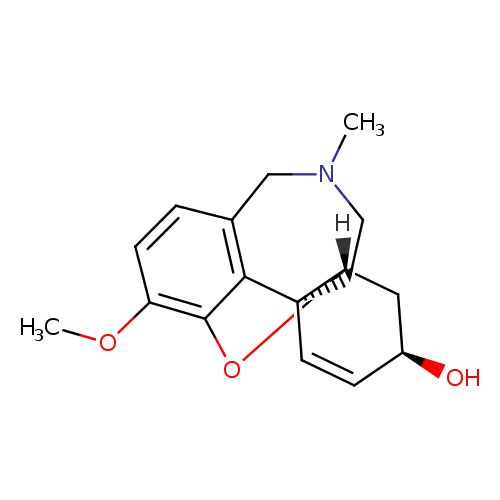
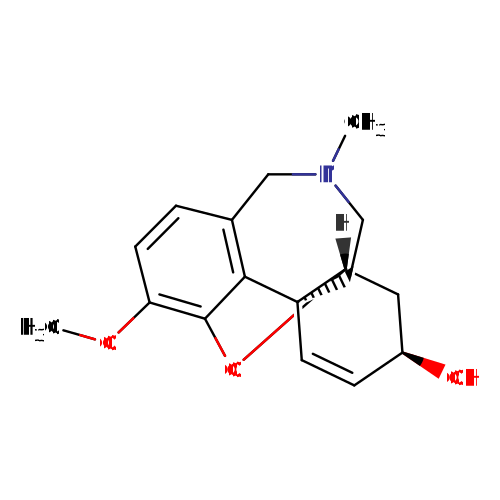
Chemical Structure
Thumb
Synonyms
ValueSource
(-)-GALANTHAMINEChEBI
ReminylKegg
GalanthamineHMDB
Galanthamine hydrobromideHMDB
LycoremineHMDB
GalantaminHMDB
RazadyneHMDB
NivalinHMDB
NivalineHMDB
Ortho mcneil neurologics brand OF galantamineHMDB
Ortho-mcneil neurologics brand OF galantamineHMDB
GalantamineChEBI
Chemical FormulaC17H21NO3
Average Molecular Mass287.354 g/mol
Monoisotopic Mass287.152 g/mol
CAS Registry Number357-70-0
IUPAC Name(1S,12S,14R)-9-methoxy-4-methyl-11-oxa-4-azatetracyclo[8.6.1.0^{1,12}.0^{6,17}]heptadeca-6(17),7,9,15-tetraen-14-ol
Traditional Namegalantamine
SMILES[H][C@]12C[C@@H](O)C=C[C@]11CCN(C)CC3=C1C(O2)=C(OC)C=C3
InChI IdentifierInChI=1S/C17H21NO3/c1-18-8-7-17-6-5-12(19)9-14(17)21-16-13(20-2)4-3-11(10-18)15(16)17/h3-6,12,14,19H,7-10H2,1-2H3/t12-,14-,17-/m0/s1
InChI KeyASUTZQLVASHGKV-JDFRZJQESA-N
Chemical Taxonomy
Description belongs to the class of organic compounds known as galanthamine-type amaryllidaceae alkaloids. These are amaryllidaceae alkaloids with a structure characterized a tetracyclic skeleton with two ortho aromatic protons in ring A.
KingdomOrganic compounds
Super ClassAlkaloids and derivatives
ClassAmaryllidaceae alkaloids
Sub ClassGalanthamine-type amaryllidaceae alkaloids
Direct ParentGalanthamine-type amaryllidaceae alkaloids
Alternative Parents
Substituents
  • Galanthamine-type amaryllidaceae alkaloid
  • Benzazepine
  • Coumaran
  • Anisole
  • Alkyl aryl ether
  • Azepine
  • Aralkylamine
  • Benzenoid
  • Secondary alcohol
  • Tertiary amine
  • Tertiary aliphatic amine
  • Ether
  • Oxacycle
  • Organoheterocyclic compound
  • Azacycle
  • Amine
  • Organic nitrogen compound
  • Alcohol
  • Organooxygen compound
  • Organonitrogen compound
  • Hydrocarbon derivative
  • Organopnictogen compound
  • Organic oxygen compound
  • Aromatic heteropolycyclic compound
Molecular FrameworkAromatic heteropolycyclic compounds
External Descriptors
Biological Properties
StatusDetected and Not Quantified
OriginExogenous
Cellular Locations
  • Cytoplasm
  • Extracellular
  • Membrane
Biofluid LocationsNot Available
Tissue LocationsNot Available
PathwaysNot Available
Applications
Biological Roles
Chemical Roles
Physical Properties
StateSolid
AppearanceWhite powder.
Experimental Properties
PropertyValue
Melting Point269-270°C (HBr salt)
Boiling PointNot Available
Solubility10 mg/mL (HBr salt)
Predicted Properties
PropertyValueSource
Water Solubility1.7 g/LALOGPS
logP1.39ALOGPS
logP1.16ChemAxon
logS-2.2ALOGPS
pKa (Strongest Acidic)14.81ChemAxon
pKa (Strongest Basic)8.91ChemAxon
Physiological Charge1ChemAxon
Hydrogen Acceptor Count4ChemAxon
Hydrogen Donor Count1ChemAxon
Polar Surface Area41.93 ŲChemAxon
Rotatable Bond Count1ChemAxon
Refractivity82.3 m³·mol⁻¹ChemAxon
Polarizability31.4 ųChemAxon
Number of Rings4ChemAxon
Bioavailability1ChemAxon
Rule of FiveYesChemAxon
Ghose FilterYesChemAxon
Veber's RuleNoChemAxon
MDDR-like RuleNoChemAxon
Spectra
Spectra
Spectrum TypeDescriptionSplash KeyView
Predicted GC-MSPredicted GC-MS Spectrum - GC-MS (Non-derivatized) - 70eV, Positivesplash10-010u-2090000000-ce0fee33e6fee456fb64Spectrum
Predicted GC-MSPredicted GC-MS Spectrum - GC-MS (1 TMS) - 70eV, Positivesplash10-00fu-9137000000-e759a1bc34f489765011Spectrum
Predicted GC-MSPredicted GC-MS Spectrum - GC-MS (Non-derivatized) - 70eV, PositiveNot AvailableSpectrum
LC-MS/MSLC-MS/MS Spectrum - , positivesplash10-000i-0390000000-f4f443a7f842d92dec39Spectrum
LC-MS/MSLC-MS/MS Spectrum - 35V, Positivesplash10-03ei-0390000000-5f20c8cd1421554a2365Spectrum
Predicted LC-MS/MSPredicted LC-MS/MS Spectrum - 10V, Positivesplash10-00dr-0090000000-c09fea1137eb040ccff3Spectrum
Predicted LC-MS/MSPredicted LC-MS/MS Spectrum - 20V, Positivesplash10-00dr-1090000000-e8fc73122c750f4a8b29Spectrum
Predicted LC-MS/MSPredicted LC-MS/MS Spectrum - 40V, Positivesplash10-1000-4190000000-4e6f34da3d49bbf029b4Spectrum
Predicted LC-MS/MSPredicted LC-MS/MS Spectrum - 10V, Negativesplash10-000i-0090000000-d57ff615302227895e9bSpectrum
Predicted LC-MS/MSPredicted LC-MS/MS Spectrum - 20V, Negativesplash10-000i-0090000000-084d311da94f251627ebSpectrum
Predicted LC-MS/MSPredicted LC-MS/MS Spectrum - 40V, Negativesplash10-0w2c-1490000000-3ee999f09979ab3820f1Spectrum
Predicted LC-MS/MSPredicted LC-MS/MS Spectrum - 10V, Positivesplash10-000i-0090000000-8e23f9bfe8905382513aSpectrum
Predicted LC-MS/MSPredicted LC-MS/MS Spectrum - 20V, Positivesplash10-0079-0090000000-a9adf4464f8392bb18adSpectrum
Predicted LC-MS/MSPredicted LC-MS/MS Spectrum - 40V, Positivesplash10-000l-1090000000-cd82eceaf8d38fd37298Spectrum
Predicted LC-MS/MSPredicted LC-MS/MS Spectrum - 10V, Negativesplash10-000i-0090000000-32affc6af32f5da1d257Spectrum
Predicted LC-MS/MSPredicted LC-MS/MS Spectrum - 20V, Negativesplash10-000i-0090000000-6b6acbca4d5713d4973fSpectrum
Predicted LC-MS/MSPredicted LC-MS/MS Spectrum - 40V, Negativesplash10-02u3-0090000000-5c86743e445ac6cabb6aSpectrum
MSMass Spectrum (Electron Ionization)splash10-000l-5980000000-928ad889466b6a2b3827Spectrum
Toxicity Profile
Route of ExposureOral
Mechanism of ToxicityGalantamine is a cholinesterase or acetylcholinesterase (AChE) inhibitor. A cholinesterase inhibitor (or 'anticholinesterase') suppresses the action of acetylcholinesterase. Because of its essential function, chemicals that interfere with the action of acetylcholinesterase are potent neurotoxins, causing excessive salivation and eye-watering in low doses, followed by muscle spasms and ultimately death. Nerve gases and many substances used in insecticides have been shown to act by binding a serine in the active site of acetylcholine esterase, inhibiting the enzyme completely. Acetylcholine esterase breaks down the neurotransmitter acetylcholine, which is released at nerve and muscle junctions, in order to allow the muscle or organ to relax. The result of acetylcholine esterase inhibition is that acetylcholine builds up and continues to act so that any nerve impulses are continually transmitted and muscle contractions do not stop. Among the most common acetylcholinesterase inhibitors are phosphorus-based compounds, which are designed to bind to the active site of the enzyme. The structural requirements are a phosphorus atom bearing two lipophilic groups, a leaving group (such as a halide or thiocyanate), and a terminal oxygen.
Metabolism Route of Elimination: Galantamine is metabolized by hepatic cytochrome P450 enzymes, glucuronidated, and excreted unchanged in the urine. Half Life: 7 hours
Toxicity ValuesLD50: 75 mg/kg (Rat) (1)
Lethal DoseNot Available
Carcinogenicity (IARC Classification)No indication of carcinogenicity to humans (not listed by IARC).
Uses/SourcesFor the treatment of mild to moderate dementia of the Alzheimer's type. Has also been investigated in patients with mild cognitive impairment who did not meet the diagnostic criteria for Alzheimer's disease.
Minimum Risk LevelNot Available
Health EffectsAcute exposure to cholinesterase inhibitors can cause a cholinergic crisis characterized by severe nausea/vomiting, salivation, sweating, bradycardia, hypotension, collapse, and convulsions. Increasing muscle weakness is a possibility and may result in death if respiratory muscles are involved. Accumulation of ACh at motor nerves causes overstimulation of nicotinic expression at the neuromuscular junction. When this occurs symptoms such as muscle weakness, fatigue, muscle cramps, fasciculation, and paralysis can be seen. When there is an accumulation of ACh at autonomic ganglia this causes overstimulation of nicotinic expression in the sympathetic system. Symptoms associated with this are hypertension, and hypoglycemia. Overstimulation of nicotinic acetylcholine receptors in the central nervous system, due to accumulation of ACh, results in anxiety, headache, convulsions, ataxia, depression of respiration and circulation, tremor, general weakness, and potentially coma. When there is expression of muscarinic overstimulation due to excess acetylcholine at muscarinic acetylcholine receptors symptoms of visual disturbances, tightness in chest, wheezing due to bronchoconstriction, increased bronchial secretions, increased salivation, lacrimation, sweating, peristalsis, and urination can occur. Certain reproductive effects in fertility, growth, and development for males and females have been linked specifically to organophosphate pesticide exposure. Most of the research on reproductive effects has been conducted on farmers working with pesticides and insecticdes in rural areas. In females menstrual cycle disturbances, longer pregnancies, spontaneous abortions, stillbirths, and some developmental effects in offspring have been linked to organophosphate pesticide exposure. Prenatal exposure has been linked to impaired fetal growth and development. Neurotoxic effects have also been linked to poisoning with OP pesticides causing four neurotoxic effects in humans: cholinergic syndrome, intermediate syndrome, organophosphate-induced delayed polyneuropathy (OPIDP), and chronic organophosphate-induced neuropsychiatric disorder (COPIND). These syndromes result after acute and chronic exposure to OP pesticides.
SymptomsSymptoms of low dose exposure include excessive salivation and eye-watering. Acute dose symptoms include severe nausea/vomiting, salivation, sweating, bradycardia, hypotension, collapse, and convulsions. Increasing muscle weakness is a possibility and may result in death if respiratory muscles are involved. Hypertension, hypoglycemia, anxiety, headache, tremor and ataxia may also result.
TreatmentIf the compound has been ingested, rapid gastric lavage should be performed using 5% sodium bicarbonate. For skin contact, the skin should be washed with soap and water. If the compound has entered the eyes, they should be washed with large quantities of isotonic saline or water. In serious cases, atropine and/or pralidoxime should be administered. Anti-cholinergic drugs work to counteract the effects of excess acetylcholine and reactivate AChE. Atropine can be used as an antidote in conjunction with pralidoxime or other pyridinium oximes (such as trimedoxime or obidoxime), though the use of '-oximes' has been found to be of no benefit, or possibly harmful, in at least two meta-analyses. Atropine is a muscarinic antagonist, and thus blocks the action of acetylcholine peripherally.

Concentrations
Not Available
DrugBank IDDB00674
HMDB IDHMDB0014812
FooDB IDNot Available
Phenol Explorer IDNot Available
KNApSAcK IDC00001570
BiGG IDNot Available
BioCyc IDNot Available
METLIN IDNot Available
PDB IDNot Available
Wikipedia LinkGalantamine
Chemspider ID9272
ChEBI ID42944
PubChem Compound ID9651
Kegg Compound IDC08526
YMDB IDNot Available
ECMDB IDNot Available
References
Synthesis Reference

Vijaya Bolugoddu, Sanjay Shukla, Mukunda Jambula, Rajeshwar Sagyam, Ramchandra Pingili, Ananda Thirunavakarasu, “Preparation of (-)-galantamine hydrobromide.” U.S. Patent US20060009640, issued January 12, 2006.

MSDSLink
General References
1. Greenblatt HM, Kryger G, Lewis T, Silman I, Sussman JL: Structure of acetylcholinesterase complexed with (-)-galanthamine at 2.3 A resolution. FEBS Lett. 1999 Dec 17;463(3):321-6.
2. Scott LJ, Goa KL: Galantamine: a review of its use in Alzheimer's disease. Drugs. 2000 Nov;60(5):1095-122.
3. Woodruff-Pak DS, Vogel RW 3rd, Wenk GL: Galantamine: effect on nicotinic receptor binding, acetylcholinesterase inhibition, and learning. Proc Natl Acad Sci U S A. 2001 Feb 13;98(4):2089-94. Epub 2001 Feb 6.
4. Olin J, Schneider L: Galantamine for Alzheimer's disease. Cochrane Database Syst Rev. 2002;(3):CD001747.
5. Birks J: Cholinesterase inhibitors for Alzheimer's disease. Cochrane Database Syst Rev. 2006 Jan 25;(1):CD005593.
6. https://www.ncbi.nlm.nih.gov/pubmed/?term=11060814
7. https://www.ncbi.nlm.nih.gov/pubmed/?term=11950787
8. https://www.ncbi.nlm.nih.gov/pubmed/?term=12177686
9. https://www.ncbi.nlm.nih.gov/pubmed/?term=14674789
10. https://www.ncbi.nlm.nih.gov/pubmed/?term=15495017
11. https://www.ncbi.nlm.nih.gov/pubmed/?term=15537482
12. https://www.ncbi.nlm.nih.gov/pubmed/?term=16437436
13. https://www.ncbi.nlm.nih.gov/pubmed/?term=19253410
14. https://www.ncbi.nlm.nih.gov/pubmed/?term=19782102
15. https://www.ncbi.nlm.nih.gov/pubmed/?term=5333582