Record Information
Version1.0
Creation Date2009-07-21 20:27:21 UTC
Update Date2026-05-14 16:45:14 UTC
Accession NumberCHEM002241
Identification
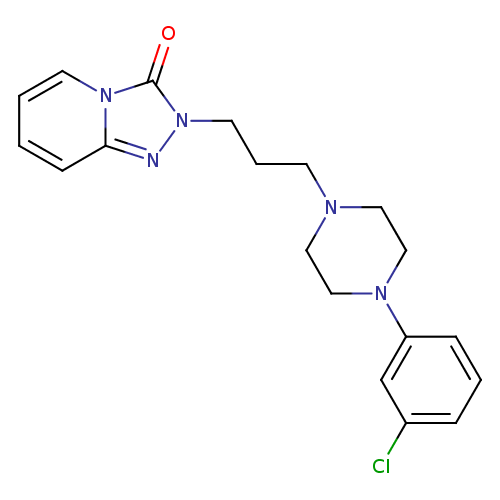
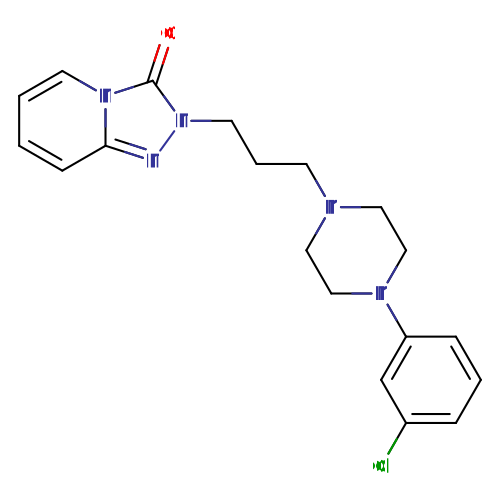
Common NameTrazodone
ClassSmall Molecule
DescriptionA serotonin uptake inhibitor that is used as an antidepressive agent. It has been shown to be effective in patients with major depressive disorders and other subsets of depressive disorders. It is generally more useful in depressive disorders associated with insomnia and anxiety. This drug does not aggravate psychotic symptoms in patients with schizophrenia or schizoaffective disorders. (From AMA Drug Evaluations Annual, 1994, p309)
Contaminant Sources
  • HMDB Contaminants - Urine
  • STOFF IDENT Compounds
  • T3DB toxins
Contaminant Type
  • Amine
  • Anti-Anxiety Agent
  • Antidepressant, Second-Generation
  • Antidepressive Agent, Second-Generation
  • Drug
  • Human Neurotoxin
  • Metabolite
  • Organic Compound
  • Organochloride
  • Serotonin Uptake Inhibitor
  • Synthetic Compound
Chemical Structure
Thumb
Synonyms
ValueSource
2-(3-[4-(3-Chlorophenyl)-1-piperazinyl]propyl)[1,2,4]triazolo[4,3-a]pyridin-3(2H)-oneChEBI
TrazodonaChEBI
TrazodonumChEBI
TritticoKegg
Aventis brand OF trazodone hydrochlorideHMDB
DesyrelHMDB
Farma lepori brand OF trazodone hydrochlorideHMDB
Gen-trazodoneHMDB
Genpharm brand OF trazodone hydrochlorideHMDB
Novopharm brand OF trazodone hydrochlorideHMDB
Nu pharm brand OF trazodone hydrochlorideHMDB
Ratiopharm brand OF trazodone hydrochlorideHMDB
Searle brand OF trazodone hydrochlorideHMDB
Trazodon-neuraxpharmHMDB
Apo-trazodoneHMDB
Apotex brand OF trazodone hydrochlorideHMDB
Boehringer ingelheim brand OF trazodone hydrochlorideHMDB
Bristol myers squibb brand OF trazodone hydrochlorideHMDB
Bristol-myers squibb brand OF trazodone hydrochlorideHMDB
Gen trazodoneHMDB
MolipaxinHMDB
Sidmark brand OF trazodone hydrochlorideHMDB
TradozoneHMDB
Trazodon hexalHMDB
Trazodone hydrochlorideHMDB
Ratio trazodoneHMDB
Apo trazodoneHMDB
DepraxHMDB
Novo-trazodoneHMDB
Nu trazodoneHMDB
Nu-trazodoneHMDB
Pharmascience brand OF trazodone hydrochlorideHMDB
ThombranHMDB
Neuraxpharm brand OF trazodone hydrochlorideHMDB
Apothecon brand OF trazodone hydrochlorideHMDB
Aventis pharma brand OF trazodone hydrochlorideHMDB
Hexal brand OF trazodone hydrochlorideHMDB
Novo trazodoneHMDB
Nu-pharm brand OF trazodone hydrochlorideHMDB
PMS TrazodoneHMDB
PMS-TrazodoneHMDB
Trazodon neuraxpharmHMDB
TrazonHMDB
Ratio-trazodoneHMDB
RatioTrazodoneHMDB
TrazodonNeuraxpharmHMDB
Chemical FormulaC19H22ClN5O
Average Molecular Mass371.864 g/mol
Monoisotopic Mass371.151 g/mol
CAS Registry Number19794-93-5
IUPAC Name2-{3-[4-(3-chlorophenyl)piperazin-1-yl]propyl}-2H,3H-[1,2,4]triazolo[4,3-a]pyridin-3-one
Traditional Nametrazodone
SMILESClC1=CC=CC(=C1)N1CCN(CCCN2N=C3C=CC=CN3C2=O)CC1
InChI IdentifierInChI=1S/C19H22ClN5O/c20-16-5-3-6-17(15-16)23-13-11-22(12-14-23)8-4-10-25-19(26)24-9-2-1-7-18(24)21-25/h1-3,5-7,9,15H,4,8,10-14H2
InChI KeyPHLBKPHSAVXXEF-UHFFFAOYSA-N
Chemical Taxonomy
Description belongs to the class of organic compounds known as phenylpiperazines. Phenylpiperazines are compounds containing a phenylpiperazine skeleton, which consists of a piperazine bound to a phenyl group.
KingdomOrganic compounds
Super ClassOrganoheterocyclic compounds
ClassDiazinanes
Sub ClassPiperazines
Direct ParentPhenylpiperazines
Alternative Parents
Substituents
  • Phenylpiperazine
  • N-arylpiperazine
  • Aryl 1,2,4-triazol-3-one
  • Triazolopyridine
  • Tertiary aliphatic/aromatic amine
  • Aniline or substituted anilines
  • Dialkylarylamine
  • Pyridinone
  • Chlorobenzene
  • N-alkylpiperazine
  • Halobenzene
  • Aryl chloride
  • Aryl halide
  • Pyridine
  • Monocyclic benzene moiety
  • Benzenoid
  • 1,2,4-triazole
  • Azole
  • Heteroaromatic compound
  • Triazole
  • Tertiary aliphatic amine
  • Tertiary amine
  • Azacycle
  • Organooxygen compound
  • Organonitrogen compound
  • Organochloride
  • Organohalogen compound
  • Hydrocarbon derivative
  • Organic oxide
  • Organopnictogen compound
  • Organic oxygen compound
  • Organic nitrogen compound
  • Amine
  • Aromatic heteropolycyclic compound
Molecular FrameworkAromatic heteropolycyclic compounds
External Descriptors
Biological Properties
StatusDetected and Not Quantified
OriginExogenous
Cellular Locations
  • Extracellular
  • Membrane
Biofluid LocationsNot Available
Tissue LocationsNot Available
PathwaysNot Available
Applications
Biological Roles
Chemical RolesNot Available
Physical Properties
StateSolid
AppearanceWhite powder.
Experimental Properties
PropertyValue
Melting Point87°C
Boiling PointNot Available
SolubilitySparigly soluble
Predicted Properties
PropertyValueSource
Water Solubility0.29 g/LALOGPS
logP2.68ALOGPS
logP3.13ChemAxon
logS-3.1ALOGPS
pKa (Strongest Basic)7.09ChemAxon
Physiological Charge1ChemAxon
Hydrogen Acceptor Count4ChemAxon
Hydrogen Donor Count0ChemAxon
Polar Surface Area42.39 ŲChemAxon
Rotatable Bond Count5ChemAxon
Refractivity105.88 m³·mol⁻¹ChemAxon
Polarizability40.12 ųChemAxon
Number of Rings4ChemAxon
Bioavailability1ChemAxon
Rule of FiveYesChemAxon
Ghose FilterYesChemAxon
Veber's RuleNoChemAxon
MDDR-like RuleNoChemAxon
Spectra
Spectra
Spectrum TypeDescriptionSplash KeyView
Predicted GC-MSPredicted GC-MS Spectrum - GC-MS (Non-derivatized) - 70eV, Positivesplash10-0a4j-3940000000-a9996f74a013c4cd5f34Spectrum
Predicted GC-MSPredicted GC-MS Spectrum - GC-MS (Non-derivatized) - 70eV, PositiveNot AvailableSpectrum
LC-MS/MSLC-MS/MS Spectrum - , positivesplash10-00di-0609000000-cee74b5bf3182c2aa324Spectrum
LC-MS/MSLC-MS/MS Spectrum - 75V, Positivesplash10-0002-6900000000-cad4ab75befff3f2968bSpectrum
LC-MS/MSLC-MS/MS Spectrum - 90V, Positivesplash10-0002-9400000000-c7d8f0dfcdffc01eea38Spectrum
LC-MS/MSLC-MS/MS Spectrum - 60V, Positivesplash10-0002-1900000000-28ba21055e54b4402211Spectrum
LC-MS/MSLC-MS/MS Spectrum - 50V, Positivesplash10-0002-0900000000-6fb990f5da8a065e9e2dSpectrum
LC-MS/MSLC-MS/MS Spectrum - 40V, Positivesplash10-004j-0900000000-3e00b6f236166b87e556Spectrum
LC-MS/MSLC-MS/MS Spectrum - 15V, Positivesplash10-00di-0009000000-389ead4eddc071685054Spectrum
LC-MS/MSLC-MS/MS Spectrum - 30V, Positivesplash10-00b9-0905000000-7559d512fbf6d562d524Spectrum
LC-MS/MSLC-MS/MS Spectrum - 30V, Positivesplash10-004i-0902000000-32913e34f1b8199d47e2Spectrum
LC-MS/MSLC-MS/MS Spectrum - 40V, Positivesplash10-004j-0900000000-eba2f098618563ae8d8dSpectrum
LC-MS/MSLC-MS/MS Spectrum - 20V, Positivesplash10-00di-0209000000-df47170d3861120bdd95Spectrum
LC-MS/MSLC-MS/MS Spectrum - 10V, Positivesplash10-00di-0009000000-bcfc1f78608d8da92b69Spectrum
LC-MS/MSLC-MS/MS Spectrum - 90V, Positivesplash10-0002-9400000000-e57c89e0b5532e2d9949Spectrum
LC-MS/MSLC-MS/MS Spectrum - 35V, Positivesplash10-00ba-0904000000-6d3af981b3cc1292370aSpectrum
Predicted LC-MS/MSPredicted LC-MS/MS Spectrum - 10V, Positivesplash10-00di-0409000000-aa395fcbb17de632c6bdSpectrum
Predicted LC-MS/MSPredicted LC-MS/MS Spectrum - 20V, Positivesplash10-009j-3943000000-2a70b3bfe44c6f0cbc7bSpectrum
Predicted LC-MS/MSPredicted LC-MS/MS Spectrum - 40V, Positivesplash10-0f7d-6910000000-98fd05d57a2cfaca1e18Spectrum
Predicted LC-MS/MSPredicted LC-MS/MS Spectrum - 10V, Negativesplash10-00di-1509000000-86e48f5bf6cb797c7455Spectrum
Predicted LC-MS/MSPredicted LC-MS/MS Spectrum - 20V, Negativesplash10-001i-4903000000-dbd293226ccdf09ec683Spectrum
Predicted LC-MS/MSPredicted LC-MS/MS Spectrum - 40V, Negativesplash10-053r-2900000000-cc4d58e26d8dc2a62148Spectrum
Predicted LC-MS/MSPredicted LC-MS/MS Spectrum - 10V, Positivesplash10-00di-0009000000-6eafab677fc7a5bcdc94Spectrum
Predicted LC-MS/MSPredicted LC-MS/MS Spectrum - 20V, Positivesplash10-00di-0429000000-7ff66c2ff10e98b15b9bSpectrum
Predicted LC-MS/MSPredicted LC-MS/MS Spectrum - 40V, Positivesplash10-0f6x-2935000000-39b0f2302534fa91975fSpectrum
Predicted LC-MS/MSPredicted LC-MS/MS Spectrum - 10V, Negativesplash10-00di-0009000000-46b6e1f93b93a9142b29Spectrum
Predicted LC-MS/MSPredicted LC-MS/MS Spectrum - 20V, Negativesplash10-00di-1009000000-fb123f08ae47e01d90aaSpectrum
MSMass Spectrum (Electron Ionization)splash10-0a4i-7980000000-5d2bde624fdd9a946993Spectrum
Toxicity Profile
Route of ExposureRapidly and almost completely absorbed following oral administration. Food may decrease the rate and extent of absorption.
Mechanism of ToxicityTrazodone binds at 5-HT2 receptor, it acts as a serotonin agonist at high doses and a serotonin antagonist at low doses. Like fluoxetine, trazodone's antidepressant activity likely results from blockage of serotonin reuptake by inhibiting serotonin reuptake pump at the presynaptic neuronal membrane. If used for long time periods, postsynaptic neuronal receptor binding sites may also be affected. The sedative effect of trazodone is likely the result of alpha-adrenergic blocking action and modest histamine blockade at H1 receptor. It weakly blocks presynaptic alpha2-adrenergic receptors and strongly inhibits postsynaptic alpha1 receptors. Trazodone does not affect the reuptake of norepinephrine or dopamine within the CNS.
MetabolismUndergoes extensive hepatic metabolism via hydroxylation, N-dealkylation, N-oxidation and splitting of the pyridine ring. Cytochrome P450 (CYP) 3A4 catalyzes the formation of the major active metabolite, m-chlorophenylpiperazine (m-CPP). Metabolites may be further conjugated to glucuonic acid or glutathione. CYP2D6 is responsible for 4'-hydroxylation of m-CPP and the formation of at least one glutathione conjugates of m-CPP, a quinone imine-sulhydryl adduct. Oxotriazolopyridinpropionic acid, an inactive metabolite, and its conjugates account for about 20% of the total excreted oral dose. Less than 1% of the oral dose is excreted unchanged. Approximately 70-75% of the dose is eliminated in urine with the remainder being excreted in feces via biliary elimination. Half Life: Undergoes biphasic elimination with an initial phase t1/2 α of 3-6 hours and a terminal phase t1/2 β of 5-9 hours.
Toxicity ValuesLD50: 96mg/kg (Intravenous, Mouse) (1)
Lethal DoseNot Available
Carcinogenicity (IARC Classification)No indication of carcinogenicity to humans (not listed by IARC).
Uses/SourcesFor the treatment of depression.
Minimum Risk LevelNot Available
Health EffectsNot Available
SymptomsNot Available
TreatmentThere is no specific antidote for Trazodone. Treatment should be symptomatic and supportive in the case of hypotension or excessive sedation. Any patient suspected of having taken an overdose should have the stomach emptied by gastric lavage. Forced diuresis may be useful in facilitating elimination of the drug. (10)
Concentrations
Not Available
DrugBank IDDB00656
HMDB IDHMDB0014794
FooDB IDNot Available
Phenol Explorer IDNot Available
KNApSAcK IDNot Available
BiGG IDNot Available
BioCyc IDNot Available
METLIN IDNot Available
PDB IDNot Available
Wikipedia LinkTrazodone
Chemspider ID5332
ChEBI ID9654
PubChem Compound ID5533
Kegg Compound IDC07156
YMDB IDNot Available
ECMDB IDNot Available
References
Synthesis ReferenceNot Available
MSDSLink
General References
1. Jauch R, Kopitar Z, Prox A, Zimmer A: [Pharmacokinetics and metabolism of trazodone in man (author's transl)]. Arzneimittelforschung. 1976;26(11):2084-9.
2. Marek GJ, McDougle CJ, Price LH, Seiden LS: A comparison of trazodone and fluoxetine: implications for a serotonergic mechanism of antidepressant action. Psychopharmacology (Berl). 1992;109(1-2):2-11.
3. Otani K, Yasui N, Kaneko S, Ishida M, Ohkubo T, Osanai T, Sugawara K, Fukushima Y: Trazodone treatment increases plasma prolactin concentrations in depressed patients. Int Clin Psychopharmacol. 1995 Jun;10(2):115-7.
4. Rotzinger S, Fang J, Baker GB: Trazodone is metabolized to m-chlorophenylpiperazine by CYP3A4 from human sources. Drug Metab Dispos. 1998 Jun;26(6):572-5.
5. Saletu-Zyhlarz GM, Abu-Bakr MH, Anderer P, Gruber G, Mandl M, Strobl R, Gollner D, Prause W, Saletu B: Insomnia in depression: differences in objective and subjective sleep and awakening quality to normal controls and acute effects of trazodone. Prog Neuropsychopharmacol Biol Psychiatry. 2002 Feb;26(2):249-60.
6. Fink HA, MacDonald R, Rutks IR, Wilt TJ: Trazodone for erectile dysfunction: a systematic review and meta-analysis. BJU Int. 2003 Sep;92(4):441-6.
7. Kalgutkar AS, Henne KR, Lame ME, Vaz AD, Collin C, Soglia JR, Zhao SX, Hop CE: Metabolic activation of the nontricyclic antidepressant trazodone to electrophilic quinone-imine and epoxide intermediates in human liver microsomes and recombinant P4503A4. Chem Biol Interact. 2005 Jun 30;155(1-2):10-20. Epub 2005 Apr 18.