Record Information
Version1.0
Creation Date2009-07-21 20:27:16 UTC
Update Date2026-05-14 16:44:13 UTC
Accession NumberCHEM002231
Identification
Common NameParamethadione
ClassSmall Molecule
DescriptionParamethadione is only found in individuals that have used or taken this drug. It is an anticonvulsant in the oxazolidinedione class. It is associated with fetal trimethadione syndrome, which is also known as paramethadione syndrome.Dione anticonvulsants such as paramethadione reduce T-type calcium currents in thalamic neurons (including thalamic relay neurons). This inhibits corticothalamic transmission and raises the threshold for repetitive activity in the thalamus. This results in a dampening of the abnormal thalamocortical rhythmicity proposed to underlie the 3-Hz spike-and-wave discharge seen on electroencephalogram (EEG) during absence seizures.
Contaminant Sources
  • HMDB Contaminants - Urine
  • T3DB toxins
Contaminant Type
  • Amide
  • Amine
  • Anticonvulsant
  • Drug
  • Ester
  • Ether
  • Metabolite
  • Organic Compound
  • Synthetic Compound
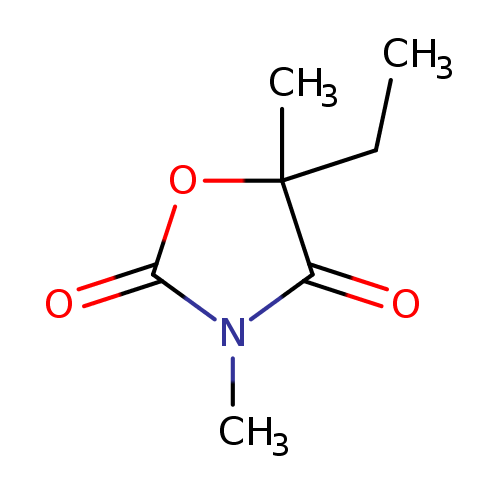
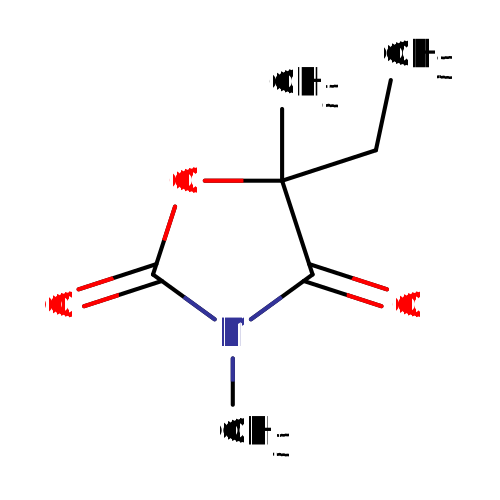
Chemical Structure
Thumb
Synonyms
ValueSource
ParadioneKegg
5-Ethyl-3,5-dimethyloxazolinedioneHMDB
Chemical FormulaC7H11NO3
Average Molecular Mass157.167 g/mol
Monoisotopic Mass157.074 g/mol
CAS Registry Number115-67-3
IUPAC Name5-ethyl-3,5-dimethyl-1,3-oxazolidine-2,4-dione
Traditional Nameparamethadione
SMILESCCC1(C)OC(=O)N(C)C1=O
InChI IdentifierInChI=1S/C7H11NO3/c1-4-7(2)5(9)8(3)6(10)11-7/h4H2,1-3H3
InChI KeyVQASKUSHBVDKGU-UHFFFAOYSA-N
Chemical Taxonomy
Description belongs to the class of organic compounds known as oxazolidinediones. Oxazolidinediones are compounds containing an oxazolidine ring which bears two ketones.
KingdomOrganic compounds
Super ClassOrganoheterocyclic compounds
ClassAzolidines
Sub ClassOxazolidines
Direct ParentOxazolidinediones
Alternative Parents
Substituents
  • Oxazolidinedione
  • Dicarboximide
  • Carbamic acid ester
  • Carbonic acid derivative
  • Oxacycle
  • Azacycle
  • Carboxylic acid derivative
  • Hydrocarbon derivative
  • Organopnictogen compound
  • Organic oxygen compound
  • Organooxygen compound
  • Organonitrogen compound
  • Organic nitrogen compound
  • Carbonyl group
  • Organic oxide
  • Aliphatic heteromonocyclic compound
Molecular FrameworkAliphatic heteromonocyclic compounds
External Descriptors
Biological Properties
StatusDetected and Not Quantified
OriginExogenous
Cellular Locations
  • Cytoplasm
  • Extracellular
  • Membrane
Biofluid LocationsNot Available
Tissue LocationsNot Available
PathwaysNot Available
ApplicationsNot Available
Biological RolesNot Available
Chemical RolesNot Available
Physical Properties
StateLiquid
AppearanceNot Available
Experimental Properties
PropertyValue
Melting PointNot Available
Boiling Point101.5°C
Solubility8.4 mg/mL
Predicted Properties
PropertyValueSource
Water Solubility135 g/LALOGPS
logP0.9ALOGPS
logP1.03ChemAxon
logS-0.07ALOGPS
Physiological Charge0ChemAxon
Hydrogen Acceptor Count2ChemAxon
Hydrogen Donor Count0ChemAxon
Polar Surface Area46.61 ŲChemAxon
Rotatable Bond Count1ChemAxon
Refractivity37.72 m³·mol⁻¹ChemAxon
Polarizability15.39 ųChemAxon
Number of Rings1ChemAxon
Bioavailability1ChemAxon
Rule of FiveYesChemAxon
Ghose FilterNoChemAxon
Veber's RuleNoChemAxon
MDDR-like RuleNoChemAxon
Spectra
Spectra
Spectrum TypeDescriptionSplash KeyView
GC-MSGC-MS Spectrum - EI-B (Non-derivatized)splash10-004i-6900000000-cb5c4b22a5f6eea03ccbSpectrum
GC-MSGC-MS Spectrum - CI-B (Non-derivatized)splash10-0a4i-0900000000-6d7437f8325dda84507aSpectrum
GC-MSGC-MS Spectrum - EI-B (Non-derivatized)splash10-004i-6900000000-cb5c4b22a5f6eea03ccbSpectrum
GC-MSGC-MS Spectrum - CI-B (Non-derivatized)splash10-0a4i-0900000000-6d7437f8325dda84507aSpectrum
Predicted GC-MSPredicted GC-MS Spectrum - GC-MS (Non-derivatized) - 70eV, Positivesplash10-05di-9300000000-2eb214bab933a55ae037Spectrum
Predicted GC-MSPredicted GC-MS Spectrum - GC-MS (Non-derivatized) - 70eV, PositiveNot AvailableSpectrum
Predicted LC-MS/MSPredicted LC-MS/MS Spectrum - 10V, Positivesplash10-0a4i-1900000000-939447f74cc7e7a8684eSpectrum
Predicted LC-MS/MSPredicted LC-MS/MS Spectrum - 20V, Positivesplash10-0kmi-9300000000-38031d50b903ad7c6498Spectrum
Predicted LC-MS/MSPredicted LC-MS/MS Spectrum - 40V, Positivesplash10-0pb9-9000000000-1e13dc003e64f9bfbd19Spectrum
Predicted LC-MS/MSPredicted LC-MS/MS Spectrum - 10V, Negativesplash10-0a4i-0900000000-f6573876063f4b2e67d3Spectrum
Predicted LC-MS/MSPredicted LC-MS/MS Spectrum - 20V, Negativesplash10-0a4i-3900000000-9323279d26818d446640Spectrum
Predicted LC-MS/MSPredicted LC-MS/MS Spectrum - 40V, Negativesplash10-0a4i-9000000000-6b6057da57118121825eSpectrum
Predicted LC-MS/MSPredicted LC-MS/MS Spectrum - 10V, Positivesplash10-0a4i-2900000000-a394c98603a9a56e9f0cSpectrum
Predicted LC-MS/MSPredicted LC-MS/MS Spectrum - 20V, Positivesplash10-0a4i-9300000000-383936e98ff88b856301Spectrum
Predicted LC-MS/MSPredicted LC-MS/MS Spectrum - 40V, Positivesplash10-0a4i-9000000000-41adabf4781a72bfc85fSpectrum
Predicted LC-MS/MSPredicted LC-MS/MS Spectrum - 10V, Negativesplash10-0a4i-0900000000-6bfe1fe3bf97bb99356dSpectrum
Predicted LC-MS/MSPredicted LC-MS/MS Spectrum - 20V, Negativesplash10-0bt9-8900000000-d20643ca1c05d11031f5Spectrum
Predicted LC-MS/MSPredicted LC-MS/MS Spectrum - 40V, Negativesplash10-0pvi-9300000000-7eb87c0cc4c9749b272dSpectrum
MSMass Spectrum (Electron Ionization)splash10-0006-9300000000-5b8273da08cb63d81fcfSpectrum
1D NMR13C NMR SpectrumNot AvailableSpectrum
1D NMR1H NMR SpectrumNot AvailableSpectrum
1D NMR13C NMR SpectrumNot AvailableSpectrum
1D NMR1H NMR SpectrumNot AvailableSpectrum
1D NMR13C NMR SpectrumNot AvailableSpectrum
1D NMR1H NMR SpectrumNot AvailableSpectrum
1D NMR13C NMR SpectrumNot AvailableSpectrum
1D NMR1H NMR SpectrumNot AvailableSpectrum
1D NMR13C NMR SpectrumNot AvailableSpectrum
1D NMR1H NMR SpectrumNot AvailableSpectrum
1D NMR13C NMR SpectrumNot AvailableSpectrum
1D NMR1H NMR SpectrumNot AvailableSpectrum
1D NMR13C NMR SpectrumNot AvailableSpectrum
1D NMR1H NMR SpectrumNot AvailableSpectrum
1D NMR13C NMR SpectrumNot AvailableSpectrum
1D NMR1H NMR SpectrumNot AvailableSpectrum
1D NMR13C NMR SpectrumNot AvailableSpectrum
1D NMR1H NMR SpectrumNot AvailableSpectrum
1D NMR13C NMR SpectrumNot AvailableSpectrum
1D NMR1H NMR SpectrumNot AvailableSpectrum
Toxicity Profile
Route of ExposureRapid via the digestive tract.
Mechanism of ToxicityDione anticonvulsants such as paramethadione reduce T-type calcium currents in thalamic neurons (including thalamic relay neurons). This inhibits corticothalamic transmission and raises the threshold for repetitive activity in the thalamus. This results in a dampening of the abnormal thalamocortical rhythmicity proposed to underlie the 3-Hz spike-and-wave discharge seen on electroencephalogram (EEG) during absence seizures.
MetabolismPrimarily hepatic (mainly via cytochrome P450 isozyme 2C9), paramethadione is completely demethylated to 5-ethyl-5-methyl-2,4-oxazolidinedione, the active metabolite. Half Life: 12 to 24 hours (however the half-life for the active metabolite is not known)
Toxicity ValuesNot Available
Lethal DoseNot Available
Carcinogenicity (IARC Classification)No indication of carcinogenicity to humans (not listed by IARC).
Uses/SourcesUsed for the control of absence (petit mal) seizures that are refractory to treatment with other medications.
Minimum Risk LevelNot Available
Health EffectsMay cause a potentially dangerous rash that may develop into Stevens Johnson syndrome, an extremely rare but potentially fatal skin disease.
SymptomsSymptoms of overdose include clumsiness or unsteadiness, coma, severe dizziness, severe drowsiness, severe nausea, and problems with vision. May cause a potentially dangerous rash that may develop into Stevens Johnson syndrome, an extremely rare but potentially fatal skin disease.
TreatmentNot Available
Concentrations
Not Available
DrugBank IDDB00617
HMDB IDHMDB0014755
FooDB IDNot Available
Phenol Explorer IDNot Available
KNApSAcK IDNot Available
BiGG IDNot Available
BioCyc IDNot Available
METLIN IDNot Available
PDB IDNot Available
Wikipedia LinkParamethadione
Chemspider ID7979
ChEBI ID250989
PubChem Compound ID8280
Kegg Compound IDC07411
YMDB IDNot Available
ECMDB IDNot Available
References
Synthesis ReferenceNot Available
MSDSNot Available
General References
1. Feldman GL, Weaver DD, Lovrien EW: The fetal trimethadione syndrome: report of an additional family and further delineation of this syndrome. Am J Dis Child. 1977 Dec;131(12):1389-92.
2. Hoffman DJ, Chun AH: Paramethadione and metabolite serum levels in humans after a single oral paramethadione dose. J Pharm Sci. 1975 Oct;64(10):1702-3.