Record Information
Version1.0
Creation Date2009-07-21 20:27:13 UTC
Update Date2026-03-31 19:42:05 UTC
Accession NumberCHEM002226
Identification
Common NameEthosuximide
ClassSmall Molecule
DescriptionEthosuximide is only found in individuals that have used or taken this drug. It is an anticonvulsant especially useful in the treatment of absence seizures unaccompanied by other types of seizures. [PubChem]Binds to T-type voltage sensitive calcium channels. Voltage-sensitive calcium channels (VSCC) mediate the entry of calcium ions into excitable cells and are also involved in a variety of calcium-dependent processes, including muscle contraction, hormone or neurotransmitter release, gene expression, cell motility, cell division and cell death. The isoform alpha-1G gives rise to T-type calcium currents. T-type calcium channels belong to the low-voltage activated (LVA) group and are strongly blocked by mibefradil. A particularity of this type of channels is an opening at quite negative potentials and a voltage-dependent inactivation. T-type channels serve pacemaking functions in both central neurons and cardiac nodal cells and support calcium signaling in secretory cells and vascular smooth muscle. They may also be involved in the modulation of firing patterns of neurons which is important for information processing as well as in cell growth processes.
Contaminant Sources
  • HMDB Contaminants - Urine
  • STOFF IDENT Compounds
  • T3DB toxins
  • ToxCast & Tox21 Chemicals
Contaminant Type
  • Amide
  • Amine
  • Anticonvulsant
  • Drug
  • Metabolite
  • Organic Compound
  • Succinimide
  • Synthetic Compound
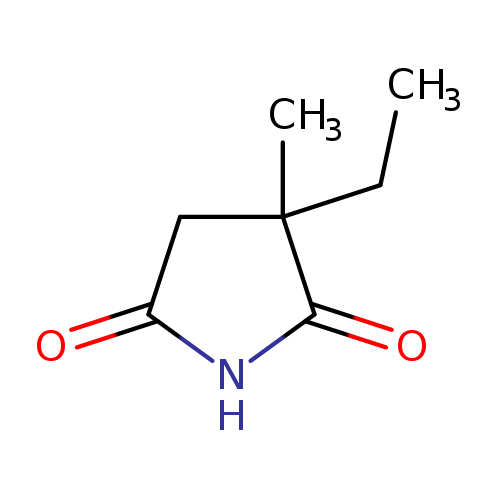
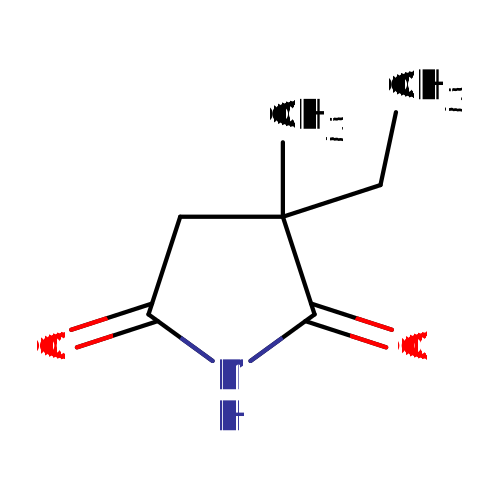
Chemical Structure
Thumb
Synonyms
ValueSource
(+-)-2-Ethyl-2-methylsuccinimideChEBI
2-Ethyl-2-methylsuccinimideChEBI
2-Methyl-2-ethylsuccinimideChEBI
3-Ethyl-3-methyl-2,5-pyrrolidinedioneChEBI
3-Ethyl-3-methylsuccinimideChEBI
3-Methyl-3-ethylpyrrolidine-2,5-dioneChEBI
3-Methyl-3-ethylsuccinimideChEBI
AethosuximideChEBI
alpha-Ethyl-alpha-methylsuccinimideChEBI
alpha-Methyl-alpha-ethylsuccinimideChEBI
EthosuximidumChEBI
EtosuximidaChEBI
gamma-Ethyl-gamma-methyl-succinimideChEBI
gamma-Methyl-gamma-ethyl-succinimideChEBI
ZarontinKegg
a-Ethyl-a-methylsuccinimideGenerator
Α-ethyl-α-methylsuccinimideGenerator
a-Methyl-a-ethylsuccinimideGenerator
Α-methyl-α-ethylsuccinimideGenerator
g-Ethyl-g-methyl-succinimideGenerator
Γ-ethyl-γ-methyl-succinimideGenerator
g-Methyl-g-ethyl-succinimideGenerator
Γ-methyl-γ-ethyl-succinimideGenerator
EthosuccimideHMDB
EthosuccinimideHMDB
EthosuxideHMDB
Desitin brand OF ethosuximideHMDB
EthylmethylsuccimideHMDB
LAB brand OF ethosuximideHMDB
Parke davis brand OF ethosuximideHMDB
PyknolepsinumHMDB
SuxilepHMDB
EmesideHMDB
Faes brand OF ethosuximideHMDB
Katwijk brand OF ethosuximideHMDB
Pfizer brand OF ethosuximideHMDB
Warner lambert brand OF ethosuximideHMDB
Warner-lambert brand OF ethosuximideHMDB
Fortbenton brand OF ethosuximideHMDB
Jenapharm brand OF ethosuximideHMDB
SuksilepHMDB
EthosuccimidHMDB
EthymalHMDB
Etosuximida faesHMDB
Faes, etosuximidaHMDB
PetnidanHMDB
United drug brand OF ethosuximideHMDB
Wernigerode brand OF ethosuximideHMDB
Chemical FormulaC7H11NO2
Average Molecular Mass141.168 g/mol
Monoisotopic Mass141.079 g/mol
CAS Registry Number77-67-8
IUPAC Name3-ethyl-3-methylpyrrolidine-2,5-dione
Traditional Nameethosuximide
SMILESCCC1(C)CC(=O)NC1=O
InChI IdentifierInChI=1S/C7H11NO2/c1-3-7(2)4-5(9)8-6(7)10/h3-4H2,1-2H3,(H,8,9,10)
InChI KeyHAPOVYFOVVWLRS-UHFFFAOYSA-N
Chemical Taxonomy
Description belongs to the class of organic compounds known as pyrrolidine-2-ones. These are pyrrolidines which bear a C=O group at position 2 of the pyrrolidine ring.
KingdomOrganic compounds
Super ClassOrganoheterocyclic compounds
ClassPyrrolidines
Sub ClassPyrrolidones
Direct ParentPyrrolidine-2-ones
Alternative Parents
Substituents
  • 2-pyrrolidone
  • Carboxylic acid imide
  • Dicarboximide
  • Carboxylic acid imide, n-unsubstituted
  • Lactam
  • Carboxylic acid derivative
  • Azacycle
  • Carbonyl group
  • Organooxygen compound
  • Organonitrogen compound
  • Hydrocarbon derivative
  • Organic oxide
  • Organopnictogen compound
  • Organic oxygen compound
  • Organic nitrogen compound
  • Aliphatic heteromonocyclic compound
Molecular FrameworkAliphatic heteromonocyclic compounds
External Descriptors
Biological Properties
StatusDetected and Not Quantified
OriginExogenous
Cellular Locations
  • Cytoplasm
  • Extracellular
  • Membrane
Biofluid LocationsNot Available
Tissue LocationsNot Available
PathwaysNot Available
Applications
Biological Roles
Chemical RolesNot Available
Physical Properties
StateSolid
AppearanceWhite powder.
Experimental Properties
PropertyValue
Melting Point64.5°C
Boiling PointNot Available
Solubility39.2 g/L
Predicted Properties
PropertyValueSource
Water Solubility101 g/LALOGPS
logP0.1ALOGPS
logP0.55ChemAxon
logS-0.15ALOGPS
pKa (Strongest Acidic)10.73ChemAxon
pKa (Strongest Basic)-6.6ChemAxon
Physiological Charge0ChemAxon
Hydrogen Acceptor Count2ChemAxon
Hydrogen Donor Count1ChemAxon
Polar Surface Area46.17 ŲChemAxon
Rotatable Bond Count1ChemAxon
Refractivity35.96 m³·mol⁻¹ChemAxon
Polarizability14.45 ųChemAxon
Number of Rings1ChemAxon
Bioavailability1ChemAxon
Rule of FiveYesChemAxon
Ghose FilterNoChemAxon
Veber's RuleNoChemAxon
MDDR-like RuleNoChemAxon
Spectra
Spectra
Spectrum TypeDescriptionSplash KeyView
GC-MSGC-MS Spectrum - EI-B (Non-derivatized)splash10-08mi-9400000000-44583cdc88d3203a4e84Spectrum
GC-MSGC-MS Spectrum - CI-B (Non-derivatized)splash10-0006-1900000000-1c27ada66f7846f9d155Spectrum
GC-MSGC-MS Spectrum - CI-B (Non-derivatized)splash10-0006-2900000000-19e57defe9ded4ed42b4Spectrum
GC-MSGC-MS Spectrum - EI-B (Non-derivatized)splash10-08mi-9400000000-44583cdc88d3203a4e84Spectrum
GC-MSGC-MS Spectrum - CI-B (Non-derivatized)splash10-0006-1900000000-1c27ada66f7846f9d155Spectrum
GC-MSGC-MS Spectrum - CI-B (Non-derivatized)splash10-0006-2900000000-19e57defe9ded4ed42b4Spectrum
Predicted GC-MSPredicted GC-MS Spectrum - GC-MS (Non-derivatized) - 70eV, Positivesplash10-056r-9300000000-85b98f89652d40beec08Spectrum
Predicted GC-MSPredicted GC-MS Spectrum - GC-MS (Non-derivatized) - 70eV, PositiveNot AvailableSpectrum
LC-MS/MSLC-MS/MS Spectrum - 10V, Positivesplash10-00dl-9600000000-7681bb12358063b47197Spectrum
LC-MS/MSLC-MS/MS Spectrum - 40V, Positivesplash10-0006-9000000000-738207dee9e4bed4ffadSpectrum
LC-MS/MSLC-MS/MS Spectrum - 10V, Negativesplash10-0006-0900000000-22316b2cb39a75c7039eSpectrum
LC-MS/MSLC-MS/MS Spectrum - 20V, Positivesplash10-006x-9000000000-ba19e15796e874885916Spectrum
LC-MS/MSLC-MS/MS Spectrum - 40V, Negativesplash10-0006-9000000000-0cff0bfc43f7a5c1e3caSpectrum
LC-MS/MSLC-MS/MS Spectrum - 20V, Negativesplash10-0006-9700000000-d743eaeb251198f5e9d1Spectrum
Predicted LC-MS/MSPredicted LC-MS/MS Spectrum - 10V, Positivesplash10-0006-0900000000-86a82d1f0e8a43f11ab5Spectrum
Predicted LC-MS/MSPredicted LC-MS/MS Spectrum - 20V, Positivesplash10-006x-3900000000-e43cf4042ca22cb5d6a8Spectrum
Predicted LC-MS/MSPredicted LC-MS/MS Spectrum - 40V, Positivesplash10-0q29-9000000000-0593295be197f643992cSpectrum
Predicted LC-MS/MSPredicted LC-MS/MS Spectrum - 10V, Negativesplash10-0006-1900000000-7b6a825d9781021fd166Spectrum
Predicted LC-MS/MSPredicted LC-MS/MS Spectrum - 20V, Negativesplash10-0006-3900000000-a161e0f30f683c657129Spectrum
Predicted LC-MS/MSPredicted LC-MS/MS Spectrum - 40V, Negativesplash10-0f6x-9000000000-25a91a77a1c19188305eSpectrum
Predicted LC-MS/MSPredicted LC-MS/MS Spectrum - 10V, Positivesplash10-0006-2900000000-72f0fd5251d48467db7eSpectrum
Predicted LC-MS/MSPredicted LC-MS/MS Spectrum - 20V, Positivesplash10-0a4i-9100000000-da7f95077b262c97a903Spectrum
Predicted LC-MS/MSPredicted LC-MS/MS Spectrum - 40V, Positivesplash10-0ldu-9000000000-34cc07c564fa5f405c00Spectrum
Predicted LC-MS/MSPredicted LC-MS/MS Spectrum - 10V, Negativesplash10-0006-1900000000-065b0eea8247fbe1ddadSpectrum
Predicted LC-MS/MSPredicted LC-MS/MS Spectrum - 20V, Negativesplash10-0006-9200000000-d7e92d2e488ef0dab2f5Spectrum
Predicted LC-MS/MSPredicted LC-MS/MS Spectrum - 40V, Negativesplash10-0006-9000000000-f9bf9d86cdc9d7fe76fbSpectrum
MSMass Spectrum (Electron Ionization)splash10-08mi-9300000000-3d87944377ee1f85803dSpectrum
1D NMR1H NMR SpectrumNot AvailableSpectrum
1D NMR13C NMR SpectrumNot AvailableSpectrum
1D NMR1H NMR SpectrumNot AvailableSpectrum
1D NMR13C NMR SpectrumNot AvailableSpectrum
1D NMR1H NMR SpectrumNot AvailableSpectrum
1D NMR13C NMR SpectrumNot AvailableSpectrum
1D NMR1H NMR SpectrumNot AvailableSpectrum
1D NMR13C NMR SpectrumNot AvailableSpectrum
1D NMR1H NMR SpectrumNot AvailableSpectrum
1D NMR13C NMR SpectrumNot AvailableSpectrum
1D NMR1H NMR SpectrumNot AvailableSpectrum
1D NMR13C NMR SpectrumNot AvailableSpectrum
1D NMR1H NMR SpectrumNot AvailableSpectrum
1D NMR13C NMR SpectrumNot AvailableSpectrum
1D NMR1H NMR SpectrumNot AvailableSpectrum
1D NMR13C NMR SpectrumNot AvailableSpectrum
1D NMR1H NMR SpectrumNot AvailableSpectrum
1D NMR13C NMR SpectrumNot AvailableSpectrum
1D NMR1H NMR SpectrumNot AvailableSpectrum
1D NMR13C NMR SpectrumNot AvailableSpectrum
Toxicity Profile
Route of ExposureBioavailability following oral administration is 93%.
Mechanism of ToxicityBinds to T-type voltage sensitive calcium channels. Voltage-sensitive calcium channels (VSCC) mediate the entry of calcium ions into excitable cells and are also involved in a variety of calcium-dependent processes, including muscle contraction, hormone or neurotransmitter release, gene expression, cell motility, cell division and cell death. The isoform alpha-1G gives rise to T-type calcium currents. T-type calcium channels belong to the "low-voltage activated (LVA)" group and are strongly blocked by mibefradil. A particularity of this type of channels is an opening at quite negative potentials and a voltage-dependent inactivation. T-type channels serve pacemaking functions in both central neurons and cardiac nodal cells and support calcium signaling in secretory cells and vascular smooth muscle. They may also be involved in the modulation of firing patterns of neurons which is important for information processing as well as in cell growth processes.
MetabolismHepatic, via CYP3A4 and CYP2E1. Half Life: 53 hours
Toxicity ValuesNot Available
Lethal DoseNot Available
Carcinogenicity (IARC Classification)No indication of carcinogenicity to humans (not listed by IARC).
Uses/SourcesFor the treatment of petit mal epilepsy.
Minimum Risk LevelNot Available
Health EffectsMay cause a potentially dangerous rash that may develop into Stevens Johnson syndrome, an extremely rare but potentially fatal skin disease.
SymptomsAcute overdoses may produce nausea, vomiting, and CNS depression including coma with respiratory depression.
TreatmentTreatment should include emesis (unless the patient is or could rapidly become obtunded, comatose, or convulsing) or gastric lavage, activated charcoal, cathartics, and general supportive measures. Hemodialysis may be useful to treat ethosuximide overdose. Forced diuresis and exchange transfusions are ineffective. (7)
Concentrations
Not Available
DrugBank IDDB00593
HMDB IDHMDB0014731
FooDB IDNot Available
Phenol Explorer IDNot Available
KNApSAcK IDNot Available
BiGG IDNot Available
BioCyc IDNot Available
METLIN IDNot Available
PDB IDNot Available
Wikipedia LinkEthosuximide
Chemspider ID3175
ChEBI ID4887
PubChem Compound ID3291
Kegg Compound IDC07505
YMDB IDNot Available
ECMDB IDNot Available
References
Synthesis Reference

Miller, C.A. and Long, L.M.; U.S. Patent 2,993,835; July 25,1961; assigned to Parke, Davis and Company.

MSDSLink
General References
1. Kostyuk PG, Molokanova EA, Pronchuk NF, Savchenko AN, Verkhratsky AN: Different action of ethosuximide on low- and high-threshold calcium currents in rat sensory neurons. Neuroscience. 1992 Dec;51(4):755-8.
2. Coulter DA, Huguenard JR, Prince DA: Differential effects of petit mal anticonvulsants and convulsants on thalamic neurones: calcium current reduction. Br J Pharmacol. 1990 Aug;100(4):800-6.
3. Coulter DA, Huguenard JR, Prince DA: Characterization of ethosuximide reduction of low-threshold calcium current in thalamic neurons. Ann Neurol. 1989 Jun;25(6):582-93.
4. Coulter DA, Huguenard JR, Prince DA: Specific petit mal anticonvulsants reduce calcium currents in thalamic neurons. Neurosci Lett. 1989 Mar 13;98(1):74-8.
5. Patsalos PN: Properties of antiepileptic drugs in the treatment of idiopathic generalized epilepsies. Epilepsia. 2005;46 Suppl 9:140-8.
6. https://www.ncbi.nlm.nih.gov/pubmed/?term=12873507
7. https://www.ncbi.nlm.nih.gov/pubmed/?term=1681105
8. https://www.ncbi.nlm.nih.gov/pubmed/?term=17011080
9. https://www.ncbi.nlm.nih.gov/pubmed/?term=17046248
10. https://www.ncbi.nlm.nih.gov/pubmed/?term=17451232
11. https://www.ncbi.nlm.nih.gov/pubmed/?term=17481896
12. https://www.ncbi.nlm.nih.gov/pubmed/?term=1847429
13. https://www.ncbi.nlm.nih.gov/pubmed/?term=19005061
14. https://www.ncbi.nlm.nih.gov/pubmed/?term=1992141
15. https://www.ncbi.nlm.nih.gov/pubmed/?term=2061925
16. https://www.ncbi.nlm.nih.gov/pubmed/?term=21332949
17. https://www.ncbi.nlm.nih.gov/pubmed/?term=21945797
18. https://www.ncbi.nlm.nih.gov/pubmed/?term=2296016
19. https://www.ncbi.nlm.nih.gov/pubmed/?term=2308142
20. https://www.ncbi.nlm.nih.gov/pubmed/?term=3336019
21. https://www.ncbi.nlm.nih.gov/pubmed/?term=3820228
22. https://www.ncbi.nlm.nih.gov/pubmed/?term=8246220
23. https://www.ncbi.nlm.nih.gov/pubmed/?term=8627613
24. https://www.ncbi.nlm.nih.gov/pubmed/?term=8691481
25. https://www.ncbi.nlm.nih.gov/pubmed/?term=9016327