Record Information
Version1.0
Creation Date2009-07-21 20:27:08 UTC
Update Date2026-05-14 16:42:08 UTC
Accession NumberCHEM002220
Identification
Common NameHydroxyzine
ClassSmall Molecule
DescriptionA histamine H1 receptor antagonist that is effective in the treatment of chronic urticaria, dermatitis, and histamine-mediated pruritus. Unlike its major metabolite cetirizine, it does cause drowsiness. It is also effective as an antiemetic, for relief of anxiety and tension, and as a sedative.
Contaminant Sources
  • HMDB Contaminants - Urine
  • STOFF IDENT Compounds
  • T3DB toxins
  • ToxCast & Tox21 Chemicals
Contaminant Type
  • Amine
  • Antipruritic
  • Anxiolytic
  • Drug
  • Ether
  • Histamine H1 Antagonist
  • Hypnotic and Sedative
  • Metabolite
  • Organic Compound
  • Organochloride
  • Synthetic Compound
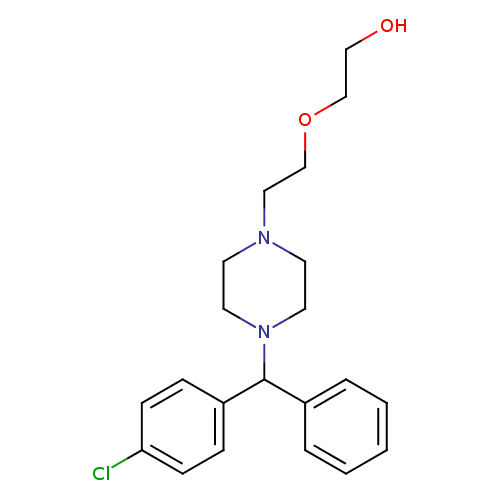
Chemical Structure
Thumb
Synonyms
ValueSource
HidroxizinaChEBI
HychotineChEBI
HydroxineChEBI
HydroxizineChEBI
HydroxizinumChEBI
HydroxycineChEBI
HydroxyzinChEBI
HydroxyzinumChEBI
MarexKegg
Hydroxyzine baseHMDB
Hydroxyzine pamoateHMDB
HydroxyzyneHMDB
IdrossizinaHMDB
AtaraxHMDB
Hydroxyzine hydrochlorideHMDB
OrgatraxHMDB
2-(2-(4-((4-Chlorophenyl)phenylmethyl)-1-piperazinyl)ethoxy)ethanolHMDB
Hydroxyzine dihydrochlorideHMDB
VistarilHMDB
DurraxHMDB
Pamoate, hydroxyzineHMDB
Chemical FormulaC21H27ClN2O2
Average Molecular Mass374.904 g/mol
Monoisotopic Mass374.176 g/mol
CAS Registry Number68-88-2
IUPAC Name2-(2-{4-[(4-chlorophenyl)(phenyl)methyl]piperazin-1-yl}ethoxy)ethan-1-ol
Traditional Namehydroxyzine
SMILESOCCOCCN1CCN(CC1)C(C1=CC=CC=C1)C1=CC=C(Cl)C=C1
InChI IdentifierInChI=1S/C21H27ClN2O2/c22-20-8-6-19(7-9-20)21(18-4-2-1-3-5-18)24-12-10-23(11-13-24)14-16-26-17-15-25/h1-9,21,25H,10-17H2
InChI KeyZQDWXGKKHFNSQK-UHFFFAOYSA-N
Chemical Taxonomy
Description belongs to the class of organic compounds known as diphenylmethanes. Diphenylmethanes are compounds containing a diphenylmethane moiety, which consists of a methane wherein two hydrogen atoms are replaced by two phenyl groups.
KingdomOrganic compounds
Super ClassBenzenoids
ClassBenzene and substituted derivatives
Sub ClassDiphenylmethanes
Direct ParentDiphenylmethanes
Alternative Parents
Substituents
  • Diphenylmethane
  • Chlorobenzene
  • Aralkylamine
  • Halobenzene
  • N-alkylpiperazine
  • Aryl chloride
  • Aryl halide
  • 1,4-diazinane
  • Piperazine
  • Tertiary aliphatic amine
  • Tertiary amine
  • Dialkyl ether
  • Azacycle
  • Ether
  • Organoheterocyclic compound
  • Organohalogen compound
  • Organic nitrogen compound
  • Amine
  • Hydrocarbon derivative
  • Alcohol
  • Organopnictogen compound
  • Organic oxygen compound
  • Organochloride
  • Organonitrogen compound
  • Organooxygen compound
  • Primary alcohol
  • Aromatic heteromonocyclic compound
Molecular FrameworkAromatic heteromonocyclic compounds
External Descriptors
Biological Properties
StatusDetected and Not Quantified
OriginExogenous
Cellular Locations
  • Membrane
Biofluid LocationsNot Available
Tissue LocationsNot Available
PathwaysNot Available
Applications
Biological Roles
Chemical RolesNot Available
Physical Properties
StateSolid
AppearanceWhite powder.
Experimental Properties
PropertyValue
Melting Point193°C
Boiling PointNot Available
Solubility< 700 mg/mL
Predicted Properties
PropertyValueSource
Water Solubility0.091 g/LALOGPS
logP3.43ALOGPS
logP3.41ChemAxon
logS-3.6ALOGPS
pKa (Strongest Acidic)15.12ChemAxon
pKa (Strongest Basic)7.82ChemAxon
Physiological Charge1ChemAxon
Hydrogen Acceptor Count4ChemAxon
Hydrogen Donor Count1ChemAxon
Polar Surface Area35.94 ŲChemAxon
Rotatable Bond Count8ChemAxon
Refractivity107.07 m³·mol⁻¹ChemAxon
Polarizability41.99 ųChemAxon
Number of Rings3ChemAxon
Bioavailability1ChemAxon
Rule of FiveYesChemAxon
Ghose FilterYesChemAxon
Veber's RuleYesChemAxon
MDDR-like RuleYesChemAxon
Spectra
Spectra
Spectrum TypeDescriptionSplash KeyView
GC-MSGC-MS Spectrum - EI-B (Non-derivatized)splash10-0udi-6491000000-95c46c16c2b29900f4d9Spectrum
Predicted GC-MSPredicted GC-MS Spectrum - GC-MS (Non-derivatized) - 70eV, Positivesplash10-0udj-4291000000-5750700bc5e75e581102Spectrum
Predicted GC-MSPredicted GC-MS Spectrum - GC-MS (1 TMS) - 70eV, Positivesplash10-0udr-6589100000-8c29584ceed777207042Spectrum
Predicted GC-MSPredicted GC-MS Spectrum - GC-MS (Non-derivatized) - 70eV, PositiveNot AvailableSpectrum
LC-MS/MSLC-MS/MS Spectrum - , positivesplash10-0udi-0593000000-f20d2328497a3a80239bSpectrum
LC-MS/MSLC-MS/MS Spectrum - 30V, Positivesplash10-0udi-0090000000-1775dbd78559702d467dSpectrum
LC-MS/MSLC-MS/MS Spectrum - 15V, Positivesplash10-0ufr-0095000000-2486fd8f41ddb000ef30Spectrum
LC-MS/MSLC-MS/MS Spectrum - 45V, Positivesplash10-0udi-0490000000-34f4ae7f6d96a96d8174Spectrum
LC-MS/MSLC-MS/MS Spectrum - 60V, Positivesplash10-014i-0920000000-4a9f93b8b1f05c5bbf5fSpectrum
LC-MS/MSLC-MS/MS Spectrum - 45V, Positivesplash10-0udi-0490000000-a0279bcdd59b767b1c23Spectrum
LC-MS/MSLC-MS/MS Spectrum - 75V, Positivesplash10-014i-0900000000-11dd6f0d87e2b77549b1Spectrum
LC-MS/MSLC-MS/MS Spectrum - 90V, Positivesplash10-014i-0900000000-3f8b71c3d5770c87aee1Spectrum
Predicted LC-MS/MSPredicted LC-MS/MS Spectrum - 10V, Positivesplash10-004i-0019000000-f6d89e75a6d7e8af9001Spectrum
Predicted LC-MS/MSPredicted LC-MS/MS Spectrum - 20V, Positivesplash10-0w4i-3179000000-af704769cca5c3dc8e6eSpectrum
Predicted LC-MS/MSPredicted LC-MS/MS Spectrum - 40V, Positivesplash10-0udj-5292000000-d581a3d2a57e2fa067fdSpectrum
Predicted LC-MS/MSPredicted LC-MS/MS Spectrum - 10V, Negativesplash10-00di-1009000000-753db826ff35e907de51Spectrum
Predicted LC-MS/MSPredicted LC-MS/MS Spectrum - 20V, Negativesplash10-00di-2029000000-b8ad29be99c096f6967aSpectrum
Predicted LC-MS/MSPredicted LC-MS/MS Spectrum - 40V, Negativesplash10-01ox-9061000000-5b2e7de6b58b52c40177Spectrum
Predicted LC-MS/MSPredicted LC-MS/MS Spectrum - 10V, Negativesplash10-00di-1009000000-ce968b789a986f8f3fc3Spectrum
Predicted LC-MS/MSPredicted LC-MS/MS Spectrum - 20V, Negativesplash10-0abc-9016000000-407400d539246a74d942Spectrum
Predicted LC-MS/MSPredicted LC-MS/MS Spectrum - 40V, Negativesplash10-0w5c-3291000000-5bcbb07a54b5bbc8895eSpectrum
Predicted LC-MS/MSPredicted LC-MS/MS Spectrum - 10V, Positivesplash10-0fb9-0079000000-7d6c850012f146c2d074Spectrum
Predicted LC-MS/MSPredicted LC-MS/MS Spectrum - 20V, Positivesplash10-0udi-0090000000-35c9b971bf421f75d391Spectrum
Predicted LC-MS/MSPredicted LC-MS/MS Spectrum - 40V, Positivesplash10-0udi-2191000000-2083d212703dd6c90743Spectrum
MSMass Spectrum (Electron Ionization)splash10-0uxr-4591000000-d2e3424c44feae8a5d9cSpectrum
Toxicity Profile
Route of ExposureOral, Intramuscular. Rapidly absorbed from the gastrointestinal tract
Mechanism of ToxicityHydroxyzine competes with histamine for binding at H1-receptor sites on the effector cell surface, resulting in suppression of histaminic edema, flare, and pruritus. The sedative properties of hydroxyzine occur at the subcortical level of the CNS. Secondary to its central anticholinergic actions, hydroxyzine may be effective as an antiemetic.
MetabolismHepatic Half Life: 20 to 25 hours
Toxicity ValuesOral, rat LD50: 950 mg/kg.
Lethal DoseNot Available
Carcinogenicity (IARC Classification)No indication of carcinogenicity to humans (not listed by IARC).
Uses/SourcesFor symptomatic relief of anxiety and tension associated with psychoneurosis and as an adjunct in organic disease states in which anxiety is manifested. Useful in the management of pruritus due to allergic conditions such as chronic urticaria.
Minimum Risk LevelNot Available
Health EffectsNot Available
SymptomsSymptoms of overexposure include hypersedation.
TreatmentIf vomiting has not occurred spontaneously, it should be induced. Immediate gastric lavage is also recommended. General supportive care, including frequent monitoring of the vital signs and close observation of the patient, is indicated. Hypotension, though unlikely, may be controlled with intravenous fluids and norepinephrine or metaraminol. Do not use epinephrine as hydroxyzine hydrochloride counteracts its pressor action. There is no specific antidote. It is doubtful that hemodialysis would be of any value in the treatment of overdosage with hydroxyzine. However, if other agents such as barbiturates have been ingested concomitantly, hemodialysis may be indicated. (5)
Concentrations
Not Available
DrugBank IDDB00557
HMDB IDHMDB0014697
FooDB IDNot Available
Phenol Explorer IDNot Available
KNApSAcK IDNot Available
BiGG IDNot Available
BioCyc IDNot Available
METLIN IDNot Available
PDB IDNot Available
Wikipedia LinkHydroxyzine
Chemspider ID3531
ChEBI ID5818
PubChem Compound ID3658
Kegg Compound IDC07045
YMDB IDNot Available
ECMDB IDNot Available
References
Synthesis Reference

U.S. Patent 2,899,436.

MSDSLink
General References
1. Clark BG, Araki M, Brown HW: Hydroxyzine-associated tardive dyskinesia. Ann Neurol. 1982 Apr;11(4):435.
2. HUTCHEON DE, MORRIS DL, SCRIABINE A: Cardiovascular action of hydroxyzine (atarax). J Pharmacol Exp Ther. 1956 Dec;118(4):451-60.
3. DOLAN CM: Management of emotional disturbances; use of hydroxyzine (atarax) in general practice. Calif Med. 1958 Jun;88(6):443-4.
4. https://www.ncbi.nlm.nih.gov/pubmed/?term=15233966
5. https://www.ncbi.nlm.nih.gov/pubmed/?term=19057127
6. https://www.ncbi.nlm.nih.gov/pubmed/?term=19348661