Record Information
Version1.0
Creation Date2009-07-21 20:27:08 UTC
Update Date2026-03-26 23:03:10 UTC
Accession NumberCHEM002219
Identification
Common NamePentostatin
ClassSmall Molecule
DescriptionPentostatin is only found in individuals that have used or taken this drug. It is a potent inhibitor of adenosine deaminase. The drug is effective in the treatment of many lymphoproliferative malignancies, particularly hairy-cell leukemia. It is also synergistic with some other antineoplastic agents and has immunosuppressive activity. Pentostatin is a potent transition state inhibitor of adenosine deaminase (ADA), the greatest activity of which is found in cells of the lymphoid system. T-cells have higher ADA activity than B-cells, and T-cell malignancies have higher activity than B-cell malignancies. The cytotoxicity that results from prevention of catabolism of adenosine or deoxyadenosine is thought to be due to elevated intracellular levels of dATP, which can block DNA synthesis through inhibition of ribonucleotide reductase. Intracellular activation results in incorporation into DNA as a false purine base. An additional cytotoxic effect is related to its incorporation into RNA. Cytotoxicity is cell cycle phase-specific (S-phase).
Contaminant Sources
  • HMDB Contaminants - Urine
  • STOFF IDENT Compounds
  • T3DB toxins
  • ToxCast & Tox21 Chemicals
Contaminant Type
  • Adenosine Deaminase Inhibitor
  • Amine
  • Antibiotic
  • Antineoplastic Agent
  • Drug
  • Enzyme Inhibitor
  • Ether
  • Immunosuppressive Agent
  • Metabolite
  • Organic Compound
  • Synthetic Compound
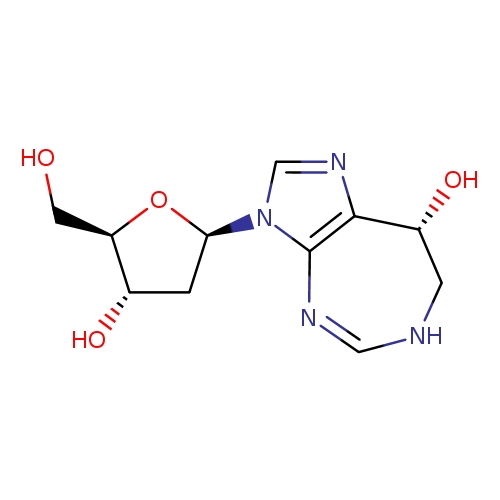
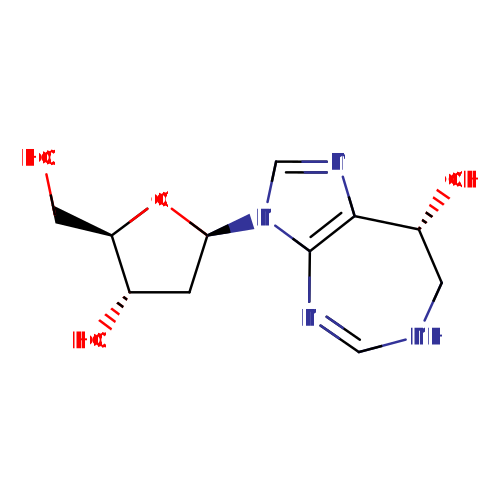
Chemical Structure
Thumb
Synonyms
ValueSource
NipentKegg
2'-DCFHMDB
2'-DeoxycoformycinHMDB
2'-DexoycoformycinHMDB
DeoxycoformycinHMDB
CO-VidarabineHMDB
Lederle brand OF pentostatinHMDB
Warner-lambert brand OF pentostatinHMDB
Prasfarma brand OF pentostatinHMDB
2' DeoxycoformycinHMDB
Co vidarabineHMDB
Supergen brand OF pentostatinHMDB
Wyeth brand OF pentostatinHMDB
PentostatinKEGG
Chemical FormulaC11H16N4O4
Average Molecular Mass268.269 g/mol
Monoisotopic Mass268.117 g/mol
CAS Registry Number53910-25-1
IUPAC Name(8R)-3-[(2R,4S,5R)-4-hydroxy-5-(hydroxymethyl)oxolan-2-yl]-3H,6H,7H,8H-imidazo[4,5-d][1,3]diazepin-8-ol
Traditional Namepentostatin
SMILESOC[C@H]1O[C@H](C[C@@H]1O)N1C=NC2=C1N=CNC[C@H]2O
InChI IdentifierInChI=1S/C11H16N4O4/c16-3-8-6(17)1-9(19-8)15-5-14-10-7(18)2-12-4-13-11(10)15/h4-9,16-18H,1-3H2,(H,12,13)/t6-,7+,8+,9+/m0/s1
InChI KeyFPVKHBSQESCIEP-JQCXWYLXSA-N
Chemical Taxonomy
Description belongs to the class of organic compounds known as imidazodiazepines. These are organic compounds containing an imidazole ring fused to a diazepine ring. Imidazole is 5-membered ring consisting of three carbon atoms, and two nitrogen centers at the 1- and 3-positions. Diazepine is a 7-membered ring consisting of five carbon and two nitrogen atoms.
KingdomOrganic compounds
Super ClassOrganoheterocyclic compounds
ClassImidazodiazepines
Sub ClassNot Available
Direct ParentImidazodiazepines
Alternative Parents
Substituents
  • Imidazo-meta-diazepine
  • Imidazodiazepine
  • Meta-diazepine
  • N-substituted imidazole
  • Azole
  • Imidazole
  • Heteroaromatic compound
  • Tetrahydrofuran
  • Secondary alcohol
  • Amidine
  • Formamidine
  • Carboxylic acid amidine
  • Oxacycle
  • Azacycle
  • Organic 1,3-dipolar compound
  • Propargyl-type 1,3-dipolar organic compound
  • Hydrocarbon derivative
  • Organopnictogen compound
  • Organonitrogen compound
  • Organooxygen compound
  • Primary alcohol
  • Alcohol
  • Organic nitrogen compound
  • Organic oxygen compound
  • Aromatic heteropolycyclic compound
Molecular FrameworkAromatic heteropolycyclic compounds
External DescriptorsNot Available
Biological Properties
StatusDetected and Not Quantified
OriginExogenous
Cellular Locations
  • Cytoplasm
  • Extracellular
Biofluid LocationsNot Available
Tissue LocationsNot Available
PathwaysNot Available
ApplicationsNot Available
Biological RolesNot Available
Chemical RolesNot Available
Physical Properties
StateSolid
AppearanceWhite powder.
Experimental Properties
PropertyValue
Melting Point220°C
Boiling PointNot Available
Solubility30 mg/mL
Predicted Properties
PropertyValueSource
Water Solubility10.7 g/LALOGPS
logP-2ALOGPS
logP-2ChemAxon
logS-1.4ALOGPS
pKa (Strongest Acidic)13.06ChemAxon
pKa (Strongest Basic)8.33ChemAxon
Physiological Charge1ChemAxon
Hydrogen Acceptor Count7ChemAxon
Hydrogen Donor Count4ChemAxon
Polar Surface Area112.13 ŲChemAxon
Rotatable Bond Count2ChemAxon
Refractivity64.98 m³·mol⁻¹ChemAxon
Polarizability26.44 ųChemAxon
Number of Rings3ChemAxon
Bioavailability1ChemAxon
Rule of FiveYesChemAxon
Ghose FilterNoChemAxon
Veber's RuleNoChemAxon
MDDR-like RuleNoChemAxon
Spectra
Spectra
Spectrum TypeDescriptionSplash KeyView
Predicted GC-MSPredicted GC-MS Spectrum - GC-MS (Non-derivatized) - 70eV, Positivesplash10-000f-9280000000-53989a5cd0535c5bb1c0Spectrum
Predicted GC-MSPredicted GC-MS Spectrum - GC-MS (3 TMS) - 70eV, Positivesplash10-0g4i-5556900000-faa1467da14d5869f1a4Spectrum
Predicted GC-MSPredicted GC-MS Spectrum - GC-MS (Non-derivatized) - 70eV, PositiveNot AvailableSpectrum
Predicted LC-MS/MSPredicted LC-MS/MS Spectrum - 10V, Positivesplash10-0udr-0920000000-59e330d7bf2bc1680990Spectrum
Predicted LC-MS/MSPredicted LC-MS/MS Spectrum - 20V, Positivesplash10-0udr-0900000000-e3af78d60d01def1ac1aSpectrum
Predicted LC-MS/MSPredicted LC-MS/MS Spectrum - 40V, Positivesplash10-0f79-1900000000-d626d4471ad700c9f0d6Spectrum
Predicted LC-MS/MSPredicted LC-MS/MS Spectrum - 10V, Negativesplash10-014i-0390000000-b18e6406ad078d5394a4Spectrum
Predicted LC-MS/MSPredicted LC-MS/MS Spectrum - 20V, Negativesplash10-0udi-0910000000-bc5d8c218c955e8890bdSpectrum
Predicted LC-MS/MSPredicted LC-MS/MS Spectrum - 40V, Negativesplash10-05ai-9400000000-3516f2a449bec4f6eab1Spectrum
Predicted LC-MS/MSPredicted LC-MS/MS Spectrum - 10V, Positivesplash10-0udi-0900000000-72c3636a284833d70d68Spectrum
Predicted LC-MS/MSPredicted LC-MS/MS Spectrum - 20V, Positivesplash10-000i-0900000000-0ed9eb4f7ab63001c261Spectrum
Predicted LC-MS/MSPredicted LC-MS/MS Spectrum - 40V, Positivesplash10-000i-0900000000-37329b69923f607d6e79Spectrum
Predicted LC-MS/MSPredicted LC-MS/MS Spectrum - 10V, Negativesplash10-0udi-0920000000-91b2100cdc647d86ee1cSpectrum
Predicted LC-MS/MSPredicted LC-MS/MS Spectrum - 20V, Negativesplash10-0udi-0900000000-5db12e941598533606e0Spectrum
Predicted LC-MS/MSPredicted LC-MS/MS Spectrum - 40V, Negativesplash10-001i-0900000000-38150a6439ac940dede9Spectrum
1D NMR1H NMR SpectrumNot AvailableSpectrum
1D NMR13C NMR SpectrumNot AvailableSpectrum
1D NMR1H NMR SpectrumNot AvailableSpectrum
1D NMR13C NMR SpectrumNot AvailableSpectrum
1D NMR1H NMR SpectrumNot AvailableSpectrum
1D NMR13C NMR SpectrumNot AvailableSpectrum
1D NMR1H NMR SpectrumNot AvailableSpectrum
1D NMR13C NMR SpectrumNot AvailableSpectrum
1D NMR1H NMR SpectrumNot AvailableSpectrum
1D NMR13C NMR SpectrumNot AvailableSpectrum
1D NMR1H NMR SpectrumNot AvailableSpectrum
1D NMR13C NMR SpectrumNot AvailableSpectrum
1D NMR1H NMR SpectrumNot AvailableSpectrum
1D NMR13C NMR SpectrumNot AvailableSpectrum
1D NMR1H NMR SpectrumNot AvailableSpectrum
1D NMR13C NMR SpectrumNot AvailableSpectrum
1D NMR1H NMR SpectrumNot AvailableSpectrum
1D NMR13C NMR SpectrumNot AvailableSpectrum
1D NMR1H NMR SpectrumNot AvailableSpectrum
1D NMR13C NMR SpectrumNot AvailableSpectrum
Toxicity Profile
Route of ExposureNot absorbed orally, crosses blood brain barrier.
Mechanism of ToxicityPentostatin is a potent transition state inhibitor of adenosine deaminase (ADA), the greatest activity of which is found in cells of the lymphoid system. T-cells have higher ADA activity than B-cells, and T-cell malignancies have higher activity than B-cell malignancies. The cytotoxicity that results from prevention of catabolism of adenosine or deoxyadenosine is thought to be due to elevated intracellular levels of dATP, which can block DNA synthesis through inhibition of ribonucleotide reductase. Intracellular activation results in incorporation into DNA as a false purine base. An additional cytotoxic effect is related to its incorporation into RNA. Cytotoxicity is cell cycle phase-specific (S-phase).
MetabolismPrimarily hepatic, but only small amounts are metabolized. Route of Elimination: In man, following a single dose of 4 mg/m2 of pentostatin infused over 5 minutes, approximately 90% of the dose was excreted in the urine as unchanged pentostatin and/or metabolites as measured by adenosine deaminase inhibitory activity. Half Life: 5.7 hours (with a range between 2.6 and 16 hrs)
Toxicity ValuesLD50=128 mg/kg (mouse)
Lethal DoseNot Available
Carcinogenicity (IARC Classification)No indication of carcinogenicity to humans (not listed by IARC).
Uses/SourcesFor the treatment of hairy cell leukaemia refractory to alpha interferon.
Minimum Risk LevelNot Available
Health EffectsAntibiotic resistance
SymptomsSide effects include lethargy, rash, fatigue, nausea and myelosuppression.
TreatmentNot Available
Concentrations
Not Available
DrugBank IDDB00552
HMDB IDHMDB0014692
FooDB IDNot Available
Phenol Explorer IDNot Available
KNApSAcK IDNot Available
BiGG IDNot Available
BioCyc IDNot Available
METLIN IDNot Available
PDB IDDCF
Wikipedia LinkPentostatin
Chemspider ID388759
ChEBI IDNot Available
PubChem Compound ID439693
Kegg Compound IDC02267
YMDB IDNot Available
ECMDB IDNot Available
References
Synthesis Reference

Nadji Sourena, “Process for the production of pentostatin aglycone and pentostatin.” U.S. Patent US20040181052, issued September 16, 2004.

MSDSLink
General References
1. Mercieca J, Matutes E, Moskovic E, MacLennan K, Matthey F, Costello C, Behrens J, Basu S, Roath S, Fairhead S, et al.: Massive abdominal lymphadenopathy in hairy cell leukaemia: a report of 12 cases. Br J Haematol. 1992 Nov;82(3):547-54.
2. Schwartz CL, Minniti CP, Harwood P, Na S, Banquerigo ML, Strauss LC, Kurtzberg J, Smith SD, Civin CI: Elimination of clonogenic malignant human T cells using monoclonal antibodies in combination with 2'-deoxycoformycin. J Clin Oncol. 1987 Dec;5(12):1900-11.
3. Thaler J, Denz H, Dietze O, Gastl G, Ho AD, Gattringer C, Greil R, Lechleitner M, Huber C, Huber H: Immunohistological assessment of bone marrow biopsies from patients with hairy cell leukemia: changes following treatment with alpha-2-interferon and deoxycoformycin. Leuk Res. 1989;13(5):377-83.
4. Ruers TJ, Buurman WA, van der Linden CJ: 2'Deoxycoformycin and deoxyadenosine affect IL 2 production and IL 2 receptor expression of human T cells. J Immunol. 1987 Jan 1;138(1):116-22.
5. Lembersky BC, Golomb HM: Hairy cell leukemia: clinical features and therapeutic advances. Cancer Metastasis Rev. 1987;6(3):283-300.
6. Sainati L, Matutes E, Mulligan S, de Oliveira MP, Rani S, Lampert IA, Catovsky D: A variant form of hairy cell leukemia resistant to alpha-interferon: clinical and phenotypic characteristics of 17 patients. Blood. 1990 Jul 1;76(1):157-62.
7. Okamura K, Ikeda T, Shimakura Y, Yoshiba F, Kishi K, Ando K, Hotta T: [Allogeneic bone marrow transplantation for chemotherapy-resistant T-prolymphocytic leukemia]. Rinsho Ketsueki. 2005 Jul;46(7):527-31.
8. Mughal TI, Goldman JM: Chronic leukaemias: can they be cured? Part II: Chronic lymphocytic leukaemia. Br J Clin Pract. 1989 Oct;43(10):353-6.
9. O'Dwyer PJ, Cheson BD, Leyland-Jones B, King SA, Hoth DF: Deoxycoformycin: an active new drug for indolent lymphomas and hairy cell leukemia. Oncology (Williston Park). 1988 Jun;2(6):17-23, 26-7.
10. Bethlenfalvay NC, Lima JE, Banks RE: 2'-Deoxyadenosine metabolism in human and opossum Didelphis virginiana erythrocytes in vitro. Comp Biochem Physiol B. 1993 Nov;106(3):641-5.
11. Dillman RO, Yu AL, Qiao CN: Repeated pentostatin (2'deoxycoformycin)-induced remissions in a patient with advanced chronic lymphocytic leukemia. West J Med. 1988 Mar;148(3):334-7.
12. Catovsky D, Matutes E, Talavera JG, O'Connor NT, Johnson SA, Emmett E, Corbett L, Swansbury J: Long term results with 2'deoxycoformycin in hairy cell leukemia. Leuk Lymphoma. 1994;14 Suppl 1:109-13.
13. Thaler J, Dietze O, Faber V, Greil R, Gastl G, Denz H, Ho AD, Huber H: Monoclonal antibody B-ly7: a sensitive marker for detection of minimal residual disease in hairy cell leukemia. Leukemia. 1990 Mar;4(3):170-6.
14. Ho AD, Thaler J, Willemze R, Lauria F, Derossi G, Kuse R, Stryckmans P, Blanc CM, Cataldo F, McVie G, et al.: Pentostatin (2'deoxycoformycin) for the treatment of lymphoid neoplasms. Bone Marrow Transplant. 1989 Jan;4 Suppl 1:60-2.
15. Romo A, Lorente F, Salazar V: Action of 2'-deoxycoformycin on mitogen-induced lymphoproliferation in the neonatal period. Allergol Immunopathol (Madr). 1988 Jul-Aug;16(4):243-7.
16. Roth E Jr, Ogasawara N, Schulman S: The deamination of adenosine and adenosine monophosphate in Plasmodium falciparum-infected human erythrocytes: in vitro use of 2'deoxycoformycin and AMP deaminase-deficient red cells. Blood. 1989 Aug 15;74(3):1121-5.
17. Mante S, Minneman KP: Is adenosine involved in inhibition of forskolin-stimulated cyclic AMP accumulation by caffeine in rat brain? Mol Pharmacol. 1990 Nov;38(5):652-9.
18. Fabian I, Williams Z: The effect of deoxycoformycin on bone marrow cells treated with adenosine and deoxyadenosine and hemopoietic growth factors. Hum Immunol. 1988 Feb;21(2):81-7.
19. Montgomery RB, Kurtzberg J, Rhinehardt-Clark A, Haleen A, Ramakrishnan S, Olsen GA, Peters WP, Smith CA, Haynes BF, Houston LL, et al.: Elimination of malignant clonogenic T cells from human bone marrow using chemoimmunoseparation with 2'-deoxycoformycin, deoxyadenosine and an immunotoxin. Bone Marrow Transplant. 1990 Jun;5(6):395-402.
20. BC Cancer Agency: http://www.bccancer.bc.ca/HPI/DrugDatabase/DrugIndexPro/Pentostatin.htm