Record Information
Version1.0
Creation Date2009-07-21 20:27:07 UTC
Update Date2026-05-14 16:41:50 UTC
Accession NumberCHEM002218
Identification
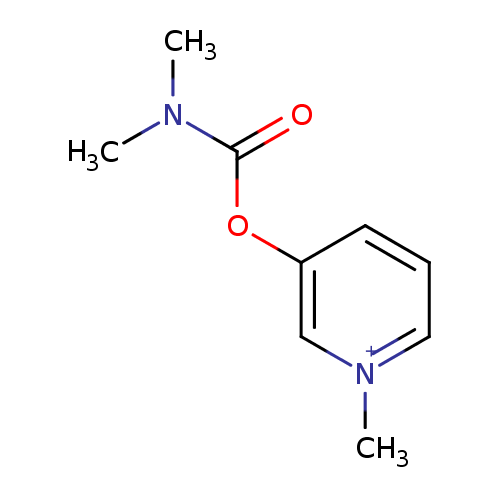
Common NamePyridostigmine
ClassSmall Molecule
DescriptionPyridostigmine is only found in individuals that have used or taken this drug. It is a cholinesterase inhibitor with a slightly longer duration of action than neostigmine. It is used in the treatment of myasthenia gravis and to reverse the actions of muscle relaxants. Pyridostigmine inhibits acetylcholinesterase in the synaptic cleft by competing with acetylcholine for attachment to acetylcholinesterase, thus slowing down the hydrolysis of acetylcholine, and thereby increases efficiency of cholinergic transmission in the neuromuscular junction and prolonges the effects of acetylcholine.
Contaminant Sources
  • HMDB Contaminants - Urine
  • STOFF IDENT Compounds
  • T3DB toxins
Contaminant Type
  • Amine
  • Antimyasthenic Agent
  • Cholinesterase Inhibitor
  • Drug
  • Ester
  • Human Neurotoxin
  • Metabolite
  • Organic Compound
  • Parasympathomimetic
  • Synthetic Compound
Chemical Structure
Thumb
Synonyms
ValueSource
MestinonHMDB
RegonolHMDB
Pyridine N-oxideHMDB
Pyridostigmine bromideHMDB
Pyridostigmine bromineHMDB
PyridostigminumHMDB
Bromide, pyridostigmineHMDB
Chemical FormulaC9H13N2O2
Average Molecular Mass181.212 g/mol
Monoisotopic Mass181.098 g/mol
CAS Registry Number155-97-5
IUPAC Name3-[(dimethylcarbamoyl)oxy]-1-methylpyridin-1-ium
Traditional Namepyridostigmine
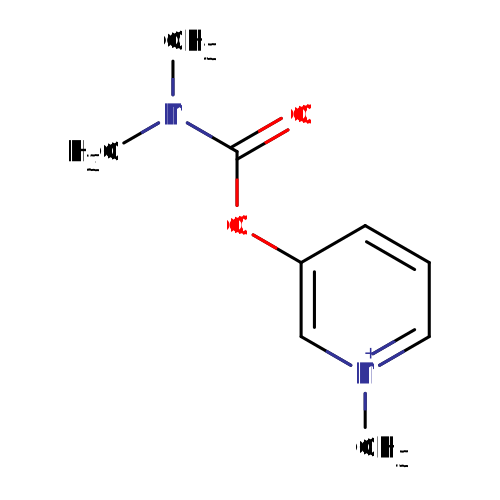
SMILESCN(C)C(=O)OC1=C[N+](C)=CC=C1
InChI IdentifierInChI=1S/C9H13N2O2/c1-10(2)9(12)13-8-5-4-6-11(3)7-8/h4-7H,1-3H3/q+1
InChI KeyRVOLLAQWKVFTGE-UHFFFAOYSA-N
Chemical Taxonomy
Description belongs to the class of organic compounds known as n-methylpyridinium compounds. These are methylpyridines that carry a methyl group at the 1-position.
KingdomOrganic compounds
Super ClassOrganoheterocyclic compounds
ClassPyridines and derivatives
Sub ClassMethylpyridines
Direct ParentN-methylpyridinium compounds
Alternative Parents
Substituents
  • N-methylpyridinium
  • Pyridinium
  • Carbamic acid ester
  • Heteroaromatic compound
  • Carbonic acid derivative
  • Azacycle
  • Organic oxide
  • Organopnictogen compound
  • Organic oxygen compound
  • Organooxygen compound
  • Organonitrogen compound
  • Organic nitrogen compound
  • Carbonyl group
  • Hydrocarbon derivative
  • Organic cation
  • Aromatic heteromonocyclic compound
Molecular FrameworkAromatic heteromonocyclic compounds
External Descriptors
Biological Properties
StatusDetected and Not Quantified
OriginExogenous
Cellular Locations
  • Cytoplasm
  • Membrane
Biofluid LocationsNot Available
Tissue Locations
  • Kidney
  • Liver
PathwaysNot Available
ApplicationsNot Available
Biological RolesNot Available
Chemical RolesNot Available
Physical Properties
StateSolid
AppearanceWhite powder.
Experimental Properties
PropertyValue
Melting Point153°C
Boiling PointNot Available
Solubility1.04e+00 g/L
Predicted Properties
PropertyValueSource
Water Solubility1.04 g/LALOGPS
logP-3.1ALOGPS
logP-3.5ChemAxon
logS-2.3ALOGPS
pKa (Strongest Acidic)19.53ChemAxon
Physiological Charge1ChemAxon
Hydrogen Acceptor Count1ChemAxon
Hydrogen Donor Count0ChemAxon
Polar Surface Area33.42 ŲChemAxon
Rotatable Bond Count2ChemAxon
Refractivity49.66 m³·mol⁻¹ChemAxon
Polarizability19.38 ųChemAxon
Number of Rings1ChemAxon
Bioavailability1ChemAxon
Rule of FiveYesChemAxon
Ghose FilterNoChemAxon
Veber's RuleYesChemAxon
MDDR-like RuleNoChemAxon
Spectra
Spectra
Spectrum TypeDescriptionSplash KeyView
Predicted GC-MSPredicted GC-MS Spectrum - GC-MS (Non-derivatized) - 70eV, Positivesplash10-0006-9700000000-144f11d8d4fca931e26fSpectrum
Predicted GC-MSPredicted GC-MS Spectrum - GC-MS (Non-derivatized) - 70eV, PositiveNot AvailableSpectrum
Predicted LC-MS/MSPredicted LC-MS/MS Spectrum - 10V, Positivesplash10-001i-4900000000-505a3902a67894832786Spectrum
Predicted LC-MS/MSPredicted LC-MS/MS Spectrum - 20V, Positivesplash10-001j-7900000000-f2fb1dbcea23a916a60dSpectrum
Predicted LC-MS/MSPredicted LC-MS/MS Spectrum - 40V, Positivesplash10-0005-9100000000-5851c472c0f98c9da49eSpectrum
Predicted LC-MS/MSPredicted LC-MS/MS Spectrum - 10V, Negativesplash10-001i-1900000000-4020266c0445cc9e4d81Spectrum
Predicted LC-MS/MSPredicted LC-MS/MS Spectrum - 20V, Negativesplash10-00lr-9700000000-76c2110cb7085d434fd7Spectrum
Predicted LC-MS/MSPredicted LC-MS/MS Spectrum - 40V, Negativesplash10-007c-9000000000-bf72b6b775960258441eSpectrum
Predicted LC-MS/MSPredicted LC-MS/MS Spectrum - 10V, Positivesplash10-03di-0900000000-7a79dd4b3f240ec6c301Spectrum
Predicted LC-MS/MSPredicted LC-MS/MS Spectrum - 20V, Positivesplash10-03ec-3900000000-f5675587ab409b8f06deSpectrum
Predicted LC-MS/MSPredicted LC-MS/MS Spectrum - 40V, Positivesplash10-0006-9000000000-d30ae42d6c1e66ffefe8Spectrum
1D NMR1H NMR SpectrumNot AvailableSpectrum
1D NMR13C NMR SpectrumNot AvailableSpectrum
1D NMR1H NMR SpectrumNot AvailableSpectrum
1D NMR13C NMR SpectrumNot AvailableSpectrum
1D NMR1H NMR SpectrumNot AvailableSpectrum
1D NMR13C NMR SpectrumNot AvailableSpectrum
1D NMR1H NMR SpectrumNot AvailableSpectrum
1D NMR13C NMR SpectrumNot AvailableSpectrum
1D NMR1H NMR SpectrumNot AvailableSpectrum
1D NMR13C NMR SpectrumNot AvailableSpectrum
1D NMR1H NMR SpectrumNot AvailableSpectrum
1D NMR13C NMR SpectrumNot AvailableSpectrum
1D NMR1H NMR SpectrumNot AvailableSpectrum
1D NMR13C NMR SpectrumNot AvailableSpectrum
1D NMR1H NMR SpectrumNot AvailableSpectrum
1D NMR13C NMR SpectrumNot AvailableSpectrum
1D NMR1H NMR SpectrumNot AvailableSpectrum
1D NMR13C NMR SpectrumNot AvailableSpectrum
1D NMR1H NMR SpectrumNot AvailableSpectrum
1D NMR13C NMR SpectrumNot AvailableSpectrum
Toxicity Profile
Route of ExposurePoorly absorbed from the GI tract with an oral bioavailability of 7.6 +/- 2.4%.
Mechanism of ToxicityPyridostigmine is a cholinesterase or acetylcholinesterase (AChE) inhibitor. A cholinesterase inhibitor (or 'anticholinesterase') suppresses the action of acetylcholinesterase. Because of its essential function, chemicals that interfere with the action of acetylcholinesterase are potent neurotoxins, causing excessive salivation and eye-watering in low doses, followed by muscle spasms and ultimately death. Nerve gases and many substances used in insecticides have been shown to act by binding a serine in the active site of acetylcholine esterase, inhibiting the enzyme completely. Acetylcholine esterase breaks down the neurotransmitter acetylcholine, which is released at nerve and muscle junctions, in order to allow the muscle or organ to relax. The result of acetylcholine esterase inhibition is that acetylcholine builds up and continues to act so that any nerve impulses are continually transmitted and muscle contractions do not stop. Among the most common acetylcholinesterase inhibitors are phosphorus-based compounds, which are designed to bind to the active site of the enzyme. The structural requirements are a phosphorus atom bearing two lipophilic groups, a leaving group (such as a halide or thiocyanate), and a terminal oxygen.
MetabolismHydrolysis by cholinesterases and by liver. Half Life: 3 hours following oral administration.
Toxicity ValuesNot Available
Lethal DoseNot Available
Carcinogenicity (IARC Classification)No indication of carcinogenicity to humans (not listed by IARC).
Uses/SourcesFor the treatment of myasthenia gravis.
Minimum Risk LevelNot Available
Health EffectsAcute exposure to cholinesterase inhibitors can cause a cholinergic crisis characterized by severe nausea/vomiting, salivation, sweating, bradycardia, hypotension, collapse, and convulsions. Increasing muscle weakness is a possibility and may result in death if respiratory muscles are involved. Accumulation of ACh at motor nerves causes overstimulation of nicotinic expression at the neuromuscular junction. When this occurs symptoms such as muscle weakness, fatigue, muscle cramps, fasciculation, and paralysis can be seen. When there is an accumulation of ACh at autonomic ganglia this causes overstimulation of nicotinic expression in the sympathetic system. Symptoms associated with this are hypertension, and hypoglycemia. Overstimulation of nicotinic acetylcholine receptors in the central nervous system, due to accumulation of ACh, results in anxiety, headache, convulsions, ataxia, depression of respiration and circulation, tremor, general weakness, and potentially coma. When there is expression of muscarinic overstimulation due to excess acetylcholine at muscarinic acetylcholine receptors symptoms of visual disturbances, tightness in chest, wheezing due to bronchoconstriction, increased bronchial secretions, increased salivation, lacrimation, sweating, peristalsis, and urination can occur. Certain reproductive effects in fertility, growth, and development for males and females have been linked specifically to organophosphate pesticide exposure. Most of the research on reproductive effects has been conducted on farmers working with pesticides and insecticdes in rural areas. In females menstrual cycle disturbances, longer pregnancies, spontaneous abortions, stillbirths, and some developmental effects in offspring have been linked to organophosphate pesticide exposure. Prenatal exposure has been linked to impaired fetal growth and development. Neurotoxic effects have also been linked to poisoning with OP pesticides causing four neurotoxic effects in humans: cholinergic syndrome, intermediate syndrome, organophosphate-induced delayed polyneuropathy (OPIDP), and chronic organophosphate-induced neuropsychiatric disorder (COPIND). These syndromes result after acute and chronic exposure to OP pesticides.
SymptomsSymptoms of low dose exposure include excessive salivation and eye-watering. Acute dose symptoms include severe nausea/vomiting, salivation, sweating, bradycardia, hypotension, collapse, and convulsions. Increasing muscle weakness is a possibility and may result in death if respiratory muscles are involved. Hypertension, hypoglycemia, anxiety, headache, tremor and ataxia may also result.
TreatmentIf the compound has been ingested, rapid gastric lavage should be performed using 5% sodium bicarbonate. For skin contact, the skin should be washed with soap and water. If the compound has entered the eyes, they should be washed with large quantities of isotonic saline or water. In serious cases, atropine and/or pralidoxime should be administered. Anti-cholinergic drugs work to counteract the effects of excess acetylcholine and reactivate AChE. Atropine can be used as an antidote in conjunction with pralidoxime or other pyridinium oximes (such as trimedoxime or obidoxime), though the use of '-oximes' has been found to be of no benefit, or possibly harmful, in at least two meta-analyses. Atropine is a muscarinic antagonist, and thus blocks the action of acetylcholine peripherally.

Concentrations
Not Available
DrugBank IDDB00545
HMDB IDHMDB0014685
FooDB IDNot Available
Phenol Explorer IDNot Available
KNApSAcK IDNot Available
BiGG IDNot Available
BioCyc IDNot Available
METLIN IDNot Available
PDB IDNot Available
Wikipedia LinkPyridostigmine
Chemspider ID4817
ChEBI ID257330
PubChem Compound ID4991
Kegg Compound IDC07410
YMDB IDNot Available
ECMDB IDNot Available
References
Synthesis Reference

Thomas Zich, “Preparation of substituted pyridine N-oxide compounds.” U.S. Patent US20040063957, issued April 01, 2004.

MSDSLink
General References
1. Singer W, Opfer-Gehrking TL, McPhee BR, Hilz MJ, Bharucha AE, Low PA: Acetylcholinesterase inhibition: a novel approach in the treatment of neurogenic orthostatic hypotension. J Neurol Neurosurg Psychiatry. 2003 Sep;74(9):1294-8.