Record Information
Version1.0
Creation Date2009-07-21 20:27:02 UTC
Update Date2026-05-14 16:40:30 UTC
Accession NumberCHEM002211
Identification
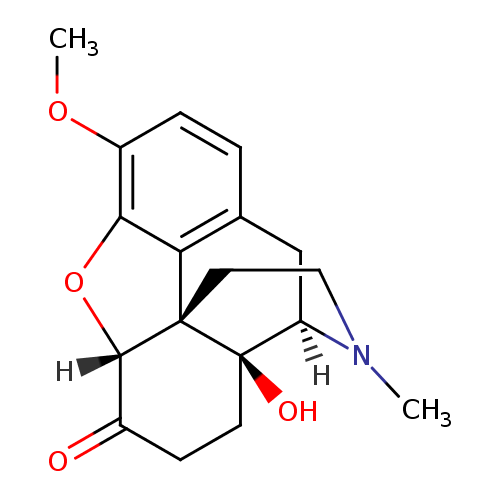
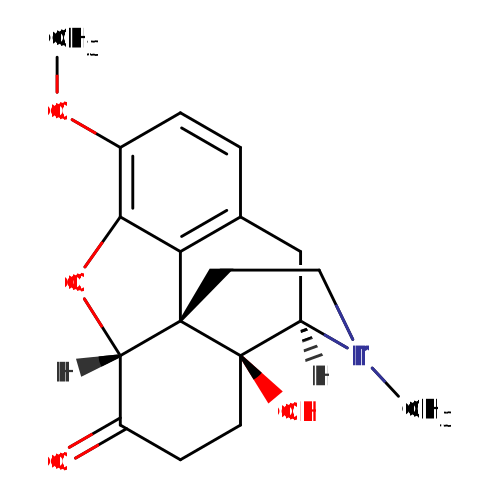
Common NameOxycodone
ClassSmall Molecule
DescriptionOxycodone is only found in individuals that have used or taken this drug. It is a semisynthetic derivative of codeine that acts as a narcotic analgesic more potent and addicting than codeine. Oxycodone acts as a weak agonist at mu, kappa, and delta opioid receptors within the central nervous system (CNS). Oxycodone primarily affects mu-type opioid receptors, which are coupled with G-protein receptors and function as modulators, both positive and negative, of synaptic transmission via G-proteins that activate effector proteins. Binding of the opiate stimulates the exchange of GTP for GDP on the G-protein complex. As the effector system is adenylate cyclase and cAMP located at the inner surface of the plasma membrane, opioids decrease intracellular cAMP by inhibiting adenylate cyclase. Subsequently, the release of nociceptive neurotransmitters such as substance P, GABA, dopamine, acetylcholine, and noradrenaline is inhibited. Opioids such as oxycodone also inhibit the release of vasopressin, somatostatin, insulin, and glucagon. Opioids close N-type voltage-operated calcium channels (kappa-receptor agonist) and open calcium-dependent inwardly rectifying potassium channels (mu and delta receptor agonist). This results in hyperpolarization and reduced neuronal excitability.
Contaminant Sources
  • HMDB Contaminants - Urine
  • STOFF IDENT Compounds
  • Suspected Compounds
  • T3DB toxins
Contaminant Type
  • Amine
  • Analgesic, Opioid
  • Antitussive Agent
  • Drug
  • Ether
  • Human Neurotoxin
  • Metabolite
  • Narcotic
  • Opiate Agonist
  • Organic Compound
  • Synthetic Compound
Chemical Structure
Thumb
Synonyms
ValueSource
(-)-14-HydroxydihydrocodeinoneChEBI
4,5-Epoxy-14-hydroxy-3-methoxy-17-methylmorphinan-6-oneChEBI
4,5alpha-Epoxy-14-hydroxy-3-methoxy-17-methylmorphinan-6-oneChEBI
Dihydro-14-hydroxycodeinoneChEBI
DihydrohydroxycodeinoneChEBI
DihydroxycodeinoneChEBI
OxicodonaChEBI
OxycodonumChEBI
4,5a-Epoxy-14-hydroxy-3-methoxy-17-methylmorphinan-6-oneGenerator
4,5Α-epoxy-14-hydroxy-3-methoxy-17-methylmorphinan-6-oneGenerator
DihydrohydroxycondeinoneHMDB
DihydroneHMDB
PTI-821HMDB
DinarkonHMDB
OxiconumHMDB
OxyconeHMDB
OxycontinHMDB
TheocodinHMDB
EucodalHMDB
OxycodeinonHMDB
Oxycodone hydrochlorideHMDB
PancodineHMDB
Purdue frederick brand OF oxycodoneHMDB
Chemical FormulaC18H21NO4
Average Molecular Mass315.364 g/mol
Monoisotopic Mass315.147 g/mol
CAS Registry Number76-42-6
IUPAC Name(1S,5R,13R,17S)-17-hydroxy-10-methoxy-4-methyl-12-oxa-4-azapentacyclo[9.6.1.0^{1,13}.0^{5,17}.0^{7,18}]octadeca-7(18),8,10-trien-14-one
Traditional Name(1S,5R,13R,17S)-17-hydroxy-10-methoxy-4-methyl-12-oxa-4-azapentacyclo[9.6.1.0^{1,13}.0^{5,17}.0^{7,18}]octadeca-7(18),8,10-trien-14-one
SMILES[H][C@@]12OC3=C(OC)C=CC4=C3[C@@]11CCN(C)[C@]([H])(C4)[C@]1(O)CCC2=O
InChI IdentifierInChI=1S/C18H21NO4/c1-19-8-7-17-14-10-3-4-12(22-2)15(14)23-16(17)11(20)5-6-18(17,21)13(19)9-10/h3-4,13,16,21H,5-9H2,1-2H3/t13-,16+,17+,18-/m1/s1
InChI KeyBRUQQQPBMZOVGD-XFKAJCMBSA-N
Chemical Taxonomy
Description belongs to the class of organic compounds known as phenanthrenes and derivatives. These are polycyclic compounds containing a phenanthrene moiety, which is a tricyclic aromatic compound with three non-linearly fused benzene.
KingdomOrganic compounds
Super ClassBenzenoids
ClassPhenanthrenes and derivatives
Sub ClassNot Available
Direct ParentPhenanthrenes and derivatives
Alternative Parents
Substituents
  • Phenanthrene
  • Isoquinolone
  • Tetralin
  • Coumaran
  • Anisole
  • Alkyl aryl ether
  • Aralkylamine
  • Piperidine
  • Cyclic alcohol
  • Tertiary alcohol
  • Tertiary aliphatic amine
  • Tertiary amine
  • 1,2-aminoalcohol
  • Ketone
  • Oxacycle
  • Azacycle
  • Organoheterocyclic compound
  • Ether
  • Alcohol
  • Organonitrogen compound
  • Organopnictogen compound
  • Organooxygen compound
  • Organic oxide
  • Carbonyl group
  • Organic oxygen compound
  • Amine
  • Organic nitrogen compound
  • Hydrocarbon derivative
  • Aromatic heteropolycyclic compound
Molecular FrameworkAromatic heteropolycyclic compounds
External Descriptors
Biological Properties
StatusDetected and Not Quantified
OriginExogenous
Cellular Locations
  • Cytoplasm
  • Extracellular
  • Membrane
Biofluid LocationsNot Available
Tissue LocationsNot Available
PathwaysNot Available
Applications
Biological Roles
Chemical RolesNot Available
Physical Properties
StateSolid
AppearanceWhite powder.
Experimental Properties
PropertyValue
Melting Point219°C
Boiling PointNot Available
Solubility100 mg/ml
Predicted Properties
PropertyValueSource
Water Solubility5.59 g/LALOGPS
logP1.04ALOGPS
logP1.03ChemAxon
logS-1.8ALOGPS
pKa (Strongest Acidic)13.56ChemAxon
pKa (Strongest Basic)8.21ChemAxon
Physiological Charge1ChemAxon
Hydrogen Acceptor Count5ChemAxon
Hydrogen Donor Count1ChemAxon
Polar Surface Area59 ŲChemAxon
Rotatable Bond Count1ChemAxon
Refractivity84.04 m³·mol⁻¹ChemAxon
Polarizability32.79 ųChemAxon
Number of Rings5ChemAxon
Bioavailability1ChemAxon
Rule of FiveYesChemAxon
Ghose FilterYesChemAxon
Veber's RuleNoChemAxon
MDDR-like RuleNoChemAxon
Spectra
Spectra
Spectrum TypeDescriptionSplash KeyView
Predicted GC-MSPredicted GC-MS Spectrum - GC-MS (Non-derivatized) - 70eV, Positivesplash10-0a4i-9061000000-5297e69aa2cc5152068fSpectrum
Predicted GC-MSPredicted GC-MS Spectrum - GC-MS (1 TMS) - 70eV, Positivesplash10-00fr-9538000000-1b9bf2a9c0682b6738c4Spectrum
Predicted GC-MSPredicted GC-MS Spectrum - GC-MS (Non-derivatized) - 70eV, PositiveNot AvailableSpectrum
Predicted GC-MSPredicted GC-MS Spectrum - GC-MS (TBDMS_1_1) - 70eV, PositiveNot AvailableSpectrum
Predicted GC-MSPredicted GC-MS Spectrum - GC-MS ("Oxycodone,1TMS,#1" TMS) - 70eV, PositiveNot AvailableSpectrum
LC-MS/MSLC-MS/MS Spectrum - LC-ESI-QTOF , positivesplash10-014i-0009000000-d55749fa4d1f47ce2244Spectrum
LC-MS/MSLC-MS/MS Spectrum - LC-ESI-QTOF , positivesplash10-00kb-0095000000-83c78e9e15857145cc78Spectrum
LC-MS/MSLC-MS/MS Spectrum - LC-ESI-QTOF , positivesplash10-0002-0090000000-ad908ecfa38c7efce138Spectrum
LC-MS/MSLC-MS/MS Spectrum - LC-ESI-QTOF , positivesplash10-0006-0390000000-88d302b8770cb7121937Spectrum
LC-MS/MSLC-MS/MS Spectrum - LC-ESI-QTOF , positivesplash10-03fu-0790000000-4af50b834ee854320001Spectrum
LC-MS/MSLC-MS/MS Spectrum - 10V, Positivesplash10-014i-0009000000-60bc25dea256a8ba83bbSpectrum
LC-MS/MSLC-MS/MS Spectrum - 30V, Positivesplash10-0002-0090000000-fccf9384aae73d4c8009Spectrum
LC-MS/MSLC-MS/MS Spectrum - 50V, Positivesplash10-03fu-0790000000-7931a551d5483e7067a3Spectrum
LC-MS/MSLC-MS/MS Spectrum - 50V, Positivesplash10-03fu-0690000000-3d8d447a366cdf1fdb74Spectrum
LC-MS/MSLC-MS/MS Spectrum - 20V, Positivesplash10-00kb-0096000000-55405b387941a889b750Spectrum
LC-MS/MSLC-MS/MS Spectrum - 40V, Positivesplash10-0006-0390000000-1f6f5ca02d934d0d4537Spectrum
LC-MS/MSLC-MS/MS Spectrum - 35V, Positivesplash10-0002-0093000000-a61df116baabe44f4c3aSpectrum
LC-MS/MSLC-MS/MS Spectrum - 50V, Positivesplash10-03fu-0690000000-7dc7939fd86861c02ab4Spectrum
LC-MS/MSLC-MS/MS Spectrum - 40V, Positivesplash10-0006-0390000000-fff1638b31b7719ed170Spectrum
LC-MS/MSLC-MS/MS Spectrum - 10V, Positivesplash10-014i-0009000000-377e0e430e1a242d1475Spectrum
LC-MS/MSLC-MS/MS Spectrum - 20V, Positivesplash10-00kb-0095000000-f6e8b2a3a26565536bcbSpectrum
LC-MS/MSLC-MS/MS Spectrum - 40V, Positivesplash10-0006-0390000000-97492063e89cfb7228d2Spectrum
LC-MS/MSLC-MS/MS Spectrum - 50V, Positivesplash10-03fu-0690000000-f855a40fc07061c8e49aSpectrum
LC-MS/MSLC-MS/MS Spectrum - 30V, Positivesplash10-0002-0090000000-e6d1bf0cfddfd668c1e7Spectrum
Predicted LC-MS/MSPredicted LC-MS/MS Spectrum - 10V, Positivesplash10-00kb-0095000000-187a15135033fe090084Spectrum
Predicted LC-MS/MSPredicted LC-MS/MS Spectrum - 20V, Positivesplash10-0002-1091000000-36b41da08ca2b913a212Spectrum
Predicted LC-MS/MSPredicted LC-MS/MS Spectrum - 40V, Positivesplash10-0a5c-5090000000-a251627d2dc7a2e0750cSpectrum
Predicted LC-MS/MSPredicted LC-MS/MS Spectrum - 10V, Negativesplash10-03di-0029000000-9ffd2b473cfe2ec06b32Spectrum
Predicted LC-MS/MSPredicted LC-MS/MS Spectrum - 20V, Negativesplash10-01ot-1096000000-a01cf940a0da1fca0ffdSpectrum
Predicted LC-MS/MSPredicted LC-MS/MS Spectrum - 40V, Negativesplash10-052g-2090000000-da3286e89dfed1ee6a32Spectrum
MSMass Spectrum (Electron Ionization)splash10-014i-6975000000-ecd49efa58246c903e23Spectrum
1D NMR1H NMR SpectrumNot AvailableSpectrum
1D NMR13C NMR SpectrumNot AvailableSpectrum
1D NMR1H NMR SpectrumNot AvailableSpectrum
1D NMR13C NMR SpectrumNot AvailableSpectrum
1D NMR1H NMR SpectrumNot AvailableSpectrum
1D NMR13C NMR SpectrumNot AvailableSpectrum
1D NMR1H NMR SpectrumNot AvailableSpectrum
1D NMR13C NMR SpectrumNot AvailableSpectrum
1D NMR1H NMR SpectrumNot AvailableSpectrum
1D NMR13C NMR SpectrumNot AvailableSpectrum
1D NMR1H NMR SpectrumNot AvailableSpectrum
1D NMR13C NMR SpectrumNot AvailableSpectrum
1D NMR1H NMR SpectrumNot AvailableSpectrum
1D NMR13C NMR SpectrumNot AvailableSpectrum
1D NMR1H NMR SpectrumNot AvailableSpectrum
1D NMR13C NMR SpectrumNot AvailableSpectrum
1D NMR1H NMR SpectrumNot AvailableSpectrum
1D NMR13C NMR SpectrumNot AvailableSpectrum
1D NMR1H NMR SpectrumNot AvailableSpectrum
1D NMR13C NMR SpectrumNot AvailableSpectrum
Toxicity Profile
Route of ExposureOral; enteral (rectal). Well absorbed with an oral bioavailability of 60% to 87%
Mechanism of ToxicityOxycodone acts as a weak agonist at mu, kappa, and delta opioid receptors within the central nervous system (CNS). Oxycodone primarily affects mu-type opioid receptors, which are coupled with G-protein receptors and function as modulators, both positive and negative, of synaptic transmission via G-proteins that activate effector proteins. Binding of the opiate stimulates the exchange of GTP for GDP on the G-protein complex. As the effector system is adenylate cyclase and cAMP located at the inner surface of the plasma membrane, opioids decrease intracellular cAMP by inhibiting adenylate cyclase. Subsequently, the release of nociceptive neurotransmitters such as substance P, GABA, dopamine, acetylcholine, and noradrenaline is inhibited. Opioids such as oxycodone also inhibit the release of vasopressin, somatostatin, insulin, and glucagon. Opioids close N-type voltage-operated calcium channels (kappa-receptor agonist) and open calcium-dependent inwardly rectifying potassium channels (mu and delta receptor agonist). This results in hyperpolarization and reduced neuronal excitability.
MetabolismHepatic Route of Elimination: Oxycodone and its metabolites are excreted primarily via the kidney. Half Life: 4.5 hours
Toxicity ValuesNot Available
Lethal DoseNot Available
Carcinogenicity (IARC Classification)No indication of carcinogenicity to humans (not listed by IARC).
Uses/SourcesFor the treatment of diarrhoea, pulmonary oedema and for the relief of moderate to moderately severe pain.
Minimum Risk LevelNot Available
Health EffectsMedical problems can include congested lungs, liver disease, tetanus, infection of the heart valves, skin abscesses, anemia and pneumonia. Death can occur from overdose.
SymptomsSymptoms of overdose include respiratory depression, somnolence progressing to stupor or coma, skeletal muscle flaccidity, cold and clammy skin, constricted pupils, bradycardia, hypotension, and death.
TreatmentTo treat Oxycodone overdose, primary attention should be given to the reestablishment of a patent airway and institution of assisted or controlled ventilation. Supportive measures (including oxygen and vasopressors) should be employed in the management of circulatory shock and pulmonary edema accompanying overdose as indicated. Cardiac arrest or arrhythmias may require cardiac massage or defibrillation. The narcotic antagonists, naloxone or nalmefene, are specific antidotes for opioid overdose. Opioid antagonists should not be administered in the absence of clinically significant respiratory or circulatory depression secondary to Oxycodone overdose. If needed the appropriate dose of naloxone hydrochloride or nalmefene should be administered simultaneously with efforts at respiratory resuscitation (see package insert for each drug for the details). Since the duration of action of oxycodone may exceed that of the antagonist, the patient should be kept under continued surveillance and repeated doses of the antagonist should be administered as needed to maintain adequate respiration. Gastric emptying may be useful in removing unabsorbed drug. (4)
Concentrations
Not Available
DrugBank IDDB00497
HMDB IDHMDB0014640
FooDB IDNot Available
Phenol Explorer IDNot Available
KNApSAcK IDNot Available
BiGG IDNot Available
BioCyc IDNot Available
METLIN IDNot Available
PDB IDNot Available
Wikipedia LinkOxycodone
Chemspider ID4447649
ChEBI ID7852
PubChem Compound ID5284603
Kegg Compound IDC08018
YMDB IDNot Available
ECMDB IDNot Available
References
Synthesis Reference

Bao-Shan Huang, Yansong Lu, Ben-Yi Ji, Aris P Christodoulou, “Preparation of oxycodone from codeine.” U.S. Patent US6008355, issued March, 1990.

MSDSLink
General References
1. https://www.ncbi.nlm.nih.gov/pubmed/?term=27093887
2. https://www.ncbi.nlm.nih.gov/pubmed/?term=27873179
3. https://www.ncbi.nlm.nih.gov/pubmed/?term=27921252
4. https://www.ncbi.nlm.nih.gov/pubmed/?term=28074831
5. https://www.ncbi.nlm.nih.gov/pubmed/?term=28080998
6. https://www.ncbi.nlm.nih.gov/pubmed/?term=28107783
7. https://www.ncbi.nlm.nih.gov/pubmed/?term=28127624
8. https://www.ncbi.nlm.nih.gov/pubmed/?term=28170358
9. https://www.ncbi.nlm.nih.gov/pubmed/?term=28194654
10. https://www.ncbi.nlm.nih.gov/pubmed/?term=28205004
11. Ordonez Gallego A, Gonzalez Baron M, Espinosa Arranz E: Oxycodone: a pharmacological and clinical review. Clin Transl Oncol. 2007 May;9(5):298-307.
12. Riley J, Eisenberg E, Muller-Schwefe G, Drewes AM, Arendt-Nielsen L: Oxycodone: a review of its use in the management of pain. Curr Med Res Opin. 2008 Jan;24(1):175-92.