Record Information
Version1.0
Creation Date2009-07-21 20:26:58 UTC
Update Date2026-05-14 16:39:44 UTC
Accession NumberCHEM002202
Identification
Common NameQuinine
ClassSmall Molecule
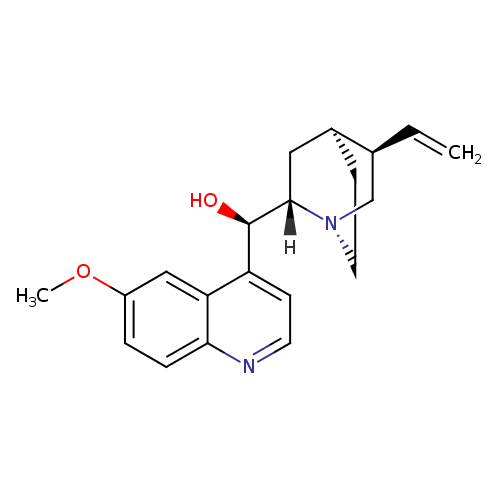
DescriptionQuinine is an alkaloid derived from the bark of the cinchona tree. It is used as an antimalarial drug, and is the active ingredient in extracts of the cinchona that have been used for that purpose since before 1633. Quinine is also a mild antipyretic and analgesic and has been used in common cold preparations for that purpose. It was used commonly and as a bitter and flavoring agent, and is still useful for the treatment of babesiosis. Quinine is also useful in some muscular disorders, especially nocturnal leg cramps and myotonia congenita, because of its direct effects on muscle membrane and sodium channels. The mechanisms of its antimalarial effects are not well understood.
Contaminant Sources
  • EAFUS Chemicals
  • FooDB Chemicals
  • HMDB Contaminants - Urine
  • STOFF IDENT Compounds
  • T3DB toxins
  • ToxCast & Tox21 Chemicals
Contaminant Type
  • Amine
  • Analgesic, Non-Narcotic
  • Antimalarial
  • Drug
  • Ether
  • Food Toxin
  • Metabolite
  • Muscle Relaxant, Central
  • Natural Compound
  • Organic Compound
  • Plant Toxin
Chemical Structure
Thumb
Synonyms
ValueSource
(-)-QuinineChEBI
(8S,9R)-QuinineChEBI
(R)-(-)-QuinineChEBI
(R)-(6-Methoxyquinolin-4-yl)((2S,4S,8R)-8-vinylquinuclidin-2-yl)methanolChEBI
6'-MethoxycinchonidineChEBI
ChininChEBI
ChinineChEBI
ChininumChEBI
QuininaChEBI
MyoquinMeSH
SurquinaMeSH
BiquinateMeSH
QuinimaxMeSH
Quinine bisulfateMeSH
Quinine sulfateMeSH
QuinoctalMeSH
QuinsonMeSH
QuinsulMeSH
Bisulfate, quinineMeSH
Hydrochloride, quinineMeSH
LegatrimMeSH
QuinammMeSH
QuinbisanMeSH
QuinbisulMeSH
Quinine lafranMeSH
Quinine sulphateMeSH
Quinine-odanMeSH
Sulfate, quinineMeSH
Sulphate, quinineMeSH
QuindanMeSH
Quinine hydrochlorideMeSH
StremaMeSH
6'-MethoxycinchonineHMDB
Quinine, anhydrousHMDB
QuinineanhydrousHMDB
Quinoline alkaloidHMDB
Aventis brand OF quinine bisulfateMeSH, HMDB
Fawns and mcallan brand OF quinine sulfateMeSH, HMDB
Foy brand OF quinine sulfateMeSH, HMDB
Plough brand OF quinine sulfateMeSH, HMDB
Fawns and mcallan brand OF quinine bisulfateMeSH, HMDB
Hoechst brand OF quinine sulfateMeSH, HMDB
Lafran brand OF quinine hydrochlorideMeSH, HMDB
Alphapharm brand OF quinine sulfateMeSH, HMDB
Innotech brand OF quinine hydrochlorideMeSH, HMDB
Odan brand OF quinine sulfateMeSH, HMDB
Prosana brand OF quinine bisulfateMeSH, HMDB
Chemical FormulaC20H24N2O2
Average Molecular Mass324.417 g/mol
Monoisotopic Mass324.184 g/mol
CAS Registry Number130-95-0
IUPAC Name(R)-[(1S,2S,4S,5R)-5-ethenyl-1-azabicyclo[2.2.2]octan-2-yl](6-methoxyquinolin-4-yl)methanol
Traditional Namequinine
SMILES[H][C@]1(C[C@@H]2CC[N@]1C[C@@H]2C=C)[C@H](O)C1=CC=NC2=CC=C(OC)C=C12
InChI IdentifierInChI=1S/C20H24N2O2/c1-3-13-12-22-9-7-14(13)10-19(22)20(23)16-6-8-21-18-5-4-15(24-2)11-17(16)18/h3-6,8,11,13-14,19-20,23H,1,7,9-10,12H2,2H3/t13-,14-,19-,20+/m0/s1
InChI KeyLOUPRKONTZGTKE-WZBLMQSHSA-N
Chemical Taxonomy
Description belongs to the class of organic compounds known as cinchona alkaloids. These are alkaloids structurally characterized by the presence of the cinchonan skeleton, which consists of a quinoline linked to an azabicyclo[2.2.2]octane moiety.
KingdomOrganic compounds
Super ClassAlkaloids and derivatives
ClassCinchona alkaloids
Sub ClassNot Available
Direct ParentCinchona alkaloids
Alternative Parents
Substituents
  • Cinchonan-skeleton
  • 4-quinolinemethanol
  • Quinoline
  • Anisole
  • Quinuclidine
  • Alkyl aryl ether
  • Aralkylamine
  • Piperidine
  • Pyridine
  • Benzenoid
  • Heteroaromatic compound
  • 1,2-aminoalcohol
  • Tertiary aliphatic amine
  • Tertiary amine
  • Secondary alcohol
  • Ether
  • Azacycle
  • Organoheterocyclic compound
  • Organooxygen compound
  • Organonitrogen compound
  • Organic nitrogen compound
  • Hydrocarbon derivative
  • Organopnictogen compound
  • Amine
  • Alcohol
  • Organic oxygen compound
  • Aromatic alcohol
  • Aromatic heteropolycyclic compound
Molecular FrameworkAromatic heteropolycyclic compounds
External Descriptors
Biological Properties
StatusDetected and Not Quantified
OriginExogenous
Cellular Locations
  • Membrane
Biofluid LocationsNot Available
Tissue LocationsNot Available
PathwaysNot Available
Applications
Biological Roles
Chemical RolesNot Available
Physical Properties
StateSolid
AppearanceWhite powder.
Experimental Properties
PropertyValue
Melting Point57°C
Boiling PointNot Available
Solubility500 mg/L (at 15°C)
Predicted Properties
PropertyValueSource
Water Solubility0.33 g/LALOGPS
logP2.82ALOGPS
logP2.51ChemAxon
logS-3ALOGPS
pKa (Strongest Acidic)13.89ChemAxon
pKa (Strongest Basic)9.05ChemAxon
Physiological Charge1ChemAxon
Hydrogen Acceptor Count4ChemAxon
Hydrogen Donor Count1ChemAxon
Polar Surface Area45.59 ŲChemAxon
Rotatable Bond Count4ChemAxon
Refractivity94.69 m³·mol⁻¹ChemAxon
Polarizability35.96 ųChemAxon
Number of Rings4ChemAxon
Bioavailability1ChemAxon
Rule of FiveYesChemAxon
Ghose FilterYesChemAxon
Veber's RuleNoChemAxon
MDDR-like RuleNoChemAxon
Spectra
Spectra
Spectrum TypeDescriptionSplash KeyView
Predicted GC-MSPredicted GC-MS Spectrum - GC-MS (Non-derivatized) - 70eV, Positivesplash10-0a4r-1901000000-8176add5a84f7ae1eb69Spectrum
Predicted GC-MSPredicted GC-MS Spectrum - GC-MS (1 TMS) - 70eV, Positivesplash10-05g0-7947000000-ee233460f7e7fbb00ca7Spectrum
Predicted GC-MSPredicted GC-MS Spectrum - GC-MS (Non-derivatized) - 70eV, PositiveNot AvailableSpectrum
LC-MS/MSLC-MS/MS Spectrum - 60V, Positivesplash10-00ai-7930000000-eb63f68d11153566b027Spectrum
LC-MS/MSLC-MS/MS Spectrum - 75V, Positivesplash10-00c0-7910000000-c0d16dda8d8a74dd1657Spectrum
LC-MS/MSLC-MS/MS Spectrum - 45V, Positivesplash10-0059-5945000000-dff1a74853685996f965Spectrum
LC-MS/MSLC-MS/MS Spectrum - 15V, Positivesplash10-004i-0009000000-4cf6c66b2059468cd1e3Spectrum
LC-MS/MSLC-MS/MS Spectrum - 30V, Positivesplash10-004i-0009000000-d4367d77a81731ba3654Spectrum
LC-MS/MSLC-MS/MS Spectrum - 60V, Positivesplash10-00ai-7930000000-94e16a407d113a547240Spectrum
LC-MS/MSLC-MS/MS Spectrum - 45V, Positivesplash10-0059-5945000000-ddc4f19918fbae8ffe0cSpectrum
LC-MS/MSLC-MS/MS Spectrum - 90V, Positivesplash10-0fc0-6900000000-8bb456f41e7cb82dfcf9Spectrum
LC-MS/MSLC-MS/MS Spectrum - 90V, Positivesplash10-0fc0-6900000000-f458cccf839df1d5239bSpectrum
LC-MS/MSLC-MS/MS Spectrum - 75V, Positivesplash10-00c0-7910000000-4b620f5ca762298602e7Spectrum
Predicted LC-MS/MSPredicted LC-MS/MS Spectrum - 10V, Positivesplash10-0a6r-0019000000-0f42379f2989cf204f72Spectrum
Predicted LC-MS/MSPredicted LC-MS/MS Spectrum - 20V, Positivesplash10-0a4r-0729000000-5a0d8aa890e6c737bf45Spectrum
Predicted LC-MS/MSPredicted LC-MS/MS Spectrum - 40V, Positivesplash10-0079-0920000000-70e4fed1a61c38cf53fbSpectrum
Predicted LC-MS/MSPredicted LC-MS/MS Spectrum - 10V, Negativesplash10-00di-0109000000-e84ce15e838ff8ac33f6Spectrum
Predicted LC-MS/MSPredicted LC-MS/MS Spectrum - 20V, Negativesplash10-05fr-0229000000-b87ca7a53d952af7505eSpectrum
Predicted LC-MS/MSPredicted LC-MS/MS Spectrum - 40V, Negativesplash10-0540-0920000000-12d8977ce43e168f8453Spectrum
Predicted LC-MS/MSPredicted LC-MS/MS Spectrum - 10V, Positivesplash10-004i-0009000000-2125f5c1412244f91fb3Spectrum
Predicted LC-MS/MSPredicted LC-MS/MS Spectrum - 20V, Positivesplash10-004i-0109000000-1096d980c779fca1eb3fSpectrum
Predicted LC-MS/MSPredicted LC-MS/MS Spectrum - 40V, Positivesplash10-00dr-0920000000-468db2e8e8941541468cSpectrum
Predicted LC-MS/MSPredicted LC-MS/MS Spectrum - 10V, Negativesplash10-00di-0019000000-9c5f7ffbd0d69038e6daSpectrum
Predicted LC-MS/MSPredicted LC-MS/MS Spectrum - 20V, Negativesplash10-0abi-0914000000-92707d10764c62ebe320Spectrum
Predicted LC-MS/MSPredicted LC-MS/MS Spectrum - 40V, Negativesplash10-0a4i-0900000000-9e1ce60a980eb9551f33Spectrum
Toxicity Profile
Route of ExposureOral
Mechanism of ToxicityThe theorized mechanism of action for quinine and related anti-malarial drugs is that these drugs are toxic to the malaria parasite. Specifically, the drugs interfere with the parasite's ability to break down and digest hemoglobin. Consequently, the parasite starves and/or builds up toxic levels of partially degraded hemoglobin in itself.
MetabolismHepatic, over 80% metabolized by the liver. Route of Elimination: Quinine is eliminated primarily via hepatic biotransformation. Approximately 20% of quinine is excreted unchanged in urine. Half Life: Approximately 18 hours
Toxicity ValuesNot Available
Lethal DoseNot Available
Carcinogenicity (IARC Classification)No indication of carcinogenicity to humans (not listed by IARC).
Uses/SourcesFor the treatment of malaria and leg cramps. Used as an antipyretic (fever-reducing), antimalarial, analgesic (painkilling), and anti-inflammatory. It is also used as a flavor component of tonic water and bitter lemon.
Minimum Risk LevelNot Available
Health EffectsIt is usual for quinine in therapeutic doses to cause cinchonism; in rare cases, it may even cause death (usually by pulmonary edema). Quinine can worsen hemoglobinuria, myasthenia gravis and optic neuritis. It can cause paralysis if accidentally injected into a nerve, and is extremely toxic in overdose[Wikipedia]
SymptomsFever, rarely hypotension. [wikipedia]
TreatmentNot Available
Concentrations
Not Available
DrugBank IDDB00468
HMDB IDHMDB0014611
FooDB IDFDB002087
Phenol Explorer IDNot Available
KNApSAcK IDC00002193
BiGG IDNot Available
BioCyc IDNot Available
METLIN IDNot Available
PDB IDNot Available
Wikipedia LinkQuinine
Chemspider ID84989
ChEBI ID15854
PubChem Compound ID3034034
Kegg Compound IDC06526
YMDB IDNot Available
ECMDB IDNot Available
References
Synthesis Reference

Tong Sun, Shawn Watson, Wei Lai, Stephan D. Parent, “QUININE SULFATE/BISULFATE SOLID COMPLEX; METHODS OF MAKING; AND METHODS OF USE THEREOF.” U.S. Patent US20090326005, issued December 31, 2009.

MSDSLink
General References
1. https://www.ncbi.nlm.nih.gov/pubmed/?term=10821711
2. https://www.ncbi.nlm.nih.gov/pubmed/?term=10891117
3. https://www.ncbi.nlm.nih.gov/pubmed/?term=10937718
4. https://www.ncbi.nlm.nih.gov/pubmed/?term=11212126
5. https://www.ncbi.nlm.nih.gov/pubmed/?term=11549443
6. https://www.ncbi.nlm.nih.gov/pubmed/?term=11728183
7. https://www.ncbi.nlm.nih.gov/pubmed/?term=11844668
8. https://www.ncbi.nlm.nih.gov/pubmed/?term=11855978
9. https://www.ncbi.nlm.nih.gov/pubmed/?term=12127529
10. https://www.ncbi.nlm.nih.gov/pubmed/?term=12213073
11. https://www.ncbi.nlm.nih.gov/pubmed/?term=12217353
12. https://www.ncbi.nlm.nih.gov/pubmed/?term=12477351
13. https://www.ncbi.nlm.nih.gov/pubmed/?term=12502361
14. https://www.ncbi.nlm.nih.gov/pubmed/?term=12798326
15. https://www.ncbi.nlm.nih.gov/pubmed/?term=12873511
16. https://www.ncbi.nlm.nih.gov/pubmed/?term=14761192
17. https://www.ncbi.nlm.nih.gov/pubmed/?term=15026051
18. https://www.ncbi.nlm.nih.gov/pubmed/?term=15027870
19. https://www.ncbi.nlm.nih.gov/pubmed/?term=15225721
20. https://www.ncbi.nlm.nih.gov/pubmed/?term=15857133
21. https://www.ncbi.nlm.nih.gov/pubmed/?term=16524728
22. https://www.ncbi.nlm.nih.gov/pubmed/?term=16933872
23. https://www.ncbi.nlm.nih.gov/pubmed/?term=17482816
24. https://www.ncbi.nlm.nih.gov/pubmed/?term=17506538
25. https://www.ncbi.nlm.nih.gov/pubmed/?term=17570664
26. https://www.ncbi.nlm.nih.gov/pubmed/?term=17850126
27. https://www.ncbi.nlm.nih.gov/pubmed/?term=18348514
28. https://www.ncbi.nlm.nih.gov/pubmed/?term=18788725
29. https://www.ncbi.nlm.nih.gov/pubmed/?term=2579237
30. https://www.ncbi.nlm.nih.gov/pubmed/?term=2657065
31. https://www.ncbi.nlm.nih.gov/pubmed/?term=7009867
32. https://www.ncbi.nlm.nih.gov/pubmed/?term=8182707
33. Paintaud G, Alvan G, Berninger E, Gustafsson LL, Idrizbegovic E, Karlsson KK, Wakelkamp M: The concentration-effect relationship of quinine-induced hearing impairment. Clin Pharmacol Ther. 1994 Mar;55(3):317-23.