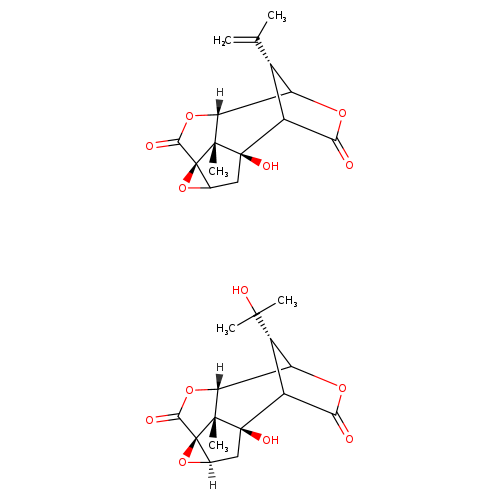
Picrotoxin is an exogenous solid with the chemical formula C30H34O13. Picrotoxin belongs to the furopyrans, a class of organoheterocyclic compounds within the organic compounds. With an average molecular weight of 602.58 g/mol, Picrotoxin is a heavy molecule.
This compound acts as a noncompetitive antagonist at GABA-A receptors and serves as a convulsant. It blocks the gamma-aminobutyric acid-activated chloride ionophore. Picrotoxin antagonizes the GABAA receptor channel directly, which is a ligand-gated ion channel concerned chiefly with the passing of chloride ions across the cell membrane; consequently, it prevents Cl- channel permeability and promotes an inhibitory influence on the target neuron. It reduces conductance through the channel by reducing the mean open time and the opening frequency. Additionally, picrotoxin antagonizes GABAC receptors (also called GABAA-rho receptors). Recorded protein targets include GABRA1, GABRR1, GLRA1, GLRA2, and GLRA3. While primarily used as a research tool, it has been used as an antidote in poisoning by CNS depressants, especially barbiturates, and as a CNS stimulant.
belongs to the class of organic compounds known as furopyrans. These are organic polycyclic compounds containing a furan ring fused to a pyran ring. Furan is a five-membered aromatic ring with four carbon atoms and one oxygen atom. Pyran a six-membered heterocyclic, non-aromatic ring, made up of five carbon atoms and one oxygen atom and containing two double bonds.
Picrotoxin antagonizes the GABAA receptor channel directly, which is a ligand-gated ion channel concerned chiefly with the passing of chloride ions across the cell membrane. Therefore picrotoxin prevents Cl- channel permeability and thus promtes an inhibitory influence on the target neuron. Picrotoxin reduces conductance through the channel by reducing not only the opening frequency but also the mean open time. Picrotoxin also antagonizes GABAC receptors (also called GABAA-rho receptors) but the result of this action is not known. The GABAC receptor is also linked to chloride channels, with distinct physiological and pharmacological properties. In contrast to the fast and transient responses elicited from GABAA receptors, GABAC receptors mediate slow and sustained responses.
No indication of carcinogenicity to humans (not listed by IARC).
Uses/Sources
Used internally for relieving respiratory distress. Also for use as an antidote in poisoning by CNS depressants, especially barbiturates.
Minimum Risk Level
Not Available
Health Effects
Using large amounts of these drugs can result in a condition known as amphetamine psychosis -- which can result in auditory, visual and tactile hallucinations, intense paranoia, irrational thoughts and beliefs, delusions, and mental confusion. Using large amounts of these drugs can result in a condition known as amphetamine psychosis -- which can result in auditory, visual and tactile hallucinations, intense paranoia, irrational thoughts and beliefs, delusions, and mental confusion.
Symptoms
In large doses it is a powerful poison, causing unconsciousness, delirium, convulsions, gastro-enteritis and stimulation of the respiratory centre followed by paralysis, from which death sometimes results.