Record Information
Version1.0
Creation Date2009-07-21 20:26:54 UTC
Update Date2026-04-05 11:52:10 UTC
Accession NumberCHEM002196
Identification
Common NameEpirubicin
ClassSmall Molecule
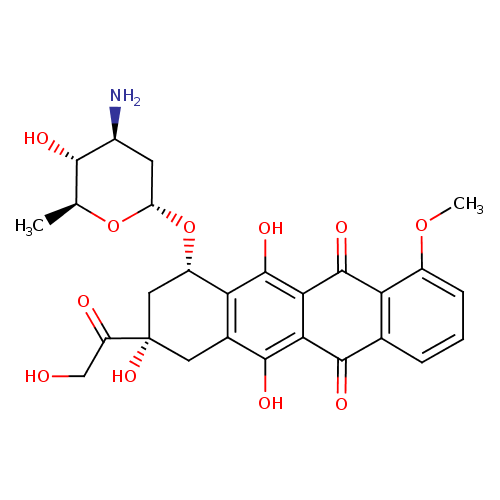
DescriptionEpirubicin is only found in individuals that have used or taken this drug. It is an anthracycline which is the 4'-epi-isomer of doxorubicin. The compound exerts its antitumor effects by interference with the synthesis and function of DNA. Epirubicin has antimitotic and cytotoxic activity. It inhibits nucleic acid (DNA and RNA) and protein synthesis through a number of proposed mechanisms of action: Epirubicin forms complexes with DNA by intercalation between base pairs, and it inhibits topoisomerase II activity by stabilizing the DNA-topoisomerase II complex, preventing the religation portion of the ligation-religation reaction that topoisomerase II catalyzes. It also interferes with DNA replication and transcription by inhibiting DNA helicase activity.
Contaminant Sources
  • HMDB Contaminants - Urine
  • STOFF IDENT Compounds
  • T3DB toxins
Contaminant Type
  • Amine
  • Antibiotic, Antineoplastic
  • Antineoplastic Agent
  • Drug
  • Ester
  • Ether
  • Metabolite
  • Organic Compound
  • Synthetic Compound
Chemical Structure
Thumb
Synonyms
ValueSource
4'-EpiadriamycinChEBI
EpiadriamycinChEBI
EpirubicinaChEBI
EpirubicineChEBI
EpirubicinumChEBI
PidorubicinaChEBI
PidorubicineChEBI
PidorubicinumChEBI
FarmorubicinKegg
EllenceHMDB
FarmorubicineHMDB
IMI 28HMDB
IMI28HMDB
Lemery brand OF epirubicin hydrochlorideHMDB
PharmorubicinHMDB
Cell pharm brand OF epirubicinHMDB
4' Epi adriamycinHMDB
4' Epi DXRHMDB
4' EpiadriamycinHMDB
4' EpidoxorubicinHMDB
4'-Epi-adriamycinHMDB
4'-Epi-doxorubicinHMDB
EPIcellHMDB
FarmorubicinaHMDB
4'-EpidoxorubicinHMDB
EPI cellHMDB
Hydrochloride, epirubicinHMDB
IMI-28HMDB
4' Epi doxorubicinHMDB
4'-Epi-DXRHMDB
EPI-cellHMDB
EpilemHMDB
Epirubicin hydrochlorideHMDB
Kenfarma brand OF epirubicin hydrochlorideHMDB
Pfizer brand OF epirubicin hydrochlorideHMDB
EpirubicinChEBI
Chemical FormulaC27H29NO11
Average Molecular Mass543.519 g/mol
Monoisotopic Mass543.174 g/mol
CAS Registry Number56420-45-2
IUPAC Name(8S,10S)-10-{[(2R,4S,5R,6S)-4-amino-5-hydroxy-6-methyloxan-2-yl]oxy}-6,8,11-trihydroxy-8-(2-hydroxyacetyl)-1-methoxy-5,7,8,9,10,12-hexahydrotetracene-5,12-dione
Traditional Nameepirubicin
SMILESCOC1=CC=CC2=C1C(=O)C1=C(O)C3=C(C[C@](O)(C[C@@H]3O[C@H]3C[C@H](N)[C@@H](O)[C@H](C)O3)C(=O)CO)C(O)=C1C2=O
InChI IdentifierInChI=1S/C27H29NO11/c1-10-22(31)13(28)6-17(38-10)39-15-8-27(36,16(30)9-29)7-12-19(15)26(35)21-20(24(12)33)23(32)11-4-3-5-14(37-2)18(11)25(21)34/h3-5,10,13,15,17,22,29,31,33,35-36H,6-9,28H2,1-2H3/t10-,13-,15-,17-,22-,27-/m0/s1
InChI KeyAOJJSUZBOXZQNB-VTZDEGQISA-N
Chemical Taxonomy
Description belongs to the class of organic compounds known as anthracyclines. These are polyketides containing a tetracenequinone ring structure with a sugar attached by glycosidic linkage.
KingdomOrganic compounds
Super ClassPhenylpropanoids and polyketides
ClassAnthracyclines
Sub ClassNot Available
Direct ParentAnthracyclines
Alternative Parents
Substituents
  • Anthracycline
  • Anthracyclinone-skeleton
  • Aminoglycoside core
  • Tetracenequinone
  • 9,10-anthraquinone
  • 1,4-anthraquinone
  • Anthracene
  • Hexose monosaccharide
  • Glycosyl compound
  • O-glycosyl compound
  • Tetralin
  • Aryl ketone
  • Anisole
  • Amino saccharide
  • Alkyl aryl ether
  • Benzenoid
  • Oxane
  • Monosaccharide
  • Vinylogous acid
  • Tertiary alcohol
  • Alpha-hydroxy ketone
  • Secondary alcohol
  • 1,2-aminoalcohol
  • Ketone
  • Acetal
  • Organoheterocyclic compound
  • Polyol
  • Ether
  • Oxacycle
  • Alcohol
  • Carbonyl group
  • Hydrocarbon derivative
  • Organic oxide
  • Organopnictogen compound
  • Organic oxygen compound
  • Organooxygen compound
  • Organic nitrogen compound
  • Amine
  • Primary amine
  • Primary alcohol
  • Primary aliphatic amine
  • Organonitrogen compound
  • Aromatic heteropolycyclic compound
Molecular FrameworkAromatic heteropolycyclic compounds
External Descriptors
Biological Properties
StatusDetected and Not Quantified
OriginExogenous
Cellular Locations
  • Caveolae
  • Cell surface
  • Cytoplasm
  • Cytosol
  • Extracellular
  • Membrane
  • Membrane Fraction
  • Microsome
  • Microtubule
  • Mitochondrion
  • Nuclear Membrane
  • Plasma Membrane
  • Sarcoplasmic Reticulum
  • Soluble Fraction
Biofluid LocationsNot Available
Tissue LocationsNot Available
Pathways
NameSMPDB LinkKEGG Link
ApoptosisNot Availablemap04210
Cell cycleNot Availablemap04110
Abc transportersNot Availablemap02010
EndocytosisNot Availablemap04144
Ubiquitin mediated proteolysisNot Availablemap04120
Homologous recombinationNot Availablemap03440
Glutathione MetabolismSMP00015 map00480
Dna replicationNot Availablemap03030
Applications
Biological Roles
Chemical Roles
Physical Properties
StateSolid
AppearanceWhite powder.
Experimental Properties
PropertyValue
Melting Point344.53°C
Boiling PointNot Available
Solubility0.093 mg/ml
Predicted Properties
PropertyValueSource
Water Solubility1.18 g/LALOGPS
logP1.41ALOGPS
logP0.92ChemAxon
logS-2.7ALOGPS
pKa (Strongest Acidic)9.53ChemAxon
pKa (Strongest Basic)8.94ChemAxon
Physiological Charge1ChemAxon
Hydrogen Acceptor Count12ChemAxon
Hydrogen Donor Count6ChemAxon
Polar Surface Area206.07 ŲChemAxon
Rotatable Bond Count5ChemAxon
Refractivity134.59 m³·mol⁻¹ChemAxon
Polarizability53.88 ųChemAxon
Number of Rings5ChemAxon
Bioavailability0ChemAxon
Rule of FiveNoChemAxon
Ghose FilterNoChemAxon
Veber's RuleNoChemAxon
MDDR-like RuleNoChemAxon
Spectra
Spectra
Spectrum TypeDescriptionSplash KeyView
Predicted GC-MSPredicted GC-MS Spectrum - GC-MS (Non-derivatized) - 70eV, Positivesplash10-0a4i-9100210000-2b807cbc2c92b3239ce2Spectrum
Predicted GC-MSPredicted GC-MS Spectrum - GC-MS (2 TMS) - 70eV, Positivesplash10-0ff0-9800335000-532e07e6705247206510Spectrum
Predicted GC-MSPredicted GC-MS Spectrum - GC-MS (TMS_1_1) - 70eV, PositiveNot AvailableSpectrum
Predicted GC-MSPredicted GC-MS Spectrum - GC-MS (TMS_1_2) - 70eV, PositiveNot AvailableSpectrum
Predicted GC-MSPredicted GC-MS Spectrum - GC-MS (TMS_1_3) - 70eV, PositiveNot AvailableSpectrum
Predicted GC-MSPredicted GC-MS Spectrum - GC-MS (TMS_1_4) - 70eV, PositiveNot AvailableSpectrum
Predicted GC-MSPredicted GC-MS Spectrum - GC-MS (TMS_1_5) - 70eV, PositiveNot AvailableSpectrum
Predicted GC-MSPredicted GC-MS Spectrum - GC-MS (TMS_1_6) - 70eV, PositiveNot AvailableSpectrum
Predicted GC-MSPredicted GC-MS Spectrum - GC-MS (TMS_1_7) - 70eV, PositiveNot AvailableSpectrum
Predicted GC-MSPredicted GC-MS Spectrum - GC-MS (TMS_2_2) - 70eV, PositiveNot AvailableSpectrum
Predicted GC-MSPredicted GC-MS Spectrum - GC-MS (TMS_2_3) - 70eV, PositiveNot AvailableSpectrum
Predicted GC-MSPredicted GC-MS Spectrum - GC-MS (TMS_2_4) - 70eV, PositiveNot AvailableSpectrum
Predicted GC-MSPredicted GC-MS Spectrum - GC-MS (TMS_2_5) - 70eV, PositiveNot AvailableSpectrum
Predicted GC-MSPredicted GC-MS Spectrum - GC-MS (TMS_2_6) - 70eV, PositiveNot AvailableSpectrum
Predicted GC-MSPredicted GC-MS Spectrum - GC-MS (TMS_2_7) - 70eV, PositiveNot AvailableSpectrum
Predicted GC-MSPredicted GC-MS Spectrum - GC-MS (TMS_2_8) - 70eV, PositiveNot AvailableSpectrum
Predicted GC-MSPredicted GC-MS Spectrum - GC-MS (TMS_2_9) - 70eV, PositiveNot AvailableSpectrum
Predicted GC-MSPredicted GC-MS Spectrum - GC-MS (TMS_2_10) - 70eV, PositiveNot AvailableSpectrum
Predicted GC-MSPredicted GC-MS Spectrum - GC-MS (TMS_2_11) - 70eV, PositiveNot AvailableSpectrum
Predicted GC-MSPredicted GC-MS Spectrum - GC-MS (TMS_2_12) - 70eV, PositiveNot AvailableSpectrum
Predicted GC-MSPredicted GC-MS Spectrum - GC-MS (TMS_2_13) - 70eV, PositiveNot AvailableSpectrum
Predicted GC-MSPredicted GC-MS Spectrum - GC-MS (TMS_2_14) - 70eV, PositiveNot AvailableSpectrum
Predicted GC-MSPredicted GC-MS Spectrum - GC-MS (TMS_2_15) - 70eV, PositiveNot AvailableSpectrum
Predicted GC-MSPredicted GC-MS Spectrum - GC-MS (TMS_2_16) - 70eV, PositiveNot AvailableSpectrum
Predicted GC-MSPredicted GC-MS Spectrum - GC-MS (TMS_2_17) - 70eV, PositiveNot AvailableSpectrum
LC-MS/MSLC-MS/MS Spectrum - LC-ESI-qTof , Positivesplash10-0002-0309010000-24e2012ac5fb139c1f97Spectrum
LC-MS/MSLC-MS/MS Spectrum - , positivesplash10-0002-0309010000-24e2012ac5fb139c1f97Spectrum
LC-MS/MSLC-MS/MS Spectrum - 35V, Positivesplash10-03ka-1209000000-c2af8c9285b9bdd05415Spectrum
LC-MS/MSLC-MS/MS Spectrum - 35V, Negativesplash10-002b-0009000000-f5988cefa7b2daf5f151Spectrum
Predicted LC-MS/MSPredicted LC-MS/MS Spectrum - 10V, Positivesplash10-00ov-0005390000-f948ee4b89881c04094fSpectrum
Predicted LC-MS/MSPredicted LC-MS/MS Spectrum - 20V, Positivesplash10-00l2-1319310000-6809908c73812c7294b0Spectrum
Predicted LC-MS/MSPredicted LC-MS/MS Spectrum - 40V, Positivesplash10-0pea-4109100000-aa6428ee7c0e41ed2d97Spectrum
Predicted LC-MS/MSPredicted LC-MS/MS Spectrum - 10V, Negativesplash10-01ox-0002390000-1d86ac1de2afc3f4ce0dSpectrum
Predicted LC-MS/MSPredicted LC-MS/MS Spectrum - 20V, Negativesplash10-08fv-5209740000-2da58c964c8e55c74f5eSpectrum
Predicted LC-MS/MSPredicted LC-MS/MS Spectrum - 40V, Negativesplash10-08fr-7207900000-9dd3041a50cddfad58dcSpectrum
Predicted LC-MS/MSPredicted LC-MS/MS Spectrum - 10V, Negativesplash10-000t-0009000000-c2261d7295031ec8b1a3Spectrum
Predicted LC-MS/MSPredicted LC-MS/MS Spectrum - 20V, Negativesplash10-00kr-0009000000-c0d23b7b41211d5bcf7dSpectrum
Predicted LC-MS/MSPredicted LC-MS/MS Spectrum - 40V, Negativesplash10-0006-1009230000-adab49e4224b716b7c2fSpectrum
Predicted LC-MS/MSPredicted LC-MS/MS Spectrum - 10V, Positivesplash10-004j-0409070000-1f754ac056625a678f5eSpectrum
Predicted LC-MS/MSPredicted LC-MS/MS Spectrum - 20V, Positivesplash10-01u1-2619140000-93871ebd236804cb7e03Spectrum
Predicted LC-MS/MSPredicted LC-MS/MS Spectrum - 40V, Positivesplash10-03e9-4910200000-64c8902380be8a1fd183Spectrum
Toxicity Profile
Route of ExposureIntravenous
Mechanism of ToxicityEpirubicin has antimitotic and cytotoxic activity. It inhibits nucleic acid (DNA and RNA) and protein synthesis through a number of proposed mechanisms of action: Epirubicin forms complexes with DNA by intercalation between base pairs, and it inhibits topoisomerase II activity by stabilizing the DNA-topoisomerase II complex, preventing the religation portion of the ligation-religation reaction that topoisomerase II catalyzes. It also interferes with DNA replication and transcription by inhibiting DNA helicase activity.
MetabolismExtensively and rapidly metabolized in the liver. Epirubicin is also metabolized by other organs and cells, including red blood cells. The four main metabolic routes are: (1) reduction of the C-13 keto-group with the formation of the 13(S)-dihydro derivative, epirubicinol; (2) conjugation of both the unchanged drug and epirubicinol with glucuronic acid; (3) loss of the amino sugar moiety through a hydrolytic process with the formation of the doxorubicin and doxorubicinol aglycones; and (4) loss of the amino sugar moiety through a redox process with the formation of the 7-deoxy-doxorubicin aglycone and 7-deoxy-doxorubicinol aglycone. Epirubicinol exhibits in vitro cytoxic activity (~10% that of epirubicin), but it is unlikely to reach sufficient concentrations in vivo to produce cytotoxic effects. Route of Elimination: Epirubicin and its major metabolites are eliminated through biliary excretion and, to a lesser extent, by urinary excretion. Half Life: Half-lives for the alpha, beta, and gamma phases of about 3 minutes, 2.5 hours and 33 hours, respectively
Toxicity ValuesNot Available
Lethal DoseNot Available
Carcinogenicity (IARC Classification)No indication of carcinogenicity to humans (not listed by IARC).
Uses/SourcesFor use as a component of adjuvant therapy in patients with evidence of axillary node tumor involvement following resection of primary breast cancer.
Minimum Risk LevelNot Available
Health EffectsNot Available
Symptomsbone marrow aplasia, grade 4 mucositis, and gastrointestinal bleeding
TreatmentIf an overdose occurs, supportive treatment (including antibiotic therapy, blood and platelet transfusions, colony-stimulating factors, and intensive care as needed) should be provided until the recovery of toxicities. Delayed CHF has been observed months after anthracycline administration. Patients must be observed carefully over time for signs of CHF and provided with appropriate supportive therapy. (2)
Concentrations
Not Available
DrugBank IDDB00445
HMDB IDHMDB0014588
FooDB IDNot Available
Phenol Explorer IDNot Available
KNApSAcK IDNot Available
BiGG IDNot Available
BioCyc IDNot Available
METLIN IDNot Available
PDB IDNot Available
Wikipedia LinkEpirubicin
Chemspider ID38201
ChEBI ID47898
PubChem Compound ID41867
Kegg Compound IDC11230
YMDB IDNot Available
ECMDB IDNot Available
References
Synthesis Reference

Marcel van der Rijst, Johan Wilhelm Scheeren, Dick de Vos, “Process for preparing epirubicin or acid addition salts thereof from daunorubicin.” U.S. Patent US5874550, issued September, 1996.

MSDSNot Available
General References
1. Pharmacia. Ellence® (epirubicin hydrochloride injection) full prescribing information. New York, NY; 2007 Feb.
2. https://www.ncbi.nlm.nih.gov/pubmed/?term=11432615
3. https://www.ncbi.nlm.nih.gov/pubmed/?term=15821120
4. https://www.ncbi.nlm.nih.gov/pubmed/?term=16005104
5. https://www.ncbi.nlm.nih.gov/pubmed/?term=17604344
6. https://www.ncbi.nlm.nih.gov/pubmed/?term=18838875