Record Information
Version1.0
Creation Date2009-07-21 20:26:53 UTC
Update Date2026-03-31 20:20:40 UTC
Accession NumberCHEM002193
Identification
Common NameStreptozocin
ClassSmall Molecule
DescriptionStreptozocin is only found in individuals that have used or taken this drug.It is an antibiotic that is produced by Stretomyces achromogenes. It is used as an antineoplastic agent and to induce diabetes in experimental animals. [PubChem]Although its mechanism of action is not completely clear, streptozocin is known to inhibit DNA synthesis, interfere with biochemical reactions of NAD and NADH, and inhibit some enzymes involved in gluconeogenesis. Its activity appears to occur as a result of formation of methylcarbonium ions, which alkylate or bind with many intracellular molecular structures including nucleic acids. Its cytotoxic action is probably due to cross-linking of strands of DNA, resulting in inhibition of DNA synthesis.
Contaminant Sources
  • Clean Air Act Chemicals
  • HMDB Contaminants - Urine
  • IARC Carcinogens Group 2B
  • T3DB toxins
  • ToxCast & Tox21 Chemicals
Contaminant Type
  • Amine
  • Antibiotic
  • Antibiotic, Antineoplastic
  • Antineoplastic Agent
  • Drug
  • Metabolite
  • Organic Compound
  • Synthetic Compound
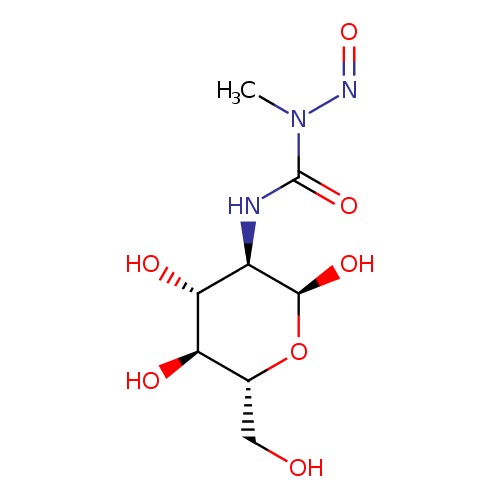
Chemical Structure
Thumb
Synonyms
ValueSource
2-Deoxy-2-(((methylnitrosoamino)carbonyl)amino)-D-glucopyranoseChEBI
2-Deoxy-2-(3-methyl-3-nitrosoureido)-D-glucopyranoseChEBI
EstreptozocinaChEBI
N-D-Glucosyl-(2)-n'-nitrosomethylharnstoffChEBI
N-D-Glucosyl-(2)-n'-nitrosomethylureaChEBI
StreptozocineChEBI
StreptozociniumChEBI
StreptozocinumChEBI
StreptozotocinChEBI
ZanosarChEBI
StreptozotocineHMDB
Teva brand OF streptozocinHMDB
Streptozocin teva brandHMDB
2-Deoxy-2-((methylnitrosoamino)carbonyl)amino-D-glucoseHMDB
Chemical FormulaC8H15N3O7
Average Molecular Mass265.221 g/mol
Monoisotopic Mass265.091 g/mol
CAS Registry Number18883-66-4
IUPAC Name3-methyl-3-nitroso-1-[(2S,3R,4R,5S,6R)-2,4,5-trihydroxy-6-(hydroxymethyl)oxan-3-yl]urea
Traditional Namestreptozocin
SMILESCN(N=O)C(=O)N[C@H]1[C@@H](O)O[C@H](CO)[C@@H](O)[C@@H]1O
InChI IdentifierInChI=1S/C8H15N3O7/c1-11(10-17)8(16)9-4-6(14)5(13)3(2-12)18-7(4)15/h3-7,12-15H,2H2,1H3,(H,9,16)/t3-,4-,5-,6-,7+/m1/s1
InChI KeyZSJLQEPLLKMAKR-GKHCUFPYSA-N
Chemical Taxonomy
Description belongs to the class of organic compounds known as hexoses. These are monosaccharides in which the sugar unit is a is a six-carbon containing moeity.
KingdomOrganic compounds
Super ClassOrganic oxygen compounds
ClassOrganooxygen compounds
Sub ClassCarbohydrates and carbohydrate conjugates
Direct ParentHexoses
Alternative Parents
Substituents
  • Hexose monosaccharide
  • N-methylnitrosourea
  • Nitrosourea
  • Oxane
  • Nitrosamide
  • Semicarbazide
  • Organic n-nitroso compound
  • Hemiacetal
  • Carbonic acid derivative
  • Secondary alcohol
  • Organic nitroso compound
  • Oxacycle
  • Polyol
  • Organoheterocyclic compound
  • Organonitrogen compound
  • Hydrocarbon derivative
  • Organic oxide
  • Organopnictogen compound
  • Organic nitrogen compound
  • Carbonyl group
  • Primary alcohol
  • Alcohol
  • Aliphatic heteromonocyclic compound
Molecular FrameworkAliphatic heteromonocyclic compounds
External Descriptors
Biological Properties
StatusDetected and Not Quantified
OriginExogenous
Cellular Locations
  • Cytoplasm
  • Extracellular
  • Membrane
Biofluid LocationsNot Available
Tissue LocationsNot Available
PathwaysNot Available
Applications
Biological Roles
Chemical Roles
Physical Properties
StateSolid
AppearanceWhite powder.
Experimental Properties
PropertyValue
Melting Point115°C
Boiling PointNot Available
Solubility5070 mg/L
Predicted Properties
PropertyValueSource
Water Solubility33.5 g/LALOGPS
logP-1.7ALOGPS
logP-2.7ChemAxon
logS-0.9ALOGPS
pKa (Strongest Acidic)11.43ChemAxon
pKa (Strongest Basic)-3ChemAxon
Physiological Charge0ChemAxon
Hydrogen Acceptor Count7ChemAxon
Hydrogen Donor Count5ChemAxon
Polar Surface Area151.92 ŲChemAxon
Rotatable Bond Count3ChemAxon
Refractivity55.96 m³·mol⁻¹ChemAxon
Polarizability23.74 ųChemAxon
Number of Rings1ChemAxon
Bioavailability1ChemAxon
Rule of FiveYesChemAxon
Ghose FilterNoChemAxon
Veber's RuleNoChemAxon
MDDR-like RuleNoChemAxon
Spectra
Spectra
Spectrum TypeDescriptionSplash KeyView
Predicted GC-MSPredicted GC-MS Spectrum - GC-MS (Non-derivatized) - 70eV, Positivesplash10-02mj-5940000000-8fb8f1885498bea8bc01Spectrum
Predicted GC-MSPredicted GC-MS Spectrum - GC-MS (4 TMS) - 70eV, Positivesplash10-000i-5384590000-954f20357dc689aab130Spectrum
Predicted GC-MSPredicted GC-MS Spectrum - GC-MS (Non-derivatized) - 70eV, PositiveNot AvailableSpectrum
Predicted LC-MS/MSPredicted LC-MS/MS Spectrum - 10V, Positivesplash10-066s-1390000000-8a52d6755935e91be345Spectrum
Predicted LC-MS/MSPredicted LC-MS/MS Spectrum - 20V, Positivesplash10-03di-9730000000-8e7df34a65b316df695eSpectrum
Predicted LC-MS/MSPredicted LC-MS/MS Spectrum - 40V, Positivesplash10-03di-9800000000-8768229ecc0345cd843aSpectrum
Predicted LC-MS/MSPredicted LC-MS/MS Spectrum - 10V, Negativesplash10-000i-9340000000-9e14b4f8a6d8f44c6ad6Spectrum
Predicted LC-MS/MSPredicted LC-MS/MS Spectrum - 20V, Negativesplash10-0a4i-9220000000-2ac584cea0c0d26bc11fSpectrum
Predicted LC-MS/MSPredicted LC-MS/MS Spectrum - 40V, Negativesplash10-0a4i-9200000000-dd74fa78262e5a7d35e0Spectrum
Predicted LC-MS/MSPredicted LC-MS/MS Spectrum - 10V, Negativesplash10-0006-4940000000-29bcfe413e3e5b2dd305Spectrum
Predicted LC-MS/MSPredicted LC-MS/MS Spectrum - 20V, Negativesplash10-0536-9100000000-2a734221e4d6f4a10693Spectrum
Predicted LC-MS/MSPredicted LC-MS/MS Spectrum - 40V, Negativesplash10-0a4i-9000000000-722b10d68ba035f6a8c2Spectrum
Predicted LC-MS/MSPredicted LC-MS/MS Spectrum - 10V, Positivesplash10-000t-1090000000-4646c5accac0f8935a29Spectrum
Predicted LC-MS/MSPredicted LC-MS/MS Spectrum - 20V, Positivesplash10-01ox-9000000000-d7d9d98474284352116cSpectrum
Predicted LC-MS/MSPredicted LC-MS/MS Spectrum - 40V, Positivesplash10-03di-9300000000-9cad9495adf263c410f9Spectrum
1D NMR1H NMR SpectrumNot AvailableSpectrum
1D NMR13C NMR SpectrumNot AvailableSpectrum
1D NMR1H NMR SpectrumNot AvailableSpectrum
1D NMR13C NMR SpectrumNot AvailableSpectrum
1D NMR1H NMR SpectrumNot AvailableSpectrum
1D NMR13C NMR SpectrumNot AvailableSpectrum
1D NMR1H NMR SpectrumNot AvailableSpectrum
1D NMR13C NMR SpectrumNot AvailableSpectrum
1D NMR1H NMR SpectrumNot AvailableSpectrum
1D NMR13C NMR SpectrumNot AvailableSpectrum
1D NMR1H NMR SpectrumNot AvailableSpectrum
1D NMR13C NMR SpectrumNot AvailableSpectrum
1D NMR1H NMR SpectrumNot AvailableSpectrum
1D NMR13C NMR SpectrumNot AvailableSpectrum
1D NMR1H NMR SpectrumNot AvailableSpectrum
1D NMR13C NMR SpectrumNot AvailableSpectrum
1D NMR1H NMR SpectrumNot AvailableSpectrum
1D NMR13C NMR SpectrumNot AvailableSpectrum
1D NMR1H NMR SpectrumNot AvailableSpectrum
1D NMR13C NMR SpectrumNot AvailableSpectrum
Toxicity Profile
Route of ExposureIntravenous. Poor oral absorption (17-25%).
Mechanism of ToxicityStreptozotocin is a naturally occurring chemical that is particularly toxic to the insulin-producing beta cells of the pancreas. It is used in medical research to produce an animal model for Type 1 diabetes in large dose as well as Type 2 diabetes with multiple low doses. Streptozotocin is similar enough to glucose to be transported into the cell by the glucose transport protein GLUT2, but is not recognized by the other glucose transporters. This explains its relative toxicity to beta cells, since these cells have relatively high levels of GLUT2. Streptozotocin is a glucosamine-nitrosourea (i.e. alkylating) compound. As with other alkylating agents in the nitrosourea class, it is toxic to cells by causing damage to the DNA, though other mechanisms may also contribute.
MetabolismPrimarily hepatic Route of Elimination: As much as 20% of the drug (or metabolites containing an N-nitrosourea group) is metabolized and/or excreted by the kidney. Half Life: 5-15 minutes
Toxicity ValuesNot Available
Lethal DoseNot Available
Carcinogenicity (IARC Classification)2B, possibly carcinogenic to humans. (6)
Uses/SourcesFor the treatment of malignant neoplasms of pancreas (metastatic islet cell carcinoma).
Minimum Risk LevelNot Available
Health EffectsAntibiotic resistance
SymptomsSymptoms of overdose include nausea and vomiting, anorexia, myelosuppression; and nephrotoxicity.
TreatmentNot Available
Concentrations
Not Available
DrugBank IDDB00428
HMDB IDHMDB0014572
FooDB IDNot Available
Phenol Explorer IDNot Available
KNApSAcK IDNot Available
BiGG IDNot Available
BioCyc IDNot Available
METLIN IDNot Available
PDB IDNot Available
Wikipedia LinkStreptozocin
Chemspider ID27273
ChEBI ID9288
PubChem Compound ID29327
Kegg Compound IDC07313
YMDB IDNot Available
ECMDB IDNot Available
References
Synthesis ReferenceNot Available
MSDSLink
General References
1. Mansford KR, Opie L: Comparison of metabolic abnormalities in diabetes mellitus induced by streptozotocin or by alloxan. Lancet. 1968 Mar 30;1(7544):670-1.
2. Schnedl WJ, Ferber S, Johnson JH, Newgard CB: STZ transport and cytotoxicity. Specific enhancement in GLUT2-expressing cells. Diabetes. 1994 Nov;43(11):1326-33.
3. Wang Z, Gleichmann H: GLUT2 in pancreatic islets: crucial target molecule in diabetes induced with multiple low doses of streptozotocin in mice. Diabetes. 1998 Jan;47(1):50-6.
4. Brentjens R, Saltz L: Islet cell tumors of the pancreas: the medical oncologist's perspective. Surg Clin North Am. 2001 Jun;81(3):527-42.
5. VAVRA JJ, DEBOER C, DIETZ A, HANKA LJ, SOKOLSKI WT: Streptozotocin, a new antibacterial antibiotic. Antibiot Annu. 1959-1960;7:230-5.
6. BC Cancer Agency: http://www.bccancer.bc.ca/HPI/DrugDatabase/DrugIndexPro/Streptozocin.htm
7. https://www.ncbi.nlm.nih.gov/pubmed/?term=12613763
8. https://www.ncbi.nlm.nih.gov/pubmed/?term=23151907
9. https://www.ncbi.nlm.nih.gov/pubmed/?term=23333576
10. https://www.ncbi.nlm.nih.gov/pubmed/?term=23600389
11. https://www.ncbi.nlm.nih.gov/pubmed/?term=23612842
12. https://www.ncbi.nlm.nih.gov/pubmed/?term=23662406
13. https://www.ncbi.nlm.nih.gov/pubmed/?term=2954873