Record Information
Version1.0
Creation Date2009-07-21 20:26:46 UTC
Update Date2026-05-14 16:37:15 UTC
Accession NumberCHEM002186
Identification
Common NameProcyclidine
ClassSmall Molecule
DescriptionProcyclidine is only found in individuals that have used or taken this drug. It is a muscarinic antagonist that crosses the blood-brain barrier and is used in the treatment of drug-induced extrapyramidal disorders and in parkinsonism. The mechanism of action is unknown. It is thought that Procyclidine acts by blocking central cholinergic receptors, and thus balancing cholinergic and dopaminergic activity in the basal ganglia. Many of its effects are due to its pharmacologic similarities with atropine. Procyclidine exerts an antispasmodic effect on smooth muscle, and may produce mydriasis and reduction in salivation.
Contaminant Sources
  • HMDB Contaminants - Urine
  • STOFF IDENT Compounds
  • T3DB toxins
Contaminant Type
  • Amine
  • Antidyskinetic
  • Antiparkinson Agent
  • Drug
  • Metabolite
  • Muscarinic Antagonist
  • Organic Compound
  • Synthetic Compound
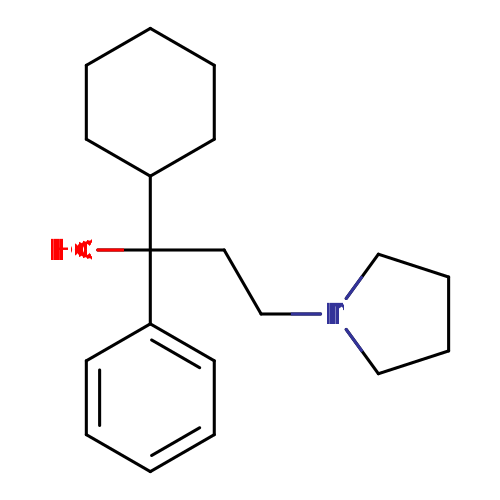
Chemical Structure
Thumb
Synonyms
ValueSource
1-Cyclohexyl-1-phenyl-3-pyrrolidino-1-propanolChEBI
ProciclidinaChEBI
ProcyclidinumChEBI
TricyclamolChEBI
Glaxo wellcome brand OF procyclidine hydrochlorideHMDB
ICN brand OF procyclidine hydrochlorideHMDB
MucinilHMDB
Wellcome brand OF procyclidine hydrochlorideHMDB
ArpicolinHMDB
Hydrochloride, procyclidineHMDB
Monarch brand OF procyclidine hydrochlorideHMDB
OsnervanHMDB
ProcyclidHMDB
Procyclidine hydrochlorideHMDB
GlaxoSmithKline brand OF procyclidine hydrochlorideHMDB
Rosemont brand OF procyclidine hydrochlorideHMDB
KemadrenHMDB
KemadrinHMDB
Opus brand OF procyclidine hydrochlorideHMDB
Chemical FormulaC19H29NO
Average Molecular Mass287.440 g/mol
Monoisotopic Mass287.225 g/mol
CAS Registry Number77-37-2
IUPAC Name1-cyclohexyl-1-phenyl-3-(pyrrolidin-1-yl)propan-1-ol
Traditional Nameprocyclidine
SMILESOC(CCN1CCCC1)(C1CCCCC1)C1=CC=CC=C1
InChI IdentifierInChI=1S/C19H29NO/c21-19(17-9-3-1-4-10-17,18-11-5-2-6-12-18)13-16-20-14-7-8-15-20/h1,3-4,9-10,18,21H,2,5-8,11-16H2
InChI KeyWYDUSKDSKCASEF-UHFFFAOYSA-N
Chemical Taxonomy
Description belongs to the class of organic compounds known as aralkylamines. These are alkylamines in which the alkyl group is substituted at one carbon atom by an aromatic hydrocarbyl group.
KingdomOrganic compounds
Super ClassOrganic nitrogen compounds
ClassOrganonitrogen compounds
Sub ClassAmines
Direct ParentAralkylamines
Alternative Parents
Substituents
  • Aralkylamine
  • Monocyclic benzene moiety
  • Benzenoid
  • N-alkylpyrrolidine
  • 1,3-aminoalcohol
  • Pyrrolidine
  • Tertiary alcohol
  • Tertiary aliphatic amine
  • Tertiary amine
  • Azacycle
  • Organoheterocyclic compound
  • Organic oxygen compound
  • Aromatic alcohol
  • Hydrocarbon derivative
  • Organooxygen compound
  • Organopnictogen compound
  • Alcohol
  • Aromatic heteromonocyclic compound
Molecular FrameworkAromatic heteromonocyclic compounds
External Descriptors
Biological Properties
StatusDetected and Not Quantified
OriginExogenous
Cellular Locations
  • Membrane
Biofluid LocationsNot Available
Tissue LocationsNot Available
PathwaysNot Available
Applications
Biological Roles
Chemical RolesNot Available
Physical Properties
StateSolid
AppearanceWhite powder.
Experimental Properties
PropertyValue
Melting Point86°C
Boiling PointNot Available
SolubilityModerately soluble in water, ~ 30 mg/ml
Predicted Properties
PropertyValueSource
Water Solubility0.0098 g/LALOGPS
logP4.13ALOGPS
logP3.79ChemAxon
logS-4.5ALOGPS
pKa (Strongest Acidic)13.84ChemAxon
pKa (Strongest Basic)9.45ChemAxon
Physiological Charge1ChemAxon
Hydrogen Acceptor Count2ChemAxon
Hydrogen Donor Count1ChemAxon
Polar Surface Area23.47 ŲChemAxon
Rotatable Bond Count5ChemAxon
Refractivity88.6 m³·mol⁻¹ChemAxon
Polarizability34.43 ųChemAxon
Number of Rings3ChemAxon
Bioavailability1ChemAxon
Rule of FiveYesChemAxon
Ghose FilterYesChemAxon
Veber's RuleYesChemAxon
MDDR-like RuleNoChemAxon
Spectra
Spectra
Spectrum TypeDescriptionSplash KeyView
Predicted GC-MSPredicted GC-MS Spectrum - GC-MS (Non-derivatized) - 70eV, Positivesplash10-053r-9510000000-bb5c957fcb63641b16dfSpectrum
Predicted GC-MSPredicted GC-MS Spectrum - GC-MS (1 TMS) - 70eV, Positivesplash10-00c3-9371000000-a8f31f6dd1ab688edc1cSpectrum
Predicted GC-MSPredicted GC-MS Spectrum - GC-MS (Non-derivatized) - 70eV, PositiveNot AvailableSpectrum
Predicted LC-MS/MSPredicted LC-MS/MS Spectrum - 10V, Positivesplash10-00dr-0090000000-346bcbb2ab2d7175b1bcSpectrum
Predicted LC-MS/MSPredicted LC-MS/MS Spectrum - 20V, Positivesplash10-001i-9240000000-b149734e30140564cb67Spectrum
Predicted LC-MS/MSPredicted LC-MS/MS Spectrum - 40V, Positivesplash10-0a4l-9210000000-752d38a1eb305bdc9d05Spectrum
Predicted LC-MS/MSPredicted LC-MS/MS Spectrum - 10V, Negativesplash10-000i-0090000000-15b4d4f82fafa22bb285Spectrum
Predicted LC-MS/MSPredicted LC-MS/MS Spectrum - 20V, Negativesplash10-0079-9080000000-bcb7857676f4ed8009edSpectrum
Predicted LC-MS/MSPredicted LC-MS/MS Spectrum - 40V, Negativesplash10-00di-9010000000-1fd43c480f58b0322708Spectrum
Predicted LC-MS/MSPredicted LC-MS/MS Spectrum - 10V, Positivesplash10-000i-0090000000-2c6fa3370147096c5f4aSpectrum
Predicted LC-MS/MSPredicted LC-MS/MS Spectrum - 20V, Positivesplash10-001i-9020000000-24b280b9f79606f08243Spectrum
Predicted LC-MS/MSPredicted LC-MS/MS Spectrum - 40V, Positivesplash10-001r-9410000000-06aeaae65e74e5546cf4Spectrum
Predicted LC-MS/MSPredicted LC-MS/MS Spectrum - 10V, Negativesplash10-000i-0090000000-8ae387832bf542033b12Spectrum
Predicted LC-MS/MSPredicted LC-MS/MS Spectrum - 20V, Negativesplash10-000i-1490000000-6ae75c02122c9e6e0e04Spectrum
Predicted LC-MS/MSPredicted LC-MS/MS Spectrum - 40V, Negativesplash10-001i-0490000000-f468d30ac48d7ded8da4Spectrum
MSMass Spectrum (Electron Ionization)splash10-001i-9010000000-7d7f1b16f54aaca37f10Spectrum
Toxicity Profile
Route of ExposureOral
Mechanism of ToxicityThe mechanism of action is unknown. It is thought that Procyclidine acts by blocking central cholinergic receptors, and thus balancing cholinergic and dopaminergic activity in the basal ganglia. Many of its effects are due to its pharmacologic similarities with atropine. Procyclidine exerts an antispasmodic effect on smooth muscle, and may produce mydriasis and reduction in salivation.
MetabolismNot Available
Toxicity ValuesLD50=60 mg/kg (IV in mice)
Lethal DoseNot Available
Carcinogenicity (IARC Classification)No indication of carcinogenicity to humans (not listed by IARC).
Uses/SourcesFor the treatment of all forms of Parkinson's Disease, as well as control of extrapyramidal reactions induced by antipsychotic agents.
Minimum Risk LevelNot Available
Health EffectsNot Available
SymptomsLD50=60 mg/kg (IV in mice)
TreatmentNot Available
Concentrations
Not Available
DrugBank IDDB00387
HMDB IDHMDB0014531
FooDB IDNot Available
Phenol Explorer IDNot Available
KNApSAcK IDNot Available
BiGG IDNot Available
BioCyc IDNot Available
METLIN IDNot Available
PDB IDNot Available
Wikipedia LinkProcyclidine
Chemspider ID4750
ChEBI ID8448
PubChem Compound ID4919
Kegg Compound IDC07378
YMDB IDNot Available
ECMDB IDNot Available
References
Synthesis ReferenceNot Available
MSDSNot Available
General References
1. Theodoridis GC, Stark L: Central role of solar information flow in pregenetic evolution. J Theor Biol. 1971 Jun;31(3):377-88.
2. https://www.ncbi.nlm.nih.gov/pubmed/?term=2878700