Record Information
Version1.0
Creation Date2009-07-21 20:26:45 UTC
Update Date2026-04-05 13:52:02 UTC
Accession NumberCHEM002184
Identification
Common NameDexrazoxane
ClassSmall Molecule
DescriptionAn antimitotic agent with immunosuppressive properties. Dexrazoxane, the (+)-enantiomorph of razoxane, provides cardioprotection against anthracycline toxicity. It appears to inhibit formation of a toxic iron-anthracycline complex. The Food and Drug Administration has designated dexrazoxane as an orphan drug for use in the prevention or reduction in the incidence and severity of anthracycline-induced cardiomyopathy.
Contaminant Sources
  • HMDB Contaminants - Urine
  • STOFF IDENT Compounds
  • T3DB toxins
  • ToxCast & Tox21 Chemicals
Contaminant Type
  • Amide
  • Amine
  • Antineoplastic Agent
  • Cardiovascular Agent
  • Chelating Agent
  • Drug
  • Food Toxin
  • Immunosuppressive Agent
  • Metabolite
  • Organic Compound
  • Synthetic Compound
Chemical Structure
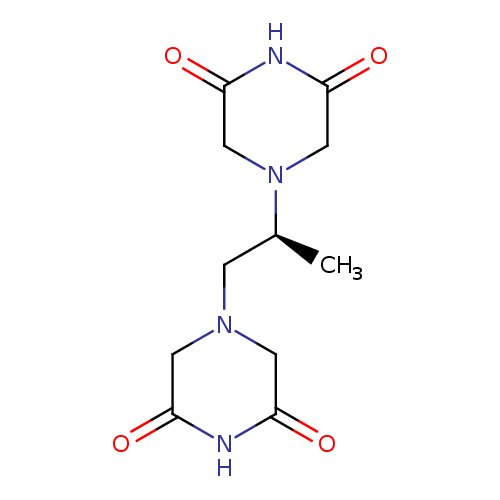
Thumb
Synonyms
ValueSource
(+)-(S)-4,4'-Propylenedi-2,6-piperazinedioneChEBI
(+)-1,2-Bis(3,5-dioxo-1-piperazinyl)propaneChEBI
DexrazoxanoChEBI
DexrazoxanumChEBI
DextrorazoxaneChEBI
DesrazoxaneHMDB
Icrf-187HMDB
ADR 529HMDB
CardioxanHMDB
CardioxaneHMDB
Dexrazoxane hydrochlorideHMDB
ICRF187HMDB
Razoxane, (S)-isomerHMDB
ZinecardHMDB
ADR-529HMDB
Razoxane, (S)-isomer, hydrochlorideHMDB
Hydrochloride, dexrazoxaneHMDB
ICRF 187HMDB
DexrazoxaneChEBI
Chemical FormulaC11H16N4O4
Average Molecular Mass268.269 g/mol
Monoisotopic Mass268.117 g/mol
CAS Registry Number24584-09-6
IUPAC Name4-[(2S)-2-(3,5-dioxopiperazin-1-yl)propyl]piperazine-2,6-dione
Traditional Namedexrazoxane
SMILESC[C@@H](CN1CC(=O)NC(=O)C1)N1CC(=O)NC(=O)C1
InChI IdentifierInChI=1S/C11H16N4O4/c1-7(15-5-10(18)13-11(19)6-15)2-14-3-8(16)12-9(17)4-14/h7H,2-6H2,1H3,(H,12,16,17)(H,13,18,19)/t7-/m0/s1
InChI KeyBMKDZUISNHGIBY-ZETCQYMHSA-N
Chemical Taxonomy
Description belongs to the class of organic compounds known as alpha amino acids and derivatives. These are amino acids in which the amino group is attached to the carbon atom immediately adjacent to the carboxylate group (alpha carbon), or a derivative thereof.
KingdomOrganic compounds
Super ClassOrganic acids and derivatives
ClassCarboxylic acids and derivatives
Sub ClassAmino acids, peptides, and analogues
Direct ParentAlpha amino acids and derivatives
Alternative Parents
Substituents
  • Alpha-amino acid or derivatives
  • Dioxopiperazine
  • N-alkylpiperazine
  • 1,4-diazinane
  • Piperazine
  • Carboxylic acid imide
  • Dicarboximide
  • Carboxylic acid imide, n-unsubstituted
  • Tertiary aliphatic amine
  • Tertiary amine
  • Organoheterocyclic compound
  • Azacycle
  • Organic nitrogen compound
  • Organooxygen compound
  • Organonitrogen compound
  • Amine
  • Organic oxygen compound
  • Hydrocarbon derivative
  • Organic oxide
  • Carbonyl group
  • Organopnictogen compound
  • Aliphatic heteromonocyclic compound
Molecular FrameworkAliphatic heteromonocyclic compounds
External Descriptors
Biological Properties
StatusDetected and Not Quantified
OriginExogenous
Cellular Locations
  • Cytoplasm
  • Extracellular
Biofluid LocationsNot Available
Tissue LocationsNot Available
PathwaysNot Available
Applications
Biological Roles
Chemical Roles
Physical Properties
StateSolid
AppearanceWhite powder.
Experimental Properties
PropertyValue
Melting Point191-197°C
Boiling PointNot Available
SolubilitySparingly soluble
Predicted Properties
PropertyValueSource
Water Solubility10.4 g/LALOGPS
logP-1ALOGPS
logP-2.7ChemAxon
logS-1.4ALOGPS
pKa (Strongest Acidic)11.2ChemAxon
pKa (Strongest Basic)3.6ChemAxon
Physiological Charge0ChemAxon
Hydrogen Acceptor Count6ChemAxon
Hydrogen Donor Count2ChemAxon
Polar Surface Area98.82 ŲChemAxon
Rotatable Bond Count3ChemAxon
Refractivity64.25 m³·mol⁻¹ChemAxon
Polarizability26.12 ųChemAxon
Number of Rings2ChemAxon
Bioavailability1ChemAxon
Rule of FiveYesChemAxon
Ghose FilterNoChemAxon
Veber's RuleNoChemAxon
MDDR-like RuleNoChemAxon
Spectra
Spectra
Spectrum TypeDescriptionSplash KeyView
Predicted GC-MSPredicted GC-MS Spectrum - GC-MS (Non-derivatized) - 70eV, Positivesplash10-0m2c-4910000000-46d13032d5f2c6472d9bSpectrum
Predicted GC-MSPredicted GC-MS Spectrum - GC-MS (Non-derivatized) - 70eV, PositiveNot AvailableSpectrum
Predicted LC-MS/MSPredicted LC-MS/MS Spectrum - 10V, Positivesplash10-014i-0490000000-80b0b21a495d2cc911a4Spectrum
Predicted LC-MS/MSPredicted LC-MS/MS Spectrum - 20V, Positivesplash10-0a4i-1910000000-5a4bec9ae0f631c4c328Spectrum
Predicted LC-MS/MSPredicted LC-MS/MS Spectrum - 40V, Positivesplash10-052b-8900000000-da472776fdfa9ff649ddSpectrum
Predicted LC-MS/MSPredicted LC-MS/MS Spectrum - 10V, Negativesplash10-014i-0090000000-3ed9d12564a96e4f79a2Spectrum
Predicted LC-MS/MSPredicted LC-MS/MS Spectrum - 20V, Negativesplash10-0006-9010000000-913da0d82e09de14ca70Spectrum
Predicted LC-MS/MSPredicted LC-MS/MS Spectrum - 40V, Negativesplash10-0006-9100000000-1b65fef6f408f48c6b59Spectrum
Predicted LC-MS/MSPredicted LC-MS/MS Spectrum - 10V, Positivesplash10-0a4i-0910000000-8bbf646c07221a874c7cSpectrum
Predicted LC-MS/MSPredicted LC-MS/MS Spectrum - 20V, Positivesplash10-0aor-3790000000-825583366aa2049c6487Spectrum
Predicted LC-MS/MSPredicted LC-MS/MS Spectrum - 40V, Positivesplash10-0abc-9610000000-e2da7526d67ac758a836Spectrum
Predicted LC-MS/MSPredicted LC-MS/MS Spectrum - 10V, Negativesplash10-014i-0090000000-bd2978e4c0725b5d29bdSpectrum
Predicted LC-MS/MSPredicted LC-MS/MS Spectrum - 20V, Negativesplash10-05p6-5890000000-a1cb5b2cd96d828fbdaaSpectrum
Predicted LC-MS/MSPredicted LC-MS/MS Spectrum - 40V, Negativesplash10-0006-9400000000-50d8c9f710f08bb20677Spectrum
1D NMR1H NMR SpectrumNot AvailableSpectrum
1D NMR13C NMR SpectrumNot AvailableSpectrum
1D NMR1H NMR SpectrumNot AvailableSpectrum
1D NMR13C NMR SpectrumNot AvailableSpectrum
1D NMR1H NMR SpectrumNot AvailableSpectrum
1D NMR13C NMR SpectrumNot AvailableSpectrum
1D NMR1H NMR SpectrumNot AvailableSpectrum
1D NMR13C NMR SpectrumNot AvailableSpectrum
1D NMR1H NMR SpectrumNot AvailableSpectrum
1D NMR13C NMR SpectrumNot AvailableSpectrum
1D NMR1H NMR SpectrumNot AvailableSpectrum
1D NMR13C NMR SpectrumNot AvailableSpectrum
1D NMR1H NMR SpectrumNot AvailableSpectrum
1D NMR13C NMR SpectrumNot AvailableSpectrum
1D NMR1H NMR SpectrumNot AvailableSpectrum
1D NMR13C NMR SpectrumNot AvailableSpectrum
1D NMR1H NMR SpectrumNot AvailableSpectrum
1D NMR13C NMR SpectrumNot AvailableSpectrum
1D NMR1H NMR SpectrumNot AvailableSpectrum
1D NMR13C NMR SpectrumNot AvailableSpectrum
Toxicity Profile
Route of ExposureIV administration results in complete bioavailability.
Mechanism of ToxicityThe mechanism by which dexrazoxane exerts its cardioprotective activity is not fully understood. Dexrazoxane is a cyclic derivative of EDTA that readily penetrates cell membranes. Results of laboratory studies suggest that dexrazoxane (a prodrug) is converted intracellularly to a ring-opened bidentate chelating agent that chelates to free iron and interferes with iron-mediated free radical generation thought to be responsible, in part, for anthracycline-induced cardiomyopathy. It should be noted that dexrazoxane may also be protective through its inhibitory effect on topoisomerase II.
MetabolismDexrazoxane is hydrolysed by the enzyme dihydropyrimidine amidohydrolase in the liver and kidney to active metabolites that are capable of binding to metal ions. Route of Elimination: Urinary excretion plays an important role in the elimination of dexrazoxane. Forty-two percent of the 500 mg/m2 dose of dexrazoxane was excreted in the urine. Half Life: 2.5 hours
Toxicity ValuesIntraperitoneal, mouse LD10 = 500 mg/kg. Intravenous, dog LD10 = 2 gm/kg.
Lethal DoseNot Available
Carcinogenicity (IARC Classification)No indication of carcinogenicity to humans (not listed by IARC).
Uses/SourcesFor reducing the incidence and severity of cardiomyopathy associated with doxorubicin administration in women with metastatic breast cancer who have received a cumulative doxorubicin hydrochloride dose of 300 mg/m^2 and would benefit from continued doxorubicin therapy. Also approved for the treatment of extravasation from intravenous anthracyclines.
Minimum Risk LevelNot Available
Health EffectsNot Available
SymptomsIntraperitoneal, mouse LD10 = 500 mg/kg. Intravenous, dog LD10 = 2 gm/kg.
TreatmentThere is no known antidote for dexrazoxane. Instances of suspected overdose should be managed with good supportive care until resolution of myelosuppression and related conditions is complete. Management of overdose should include treatment of infections, fluid regulation, and maintenance of nutritional requirements. (7)
Concentrations
Not Available
DrugBank IDDB00380
HMDB IDHMDB0014524
FooDB IDNot Available
Phenol Explorer IDNot Available
KNApSAcK IDNot Available
BiGG IDNot Available
BioCyc IDNot Available
METLIN IDNot Available
PDB IDNot Available
Wikipedia LinkDexrazoxane
Chemspider ID64479
ChEBI ID50223
PubChem Compound ID71384
Kegg Compound IDNot Available
YMDB IDNot Available
ECMDB IDNot Available
References
Synthesis ReferenceNot Available
MSDSLink
General References
1. Weiss G, Loyevsky M, Gordeuk VR: Dexrazoxane (ICRF-187). Gen Pharmacol. 1999 Jan;32(1):155-8.
2. Kik K, Szmigiero L: [Dexrazoxane (ICRF-187)--a cardioprotectant and modulator of action of some anticancer drugs]. Postepy Hig Med Dosw (Online). 2006;60:584-90.
3. Hasinoff BB, Herman EH: Dexrazoxane: how it works in cardiac and tumor cells. Is it a prodrug or is it a drug? Cardiovasc Toxicol. 2007;7(2):140-4.
4. Langer SW: Dexrazoxane for anthracycline extravasation. Expert Rev Anticancer Ther. 2007 Aug;7(8):1081-8.
5. Hasinoff BB: The use of dexrazoxane for the prevention of anthracycline extravasation injury. Expert Opin Investig Drugs. 2008 Feb;17(2):217-23. doi: 10.1517/13543784.17.2.217.