Record Information
Version1.0
Creation Date2009-07-21 20:26:43 UTC
Update Date2026-03-31 17:44:31 UTC
Accession NumberCHEM002182
Identification
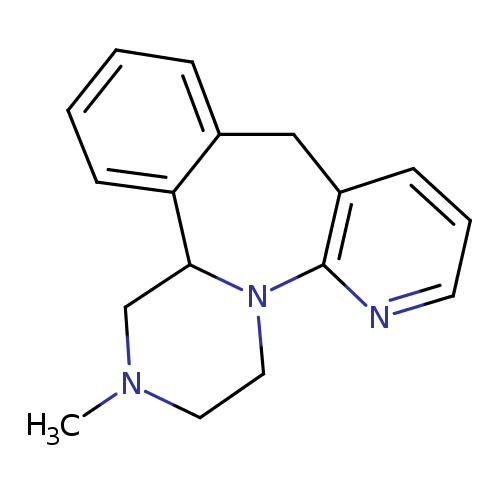
Common NameMirtazapine
ClassSmall Molecule
DescriptionMirtazapine is an antidepressant introduced by Organon International in 1996 used for the treatment of moderate to severe depression. Mirtazapine has a tetracyclic chemical structure and is classified as a noradrenergic and specific serotonergic antidepressant (NaSSA). It is the only tetracyclic antidepressant that has been approved by the Food and Drug Administration to treat depression.
Contaminant Sources
  • HMDB Contaminants - Urine
  • STOFF IDENT Compounds
  • T3DB toxins
  • ToxCast & Tox21 Chemicals
Contaminant Type
  • Adrenergic alpha-Antagonist
  • Amine
  • Antidepressive Agent, Tricyclic
  • Drug
  • Food Toxin
  • Histamine H1 Antagonist
  • Metabolite
  • Organic Compound
  • Synthetic Compound
Chemical Structure
Thumb
Synonyms
ValueSource
1,2,3,4,10,14b-Hexahydro-2-methylpyrazino(2,1-a)pyrido(2,3-c)benzazepineChEBI
MirtazapinaChEBI
MirtazapinumChEBI
RemeronKegg
ReflexKegg
MepirzepineHMDB
MirtazepineHMDB
Celltech brand OF mirtazapineMeSH, HMDB
NorsetMeSH, HMDB
Organon brand OF mirtazapineMeSH, HMDB
RexerMeSH, HMDB
(N-Methyl-11C)mirtazapineMeSH, HMDB
RemergilMeSH, HMDB
6-AzamianserinMeSH, HMDB
Mundogen brand OF mirtazapineMeSH, HMDB
ZispinMeSH, HMDB
EsmirtazapineMeSH, HMDB
(S)-MirtazapineMeSH, HMDB
6 AzamianserinMeSH, HMDB
Chemical FormulaC17H19N3
Average Molecular Mass265.353 g/mol
Monoisotopic Mass265.158 g/mol
CAS Registry Number61337-67-5
IUPAC Name5-methyl-2,5,19-triazatetracyclo[13.4.0.0²,⁷.0⁸,¹³]nonadeca-1(15),8,10,12,16,18-hexaene
Traditional Namemirtazapine
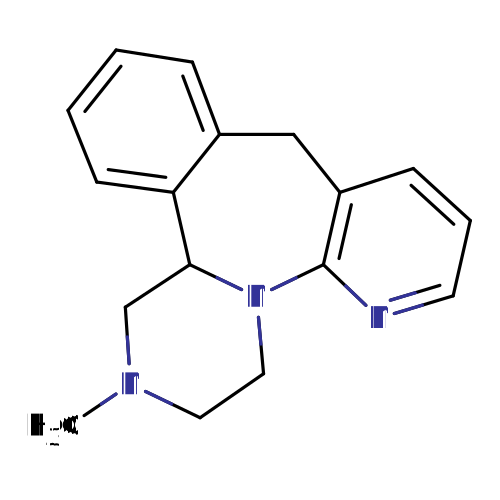
SMILESCN1CCN2C(C1)C1=CC=CC=C1CC1=C2N=CC=C1
InChI IdentifierInChI=1S/C17H19N3/c1-19-9-10-20-16(12-19)15-7-3-2-5-13(15)11-14-6-4-8-18-17(14)20/h2-8,16H,9-12H2,1H3
InChI KeyRONZAEMNMFQXRA-UHFFFAOYSA-N
Chemical Taxonomy
Description belongs to the class of organic compounds known as piperazinoazepines. Piperazinoazepines are compounds containing a piperazinoazepine skeleton, which consists of an azepine ring fused to a piperazine.
KingdomOrganic compounds
Super ClassOrganoheterocyclic compounds
ClassPiperazinoazepines
Sub ClassNot Available
Direct ParentPiperazinoazepines
Alternative Parents
Substituents
  • Benzazepine
  • Piperazino-azepine
  • Dialkylarylamine
  • Azepine
  • N-methylpiperazine
  • N-alkylpiperazine
  • Aralkylamine
  • Imidolactam
  • Benzenoid
  • Pyridine
  • Piperazine
  • 1,4-diazinane
  • Heteroaromatic compound
  • Tertiary aliphatic amine
  • Tertiary amine
  • Azacycle
  • Amine
  • Organopnictogen compound
  • Organonitrogen compound
  • Organic nitrogen compound
  • Hydrocarbon derivative
  • Aromatic heteropolycyclic compound
Molecular FrameworkAromatic heteropolycyclic compounds
External Descriptors
Biological Properties
StatusDetected and Not Quantified
OriginExogenous
Cellular Locations
  • Membrane
Biofluid LocationsNot Available
Tissue LocationsNot Available
PathwaysNot Available
Applications
Biological Roles
Chemical RolesNot Available
Physical Properties
StateSolid
AppearanceWhite powder.
Experimental Properties
PropertyValue
Melting Point114-116°C
Boiling PointNot Available
SolubilitySlight
Predicted Properties
PropertyValueSource
Water Solubility1.1 g/LALOGPS
logP2.9ALOGPS
logP3.21ChemAxon
logS-2.4ALOGPS
pKa (Strongest Basic)6.67ChemAxon
Physiological Charge0ChemAxon
Hydrogen Acceptor Count3ChemAxon
Hydrogen Donor Count0ChemAxon
Polar Surface Area19.37 ŲChemAxon
Rotatable Bond Count0ChemAxon
Refractivity82.66 m³·mol⁻¹ChemAxon
Polarizability30.35 ųChemAxon
Number of Rings4ChemAxon
Bioavailability1ChemAxon
Rule of FiveYesChemAxon
Ghose FilterYesChemAxon
Veber's RuleYesChemAxon
MDDR-like RuleNoChemAxon
Spectra
Spectra
Spectrum TypeDescriptionSplash KeyView
Predicted GC-MSPredicted GC-MS Spectrum - GC-MS (Non-derivatized) - 70eV, Positivesplash10-0kmr-0190000000-a83848620967f6019b9dSpectrum
Predicted GC-MSPredicted GC-MS Spectrum - GC-MS (Non-derivatized) - 70eV, PositiveNot AvailableSpectrum
LC-MS/MSLC-MS/MS Spectrum - LC-ESI-qTof , Positivesplash10-001i-0920000000-0a76314cf99840d246adSpectrum
LC-MS/MSLC-MS/MS Spectrum - LC-ESI-qTof , Positivesplash10-001i-1920000000-27fff664f04384263f02Spectrum
LC-MS/MSLC-MS/MS Spectrum - LC-ESI-qTof , Positivesplash10-014j-0790000000-5653705decf2e797e122Spectrum
LC-MS/MSLC-MS/MS Spectrum - LC-ESI-QTOF , positivesplash10-014i-0090000000-57eb768d0827fa54b248Spectrum
LC-MS/MSLC-MS/MS Spectrum - LC-ESI-QTOF , positivesplash10-014j-0490000000-4baae8cca5ab43f65dd9Spectrum
LC-MS/MSLC-MS/MS Spectrum - LC-ESI-QTOF , positivesplash10-0002-0910000000-c22ff3266fd0a936312dSpectrum
LC-MS/MSLC-MS/MS Spectrum - LC-ESI-QTOF , positivesplash10-0002-0900000000-ba0af76733c8ba5925ceSpectrum
LC-MS/MSLC-MS/MS Spectrum - LC-ESI-QTOF , positivesplash10-0002-0900000000-1b44d823d26f0e0bcd4dSpectrum
LC-MS/MSLC-MS/MS Spectrum - LC-ESI-QFT , positivesplash10-014i-0090000000-3582965e74f282e6bdeaSpectrum
LC-MS/MSLC-MS/MS Spectrum - LC-ESI-QFT , positivesplash10-014i-3290000000-d8839a66bb5976dbb5fdSpectrum
LC-MS/MSLC-MS/MS Spectrum - LC-ESI-QFT , positivesplash10-006t-5930000000-9d1fc48d559a70f6a0e1Spectrum
LC-MS/MSLC-MS/MS Spectrum - LC-ESI-QFT , positivesplash10-0002-2910000000-7c8bdce5145b9fd2fda0Spectrum
LC-MS/MSLC-MS/MS Spectrum - LC-ESI-QFT , positivesplash10-0002-1900000000-05e225af5ed24498466eSpectrum
LC-MS/MSLC-MS/MS Spectrum - LC-ESI-QFT , positivesplash10-0005-1900000000-f4e13abbfa0358ad282cSpectrum
LC-MS/MSLC-MS/MS Spectrum - LC-ESI-QFT , positivesplash10-00kf-2900000000-0a101b135d8e91d9b9a2Spectrum
LC-MS/MSLC-MS/MS Spectrum - LC-ESI-QFT , positivesplash10-014l-2900000000-6c01bee517524e647dc2Spectrum
LC-MS/MSLC-MS/MS Spectrum - LC-ESI-QFT , positivesplash10-014u-3900000000-7b5b5e6493206d8c9a67Spectrum
LC-MS/MSLC-MS/MS Spectrum - , positivesplash10-014j-0890000000-37665999329d651a1038Spectrum
LC-MS/MSLC-MS/MS Spectrum - , positivesplash10-001i-0920000000-0a76314cf99840d246adSpectrum
Predicted LC-MS/MSPredicted LC-MS/MS Spectrum - 10V, Positivesplash10-014i-0090000000-7317c8e3c74e54196aa7Spectrum
Predicted LC-MS/MSPredicted LC-MS/MS Spectrum - 20V, Positivesplash10-014i-0090000000-850d707320b5c89dca38Spectrum
Predicted LC-MS/MSPredicted LC-MS/MS Spectrum - 40V, Positivesplash10-0597-8940000000-134bd5046c73cedf41eeSpectrum
Predicted LC-MS/MSPredicted LC-MS/MS Spectrum - 10V, Negativesplash10-03di-0090000000-32137ba60af471e694c7Spectrum
Predicted LC-MS/MSPredicted LC-MS/MS Spectrum - 20V, Negativesplash10-03di-0090000000-9965f37f1c8e24b8492cSpectrum
Predicted LC-MS/MSPredicted LC-MS/MS Spectrum - 40V, Negativesplash10-0006-0920000000-48a76a8fca592616a5e9Spectrum
Toxicity Profile
Route of ExposureOral. Rapid and complete, but, due to first-pass metabolism, absolute bioavailability is 50%.
Mechanism of ToxicityMirtazapine acts as an antagonist at central pre-synaptic alpha(2)-receptors, inhibiting negative feedback to the presynaptic nerve and causing an increase in NE release. Blockade of heteroreceptors, alpha(2)-receptors contained in serotenergic neurons, enhances the release of 5-HT, increasing the interactions between 5-HT and 5-HT1 receptors and contributing to the anxiolytic effects of mirtazapine. Mirtazapine also acts as a weak antagonist at 5-HT1 receptors and as a potent antagonist at 5-HT2 (particularly subtypes 2A and 2C) and 5-HT3 receptors. Blockade of these receptors may explain the lower incidence of adverse effects such as anxiety, insomnia, and nausea. Mirtazapine also exhibits significant antagonism at H1-receptors, resulting in sedation. Mirtazapine has no effects on the reuptake of either NE or 5-HT and has only minimal activity at dopaminergic and muscarinic receptors.
MetabolismMirtazapine is extensively metabolized by demethylation and hydroxylation followed by glucuronide conjugation. Cytochrome P450 2D6 and cytochrome P450 1A2 are involved in formation of the 8-hydroxy metabolite of mirtazapine, and cytochrome P450 3A4 is responsible for the formation of the N-desmethyl and N-oxide metabolites. Several metabolites possess pharmacological activity, but plasma levels are very low. Route of Elimination: This drug is known to be substantially excreted by the kidney (75%). Half Life: 20-40 hours
Toxicity ValuesLD50: 600-720mg/kg (oral, mice) (9) LD50: 320-490mg/kg (oral, rat) (9)
Lethal DoseNot Available
Carcinogenicity (IARC Classification)No indication of carcinogenicity to humans (not listed by IARC).
Uses/SourcesFor the treatment of major depressive disorder.
Minimum Risk LevelNot Available
Health EffectsNot Available
SymptomsSymptoms of overdose include disorientation, drowsiness, impaired memory, and tachycardia.
TreatmentTreatment should consist of those general measures employed in the management of overdose with any drug effective in the treatment of major depressive disorder. Ensure an adequate airway, oxygenation, and ventilation. Monitor cardiac rhythm and vital signs. General supportive and symptomatic measures are also recommended. Induction of emesis is not recommended. Gastric lavage with a large-bore orogastric tube with appropriate airway protection, if needed, may be indicated if performed soon after ingestion, or in symptomatic patients. Activated charcoal should be administered. There is no experience with the use of forced diuresis, dialysis, hemoperfusion or exchange transfusion in the treatment of mirtazapine overdosage. No specific antidotes for mirtazapine are known. (8)
Concentrations
Not Available
DrugBank IDDB00370
HMDB IDHMDB0251951
FooDB IDNot Available
Phenol Explorer IDNot Available
KNApSAcK IDNot Available
BiGG IDNot Available
BioCyc IDNot Available
METLIN IDNot Available
PDB IDNot Available
Wikipedia LinkMirtazapine
Chemspider ID4060
ChEBI ID6950
PubChem Compound IDNot Available
Kegg Compound IDC07570
YMDB IDNot Available
ECMDB IDNot Available
References
Synthesis Reference

Leonid Metzger, “Methods for the preparation of mirtazapine intermediates.” U.S. Patent US20020165238, issued November 07, 2002.

MSDSLink
General References
1. https://www.ncbi.nlm.nih.gov/pubmed/?term=10446735
2. https://www.ncbi.nlm.nih.gov/pubmed/?term=10653218
3. https://www.ncbi.nlm.nih.gov/pubmed/?term=16965209
4. https://www.ncbi.nlm.nih.gov/pubmed/?term=18548827
5. https://www.ncbi.nlm.nih.gov/pubmed/?term=33163376
6. https://www.ncbi.nlm.nih.gov/pubmed/?term=33422759
7. https://www.ncbi.nlm.nih.gov/pubmed/?term=33559900
8. https://www.ncbi.nlm.nih.gov/pubmed/?term=33685359
9. https://www.ncbi.nlm.nih.gov/pubmed/?term=33841403
10. https://www.ncbi.nlm.nih.gov/pubmed/?term=33856954