Record Information
Version1.0
Creation Date2009-07-21 20:26:41 UTC
Update Date2026-03-27 01:47:27 UTC
Accession NumberCHEM002180
Identification
Common NameAnidulafungin
ClassSmall Molecule
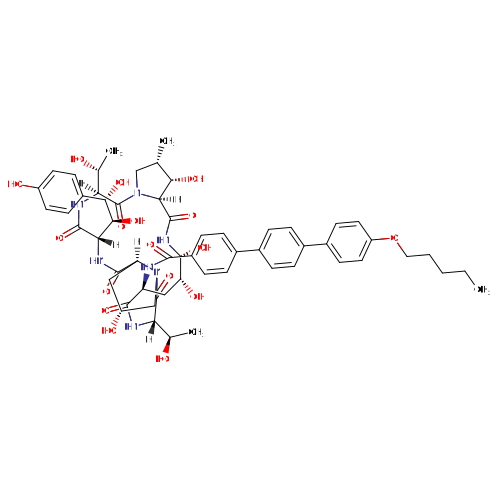
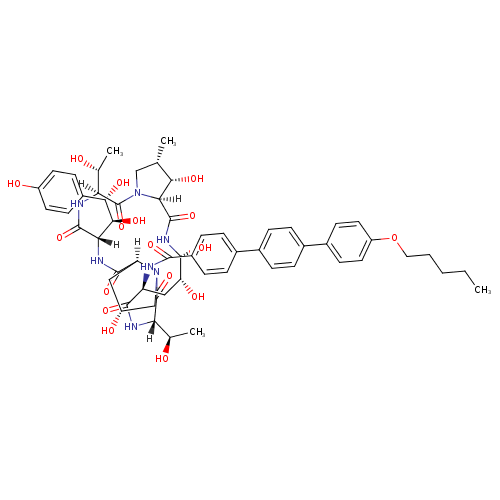
DescriptionAnidulafungin or Eraxis is an anti-fungal drug manufactured by Pfizer that gained approval by the Food and Drug Administration (FDA) in February 21, 2006; it was previously known as LY303366. There is preliminary evidence that it has a similar safety profile to caspofungin.
Contaminant Sources
  • HMDB Contaminants - Urine
  • STOFF IDENT Compounds
  • T3DB toxins
Contaminant Type
  • Amide
  • Amine
  • Antibiotic, Antifungal
  • Antifungal Agent
  • Drug
  • Ester
  • Ether
  • Food Toxin
  • Metabolite
  • Organic Compound
  • Synthetic Compound
Chemical Structure
Thumb
Synonyms
ValueSource
AnidulafunginaChEBI
AnidulafungineChEBI
AnidulafunginumChEBI
EraxisChEBI
1-((4R,5R)-4,5-Dihydroxy-N2-((4''-(pentyloxy)(1,1':4',1''-terphenyl)-4-yl)carbonyl)-L-ornithine)-echinocandin bHMDB
Chemical FormulaC58H73N7O17
Average Molecular Mass1140.237 g/mol
Monoisotopic Mass1139.506 g/mol
CAS Registry Number166663-25-8
IUPAC NameN-[(3S,6S,9S,11R,15S,18S,20R,21R,24S,25S,26S)-6-[(1S,2S)-1,2-dihydroxy-2-(4-hydroxyphenyl)ethyl]-11,20,21,25-tetrahydroxy-3,15-bis[(1R)-1-hydroxyethyl]-26-methyl-2,5,8,14,17,23-hexaoxo-1,4,7,13,16,22-hexaazatricyclo[22.3.0.0⁹,¹³]heptacosan-18-yl]-4-{4-[4-(pentyloxy)phenyl]phenyl}benzamide
Traditional Nameanidulafungin
SMILES[H][C@@]12C[C@@H](O)CN1C(=O)[C@@]([H])(NC(=O)[C@H](C[C@@H](O)[C@@H](O)NC(=O)[C@]1([H])[C@@H](O)[C@@H](C)CN1C(=O)[C@@]([H])(NC(=O)[C@@]([H])(NC2=O)[C@H](O)[C@@H](O)C1=CC=C(O)C=C1)[C@@H](C)O)NC(=O)C1=CC=C(C=C1)C1=CC=C(C=C1)C1=CC=C(OCCCCC)C=C1)[C@@H](C)O
InChI IdentifierInChI=1S/C58H73N7O17/c1-5-6-7-24-82-40-22-18-35(19-23-40)33-10-8-32(9-11-33)34-12-14-37(15-13-34)51(74)59-41-26-43(70)54(77)63-56(79)47-48(71)29(2)27-65(47)58(81)45(31(4)67)61-55(78)46(50(73)49(72)36-16-20-38(68)21-17-36)62-53(76)42-25-39(69)28-64(42)57(80)44(30(3)66)60-52(41)75/h8-23,29-31,39,41-50,54,66-73,77H,5-7,24-28H2,1-4H3,(H,59,74)(H,60,75)(H,61,78)(H,62,76)(H,63,79)/t29-,30+,31+,39+,41-,42-,43+,44-,45-,46-,47-,48-,49-,50-,54+/m0/s1
InChI KeyJHVAMHSQVVQIOT-MFAJLEFUSA-N
Chemical Taxonomy
Description belongs to the class of organic compounds known as pyrimidones. Pyrimidones are compounds that contain a pyrimidine ring, which bears a ketone. Pyrimidine is a 6-membered ring consisting of four carbon atoms and two nitrogen centers at the 1- and 3- ring positions.
KingdomOrganic compounds
Super ClassOrganoheterocyclic compounds
ClassDiazines
Sub ClassPyrimidines and pyrimidine derivatives
Direct ParentPyrimidones
Alternative Parents
Substituents
  • Aminopyrimidine
  • Pyrimidone
  • Hydropyrimidine
  • Imidolactam
  • Organophosphonic acid
  • Organophosphonic acid derivative
  • Heteroaromatic compound
  • Azacycle
  • Organic oxide
  • Organopnictogen compound
  • Primary amine
  • Primary alcohol
  • Organophosphorus compound
  • Organooxygen compound
  • Organonitrogen compound
  • Amine
  • Alcohol
  • Organic oxygen compound
  • Organic nitrogen compound
  • Hydrocarbon derivative
  • Aromatic heteromonocyclic compound
Molecular FrameworkAromatic heteromonocyclic compounds
External Descriptors
Biological Properties
StatusDetected and Not Quantified
OriginExogenous
Cellular Locations
  • Cytoplasm
  • Extracellular
Biofluid LocationsNot Available
Tissue LocationsNot Available
PathwaysNot Available
Applications
Biological Roles
Chemical RolesNot Available
Physical Properties
StateSolid
AppearanceWhite powder.
Experimental Properties
PropertyValue
Melting PointNot Available
Boiling PointNot Available
SolubilityPractically insoluble
Predicted Properties
PropertyValueSource
Water Solubility0.056 g/LALOGPS
logP1.87ALOGPS
logP-1.5ChemAxon
logS-4.3ALOGPS
pKa (Strongest Acidic)9.46ChemAxon
pKa (Strongest Basic)-3.5ChemAxon
Physiological Charge0ChemAxon
Hydrogen Acceptor Count17ChemAxon
Hydrogen Donor Count14ChemAxon
Polar Surface Area377.42 ŲChemAxon
Rotatable Bond Count14ChemAxon
Refractivity292.29 m³·mol⁻¹ChemAxon
Polarizability122.38 ųChemAxon
Number of Rings7ChemAxon
Bioavailability0ChemAxon
Rule of FiveNoChemAxon
Ghose FilterNoChemAxon
Veber's RuleNoChemAxon
MDDR-like RuleYesChemAxon
Spectra
Spectra
Spectrum TypeDescriptionSplash KeyView
Predicted LC-MS/MSPredicted LC-MS/MS Spectrum - 10V, Positivesplash10-0uk9-0900000000-796d08ab3a918780ed58Spectrum
Predicted LC-MS/MSPredicted LC-MS/MS Spectrum - 20V, Positivesplash10-0uk9-2901000001-b967b97492df038b2228Spectrum
Predicted LC-MS/MSPredicted LC-MS/MS Spectrum - 40V, Positivesplash10-00kf-6940121103-1ffee80492a108a9ab34Spectrum
Predicted LC-MS/MSPredicted LC-MS/MS Spectrum - 10V, Negativesplash10-0umu-8900000000-f3d09209ecd555a28150Spectrum
Predicted LC-MS/MSPredicted LC-MS/MS Spectrum - 20V, Negativesplash10-0ftf-9400000005-0db24177f2efbcd59856Spectrum
Predicted LC-MS/MSPredicted LC-MS/MS Spectrum - 40V, Negativesplash10-0fdx-9120000101-b911329bff55a73c856cSpectrum
Predicted LC-MS/MSPredicted LC-MS/MS Spectrum - 10V, Positivesplash10-00dl-5900000000-fd5272e67805a955d868Spectrum
Predicted LC-MS/MSPredicted LC-MS/MS Spectrum - 20V, Positivesplash10-0fkc-5911000000-c9996a3d915462fc95acSpectrum
Predicted LC-MS/MSPredicted LC-MS/MS Spectrum - 40V, Positivesplash10-00di-8691001003-a9aabd89fd55043f4ecfSpectrum
Predicted LC-MS/MSPredicted LC-MS/MS Spectrum - 10V, Negativesplash10-004s-9500000005-47bc884c5a1cca2e1ca0Spectrum
Predicted LC-MS/MSPredicted LC-MS/MS Spectrum - 20V, Negativesplash10-004i-9100000004-1bfb82e496d783ebd965Spectrum
Predicted LC-MS/MSPredicted LC-MS/MS Spectrum - 40V, Negativesplash10-000f-8700001219-2246d0f5f1a232a20f9bSpectrum
1D NMR13C NMR SpectrumNot AvailableSpectrum
1D NMR1H NMR SpectrumNot AvailableSpectrum
1D NMR13C NMR SpectrumNot AvailableSpectrum
1D NMR1H NMR SpectrumNot AvailableSpectrum
1D NMR13C NMR SpectrumNot AvailableSpectrum
1D NMR1H NMR SpectrumNot AvailableSpectrum
1D NMR13C NMR SpectrumNot AvailableSpectrum
1D NMR1H NMR SpectrumNot AvailableSpectrum
1D NMR13C NMR SpectrumNot AvailableSpectrum
1D NMR1H NMR SpectrumNot AvailableSpectrum
1D NMR13C NMR SpectrumNot AvailableSpectrum
1D NMR1H NMR SpectrumNot AvailableSpectrum
1D NMR13C NMR SpectrumNot AvailableSpectrum
1D NMR1H NMR SpectrumNot AvailableSpectrum
1D NMR13C NMR SpectrumNot AvailableSpectrum
1D NMR1H NMR SpectrumNot AvailableSpectrum
1D NMR13C NMR SpectrumNot AvailableSpectrum
1D NMR1H NMR SpectrumNot AvailableSpectrum
1D NMR13C NMR SpectrumNot AvailableSpectrum
1D NMR1H NMR SpectrumNot AvailableSpectrum
Toxicity Profile
Route of ExposureInjection
Mechanism of ToxicityAnidulafungin is a semi-synthetic echinocandin with antifungal activity. Anidulafungin inhibits glucan synthase, an enzyme present in fungal, but not mammalian cells. This results in inhibition of the formation of 1,3-β-D-glucan, an essential component of the fungal cell wall, ultimately leading to osmotic instability and cell death.
MetabolismHepatic metabolism of anidulafungin has not been observed. Anidulafungin is not a clinically relevant substrate, inducer, or inhibitor of cytochrome P450 (CYP450) isoenzymes. Anidulafungin undergoes slow chemical degradation at physiologic temperature and pH to a ring-opened peptide that lacks antifungal activity. Route of Elimination: Less than 1% of the administered radioactive dose was excreted in the urine. Anidulafungin is not hepatically metabolized. Half Life: 40-50 hours
Toxicity ValuesDuring clinical trials a single 400 mg dose of anidulafungin was inadvertently administered as a loading dose. No clinical adverse events were reported. The maximum non-lethal dose of anidulafungin in rats was 50 mg/kg, a dose which is equivalent to 10 times the recommended daily dose for esophageal candidiasis (50mg/day).
Lethal DoseNot Available
Carcinogenicity (IARC Classification)No indication of carcinogenicity to humans (not listed by IARC).
Uses/SourcesFor use in the treatment of the following fungal infections: Candidemia and other forms of Candida infections (intra-abdominal abscess, and peritonitis), Aspergillus infections, and esophageal candidiasis. Also considered an alternative treatment for oropharyngeal canaidiasis.
Minimum Risk LevelNot Available
Health EffectsPossible side effects include allergic reaction; bronchospasm; fever, chills, body aches, flu symptoms, sores in mouth and throat; nausea, upper stomach pain, itching, loss of appetite, dark urine, clay-colored stools, jaundice (yellowing of the skin or eyes); low potassium; hot flashes; diarrhea or constipation; nausea, vomiting. (10)
SymptomsDuring clinical trials a single 400 mg dose of anidulafungin was inadvertently administered as a loading dose. No clinical adverse events were reported. The maximum non-lethal dose of anidulafungin in rats was 50 mg/kg, a dose which is equivalent to 10 times the recommended daily dose for esophageal candidiasis (50mg/day).
TreatmentNot Available
Concentrations
Not Available
DrugBank IDDB00362
HMDB IDHMDB0014506
FooDB IDNot Available
Phenol Explorer IDNot Available
KNApSAcK IDNot Available
BiGG IDNot Available
BioCyc IDNot Available
METLIN IDNot Available
PDB IDNot Available
Wikipedia LinkAnidulafungin
Chemspider ID145752
ChEBI ID55346
PubChem Compound ID166548
Kegg Compound IDNot Available
YMDB IDNot Available
ECMDB IDNot Available
References
Synthesis Reference

Scott Jenkins, Gary Liversidge, Deborah Neville, “Nanoparticulate Anidulafungin Compositions and Methods for Making the Same.” U.S. Patent US20090238867, issued September 24, 2009.

MSDSNot Available
General References
1. https://www.ncbi.nlm.nih.gov/pubmed/?term=15482216
2. https://www.ncbi.nlm.nih.gov/pubmed/?term=16770294
3. https://www.ncbi.nlm.nih.gov/pubmed/?term=17316149
4. https://www.ncbi.nlm.nih.gov/pubmed/?term=19072176
5. https://www.ncbi.nlm.nih.gov/pubmed/?term=19113794
6. https://www.ncbi.nlm.nih.gov/pubmed/?term=19877739
7. https://www.ncbi.nlm.nih.gov/pubmed/?term=19877740
8. https://www.ncbi.nlm.nih.gov/pubmed/?term=19877741
9. https://www.ncbi.nlm.nih.gov/pubmed/?term=19877742
10. https://www.ncbi.nlm.nih.gov/pubmed/?term=24165173
11. https://www.ncbi.nlm.nih.gov/pubmed/?term=24955796
12. https://www.ncbi.nlm.nih.gov/pubmed/?term=25473029
13. Vazquez JA: Anidulafungin: a new echinocandin with a novel profile. Clin Ther. 2005 Jun;27(6):657-73.
14. Vazquez JA, Sobel JD: Anidulafungin: a novel echinocandin. Clin Infect Dis. 2006 Jul 15;43(2):215-22. Epub 2006 Jun 9.
15. Vazquez JA: The safety of anidulafungin. Expert Opin Drug Saf. 2006 Nov;5(6):751-8.
16. Cappelletty D, Eiselstein-McKitrick K: The echinocandins. Pharmacotherapy. 2007 Mar;27(3):369-88.
17. Estes KE, Penzak SR, Calis KA, Walsh TJ: Pharmacology and antifungal properties of anidulafungin, a new echinocandin. Pharmacotherapy. 2009 Jan;29(1):17-30. doi: 10.1592/phco.29.1.17.
18. Morace G, Borghi E, Iatta R, Montagna MT: Anidulafungin, a new echinocandin: in vitro activity. Drugs. 2009;69 Suppl 1:91-4. doi: 10.2165/11315560-000000000-00000.
19. Menichetti F: Anidulafungin, a new echinocandin: effectiveness and tolerability. Drugs. 2009;69 Suppl 1:95-7. doi: 10.2165/11315570-000000000-00000.
20. Grover ND: Echinocandins: A ray of hope in antifungal drug therapy. Indian J Pharmacol. 2010 Feb;42(1):9-11. doi: 10.4103/0253-7613.62396.