Record Information
Version1.0
Creation Date2009-07-21 20:26:38 UTC
Update Date2026-03-26 18:30:00 UTC
Accession NumberCHEM002175
Identification
Common NameCetirizine
ClassSmall Molecule
DescriptionCetirizine is a medication used for the treatment of allergies, hay fever, angioedema, and hives. It is a second-generation H1-receptor antagonist antihistamine and works by blocking H1 histamine receptors. It is a major metabolite of hydroxyzine, and has the same basic side effects, including dry mouth. A potent second-generation histamine H1 antagonist that is effective in the treatment of allergic rhinitis, chronic urticaria, and pollen-induced asthma. Unlike many traditional antihistamines, it does not cause drowsiness or anticholinergic side effects. Cetirizine hydrochloride is a medication used for the treatment of allergies, hay fever, angioedema, and hives. It is a second-generation H1-receptor antagonist antihistamine and works by blocking H1 histamine receptors. It is a major metabolite of hydroxyzine, and has the same basic side effects, including dry mouth.
Contaminant Sources
  • FooDB Chemicals
  • STOFF IDENT Compounds
  • T3DB toxins
Contaminant Type
  • Amine
  • Anti-Allergic Agent
  • Drug
  • Ether
  • Food Toxin
  • Histamine Antagonist
  • Histamine H1 Antagonist, Non-Sedating
  • Metabolite
  • Organic Compound
  • Organochloride
  • Synthetic Compound
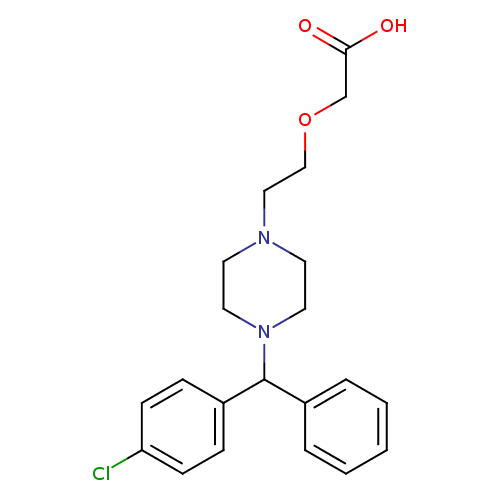
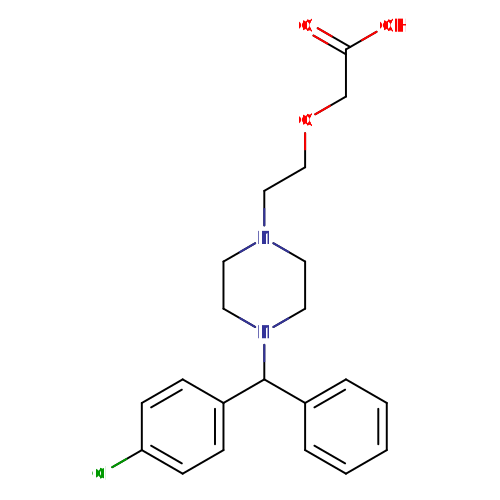
Chemical Structure
Thumb
Synonyms
ValueSource
CetirizinChEBI
CetirizinaChEBI
CetirizinumChEBI
CetidermKegg
BenadayHMDB
Cetirizine hydrochlorideHMDB
HumexHMDB
ReactineHMDB, MeSH
VirlixHMDB, MeSH
ZirtekHMDB, MeSH
ZyrlexHMDB
ZyrtecHMDB, MeSH
Alpharma brand OF cetirizine dihydrochlorideMeSH, HMDB
Ceti-purenMeSH, HMDB
CetiLichMeSH, HMDB
CetirigammaMeSH, HMDB
Cetirizin alMeSH, HMDB
Dihydrochloride, cetirizineMeSH, HMDB
glaxo Wellcome brand OF cetirizine dihydrochlorideMeSH, HMDB
TAD brand OF cetirizine dihydrochlorideMeSH, HMDB
UCB brand OF cetirizine dihydrochlorideMeSH, HMDB
VoltricMeSH, HMDB
CT-Arzneimittel brand OF cetirizine dihydrochlorideMeSH, HMDB
Azupharma brand OF cetirizine dihydrochlorideMeSH, HMDB
Basics brand OF cetirizine dihydrochlorideMeSH, HMDB
CetalergMeSH, HMDB
Dermapharm brand OF cetirizine dihydrochlorideMeSH, HMDB
Krewel brand OF cetirizine dihydrochlorideMeSH, HMDB
Lacer brand OF cetirizine dihydrochlorideMeSH, HMDB
Menarini brand OF cetirizine dihydrochlorideMeSH, HMDB
Pfizer brand OF cetirizine dihydrochlorideMeSH, HMDB
Pfizer consumer healthcare brand OF cetirizine dihydrochlorideMeSH, HMDB
UCB pharma brand OF cetirizine dihydrochlorideMeSH, HMDB
AWD.pharma brand OF cetirizine dihydrochlorideMeSH, HMDB
Aliud brand OF cetirizine dihydrochlorideMeSH, HMDB
Ceti tadMeSH, HMDB
CetiduraMeSH, HMDB
Cetirizin azuMeSH, HMDB
Cetirizine dihydrochlorideMeSH, HMDB
CetirlanMeSH, HMDB
Lichtenstein brand OF cetirizine dihydrochlorideMeSH, HMDB
Rodleben brand OF cetirizineMeSH, HMDB
United drug brand OF cetirizine dihydrochlorideMeSH, HMDB
Wolff brand OF cetirizine dihydrochlorideMeSH, HMDB
(2-(4-((4-Chlorophenyl)phenylmethyl)-1-piperazinyl)ethoxy)acetic acidMeSH, HMDB
AlerlisinMeSH, HMDB
CeterifugMeSH, HMDB
Cetil von CTMeSH, HMDB
Cetirizin basicsMeSH, HMDB
Merck dura brand OF cetirizine dihydrochlorideMeSH, HMDB
Sanofi synthelabo brand OF cetirizine dihydrochlorideMeSH, HMDB
Wörwag brand OF cetirizine dihydrochlorideMeSH, HMDB
ZetirMeSH, HMDB
Chemical FormulaC21H25ClN2O3
Average Molecular Mass388.888 g/mol
Monoisotopic Mass388.155 g/mol
CAS Registry Number83881-51-0
IUPAC Name2-(2-{4-[(4-chlorophenyl)(phenyl)methyl]piperazin-1-yl}ethoxy)acetic acid
Traditional Namecetirizine
SMILESOC(=O)COCCN1CCN(CC1)C(C1=CC=CC=C1)C1=CC=C(Cl)C=C1
InChI IdentifierInChI=1S/C21H25ClN2O3/c22-19-8-6-18(7-9-19)21(17-4-2-1-3-5-17)24-12-10-23(11-13-24)14-15-27-16-20(25)26/h1-9,21H,10-16H2,(H,25,26)
InChI KeyZKLPARSLTMPFCP-UHFFFAOYSA-N
Chemical Taxonomy
Description belongs to the class of organic compounds known as diphenylmethanes. Diphenylmethanes are compounds containing a diphenylmethane moiety, which consists of a methane wherein two hydrogen atoms are replaced by two phenyl groups.
KingdomOrganic compounds
Super ClassBenzenoids
ClassBenzene and substituted derivatives
Sub ClassDiphenylmethanes
Direct ParentDiphenylmethanes
Alternative Parents
Substituents
  • Diphenylmethane
  • Chlorobenzene
  • Halobenzene
  • N-alkylpiperazine
  • Aralkylamine
  • Aryl halide
  • 1,4-diazinane
  • Aryl chloride
  • Piperazine
  • Amino acid
  • Amino acid or derivatives
  • Tertiary amine
  • Tertiary aliphatic amine
  • Organoheterocyclic compound
  • Carboxylic acid derivative
  • Carboxylic acid
  • Dialkyl ether
  • Monocarboxylic acid or derivatives
  • Azacycle
  • Ether
  • Organic oxygen compound
  • Organic nitrogen compound
  • Organopnictogen compound
  • Organohalogen compound
  • Amine
  • Organochloride
  • Organonitrogen compound
  • Carbonyl group
  • Hydrocarbon derivative
  • Organooxygen compound
  • Organic oxide
  • Aromatic heteromonocyclic compound
Molecular FrameworkAromatic heteromonocyclic compounds
External Descriptors
Biological Properties
StatusDetected and Not Quantified
OriginExogenous
Cellular Locations
  • Cytoplasm
  • Extracellular
Biofluid LocationsNot Available
Tissue Locations
  • Brain
  • Skin
PathwaysNot Available
Applications
Biological Roles
Chemical RolesNot Available
Physical Properties
StateSolid
AppearanceWhite powder.
Experimental Properties
PropertyValue
Melting Point112.5°C
Boiling PointNot Available
Solubility101 mg/L
Predicted Properties
PropertyValueSource
Water Solubility0.066 g/LALOGPS
logP2.98ALOGPS
logP0.86ChemAxon
logS-3.8ALOGPS
pKa (Strongest Acidic)3.6ChemAxon
pKa (Strongest Basic)7.79ChemAxon
Physiological Charge0ChemAxon
Hydrogen Acceptor Count5ChemAxon
Hydrogen Donor Count1ChemAxon
Polar Surface Area53.01 ŲChemAxon
Rotatable Bond Count8ChemAxon
Refractivity106.87 m³·mol⁻¹ChemAxon
Polarizability41.88 ųChemAxon
Number of Rings3ChemAxon
Bioavailability1ChemAxon
Rule of FiveYesChemAxon
Ghose FilterYesChemAxon
Veber's RuleNoChemAxon
MDDR-like RuleYesChemAxon
Spectra
Spectra
Spectrum TypeDescriptionSplash KeyView
Predicted GC-MSPredicted GC-MS Spectrum - GC-MS (Non-derivatized) - 70eV, Positivesplash10-0udr-3292000000-e20abaab20740ce81a18Spectrum
Predicted GC-MSPredicted GC-MS Spectrum - GC-MS (1 TMS) - 70eV, Positivesplash10-0uds-7498000000-d6daecf118171395d6b7Spectrum
Predicted GC-MSPredicted GC-MS Spectrum - GC-MS (Non-derivatized) - 70eV, PositiveNot AvailableSpectrum
Predicted GC-MSPredicted GC-MS Spectrum - GC-MS (TBDMS_1_1) - 70eV, PositiveNot AvailableSpectrum
LC-MS/MSLC-MS/MS Spectrum - LC-ESI-ITFT , negativesplash10-000j-0900000000-9801bb859e79fa9922aaSpectrum
LC-MS/MSLC-MS/MS Spectrum - LC-ESI-ITFT , negativesplash10-000i-0009000000-014b559d56b0f32984ffSpectrum
LC-MS/MSLC-MS/MS Spectrum - LC-ESI-ITFT , negativesplash10-000i-0009000000-213bd47e17d5ab69ad4bSpectrum
LC-MS/MSLC-MS/MS Spectrum - LC-ESI-ITFT , negativesplash10-004r-9006000000-f496e22c8e0e293fe98cSpectrum
LC-MS/MSLC-MS/MS Spectrum - LC-ESI-ITFT , negativesplash10-000i-0009000000-d8a55ab1a7aff0580a91Spectrum
LC-MS/MSLC-MS/MS Spectrum - LC-ESI-ITFT , negativesplash10-000i-0009000000-dc957bb6f947575ae4faSpectrum
LC-MS/MSLC-MS/MS Spectrum - LC-ESI-ITFT , negativesplash10-000b-0900000000-48fc0581ff9fff15e16dSpectrum
LC-MS/MSLC-MS/MS Spectrum - LC-ESI-ITFT , negativesplash10-000i-0009000000-04ca95fadd952d0aaeb8Spectrum
LC-MS/MSLC-MS/MS Spectrum - LC-ESI-ITFT , negativesplash10-000i-0009000000-014b559d56b0f32984ffSpectrum
LC-MS/MSLC-MS/MS Spectrum - LC-ESI-ITFT , negativesplash10-0006-0009000000-26a7769df28c2325ec53Spectrum
LC-MS/MSLC-MS/MS Spectrum - LC-ESI-ITFT , negativesplash10-0006-0009000000-284c2e7b25733d7c9875Spectrum
LC-MS/MSLC-MS/MS Spectrum - LC-ESI-QFT , negativesplash10-000i-0009000000-04befed283d691217ba2Spectrum
LC-MS/MSLC-MS/MS Spectrum - LC-ESI-ITFT , positivesplash10-0udi-0190000000-14715ff4d57580fbb166Spectrum
LC-MS/MSLC-MS/MS Spectrum - LC-ESI-ITFT , positivesplash10-0f79-0069000000-431df9c3533b77cf08bcSpectrum
LC-MS/MSLC-MS/MS Spectrum - LC-ESI-ITFT , positivesplash10-0udi-0090000000-e042b67e2048318e7dbdSpectrum
LC-MS/MSLC-MS/MS Spectrum - LC-ESI-ITFT , positivesplash10-0udi-0190000000-b0dfb67717c01fd0c0b9Spectrum
LC-MS/MSLC-MS/MS Spectrum - LC-ESI-ITFT , positivesplash10-0gb9-0970000000-e2810b242fefb4a419e7Spectrum
LC-MS/MSLC-MS/MS Spectrum - LC-ESI-ITFT , positivesplash10-014i-0900000000-72f7cddc4ff6d45f98c0Spectrum
Predicted LC-MS/MSPredicted LC-MS/MS Spectrum - 10V, Positivesplash10-000i-0019000000-e2cc239f762011eb0c4dSpectrum
Predicted LC-MS/MSPredicted LC-MS/MS Spectrum - 20V, Positivesplash10-0w2i-1169000000-185e6899ae017256a767Spectrum
Predicted LC-MS/MSPredicted LC-MS/MS Spectrum - 40V, Positivesplash10-0udi-3391000000-bfd70499959ae71093ebSpectrum
Predicted LC-MS/MSPredicted LC-MS/MS Spectrum - 10V, Negativesplash10-000i-0009000000-caf1604c9603d45a6712Spectrum
Predicted LC-MS/MSPredicted LC-MS/MS Spectrum - 20V, Negativesplash10-000i-1119000000-61c40cd9a0e9b76b5e91Spectrum
Predicted LC-MS/MSPredicted LC-MS/MS Spectrum - 40V, Negativesplash10-056r-9162000000-08731719ee47b215e4c7Spectrum
Toxicity Profile
Route of ExposureOral; mean peak plasma concentration (Cmax) of 114 ng/mL at a time (Tmax) of 2.2 hours postdose was observed for cetirizine.
Mechanism of ToxicityCetirizine competes with histamine for binding at H1-receptor sites on the effector cell surface, resulting in suppression of histaminic edema, flare, and pruritus. The low incidence of sedation can be attributed to reduced penetration of cetirizine into the CNS as a result of the less lipophilic carboxyl group on the ethylamine side chain.
Metabolism Half Life: 8.3 hours
Toxicity ValuesNot Available
Lethal DoseNot Available
Carcinogenicity (IARC Classification)No indication of carcinogenicity to humans (not listed by IARC).
Uses/SourcesFor the relief of symptoms associated with seasonal allergic rhinitis, perennial allergic rhinitis and the treatment of the uncomplicated skin manifestations of chronic idiopathic urticaria
Minimum Risk LevelNot Available
Health EffectsOverdosage has been reported with ZYRTEC (cetirizine) . In one adult patient who took 150 mg of ZYRTEC (cetirizine) , the patient was somnolent but did not display any other clinical signs or abnormal blood chemistry or hematology results. In an 18 month old pediatric patient who took an overdose of ZYRTEC (cetirizine) (approximately 180 mg), restlessness and irritability were observed initially; this was followed by drowsiness. (13)
SymptomsSomnolence (sleepiness or unusual drowsiness), restlessness, irritability.
TreatmentShould overdose occur, treatment should be symptomatic or supportive, taking into account any concomitantly ingested medications. There is no known specific antidote to Cetirizine. (13)
Concentrations
Not Available
DrugBank IDNot Available
HMDB IDNot Available
FooDB IDNot Available
Phenol Explorer IDNot Available
KNApSAcK IDNot Available
BiGG IDNot Available
BioCyc IDNot Available
METLIN IDNot Available
PDB IDNot Available
Wikipedia LinkCetirizine
Chemspider ID2577
ChEBI ID3561
PubChem Compound IDNot Available
Kegg Compound IDC07778
YMDB IDNot Available
ECMDB IDNot Available
References
Synthesis Reference

Manne Reddy, “Polymorphic forms of dihydrochloride salts of cetirizine and processes for preparation thereof.” U.S. Patent US20040186112, issued September 23, 2004.

MSDSLink
General References
1. https://www.ncbi.nlm.nih.gov/pubmed/?term=15850951
2. https://www.ncbi.nlm.nih.gov/pubmed/?term=20455340
3. https://www.ncbi.nlm.nih.gov/pubmed/?term=8103703