Record Information
Version1.0
Creation Date2009-07-21 20:26:28 UTC
Update Date2026-03-26 18:30:53 UTC
Accession NumberCHEM002160
Identification
Common NameAtomoxetine
ClassSmall Molecule
DescriptionAtomoxetine is the first non-stimulant drug approved for the treatment of attention-deficit hyperactivity disorder (ADHD). It is sold in the form of the hydrochloride salt of atomoxetine. This chemical is manufactured and marketed under the brand name Strattera; by Eli Lilly and Company and as a generic Attentin by Torrent Pharmaceuticals. There is currently no generic available within the United States due to patent restrictions.
Contaminant Sources
  • HMDB Contaminants - Urine
  • STOFF IDENT Compounds
  • T3DB toxins
  • ToxCast & Tox21 Chemicals
Contaminant Type
  • Adrenergic Uptake Inhibitor
  • Amine
  • Antidepressant
  • Antidepressive Agent
  • Central Nervous System Agent
  • Drug
  • Ether
  • Metabolite
  • Organic Compound
  • Synthetic Compound
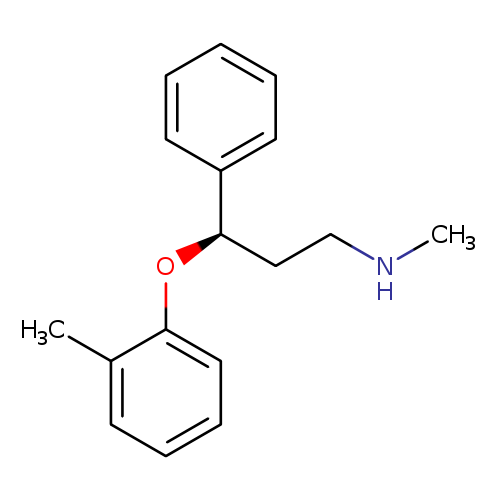
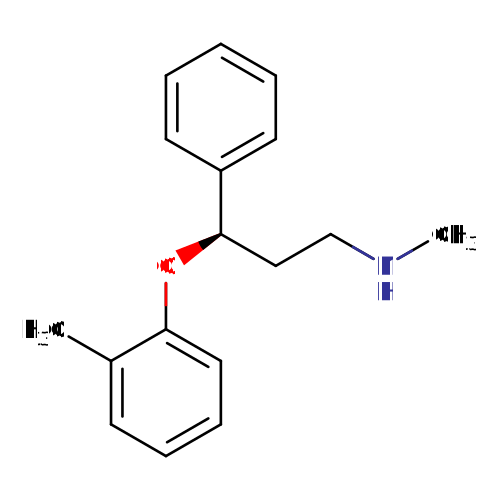
Chemical Structure
Thumb
Synonyms
ValueSource
(-)-TomoxetineChEBI
TomoxetinaChEBI
TomoxetineChEBI
TomoxetinumChEBI
Tomoxetine hydrochloride, (-)-isomerHMDB
HCL, AtomoxetineHMDB
Hydrochloride, atomoxetineHMDB
StratteraHMDB
Atomoxetine hydrochlorideHMDB
Tomoxetine hydrochloride, (+-)-isomerHMDB
Atomoxetine HCLHMDB
N-Methyl-gamma-(2-methylphenoxy)benzenepropanamine hydrochlorideHMDB
Tomoxetine hydrochloride, (+)-isomer - T351671HMDB
Chemical FormulaC17H21NO
Average Molecular Mass255.355 g/mol
Monoisotopic Mass255.162 g/mol
CAS Registry Number82248-59-7
IUPAC Namemethyl[(3R)-3-(2-methylphenoxy)-3-phenylpropyl]amine
Traditional Nameatomoxetine
SMILESCNCC[C@@H](OC1=CC=CC=C1C)C1=CC=CC=C1
InChI IdentifierInChI=1S/C17H21NO/c1-14-8-6-7-11-16(14)19-17(12-13-18-2)15-9-4-3-5-10-15/h3-11,17-18H,12-13H2,1-2H3/t17-/m1/s1
InChI KeyVHGCDTVCOLNTBX-QGZVFWFLSA-N
Chemical Taxonomy
Description belongs to the class of organic compounds known as phenol ethers. These are aromatic compounds containing an ether group substituted with a benzene ring.
KingdomOrganic compounds
Super ClassBenzenoids
ClassPhenol ethers
Sub ClassNot Available
Direct ParentPhenol ethers
Alternative Parents
Substituents
  • Phenoxy compound
  • Phenol ether
  • Alkyl aryl ether
  • Toluene
  • Aralkylamine
  • Monocyclic benzene moiety
  • Secondary aliphatic amine
  • Ether
  • Secondary amine
  • Organooxygen compound
  • Organonitrogen compound
  • Amine
  • Organic nitrogen compound
  • Organic oxygen compound
  • Organopnictogen compound
  • Hydrocarbon derivative
  • Aromatic homomonocyclic compound
Molecular FrameworkAromatic homomonocyclic compounds
External Descriptors
Biological Properties
StatusDetected and Not Quantified
OriginExogenous
Cellular Locations
  • Membrane
Biofluid LocationsNot Available
Tissue LocationsNot Available
PathwaysNot Available
Applications
Biological Roles
Chemical RolesNot Available
Physical Properties
StateSolid
AppearanceWhite powder.
Experimental Properties
PropertyValue
Melting PointNot Available
Boiling PointNot Available
Solubility27.8 mg/mL
Predicted Properties
PropertyValueSource
Water Solubility0.0039 g/LALOGPS
logP3.95ALOGPS
logP3.81ChemAxon
logS-4.8ALOGPS
pKa (Strongest Basic)9.8ChemAxon
Physiological Charge1ChemAxon
Hydrogen Acceptor Count2ChemAxon
Hydrogen Donor Count1ChemAxon
Polar Surface Area21.26 ŲChemAxon
Rotatable Bond Count6ChemAxon
Refractivity79.44 m³·mol⁻¹ChemAxon
Polarizability29.79 ųChemAxon
Number of Rings2ChemAxon
Bioavailability1ChemAxon
Rule of FiveYesChemAxon
Ghose FilterYesChemAxon
Veber's RuleYesChemAxon
MDDR-like RuleNoChemAxon
Spectra
Spectra
Spectrum TypeDescriptionSplash KeyView
Predicted GC-MSPredicted GC-MS Spectrum - GC-MS (Non-derivatized) - 70eV, Positivesplash10-0007-9510000000-b436c1286414de57d10eSpectrum
Predicted GC-MSPredicted GC-MS Spectrum - GC-MS (Non-derivatized) - 70eV, PositiveNot AvailableSpectrum
LC-MS/MSLC-MS/MS Spectrum - LC-ESI-qTof , Positivesplash10-0a4i-0690000000-494128ae0f3b90b415b3Spectrum
LC-MS/MSLC-MS/MS Spectrum - LC-ESI-ITFT , positivesplash10-0002-0900000000-456e1257123470a131c2Spectrum
LC-MS/MSLC-MS/MS Spectrum - LC-ESI-ITFT , positivesplash10-0a4i-0190000000-0f4cf059747adb026b96Spectrum
LC-MS/MSLC-MS/MS Spectrum - LC-ESI-ITFT , positivesplash10-0a4i-0090000000-ecaeebd63dc195659e57Spectrum
LC-MS/MSLC-MS/MS Spectrum - LC-ESI-ITFT , positivesplash10-0002-0900000000-6da1a9a3edfed770c2cdSpectrum
LC-MS/MSLC-MS/MS Spectrum - LC-ESI-ITFT , positivesplash10-00xs-0900000000-d71f5b857319380ce595Spectrum
LC-MS/MSLC-MS/MS Spectrum - LC-ESI-ITFT , positivesplash10-01bc-2900000000-37eb3191934e545cc338Spectrum
LC-MS/MSLC-MS/MS Spectrum - LC-ESI-ITFT , positivesplash10-014l-6900000000-6be893f7d4702639eac2Spectrum
LC-MS/MSLC-MS/MS Spectrum - LC-ESI-ITFT , positivesplash10-0a4i-0190000000-c2030f3f981d83eacf57Spectrum
LC-MS/MSLC-MS/MS Spectrum - LC-ESI-ITFT , positivesplash10-0a4i-0190000000-3c27da7fa8c958a76be1Spectrum
LC-MS/MSLC-MS/MS Spectrum - LC-ESI-ITFT , positivesplash10-0002-0900000000-133c9cb2f2383aa0fe8aSpectrum
LC-MS/MSLC-MS/MS Spectrum - LC-ESI-ITFT , positivesplash10-00r5-1900000000-b68a2013855cb02e4512Spectrum
LC-MS/MSLC-MS/MS Spectrum - LC-ESI-ITFT , positivesplash10-01bd-1900000000-c4fd6863785e44cc724eSpectrum
LC-MS/MSLC-MS/MS Spectrum - LC-ESI-ITFT , positivesplash10-014l-3900000000-4529fcb6c89f3acafac9Spectrum
LC-MS/MSLC-MS/MS Spectrum - LC-ESI-ITFT , positivesplash10-0002-0900000000-06348bdc8d24fed52e75Spectrum
LC-MS/MSLC-MS/MS Spectrum - , positivesplash10-0a4i-0690000000-494128ae0f3b90b415b3Spectrum
LC-MS/MSLC-MS/MS Spectrum - 45V, Positivesplash10-0002-0900000000-133c9cb2f2383aa0fe8aSpectrum
LC-MS/MSLC-MS/MS Spectrum - 30V, Positivesplash10-0a4i-0190000000-3c27da7fa8c958a76be1Spectrum
LC-MS/MSLC-MS/MS Spectrum - 45V, Positivesplash10-0002-0900000000-6da1a9a3edfed770c2cdSpectrum
Predicted LC-MS/MSPredicted LC-MS/MS Spectrum - 10V, Positivesplash10-0a6r-0090000000-baa3d0729ad3bb59a89fSpectrum
Predicted LC-MS/MSPredicted LC-MS/MS Spectrum - 20V, Positivesplash10-054p-7690000000-47a6bba7ee3a8fb547e3Spectrum
Predicted LC-MS/MSPredicted LC-MS/MS Spectrum - 40V, Positivesplash10-0006-9400000000-2bb86246ec7cd0612674Spectrum
Predicted LC-MS/MSPredicted LC-MS/MS Spectrum - 10V, Negativesplash10-0udi-0090000000-02a8368dee3cab1e1702Spectrum
Predicted LC-MS/MSPredicted LC-MS/MS Spectrum - 20V, Negativesplash10-0udi-2290000000-6d5c426420a70e542e1cSpectrum
Predicted LC-MS/MSPredicted LC-MS/MS Spectrum - 40V, Negativesplash10-0a6r-9710000000-6adb2c5abb0cab9b62a8Spectrum
Toxicity Profile
Route of ExposureAtomoxetine is rapidly absorbed after oral administration, with absolute bioavailability of about 63% in EMs and 94% in PMs. Drugs that elevate gastric pH (magnesium hydroxide/aluminum hydroxide, omeprazole) have no effect on atomoxetine bioavailability. Absorption is minimally affected by food.
Mechanism of ToxicityThe precise mechanism by which atomoxetine produces its therapeutic effects in Attention-Deficit/Hyperactivity Disorder (ADHD) is unknown, but is thought to be related to selective inhibition of the pre-synaptic norepinephrine transporter, as determined through in-vitro studies. Atomoxetine appears to have minimal affinity for other noradrenergic receptors or for other neurotransmitter transporters or receptors.
MetabolismAtomoxetine is primarily metabolized by the CYP2D6 pathway to 4-hydroxyatomoxetine. 4-Hydroxyatomoxetine is equipotent to atomoxetine as an inhibitor of the norepinephrine transporter but circulates in plasma at much lower concentrations (1% of atomoxetine concentration in EMs and 0.1% of atomoxetine concentration in PMs). Half Life: 5 hours
Toxicity ValuesNot Available
Lethal DoseNot Available
Carcinogenicity (IARC Classification)No indication of carcinogenicity to humans (not listed by IARC).
Uses/SourcesFor the treatment of Attention-Deficit/Hyperactivity Disorder (ADHD) alone or in combination with behavioral treatment, as an adjunct to psychological, educational, social, and other remedial measures.
Minimum Risk LevelNot Available
Health EffectsNot Available
SymptomsThe most commonly reported symptoms accompanying acute and chronic overdoses are somnolence, agitation, hyperactivity, abnormal behavior, and gastrointestinal symptoms.
TreatmentAn airway should be established. Monitoring of cardiac and vital signs is recommended, along with appropriate symptomatic and supportive measures. Gastric lavage may be indicated if performed soon after ingestion. Activated charcoal may be useful in limiting absorption. Because atomoxetine is highly protein-bound, dialysis is not likely to be useful in the treatment of overdose. (10)
Concentrations
Not Available
DrugBank IDDB00289
HMDB IDHMDB0014434
FooDB IDNot Available
Phenol Explorer IDNot Available
KNApSAcK IDNot Available
BiGG IDNot Available
BioCyc IDNot Available
METLIN IDNot Available
PDB IDNot Available
Wikipedia LinkAtomoxetine
Chemspider ID49516
ChEBI ID127342
PubChem Compound ID54841
Kegg Compound IDNot Available
YMDB IDNot Available
ECMDB IDNot Available
References
Synthesis Reference

Judith Aronhime, Stefano Bianchi, Eugenio Castelli, Paola Daverio, Silvia Mantovani, Adrienne Kovacsne-Mezei, “Processes for the preparation of atomoxetine hydrochloride.” U.S. Patent US20060211772, issued September 21, 2006.

MSDSNot Available
General References
1. Kratochvil CJ, Newcorn JH, Arnold LE, Duesenberg D, Emslie GJ, Quintana H, Sarkis EH, Wagner KD, Gao H, Michelson D, Biederman J: Atomoxetine alone or combined with fluoxetine for treating ADHD with comorbid depressive or anxiety symptoms. J Am Acad Child Adolesc Psychiatry. 2005 Sep;44(9):915-24.
2. Purper-Ouakil D, Fourneret P, Wohl M, Reneric JP: [Atomoxetine: a new treatment for Attention Deficit/Hyperactivity Disorder (ADHD) in children and adolescents]. Encephale. 2005 May-Jun;31(3):337-48.
3. Carpenter LL, Milosavljevic N, Schecter JM, Tyrka AR, Price LH: Augmentation with open-label atomoxetine for partial or nonresponse to antidepressants. J Clin Psychiatry. 2005 Oct;66(10):1234-8.
4. Pilhatsch MK, Burghardt R, Wandinger KP, Bauer M, Adli M: Augmentation with atomoxetine in treatment-resistant depression with psychotic features. A case report. Pharmacopsychiatry. 2006 Mar;39(2):79-80.
5. Spencer TJ, Faraone SV, Michelson D, Adler LA, Reimherr FW, Glatt SJ, Biederman J: Atomoxetine and adult attention-deficit/hyperactivity disorder: the effects of comorbidity. J Clin Psychiatry. 2006 Mar;67(3):415-20.
6. McElroy SL, Guerdjikova A, Kotwal R, Welge JA, Nelson EB, Lake KA, Keck PE Jr, Hudson JI: Atomoxetine in the treatment of binge-eating disorder: a randomized placebo-controlled trial. J Clin Psychiatry. 2007 Mar;68(3):390-8.
7. Gaillez C, Sorbara F, Perrin E: [Atomoxetine (Strattera), an alternative in the treatment of attention-deficit/hyperactivity disorder (ADHD) in children]. Encephale. 2007 Sep;33(4 Pt 1):621-8.
8. Montoya A, Hervas A, Cardo E, Artigas J, Mardomingo MJ, Alda JA, Gastaminza X, Garcia-Polavieja MJ, Gilaberte I, Escobar R: Evaluation of atomoxetine for first-line treatment of newly diagnosed, treatment-naive children and adolescents with attention deficit/hyperactivity disorder. Curr Med Res Opin. 2009 Nov;25(11):2745-54. doi: 10.1185/03007990903316152.
9. https://www.ncbi.nlm.nih.gov/pubmed/?term=15338851
10. https://www.ncbi.nlm.nih.gov/pubmed/?term=23048018