Record Information
Version1.0
Creation Date2009-07-21 20:26:24 UTC
Update Date2026-03-31 18:53:50 UTC
Accession NumberCHEM002154
Identification
Common NamePhenytoin
ClassSmall Molecule
DescriptionAn anticonvulsant that is used in a wide variety of seizures. It is also an anti-arrhythmic and a muscle relaxant. The mechanism of therapeutic action is not clear, although several cellular actions have been described including effects on ion channels, active transport, and general membrane stabilization. The mechanism of its muscle relaxant effect appears to involve a reduction in the sensitivity of muscle spindles to stretch. Phenytoin has been proposed for several other therapeutic uses, but its use has been limited by its many adverse effects and interactions with other drugs.
Contaminant Sources
  • Clean Air Act Chemicals
  • HMDB Contaminants - Urine
  • HPV EPA Chemicals
  • IARC Carcinogens Group 2B
  • STOFF IDENT Compounds
  • Suspected Compounds
  • T3DB toxins
  • ToxCast & Tox21 Chemicals
Contaminant Type
  • Amide
  • Amine
  • Anticonvulsant
  • Drug
  • Metabolite
  • Organic Compound
  • Synthetic Compound
  • Voltage-Gated Sodium Channel Blocker
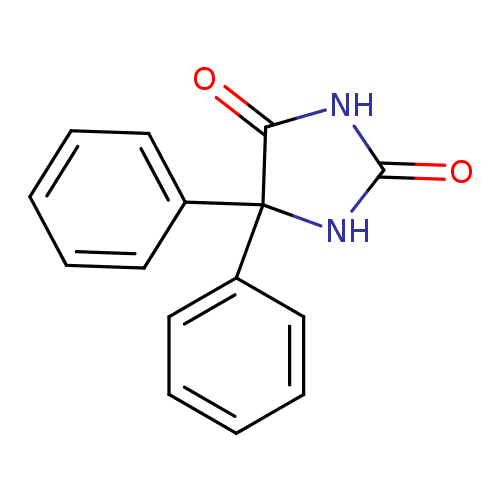
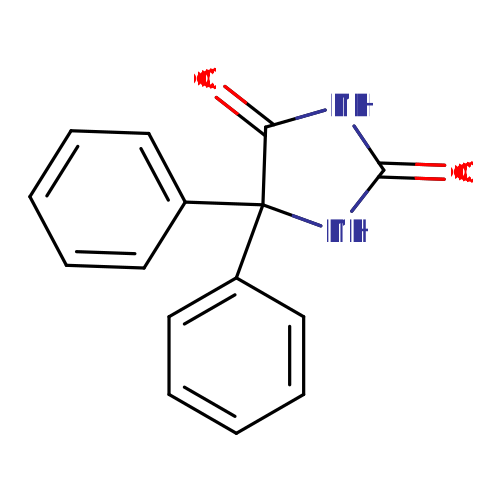
Chemical Structure
Thumb
Synonyms
ValueSource
5,5-Diphenyl-imidazolidine-2,4-dioneChEBI
5,5-Diphenylimidazolidine-2,4-dioneChEBI
5,5-Diphenyltetrahydro-1H-2,4-imidazoledioneChEBI
DILANTINChEBI
FenitoinaChEBI
PHENTYTOINChEBI
PhenytoineChEBI
PhenytoinumChEBI
5,5-DiphenylhydantoinHMDB
5,5-DwufenylohydantoinaHMDB
DihydantoinHMDB
Diphenylan sodiumHMDB
DiphenylhydantoinHMDB
DiphenylhydatanoinHMDB
Phenytoin sodiumHMDB
DifeninHMDB
Diphenylhydantoinate, sodiumHMDB
Park davis brand OF phenytoinHMDB
Pfizer brand OF phenytoinHMDB
Sodium diphenylhydantoinateHMDB
DihydanHMDB
EpaminHMDB
Phenytoin pfizer brandHMDB
AntisacerHMDB
EpanutinHMDB
HydantolHMDB
Phenytoin phizer brandHMDB
FenitoinHMDB
Phizer brand OF phenytoinHMDB
Chemical FormulaC15H12N2O2
Average Molecular Mass252.268 g/mol
Monoisotopic Mass252.090 g/mol
CAS Registry Number57-41-0
IUPAC Name5,5-diphenylimidazolidine-2,4-dione
Traditional Namesilantin
SMILESO=C1NC(=O)C(N1)(C1=CC=CC=C1)C1=CC=CC=C1
InChI IdentifierInChI=1S/C15H12N2O2/c18-13-15(17-14(19)16-13,11-7-3-1-4-8-11)12-9-5-2-6-10-12/h1-10H,(H2,16,17,18,19)
InChI KeyCXOFVDLJLONNDW-UHFFFAOYSA-N
Chemical Taxonomy
Description belongs to the class of organic compounds known as phenylhydantoins. These are heterocyclic aromatic compounds containing an imiazolidinedione moiety substituted by a phenyl group.
KingdomOrganic compounds
Super ClassOrganoheterocyclic compounds
ClassAzolidines
Sub ClassImidazolidines
Direct ParentPhenylhydantoins
Alternative Parents
Substituents
  • Diphenylmethane
  • 5-phenylhydantoin
  • Phenylimidazolidine
  • Alpha-amino acid or derivatives
  • 5-monosubstituted hydantoin
  • N-acyl urea
  • Ureide
  • Monocyclic benzene moiety
  • Benzenoid
  • Dicarboximide
  • Urea
  • Carbonic acid derivative
  • Carboxylic acid derivative
  • Azacycle
  • Hydrocarbon derivative
  • Organic oxide
  • Organooxygen compound
  • Organonitrogen compound
  • Organopnictogen compound
  • Organic oxygen compound
  • Carbonyl group
  • Organic nitrogen compound
  • Aromatic heteromonocyclic compound
Molecular FrameworkAromatic heteromonocyclic compounds
External Descriptors
Biological Properties
StatusDetected and Not Quantified
OriginExogenous
Cellular Locations
  • Cytoplasm
  • Extracellular
  • Membrane
Biofluid LocationsNot Available
Tissue LocationsNot Available
PathwaysNot Available
Applications
Biological Roles
Chemical RolesNot Available
Physical Properties
StateSolid
AppearanceWhite powder.
Experimental Properties
PropertyValue
Melting Point286°C
Boiling PointNot Available
Solubility32 mg/L (at 22°C)
Predicted Properties
PropertyValueSource
Water Solubility0.071 g/LALOGPS
logP2.26ALOGPS
logP2.15ChemAxon
logS-3.6ALOGPS
pKa (Strongest Acidic)8.49ChemAxon
pKa (Strongest Basic)-9ChemAxon
Physiological Charge0ChemAxon
Hydrogen Acceptor Count2ChemAxon
Hydrogen Donor Count2ChemAxon
Polar Surface Area58.2 ŲChemAxon
Rotatable Bond Count2ChemAxon
Refractivity70.18 m³·mol⁻¹ChemAxon
Polarizability25.48 ųChemAxon
Number of Rings3ChemAxon
Bioavailability1ChemAxon
Rule of FiveYesChemAxon
Ghose FilterYesChemAxon
Veber's RuleNoChemAxon
MDDR-like RuleNoChemAxon
Spectra
Spectra
Spectrum TypeDescriptionSplash KeyView
GC-MSGC-MS Spectrum - EI-B (Non-derivatized)splash10-003r-7930000000-447969b9c242748dd943Spectrum
GC-MSGC-MS Spectrum - CI-B (Non-derivatized)splash10-0udi-0090000000-4176043a7a73caee2667Spectrum
GC-MSGC-MS Spectrum - EI-B (Non-derivatized)splash10-0zgi-5960000000-e1dcb47a1c082f04f456Spectrum
GC-MSGC-MS Spectrum - CI-B (Non-derivatized)splash10-0udi-1390000000-22c71a7e4dbf9c7acab5Spectrum
GC-MSGC-MS Spectrum - CI-B (Non-derivatized)splash10-0udi-2190000000-50174e33af92b04d1a6eSpectrum
GC-MSGC-MS Spectrum - EI-B (Non-derivatized)splash10-003r-7930000000-447969b9c242748dd943Spectrum
GC-MSGC-MS Spectrum - CI-B (Non-derivatized)splash10-0udi-0090000000-4176043a7a73caee2667Spectrum
GC-MSGC-MS Spectrum - EI-B (Non-derivatized)splash10-0zgi-5960000000-e1dcb47a1c082f04f456Spectrum
GC-MSGC-MS Spectrum - CI-B (Non-derivatized)splash10-0udi-1390000000-22c71a7e4dbf9c7acab5Spectrum
GC-MSGC-MS Spectrum - CI-B (Non-derivatized)splash10-0udi-2190000000-50174e33af92b04d1a6eSpectrum
Predicted GC-MSPredicted GC-MS Spectrum - GC-MS (Non-derivatized) - 70eV, Positivesplash10-00lr-0920000000-edf72a4c297e405a2600Spectrum
Predicted GC-MSPredicted GC-MS Spectrum - GC-MS (Non-derivatized) - 70eV, PositiveNot AvailableSpectrum
LC-MS/MSLC-MS/MS Spectrum - LC-ESI-qTof , Positivesplash10-001i-0950000000-a80521d4dc3976a29b2cSpectrum
LC-MS/MSLC-MS/MS Spectrum - LC-ESI-qTof , Positivesplash10-0ue9-2900000000-a58471ae75fa7319c03dSpectrum
LC-MS/MSLC-MS/MS Spectrum - LC-ESI-QFT , negativesplash10-0udi-0090000000-aaae845342f345f89695Spectrum
LC-MS/MSLC-MS/MS Spectrum - LC-ESI-QFT , negativesplash10-0udi-0390000000-f8da1896c569c120faa2Spectrum
LC-MS/MSLC-MS/MS Spectrum - LC-ESI-QFT , negativesplash10-0udi-0920000000-07c872b05aade63c402bSpectrum
LC-MS/MSLC-MS/MS Spectrum - LC-ESI-QFT , negativesplash10-0udi-0900000000-be6790637be99260525eSpectrum
LC-MS/MSLC-MS/MS Spectrum - LC-ESI-QFT , negativesplash10-0udi-0900000000-9a17fa0b243c8282f3baSpectrum
LC-MS/MSLC-MS/MS Spectrum - LC-ESI-QFT , negativesplash10-0udi-0900000000-69302626996b2b24c153Spectrum
LC-MS/MSLC-MS/MS Spectrum - LC-ESI-QFT , positivesplash10-0fai-0690000000-f9eeceb82d117127f6eaSpectrum
LC-MS/MSLC-MS/MS Spectrum - LC-ESI-QFT , positivesplash10-001i-0910000000-9edcfc62014a6aa7778fSpectrum
LC-MS/MSLC-MS/MS Spectrum - LC-ESI-QFT , positivesplash10-001i-0900000000-d4dde5db680fb7722a49Spectrum
LC-MS/MSLC-MS/MS Spectrum - LC-ESI-QFT , positivesplash10-0ue9-0900000000-482874b33812389ae726Spectrum
LC-MS/MSLC-MS/MS Spectrum - LC-ESI-QFT , positivesplash10-0udi-0900000000-44f07dc29daf8cdf80c2Spectrum
LC-MS/MSLC-MS/MS Spectrum - LC-ESI-QFT , positivesplash10-0udi-1900000000-1241292d531ed37544c7Spectrum
LC-MS/MSLC-MS/MS Spectrum - , positivesplash10-001i-0950000000-a80521d4dc3976a29b2cSpectrum
LC-MS/MSLC-MS/MS Spectrum - , positivesplash10-0ue9-2900000000-a58471ae75fa7319c03dSpectrum
LC-MS/MSLC-MS/MS Spectrum - 45V, Negativesplash10-0udi-0920000000-97a0af331da9afcf54b8Spectrum
LC-MS/MSLC-MS/MS Spectrum - 60V, Negativesplash10-0udi-0900000000-9918b159c9e50b11016fSpectrum
LC-MS/MSLC-MS/MS Spectrum - 90V, Negativesplash10-0udi-0900000000-c2ba734800c5db1b68cfSpectrum
Predicted LC-MS/MSPredicted LC-MS/MS Spectrum - 10V, Positivesplash10-0udi-0290000000-168825c4263cc790be0bSpectrum
Predicted LC-MS/MSPredicted LC-MS/MS Spectrum - 20V, Positivesplash10-0f89-0950000000-27e345a92f7734114654Spectrum
Predicted LC-MS/MSPredicted LC-MS/MS Spectrum - 40V, Positivesplash10-0uyi-1900000000-5828317e8dac2d03e548Spectrum
Predicted LC-MS/MSPredicted LC-MS/MS Spectrum - 10V, Negativesplash10-0udi-0090000000-e1551530faa59a549515Spectrum
Predicted LC-MS/MSPredicted LC-MS/MS Spectrum - 20V, Negativesplash10-0udi-1190000000-354c210fa308dab349f3Spectrum
Predicted LC-MS/MSPredicted LC-MS/MS Spectrum - 40V, Negativesplash10-0006-9700000000-d5833bfc084997249fe4Spectrum
MSMass Spectrum (Electron Ionization)splash10-0f89-4940000000-2a0dda513d9f63dc6610Spectrum
1D NMR1H NMR SpectrumNot AvailableSpectrum
1D NMR13C NMR SpectrumNot AvailableSpectrum
Toxicity Profile
Route of ExposureIntravenous, Oral, Intramuscular. Bioavailability 70-100% oral, 24.4% for rectal and intravenous administration. Rapid rate of absorption with peak blood concentration expected in 1½ to 3 hours.
Mechanism of ToxicityPhenytoin acts on sodium channels on the neuronal cell membrane, limiting the spread of seizure activity and reducing seizure propagation. By promoting sodium efflux from neurons, phenytoin tends to stabilize the threshold against hyperexcitability caused by excessive stimulation or environmental changes capable of reducing membrane sodium gradient. This includes the reduction of post-tetanic potentiation at synapses. Loss of post-tetanic potentiation prevents cortical seizure foci from detonating adjacent cortical areas.
MetabolismPrimarily hepatic. The majority of the dose (up to 90%) is metabolized to 5-(4'-hydroxyphenyl)-5-phenylhydantoin (p-HPPH). This metabolite undergoes further glucuronidation and is excreted into the urine. CYP2C19 and CYP2C9 catalyze the aforementioned reaction. Route of Elimination: Most of the drug is excreted in the bile as inactive metabolites which are then reabsorbed from the intestinal tract and excreted in the urine. Urinary excretion of phenytoin and its metabolites occurs partly with glomerular filtration but, more importantly, by tubular secretion. Half Life: 22 hours (range of 7 to 42 hours)
Toxicity ValuesOral, mouse: LD50 = 150 mg/kg; Oral, rat: LD50 = 1635 mg/kg.
Lethal DoseNot Available
Carcinogenicity (IARC Classification)2B, possibly carcinogenic to humans. (1)
Uses/SourcesFor the control of generalized tonic-clonic (grand mal) and complex partial (psychomotor, temporal lobe) seizures and prevention and treatment of seizures occurring during or following neurosurgery.
Minimum Risk LevelNot Available
Health EffectsMay cause a potentially dangerous rash that may develop into Stevens Johnson syndrome, an extremely rare but potentially fatal skin disease.
SymptomsSymptoms of overdose include coma, difficulty in pronouncing words correctly, involuntary eye movement, lack of muscle coordination, low blood pressure, nausea, sluggishness, slurred speech, tremors, and vomiting.
TreatmentTreatment is nonspecific since there is no known antidote. The adequacy of the respiratory and circulatory systems should be carefully observed and appropriate supportive measures employed. Hemodialysis can be considered since phenytoin is not completely bound to plasma proteins. Total exchange transfusion has been used in the treatment of severe intoxication in pediatric patients. (3)
Concentrations
Not Available
DrugBank IDDB00252
HMDB IDHMDB0014397
FooDB IDNot Available
Phenol Explorer IDNot Available
KNApSAcK IDNot Available
BiGG IDNot Available
BioCyc IDNot Available
METLIN IDNot Available
PDB IDNot Available
Wikipedia LinkPhenytoin
Chemspider ID1710
ChEBI ID8107
PubChem Compound ID1775
Kegg Compound IDC07443
YMDB IDNot Available
ECMDB IDNot Available
References
Synthesis Reference

Mahdi B. Fawzi, Anne K. Taylor, “Parenteral phenytoin preparations.” U.S. Patent US4642316, issued April, 1981.

MSDSLink
General References
1. https://www.ncbi.nlm.nih.gov/pubmed/?term=10698828
2. https://www.ncbi.nlm.nih.gov/pubmed/?term=12952753
3. https://www.ncbi.nlm.nih.gov/pubmed/?term=15246836
4. https://www.ncbi.nlm.nih.gov/pubmed/?term=15744730
5. https://www.ncbi.nlm.nih.gov/pubmed/?term=16303054
6. https://www.ncbi.nlm.nih.gov/pubmed/?term=7105825
7. https://www.ncbi.nlm.nih.gov/pubmed/?term=7602118
8. https://www.ncbi.nlm.nih.gov/pubmed/?term=9186244
9. PharmGKB: https://www.pharmgkb.org/pathway/PA145011115