Record Information
Version1.0
Creation Date2009-07-21 20:26:24 UTC
Update Date2026-05-14 16:24:55 UTC
Accession NumberCHEM002153
Identification
Common NameCabergoline
ClassSmall Molecule
DescriptionCabergoline is only found in individuals that have used or taken this drug. It is a long-acting dopamine agonist and prolactin inhibitor. It is used to treat hyperprolactinemic disorders and Parkinsonian Syndrome. Cabergoline possesses potent agonist activity on dopamine D2 receptors. The dopamine D2 receptor is a 7-transmembrane G-protein coupled receptor associated with Gi proteins. In lactotrophs, stimulation of dopamine D2 causes inhibition of adenylyl cyclase, which decreases intracellular cAMP concentrations and blocks IP3-dependent release of Ca2+ from intracellular stores. Decreases in intracellular calcium levels may also be brought about via inhibition of calcium influx through voltage-gated calcium channels, rather than via inhibition of adenylyl cyclase. Additionally, receptor activation blocks phosphorylation of p42/p44 MAPK and decreases MAPK/ERK kinase phosphorylation. Inhibition of MAPK appears to be mediated by c-Raf and B-Raf-dependent inhibition of MAPK/ERK kinase. Dopamine-stimulated growth hormone release from the pituitary gland is mediated by a decrease in intracellular calcium influx through voltage-gated calcium channels rather than via adenylyl cyclase inhibition. Stimulation of dopamine D2 receptors in the nigrostriatal pathway leads to improvements in coordinated muscle activity in those with movement disorders. Cabergoline is a long-acting dopamine receptor agonist with a high affinity for D2 receptors. Receptor-binding studies indicate that cabergoline has low affinity for dopamine D1, alpha1,- and alpha2- adrenergic, and 5-HT1- and 5-HT2-serotonin receptors.
Contaminant Sources
  • HMDB Contaminants - Urine
  • STOFF IDENT Compounds
  • T3DB toxins
  • ToxCast & Tox21 Chemicals
Contaminant Type
  • Amide
  • Amine
  • Antineoplastic Agent
  • Antiparkinson Agent
  • Dopamine Agonist
  • Drug
  • Human Neurotoxin
  • Metabolite
  • Organic Compound
  • Synthetic Compound
Chemical Structure
Thumb
Synonyms
ValueSource
(8beta)-N-[3-(Dimethylamino)propyl]-N-[(ethylamino)carbonyl]-6-(2-propenyl)-ergoline-8-carboxamideChEBI
(8R)-6-Allyl-N-[3-(dimethylamino)propyl]-N-(ethylcarbamoyl)ergoline-8-carboxamideChEBI
1-((6-Allylergolin-8beta-yl)carbonyl)-1-(3-(dimethylamino)propyl)-3-ethylureaChEBI
1-[(6-Allylergoline-8beta-yl)carbonyl]-1-[3-(dimethylamino)propyl]-3-ethylureaChEBI
1-Ethyl-3-(3'-dimethylamionpropyl)-2-(6'-allylergoline-8'beta-carbonyl)ureaChEBI
CabergolinaChEBI
CabergolinumChEBI
CabaserKegg
DostinexKegg
(8b)-N-[3-(Dimethylamino)propyl]-N-[(ethylamino)carbonyl]-6-(2-propenyl)-ergoline-8-carboxamideGenerator
(8Β)-N-[3-(dimethylamino)propyl]-N-[(ethylamino)carbonyl]-6-(2-propenyl)-ergoline-8-carboxamideGenerator
1-((6-Allylergolin-8b-yl)carbonyl)-1-(3-(dimethylamino)propyl)-3-ethylureaGenerator
1-((6-Allylergolin-8β-yl)carbonyl)-1-(3-(dimethylamino)propyl)-3-ethylureaGenerator
1-[(6-Allylergoline-8b-yl)carbonyl]-1-[3-(dimethylamino)propyl]-3-ethylureaGenerator
1-[(6-Allylergoline-8β-yl)carbonyl]-1-[3-(dimethylamino)propyl]-3-ethylureaGenerator
1-Ethyl-3-(3'-dimethylamionpropyl)-2-(6'-allylergoline-8'b-carbonyl)ureaGenerator
1-Ethyl-3-(3'-dimethylamionpropyl)-2-(6'-allylergoline-8'β-carbonyl)ureaGenerator
1-Ethyl-2-(3'-dimethylaminopropyl)-3-(6'-allylergoline-8'-beta-carbonyl)urea diphosphateHMDB
CabaserilHMDB
GalastopHMDB
Cabergoline diphosphateHMDB
Chemical FormulaC26H37N5O2
Average Molecular Mass451.604 g/mol
Monoisotopic Mass451.295 g/mol
CAS Registry Number81409-90-7
IUPAC Name1-[3-(dimethylamino)propyl]-3-ethyl-1-[(2R,4R,7R)-6-(prop-2-en-1-yl)-6,11-diazatetracyclo[7.6.1.0^{2,7}.0^{12,16}]hexadeca-1(16),9,12,14-tetraene-4-carbonyl]urea
Traditional Namecabergoline
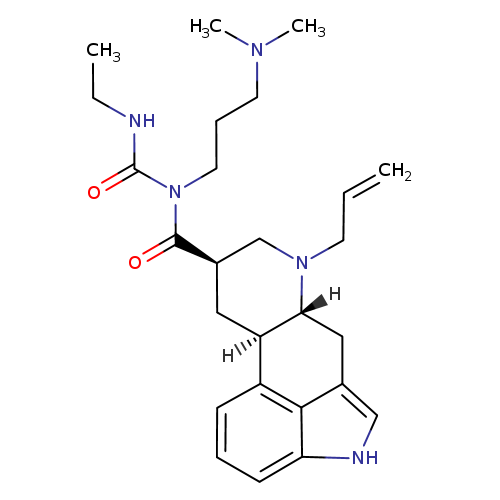
SMILES[H][C@@]12CC3=CNC4=CC=CC(=C34)[C@@]1([H])C[C@H](CN2CC=C)C(=O)N(CCCN(C)C)C(=O)NCC
InChI IdentifierInChI=1S/C26H37N5O2/c1-5-11-30-17-19(25(32)31(26(33)27-6-2)13-8-12-29(3)4)14-21-20-9-7-10-22-24(20)18(16-28-22)15-23(21)30/h5,7,9-10,16,19,21,23,28H,1,6,8,11-15,17H2,2-4H3,(H,27,33)/t19-,21-,23-/m1/s1
InChI KeyKORNTPPJEAJQIU-KJXAQDMKSA-N
Chemical Taxonomy
Description belongs to the class of organic compounds known as lysergic acids and derivatives. These are alkaloids with a structure based on the lysergic acid skeleton.
KingdomOrganic compounds
Super ClassAlkaloids and derivatives
ClassErgoline and derivatives
Sub ClassLysergic acids and derivatives
Direct ParentLysergic acids and derivatives
Alternative Parents
Substituents
  • Lysergic acid or derivatives
  • Indoloquinoline
  • Benzoquinoline
  • Quinoline-3-carboxamide
  • Pyrroloquinoline
  • Quinoline
  • 3-alkylindole
  • Indole
  • Indole or derivatives
  • Isoindole or derivatives
  • 3-piperidinecarboxamide
  • Piperidinecarboxamide
  • N-acyl urea
  • Aralkylamine
  • Ureide
  • Benzenoid
  • Piperidine
  • Dicarboximide
  • Heteroaromatic compound
  • Pyrrole
  • Urea
  • Tertiary amine
  • Tertiary aliphatic amine
  • Carbonic acid derivative
  • Amino acid or derivatives
  • Organoheterocyclic compound
  • Azacycle
  • Carboxylic acid derivative
  • Organooxygen compound
  • Organic oxide
  • Organopnictogen compound
  • Organic oxygen compound
  • Amine
  • Hydrocarbon derivative
  • Carbonyl group
  • Organic nitrogen compound
  • Organonitrogen compound
  • Aromatic heteropolycyclic compound
Molecular FrameworkAromatic heteropolycyclic compounds
External Descriptors
Biological Properties
StatusDetected and Not Quantified
OriginExogenous
Cellular Locations
  • Cytoplasm
  • Extracellular
  • Membrane
Biofluid LocationsNot Available
Tissue LocationsNot Available
PathwaysNot Available
Applications
Biological Roles
Chemical RolesNot Available
Physical Properties
StateSolid
AppearanceWhite powder.
Experimental Properties
PropertyValue
Melting Point102-104°C
Boiling PointNot Available
SolubilityInsoluble
Predicted Properties
PropertyValueSource
Water Solubility0.064 g/LALOGPS
logP2.97ALOGPS
logP2.58ChemAxon
logS-3.8ALOGPS
pKa (Strongest Acidic)15.25ChemAxon
pKa (Strongest Basic)9.32ChemAxon
Physiological Charge2ChemAxon
Hydrogen Acceptor Count4ChemAxon
Hydrogen Donor Count2ChemAxon
Polar Surface Area71.68 ŲChemAxon
Rotatable Bond Count8ChemAxon
Refractivity133.5 m³·mol⁻¹ChemAxon
Polarizability52.5 ųChemAxon
Number of Rings4ChemAxon
Bioavailability1ChemAxon
Rule of FiveYesChemAxon
Ghose FilterNoChemAxon
Veber's RuleNoChemAxon
MDDR-like RuleYesChemAxon
Spectra
Spectra
Spectrum TypeDescriptionSplash KeyView
Predicted GC-MSPredicted GC-MS Spectrum - GC-MS (Non-derivatized) - 70eV, Positivesplash10-0a4u-9332300000-c399dad54a5ca1142e58Spectrum
Predicted GC-MSPredicted GC-MS Spectrum - GC-MS (Non-derivatized) - 70eV, PositiveNot AvailableSpectrum
Predicted LC-MS/MSPredicted LC-MS/MS Spectrum - 10V, Positivesplash10-0uk9-6612900000-09532480a6bc0ee23c8bSpectrum
Predicted LC-MS/MSPredicted LC-MS/MS Spectrum - 20V, Positivesplash10-0006-9547200000-4408faaf3f5607911d33Spectrum
Predicted LC-MS/MSPredicted LC-MS/MS Spectrum - 40V, Positivesplash10-0006-9230000000-e8bfe5d55836ee96fff9Spectrum
Predicted LC-MS/MSPredicted LC-MS/MS Spectrum - 10V, Negativesplash10-0udi-4004900000-a2459baf72baf4f7d4c0Spectrum
Predicted LC-MS/MSPredicted LC-MS/MS Spectrum - 20V, Negativesplash10-0fml-8138900000-802be7d5b4ed6f5ea2eaSpectrum
Predicted LC-MS/MSPredicted LC-MS/MS Spectrum - 40V, Negativesplash10-0006-9456000000-a805853927d5cdb1b2faSpectrum
Predicted LC-MS/MSPredicted LC-MS/MS Spectrum - 10V, Positivesplash10-0udi-0000900000-789dda3470f1d5d2b188Spectrum
Predicted LC-MS/MSPredicted LC-MS/MS Spectrum - 20V, Positivesplash10-0zgi-3008900000-cefe7417b2ff493d14e7Spectrum
Predicted LC-MS/MSPredicted LC-MS/MS Spectrum - 40V, Positivesplash10-0zfr-4549000000-ffec92d47b323b6e170cSpectrum
Predicted LC-MS/MSPredicted LC-MS/MS Spectrum - 10V, Negativesplash10-0udi-0003900000-4c85bc032d2cb605ace4Spectrum
Predicted LC-MS/MSPredicted LC-MS/MS Spectrum - 20V, Negativesplash10-004i-1209000000-00a4b086d755fec1cdd3Spectrum
Predicted LC-MS/MSPredicted LC-MS/MS Spectrum - 40V, Negativesplash10-052o-3069000000-6aeb0c0daa38a57cc470Spectrum
Toxicity Profile
Route of ExposureOral (12) First-pass effect is seen, however the absolute bioavailability is unknown.
Mechanism of ToxicityErgoline alkaloids have been shown to have the significant affinity towards the 5-HT1 and 5-HT2 serotonin receptors, D1 and D2 dopamine receptors, and alpha-adrenergic receptors. This can result in a number of different effects, including vasoconstriction, convulsions, and hallucinations. (2, 3, 4, 12) The dopamine D2 receptor is a 7-transmembrane G-protein coupled receptor associated with Gi proteins. In lactotrophs, stimulation of dopamine D2 causes inhibition of adenylyl cyclase, which decreases intracellular cAMP concentrations and blocks IP3-dependent release of Ca2+ from intracellular stores. Decreases in intracellular calcium levels may also be brought about via inhibition of calcium influx through voltage-gated calcium channels, rather than via inhibition of adenylyl cyclase. Additionally, receptor activation blocks phosphorylation of p42/p44 MAPK and decreases MAPK/ERK kinase phosphorylation. Inhibition of MAPK appears to be mediated by c-Raf and B-Raf-dependent inhibition of MAPK/ERK kinase. Dopamine-stimulated growth hormone release from the pituitary gland is mediated by a decrease in intracellular calcium influx through voltage-gated calcium channels rather than via adenylyl cyclase inhibition. Stimulation of dopamine D2 receptors in the nigrostriatal pathway leads to improvements in coordinated muscle activity in those with movement disorders. Cabergoline is a long-acting dopamine receptor agonist with a high affinity for D2 receptors. Receptor-binding studies indicate that cabergoline has low affinity for dopamine D1, α1,- and α2- adrenergic, and 5-HT1- and 5-HT2-serotonin receptors.
MetabolismHepatic. Cabergoline is extensively metabolized, predominately via hydrolysis of the acylurea bond of the urea moiety. Cytochrome P-450 mediated metabolism appears to be minimal. The main metabolite identified in urine is 6-allyl-8b-carboxy-ergoline (4-6% of dose). Three other metabolites were identified urine (less than 3% of dose). Route of Elimination: After oral dosing of radioactive cabergoline to five healthy volunteers, approximately 22% and 60% of the dose was excreted within 20 days in the urine and feces, respectively. Less than 4% of the dose was excreted unchanged in the urine. Half Life: The elimination half-life is estimated from urinary data of 12 healthy subjects to range between 63 to 69 hours.
Toxicity ValuesNot Available
Lethal DoseNot Available
Carcinogenicity (IARC Classification)No indication of carcinogenicity to humans (not listed by IARC).
Uses/SourcesFor the treatment of hyperprolactinemic disorders, either idiopathic or due to prolactinoma (prolactin-secreting adenomas). May also be used to manage symptoms of Parkinsonian Syndrome as monotherapy during initial symptomatic management or as an adjunct to levodopa therapy during advanced stages of disease. Cabergoline is frequently used as a second-line agent in the management of prolactinomas when bromocriptine is ineffective. Ergoline alkaloids occurs in various species of vines of the Convolvulaceae (morning glory) family and in some species of lower fungi. (9, 12)
Minimum Risk LevelNot Available
Health EffectsCabergoline use may cause valvular heart disease and fibrosis. Ingestion of ergoline alkaloids is known to cause the disease ergotism. Ergotism occurs in two forms, gangrenous and convulsive, likely depending on the different kinds and amounts of ergoline alkaloids present. (1, 12, 13)
SymptomsSide effects of cabergoline include nausea, constipation, dry mouth, sleep disturbances, vertigo, depression, hypotension, and peripheral edema. Convulsive ergotism can cause painful seizures and spasms, diarrhea, paresthesias, itching, headaches, nausea and vomiting. Usually the gastrointestinal effects precede the central nervous system effects. As well as seizures there can be hallucinations and mental effects including mania or psychosis. Gangrenous ergotism causes dry gangrene as a result of vasoconstriction induced in the more poorly vascularized distal structures, such as the fingers and toes. Symptoms include desquamation, weak periphery pulse, loss of peripheral sensation, edema and ultimately the death and loss of affected tissues. (10, 13) Overdosage might be expected to produce nasal congestion, syncope, or hallucinations.
TreatmentTreatment for ergotism consists of vasodilators, anticoagulants and low molecular weight dextrans. If necessary, a sympathetic nerve blockade may be carried out, such as brachial plexus blockade. Temporary sedation (e.g. haloperidol) will be necessary in hallucination and diazepam is used for convulsions. There is no specific antidote. (11)

Concentrations
Not Available
DrugBank IDDB00248
HMDB IDHMDB0014393
FooDB IDNot Available
Phenol Explorer IDNot Available
KNApSAcK IDNot Available
BiGG IDNot Available
BioCyc IDNot Available
METLIN IDNot Available
PDB IDNot Available
Wikipedia LinkCabergoline
Chemspider ID49452
ChEBI ID3286
PubChem Compound ID54746
Kegg Compound IDC08187
YMDB IDNot Available
ECMDB IDNot Available
References
Synthesis Reference

DrugSyn.org

MSDSNot Available
General References
1. Miyagi M, Arai N, Taya F, Itoh F, Komatsu Y, Kojima M, Isaji M: Effect of cabergoline, a long-acting dopamine D2 agonist, on reserpine-treated rodents. Biol Pharm Bull. 1996 Nov;19(11):1499-502.
2. Pastor P, Tolosa E: [Cabergoline in the treatment of Parkinson's disease]. Neurologia. 2003 May;18(4):202-9.
3. Bracco F, Battaglia A, Chouza C, Dupont E, Gershanik O, Marti Masso JF, Montastruc JL: The long-acting dopamine receptor agonist cabergoline in early Parkinson's disease: final results of a 5-year, double-blind, levodopa-controlled study. CNS Drugs. 2004;18(11):733-46.
4. Curran MP, Perry CM: Cabergoline : a review of its use in the treatment of Parkinson's disease. Drugs. 2004;64(18):2125-41.
5. https://www.ncbi.nlm.nih.gov/pubmed/?term=22075008
6. https://www.ncbi.nlm.nih.gov/pubmed/?term=22336848
7. https://www.ncbi.nlm.nih.gov/pubmed/?term=22740242
8. https://www.ncbi.nlm.nih.gov/pubmed/?term=23110560
9. https://www.ncbi.nlm.nih.gov/pubmed/?term=23743769