Record Information
Version1.0
Creation Date2009-07-21 20:26:20 UTC
Update Date2026-05-14 16:24:49 UTC
Accession NumberCHEM002147
Identification
Common NameTemazepam
ClassSmall Molecule
DescriptionTemazepam is only found in individuals that have used or taken this drug. It is a benzodiazepine that acts as a gamma-aminobutyric acid modulator and anti-anxiety agent. [PubChem]Benzodiazepines bind nonspecifically to benzodiazepine receptors, which affects muscle relaxation, anticonvulsant activity, motor coordination, and memory. As benzodiazepine receptors are thought to be coupled to gamma-aminobutyric acid-A (GABAA) receptors, this enhances the effects of GABA by increasing GABA affinity for the GABA receptor. Binding of the inhibitory neurotransmitter GABA to the site opens the chloride channel, resulting in a hyperpolarized cell membrane that prevents further excitation of the cell.
Contaminant Sources
  • HMDB Contaminants - Urine
  • IARC Carcinogens Group 3
  • STOFF IDENT Compounds
  • T3DB toxins
  • ToxCast & Tox21 Chemicals
Contaminant Type
  • Adjuvant, Anesthesia
  • Amide
  • Amine
  • Anti-Anxiety Agent
  • Benzodiazepine
  • Drug
  • GABA Modulator
  • Human Neurotoxin
  • Hypnotic and Sedative
  • Metabolite
  • Organic Compound
  • Organochloride
  • Synthetic Compound
Chemical Structure
Thumb
Synonyms
ValueSource
RestorilKegg
HydroxydiazepamHMDB
MethyloxazepamHMDB
N-MethyloxazepamHMDB
OxydiazepamHMDB
Apotex brand OF temazepamMeSH, HMDB
Katwijk brand OF temazepamMeSH, HMDB
Knoll brand OF temazepamMeSH, HMDB
NocturneMeSH, HMDB
NormitabMeSH, HMDB
Novopharm brand OF temazepamMeSH, HMDB
Nu pharm brand OF temazepamMeSH, HMDB
Nu temazepamMeSH, HMDB
Nu-pharm brand OF temazepamMeSH, HMDB
PMS TemazepamMeSH, HMDB
PMS-TemazepamMeSH, HMDB
RemestanMeSH, HMDB
Sigma brand OF temazepamMeSH, HMDB
3 HydroxydiazepamMeSH, HMDB
3-HydroxydiazepamMeSH, HMDB
AHP brand OF temazepamMeSH, HMDB
apo-TemazepamMeSH, HMDB
Genopharm brand OF temazepamMeSH, HMDB
Genpharm brand OF temazepamMeSH, HMDB
Mallinckrodt brand OF temazepamMeSH, HMDB
NortemMeSH, HMDB
novo TemazepamMeSH, HMDB
Nu-temazepamMeSH, HMDB
Orion brand OF temazepamMeSH, HMDB
PlanumMeSH, HMDB
TenoxMeSH, HMDB
Wyeth brand OF temazepamMeSH, HMDB
CT-Arzneimittel brand OF temazepamMeSH, HMDB
apo TemazepamMeSH, HMDB
EuhypnosMeSH, HMDB
ICN brand OF temazepamMeSH, HMDB
NormisonMeSH, HMDB
Norton brand OF temazepamMeSH, HMDB
Novartis brand OF temazepamMeSH, HMDB
Pfizer brand 1 OF temazepamMeSH, HMDB
Pfizer brand 2 OF temazepamMeSH, HMDB
Pharmascience brand OF temazepamMeSH, HMDB
Scheffler brand OF temazepamMeSH, HMDB
SignopamMeSH, HMDB
Tema, norkotralMeSH, HMDB
TemazeMeSH, HMDB
TemtabsMeSH, HMDB
CT Arzneimittel brand OF temazepamMeSH, HMDB
Alphapharm brand OF temazepamMeSH, HMDB
DasuenMeSH, HMDB
Desitin brand OF temazepamMeSH, HMDB
Gen temazepamMeSH, HMDB
Gen-temazepamMeSH, HMDB
LevanxolMeSH, HMDB
Norkotral temaMeSH, HMDB
novo-TemazepamMeSH, HMDB
Pronervon TMeSH, HMDB
Temazep von CTMeSH, HMDB
Von CT, temazepMeSH, HMDB
Chemical FormulaC16H13ClN2O2
Average Molecular Mass300.740 g/mol
Monoisotopic Mass300.067 g/mol
CAS Registry Number846-50-4
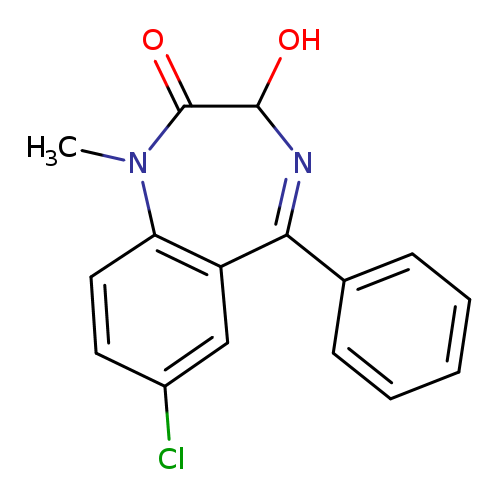
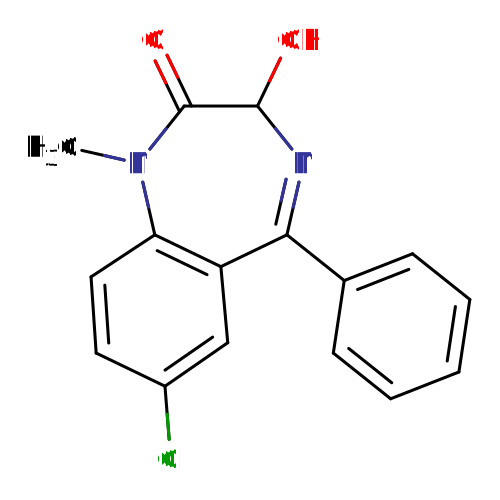
IUPAC Name7-chloro-3-hydroxy-1-methyl-5-phenyl-2,3-dihydro-1H-1,4-benzodiazepin-2-one
Traditional Nametemazepam
SMILESCN1C2=C(C=C(Cl)C=C2)C(=NC(O)C1=O)C1=CC=CC=C1
InChI IdentifierInChI=1/C16H13ClN2O2/c1-19-13-8-7-11(17)9-12(13)14(18-15(20)16(19)21)10-5-3-2-4-6-10/h2-9,15,20H,1H3
InChI KeyInChIKey=SEQDDYPDSLOBDC-UHFFFAOYNA-N
Chemical Taxonomy
Description belongs to the class of organic compounds known as 1,4-benzodiazepines. These are organic compounds containing a benzene ring fused to a 1,4-azepine.
KingdomOrganic compounds
Super ClassOrganoheterocyclic compounds
ClassBenzodiazepines
Sub Class1,4-benzodiazepines
Direct Parent1,4-benzodiazepines
Alternative Parents
Substituents
  • 1,4-benzodiazepine
  • Alpha-amino acid or derivatives
  • Aryl chloride
  • Aryl halide
  • Monocyclic benzene moiety
  • Benzenoid
  • Tertiary carboxylic acid amide
  • Carboxamide group
  • Ketimine
  • Lactam
  • Alkanolamine
  • Azacycle
  • Organic 1,3-dipolar compound
  • Propargyl-type 1,3-dipolar organic compound
  • Carboxylic acid derivative
  • Organic nitrogen compound
  • Organohalogen compound
  • Organochloride
  • Imine
  • Organonitrogen compound
  • Organooxygen compound
  • Carbonyl group
  • Hydrocarbon derivative
  • Organic oxide
  • Organopnictogen compound
  • Organic oxygen compound
  • Aromatic heteropolycyclic compound
Molecular FrameworkAromatic heteropolycyclic compounds
External Descriptors
Biological Properties
StatusDetected and Not Quantified
OriginExogenous
Cellular Locations
  • Cytoplasm
  • Membrane
Biofluid LocationsNot Available
Tissue Locations
  • Kidney
  • Liver
PathwaysNot Available
ApplicationsNot Available
Biological RolesNot Available
Chemical RolesNot Available
Physical Properties
StateSolid
AppearanceWhite powder.
Experimental Properties
PropertyValue
Melting Point119-121°C
Boiling PointNot Available
Solubility164 mg/L
Predicted Properties
PropertyValueSource
Water Solubility0.053 g/LALOGPS
logP2.16ALOGPS
logP2.79ChemAxon
logS-3.8ALOGPS
pKa (Strongest Acidic)10.68ChemAxon
pKa (Strongest Basic)-1.4ChemAxon
Physiological Charge0ChemAxon
Hydrogen Acceptor Count3ChemAxon
Hydrogen Donor Count1ChemAxon
Polar Surface Area52.9 ŲChemAxon
Rotatable Bond Count1ChemAxon
Refractivity81.01 m³·mol⁻¹ChemAxon
Polarizability30.32 ųChemAxon
Number of Rings3ChemAxon
Bioavailability1ChemAxon
Rule of FiveYesChemAxon
Ghose FilterYesChemAxon
Veber's RuleNoChemAxon
MDDR-like RuleNoChemAxon
Spectra
Spectra
Spectrum TypeDescriptionSplash KeyView
Predicted GC-MSPredicted GC-MS Spectrum - GC-MS (Non-derivatized) - 70eV, Positivesplash10-0076-1290000000-b5520ec3d2305756be73Spectrum
Predicted GC-MSPredicted GC-MS Spectrum - GC-MS (1 TMS) - 70eV, Positivesplash10-0kmr-9437000000-0244d11da064e8c0d1e6Spectrum
Predicted GC-MSPredicted GC-MS Spectrum - GC-MS (Non-derivatized) - 70eV, PositiveNot AvailableSpectrum
Predicted GC-MSPredicted GC-MS Spectrum - GC-MS (TBDMS_1_1) - 70eV, PositiveNot AvailableSpectrum
LC-MS/MSLC-MS/MS Spectrum - LC-ESI-QTOF , positivesplash10-0udi-0019000000-f9c9fe92391b593143ebSpectrum
LC-MS/MSLC-MS/MS Spectrum - LC-ESI-QTOF , positivesplash10-0a4i-0091000000-b26b004678460e39d9dbSpectrum
LC-MS/MSLC-MS/MS Spectrum - LC-ESI-QTOF , positivesplash10-0a4i-0090000000-d71ab75b6d551af5cf29Spectrum
LC-MS/MSLC-MS/MS Spectrum - LC-ESI-QTOF , positivesplash10-0a4i-0390000000-43e671827e9519f8cbd7Spectrum
LC-MS/MSLC-MS/MS Spectrum - LC-ESI-QTOF , positivesplash10-0a6r-0980000000-6fcab627ec42157d1ed9Spectrum
LC-MS/MSLC-MS/MS Spectrum - LC-ESI-QFT , positivesplash10-0a4i-0092000000-36017deb260bb70b05cdSpectrum
LC-MS/MSLC-MS/MS Spectrum - 35V, Positivesplash10-0a4i-0092000000-6a05dc5e5e75afdcbb8eSpectrum
LC-MS/MSLC-MS/MS Spectrum - 40V, Positivesplash10-0a4i-0390000000-d827d877da314f89978bSpectrum
LC-MS/MSLC-MS/MS Spectrum - 30V, Positivesplash10-0a4i-0090000000-4d4b7b7e906e1e440ca6Spectrum
LC-MS/MSLC-MS/MS Spectrum - 10V, Positivesplash10-0udi-0019000000-63de5541966279a763b9Spectrum
LC-MS/MSLC-MS/MS Spectrum - 20V, Positivesplash10-0a4i-0091000000-6f9aea1c6f9196a6e83bSpectrum
LC-MS/MSLC-MS/MS Spectrum - 35V, Positivesplash10-0a4i-0090000000-870c794aaa0e39428afaSpectrum
LC-MS/MSLC-MS/MS Spectrum - 50V, Positivesplash10-0a6r-0980000000-66dedd2284e2508d3ac3Spectrum
LC-MS/MSLC-MS/MS Spectrum - 50V, Positivesplash10-0a6r-0980000000-675aed8b116c38e11e48Spectrum
LC-MS/MSLC-MS/MS Spectrum - 50V, Positivesplash10-0a6r-0980000000-5dbd9ed3345c15cac665Spectrum
Predicted LC-MS/MSPredicted LC-MS/MS Spectrum - 10V, Positivesplash10-0udi-0009000000-7d9e12c41cdc37869173Spectrum
Predicted LC-MS/MSPredicted LC-MS/MS Spectrum - 20V, Positivesplash10-0udi-0339000000-d65623eab9da4e6e0a8fSpectrum
Predicted LC-MS/MSPredicted LC-MS/MS Spectrum - 40V, Positivesplash10-002f-3930000000-e6777c2ed8db44e9e193Spectrum
Predicted LC-MS/MSPredicted LC-MS/MS Spectrum - 10V, Negativesplash10-0002-0090000000-7fc31b3910bb0c20262cSpectrum
Predicted LC-MS/MSPredicted LC-MS/MS Spectrum - 20V, Negativesplash10-0007-0190000000-f5990016db4cbf3432daSpectrum
Predicted LC-MS/MSPredicted LC-MS/MS Spectrum - 40V, Negativesplash10-052f-9340000000-37b87e4eed991dce5a03Spectrum
Predicted LC-MS/MSPredicted LC-MS/MS Spectrum - 10V, Negativesplash10-0002-0090000000-cde58810059d12ab5be7Spectrum
Predicted LC-MS/MSPredicted LC-MS/MS Spectrum - 20V, Negativesplash10-0002-1090000000-2dc539ab79eba1a4f1d7Spectrum
Predicted LC-MS/MSPredicted LC-MS/MS Spectrum - 40V, Negativesplash10-001i-9020000000-9bd67fa93999e29b9582Spectrum
Predicted LC-MS/MSPredicted LC-MS/MS Spectrum - 10V, Positivesplash10-0udi-0039000000-3e8551a1d6ec2eac7db0Spectrum
MSMass Spectrum (Electron Ionization)splash10-00di-4391000000-eba55d0cdbd09c877424Spectrum
Toxicity Profile
Route of ExposureOral, well absorbed, minimal first-pass metabolism.
Mechanism of ToxicityBenzodiazepines bind nonspecifically to benzodiazepine receptors, which affects muscle relaxation, anticonvulsant activity, motor coordination, and memory. As benzodiazepine receptors are thought to be coupled to gamma-aminobutyric acid-A (GABAA) receptors, this enhances the effects of GABA by increasing GABA affinity for the GABA receptor. Binding of the inhibitory neurotransmitter GABA to the site opens the chloride channel, resulting in a hyperpolarized cell membrane that prevents further excitation of the cell.
MetabolismHepatic. Temazepam is completely metabolized through conjugation prior to excretion. The major metabolite is the O-conjugate of temazepam (90%). Route of Elimination: Temazepam was completely metabolized through conjugation prior to excretion; 80% to 90% of the dose appeared in the urine. Half Life: 10-20 hours
Toxicity ValuesLD50: 1963 mg/kg (oral, mice) (7) LD50: 1833 mg/kg (oral, rat) (7) LD50: >2400 mg/kg (oral, rabbit) (7)
Lethal DoseNot Available
Carcinogenicity (IARC Classification)3, not classifiable as to its carcinogenicity to humans. (6)
Uses/SourcesOfficially indicated for severe insomnia and other severe or disabling sleep disorders. For the short-term treatment of insomnia (generally 7-10 days).
Minimum Risk LevelNot Available
Health EffectsThey cause slurred speech, disorientation and "drunken" behavior. They are physically and psychologically addictive.
SymptomsNot Available
TreatmentIf the patient is conscious, vomiting should be induced mechanically or with emetics. Gastric lavage should be employed utilizing concurrently a cuffed endotracheal tube if the patient is unconscious to prevent aspiration and pulmonary complications. Maintenance of adequate pulmonary ventilation is essential. The use of pressor agents intravenously may be necessary to combat hypotension. Fluids should be administered intravenously to encourage diuresis. (8)
Concentrations
Not Available
DrugBank IDDB00231
HMDB IDHMDB0259493
FooDB IDNot Available
Phenol Explorer IDNot Available
KNApSAcK IDNot Available
BiGG IDNot Available
BioCyc IDNot Available
METLIN IDNot Available
PDB IDNot Available
Wikipedia LinkTemazepam
Chemspider ID5198
ChEBI IDNot Available
PubChem Compound IDNot Available
Kegg Compound IDC07125
YMDB IDNot Available
ECMDB IDNot Available
References
Synthesis ReferenceNot Available
MSDSNot Available
General ReferencesNot Available