Record Information
Version1.0
Creation Date2009-07-21 20:26:17 UTC
Update Date2026-05-14 16:24:40 UTC
Accession NumberCHEM002144
Identification
Common NameReserpine
ClassSmall Molecule
DescriptionAn alkaloid found in the roots of Rauwolfia serpentina and R. vomitoria. Reserpine inhibits the uptake of norepinephrine into storage vesicles resulting in depletion of catecholamines and serotonin from central and peripheral axon terminals. It has been used as an antihypertensive and an antipsychotic as well as a research tool, but its adverse effects limit its clinical use.
Contaminant Sources
  • Clean Air Act Chemicals
  • HMDB Contaminants - Urine
  • HPV EPA Chemicals
  • IARC Carcinogens Group 3
  • STOFF IDENT Compounds
  • T3DB toxins
  • ToxCast & Tox21 Chemicals
Contaminant Type
  • Adrenergic Antagonist
  • Adrenergic Uptake Inhibitor
  • Amine
  • Antihypertensive Agent
  • Antipsychotic Agent
  • Drug
  • Ester
  • Ether
  • Human Neurotoxin
  • Metabolite
  • Natural Compound
  • Organic Compound
  • PFAS
  • Peripheral Adrenergic Inhibitor
  • Phytotoxin
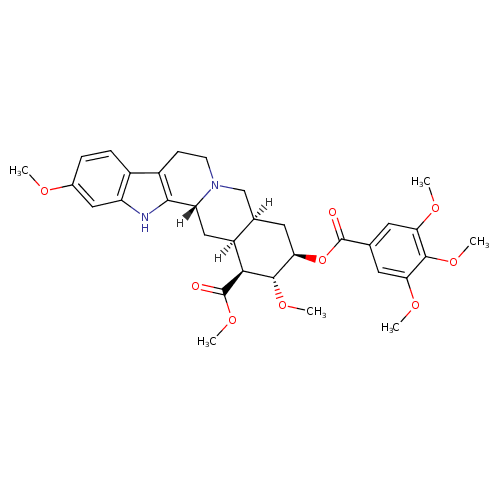
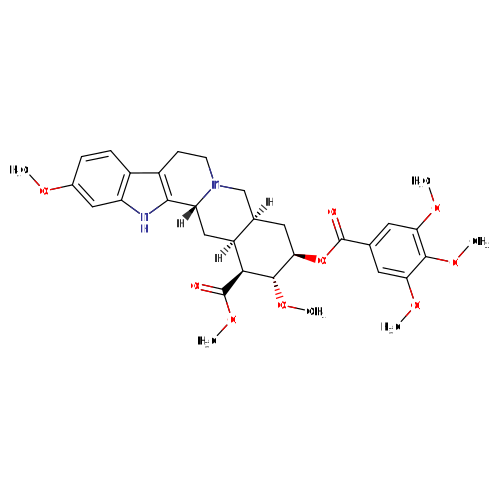
Chemical Structure
Thumb
Synonyms
ValueSource
(-)-ReserpineChEBI
(3beta,16beta,17alpha,18beta,20alpha)-11,17-Dimethoxy-18-[(3,4,5-trimethoxybenzoyl)oxy]yohimban-16-carboxylic acid methyl esterChEBI
3,4,5-Trimethoxybenzoyl methyl reserpateChEBI
ApoplonChEBI
ReserpinChEBI
SerpalanChEBI
(3b,16b,17a,18b,20a)-11,17-Dimethoxy-18-[(3,4,5-trimethoxybenzoyl)oxy]yohimban-16-carboxylate methyl esterGenerator
(3b,16b,17a,18b,20a)-11,17-Dimethoxy-18-[(3,4,5-trimethoxybenzoyl)oxy]yohimban-16-carboxylic acid methyl esterGenerator
(3beta,16beta,17alpha,18beta,20alpha)-11,17-Dimethoxy-18-[(3,4,5-trimethoxybenzoyl)oxy]yohimban-16-carboxylate methyl esterGenerator
(3Β,16β,17α,18β,20α)-11,17-dimethoxy-18-[(3,4,5-trimethoxybenzoyl)oxy]yohimban-16-carboxylate methyl esterGenerator
(3Β,16β,17α,18β,20α)-11,17-dimethoxy-18-[(3,4,5-trimethoxybenzoyl)oxy]yohimban-16-carboxylic acid methyl esterGenerator
3,4,5-Trimethoxybenzoyl methyl reserpic acidGenerator
RausedilHMDB
SerpasilHMDB
V SerpHMDB
V-SerpHMDB
RaupasilHMDB
SerpiviteHMDB
RaunervilHMDB
Vitarine brand OF reserpineHMDB
RausedylHMDB
Vangarde brand OF reserpineHMDB
Chemical FormulaC33H40N2O9
Average Molecular Mass608.679 g/mol
Monoisotopic Mass608.273 g/mol
CAS Registry Number50-55-5
IUPAC Namemethyl (1R,15S,17R,18R,19S,20S)-6,18-dimethoxy-17-(3,4,5-trimethoxybenzoyloxy)-3,13-diazapentacyclo[11.8.0.0^{2,10}.0^{4,9}.0^{15,20}]henicosa-2(10),4(9),5,7-tetraene-19-carboxylate
Traditional Namereserpine
SMILES[H][C@]12C[C@@H](OC(=O)C3=CC(OC)=C(OC)C(OC)=C3)[C@H](OC)[C@@H](C(=O)OC)[C@@]1([H])C[C@@]1([H])N(CCC3=C1NC1=C3C=CC(OC)=C1)C2
InChI IdentifierInChI=1S/C33H40N2O9/c1-38-19-7-8-20-21-9-10-35-16-18-13-27(44-32(36)17-11-25(39-2)30(41-4)26(12-17)40-3)31(42-5)28(33(37)43-6)22(18)15-24(35)29(21)34-23(20)14-19/h7-8,11-12,14,18,22,24,27-28,31,34H,9-10,13,15-16H2,1-6H3/t18-,22+,24-,27-,28+,31+/m1/s1
InChI KeyQEVHRUUCFGRFIF-MDEJGZGSSA-N
Chemical Taxonomy
Description belongs to the class of organic compounds known as yohimbine alkaloids. These are alkaloids containing the pentacyclic yohimban skeleton. The Yohimbinoid alkaloids contain a carbocyclic ring E arising through C-17 to C-18 bond formation in a corynantheine precursor.
KingdomOrganic compounds
Super ClassAlkaloids and derivatives
ClassYohimbine alkaloids
Sub ClassNot Available
Direct ParentYohimbine alkaloids
Alternative Parents
Substituents
  • Yohimbine
  • Corynanthean skeleton
  • Yohimbine alkaloid
  • Pyridoindole
  • Beta-carboline
  • Gallic acid or derivatives
  • P-methoxybenzoic acid or derivatives
  • M-methoxybenzoic acid or derivatives
  • Benzoate ester
  • 3-alkylindole
  • Indole
  • Indole or derivatives
  • Benzoic acid or derivatives
  • Benzoyl
  • Phenol ether
  • Anisole
  • Phenoxy compound
  • Methoxybenzene
  • Alkyl aryl ether
  • Aralkylamine
  • Monocyclic benzene moiety
  • Dicarboxylic acid or derivatives
  • Benzenoid
  • Piperidine
  • Pyrrole
  • Methyl ester
  • Heteroaromatic compound
  • Tertiary aliphatic amine
  • Amino acid or derivatives
  • Tertiary amine
  • Carboxylic acid ester
  • Organoheterocyclic compound
  • Ether
  • Carboxylic acid derivative
  • Azacycle
  • Dialkyl ether
  • Organonitrogen compound
  • Hydrocarbon derivative
  • Organic oxide
  • Organopnictogen compound
  • Organic nitrogen compound
  • Carbonyl group
  • Organic oxygen compound
  • Amine
  • Organooxygen compound
  • Aromatic heteropolycyclic compound
Molecular FrameworkAromatic heteropolycyclic compounds
External Descriptors
Biological Properties
StatusDetected and Not Quantified
OriginExogenous
Cellular Locations
  • Cytoplasm
  • Membrane
Biofluid LocationsNot Available
Tissue LocationsNot Available
PathwaysNot Available
Applications
Biological Roles
Chemical Roles
Physical Properties
StateSolid
AppearanceWhite powder.
Experimental Properties
PropertyValue
Melting Point264.5°C
Boiling PointNot Available
Solubility73 mg/L (at 30°C)
Predicted Properties
PropertyValueSource
Water Solubility0.011 g/LALOGPS
logP4.05ALOGPS
logP3.53ChemAxon
logS-4.7ALOGPS
pKa (Strongest Acidic)16.29ChemAxon
pKa (Strongest Basic)7.56ChemAxon
Physiological Charge1ChemAxon
Hydrogen Acceptor Count8ChemAxon
Hydrogen Donor Count1ChemAxon
Polar Surface Area117.78 ŲChemAxon
Rotatable Bond Count10ChemAxon
Refractivity161.42 m³·mol⁻¹ChemAxon
Polarizability66.05 ųChemAxon
Number of Rings6ChemAxon
Bioavailability1ChemAxon
Rule of FiveNoChemAxon
Ghose FilterNoChemAxon
Veber's RuleNoChemAxon
MDDR-like RuleYesChemAxon
Spectra
Spectra
Spectrum TypeDescriptionSplash KeyView
GC-MSGC-MS Spectrum - EI-B (Non-derivatized)splash10-052b-0944108000-d2416a07c507dd693e2bSpectrum
Predicted GC-MSPredicted GC-MS Spectrum - GC-MS (Non-derivatized) - 70eV, Positivesplash10-0002-0549060000-793104ae04e257941689Spectrum
LC-MS/MSLC-MS/MS Spectrum - Linear Ion Trap , negativesplash10-0006-0000090000-a4f3a4e74644a66e8705Spectrum
LC-MS/MSLC-MS/MS Spectrum - Linear Ion Trap , negativesplash10-0006-0000090000-22aa398156f73127b459Spectrum
LC-MS/MSLC-MS/MS Spectrum - Linear Ion Trap , negativesplash10-0006-0000090000-1a35ce10a9657b978845Spectrum
LC-MS/MSLC-MS/MS Spectrum - Linear Ion Trap , negativesplash10-0006-0000090000-f1a507980fe5d4bc47a4Spectrum
LC-MS/MSLC-MS/MS Spectrum - LC-ESI-ITFT , positivesplash10-0002-0108920000-d8cec36e08efb0c1e16eSpectrum
LC-MS/MSLC-MS/MS Spectrum - LC-ESI-ITFT , positivesplash10-0a4i-0000009000-2bafaa3238dfda9f4989Spectrum
LC-MS/MSLC-MS/MS Spectrum - LC-ESI-ITFT , positivesplash10-0002-0916102000-d591ae99a68ca35e63b7Spectrum
LC-MS/MSLC-MS/MS Spectrum - LC-ESI-ITFT , positivesplash10-006t-0911000000-1cb6207a1835b7efb13aSpectrum
LC-MS/MSLC-MS/MS Spectrum - LC-ESI-ITFT , positivesplash10-00dj-0910000000-550f1f23f96cefe74849Spectrum
LC-MS/MSLC-MS/MS Spectrum - LC-ESI-ITFT , positivesplash10-05gi-1910000000-9dd2d1b6087fe8b9d1c9Spectrum
LC-MS/MSLC-MS/MS Spectrum - LC-ESI-ITFT , positivesplash10-001i-1910000000-7038e3a2f74fff79f220Spectrum
LC-MS/MSLC-MS/MS Spectrum - LC-ESI-ITFT , positivesplash10-0a4i-0000009000-ea7c0832701dc10b3266Spectrum
LC-MS/MSLC-MS/MS Spectrum - LC-ESI-ITFT , positivesplash10-0002-0916103000-b1128c59f469bc4d949fSpectrum
LC-MS/MSLC-MS/MS Spectrum - LC-ESI-ITFT , positivesplash10-006t-0911000000-8109e56a0558f3f60659Spectrum
LC-MS/MSLC-MS/MS Spectrum - LC-ESI-ITFT , positivesplash10-00dj-0910000000-c3773763c7f72b03b234Spectrum
LC-MS/MSLC-MS/MS Spectrum - LC-ESI-ITFT , positivesplash10-05gi-1910000000-21728d59759dc657e49bSpectrum
LC-MS/MSLC-MS/MS Spectrum - LC-ESI-ITFT , positivesplash10-001i-1910000000-bf727df9cb8b3d8296a0Spectrum
LC-MS/MSLC-MS/MS Spectrum - LC-ESI-ITFT , positivesplash10-0002-0108920000-29c40cb6bef71c53750fSpectrum
LC-MS/MSLC-MS/MS Spectrum - LC-ESI-QTOF , positivesplash10-0a4i-0000009000-0004d3aa672941e611c5Spectrum
Predicted LC-MS/MSPredicted LC-MS/MS Spectrum - 10V, Positivesplash10-0a4i-0004069000-dbc0a3b6edf66c8683bdSpectrum
Predicted LC-MS/MSPredicted LC-MS/MS Spectrum - 20V, Positivesplash10-054k-0205093000-0c6931938051f0e1a721Spectrum
Predicted LC-MS/MSPredicted LC-MS/MS Spectrum - 40V, Positivesplash10-066r-6438290000-e3ef63fc93c29206b47cSpectrum
Predicted LC-MS/MSPredicted LC-MS/MS Spectrum - 10V, Negativesplash10-0a4i-0120029000-1e1e860a71102dcc5e5bSpectrum
Predicted LC-MS/MSPredicted LC-MS/MS Spectrum - 20V, Negativesplash10-092c-0321092000-7fe3c97e8909b5c37599Spectrum
Predicted LC-MS/MSPredicted LC-MS/MS Spectrum - 40V, Negativesplash10-01t9-2940040000-c9fe57795b1118e171f4Spectrum
MSMass Spectrum (Electron Ionization)splash10-0002-2943000000-8f7998aa667566277f3fSpectrum
Toxicity Profile
Route of ExposureOral
Mechanism of ToxicityReserpine's mechanism of action is through inhibition of the ATP/Mg2+ pump responsible for the sequestering of neurotransmitters into storage vesicles located in the presynaptic neuron. The neurotransmitters that are not sequestered in the storage vesicle are readily metabolized by monoamine oxidase (MAO) causing a reduction in catecholamines.
Metabolism Route of Elimination: Reserpine is extensively metabolized to inactive compounds. It is slowly excreted via the urine and feces.
Toxicity ValuesLD50: 420 mg/kg (Oral, Rat) (1) LD50: 44 mg/kg (Intraperitoneal(parenteral), Rat) (1) LD50: 15 mg/kg (Intravenous(parenteral), Rat) (1) LD50: 200 mg/kg (Oral, Mouse) (1) LD50: 52 mg/kg (Subcutaneous(parenteral), Mouse) (1) LD50: 7 mg/kg (Intraperitoneal(parenteral), Rabbit) (1)
Lethal DoseNot Available
Carcinogenicity (IARC Classification)3, not classifiable as to its carcinogenicity to humans. (7)
Uses/SourcesFoe the treatment of hypertension
Minimum Risk LevelNot Available
Health EffectsNot Available
SymptomsNot Available
TreatmentNot Available
Concentrations
Not Available
DrugBank IDDB00206
HMDB IDHMDB0014351
FooDB IDNot Available
Phenol Explorer IDNot Available
KNApSAcK IDC00001763
BiGG IDNot Available
BioCyc IDNot Available
METLIN IDNot Available
PDB IDNot Available
Wikipedia LinkReserpine
Chemspider ID5566
ChEBI ID28487
PubChem Compound ID5770
Kegg Compound IDC06539
YMDB IDNot Available
ECMDB IDNot Available
References
Synthesis ReferenceNot Available
MSDSLink
General References
1. Authors unspecified: Five-year findings of the hypertension detection and follow-up program. I. Reduction in mortality of persons with high blood pressure, including mild hypertension. Hypertension Detection and Follow-up Program Cooperative Group. JAMA. 1979 Dec 7;242(23):2562-71.
2. Authors unspecified: Prevention of stroke by antihypertensive drug treatment in older persons with isolated systolic hypertension. Final results of the Systolic Hypertension in the Elderly Program (SHEP). SHEP Cooperative Research Group. JAMA. 1991 Jun 26;265(24):3255-64.
3. Moser M: "Cost containment" in the management of hypertension. Ann Intern Med. 1987 Jul;107(1):107-9.
4. Authors unspecified: Effects of treatment on morbidity in hypertension. Results in patients with diastolic blood pressures averaging 115 through 129 mm Hg. JAMA. 1967 Dec 11;202(11):1028-34.
5. Chobanian AV, Bakris GL, Black HR, Cushman WC, Green LA, Izzo JL Jr, Jones DW, Materson BJ, Oparil S, Wright JT Jr, Roccella EJ: The Seventh Report of the Joint National Committee on Prevention, Detection, Evaluation, and Treatment of High Blood Pressure: the JNC 7 report. JAMA. 2003 May 21;289(19):2560-72. Epub 2003 May 14.
6. https://www.ncbi.nlm.nih.gov/pubmed/?term=20701244
7. https://www.ncbi.nlm.nih.gov/pubmed/?term=20825390
8. https://www.ncbi.nlm.nih.gov/pubmed/?term=24603678