Record Information
Version1.0
Creation Date2009-07-21 20:26:15 UTC
Update Date2026-05-14 16:24:34 UTC
Accession NumberCHEM002141
Identification
Common NamePhentermine
ClassSmall Molecule
DescriptionPhentermine is only found in individuals that have used or taken this drug. It is a central nervous system stimulant and sympathomimetic with actions and uses similar to those of dextroamphetamine. It has been used most frequently in the treatment of obesity. Phentermine is an amphetamine that stimulates neurons to release or maintain high levels of a particular group of neurotransmitters known as catecholamines; these include dopamine and norepinephrine. High levels of these catecholamines tend to suppress hunger signals and appetite. The drug seems to inhibit reuptake of noradrenaline, dopamine, and seratonin through inhibition or reversal of the reuptake transporters. It may also inhibit MAO enzymes leaving more neurotransmitter available at the synapse.Phentermine (through catecholamine elevation) may also indirectly affect leptin levels in the brain. It is theorized that phentermine can raise levels of leptin which signal satiety. It is also theorized that increased levels of the catecholamines are partially responsible for halting another chemical messenger known as neuropeptide Y. This peptide initiates eating, decreases energy expenditure, and increases fat storage.
Contaminant Sources
  • Clean Air Act Chemicals
  • HMDB Contaminants - Urine
  • STOFF IDENT Compounds
  • T3DB toxins
Contaminant Type
  • Adrenergic Agent
  • Amine
  • Anorexigenic Agent
  • Appetite Depressant
  • Central Nervous System Agent
  • Central Nervous System Stimulant
  • Drug
  • Human Neurotoxin
  • Metabolite
  • Organic Compound
  • Stimulant
  • Sympathomimetic
  • Synthetic Compound
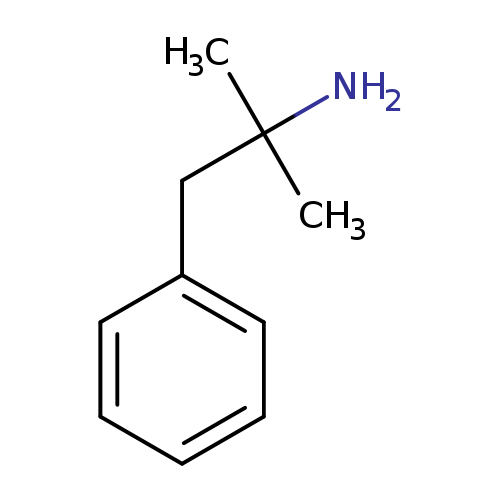
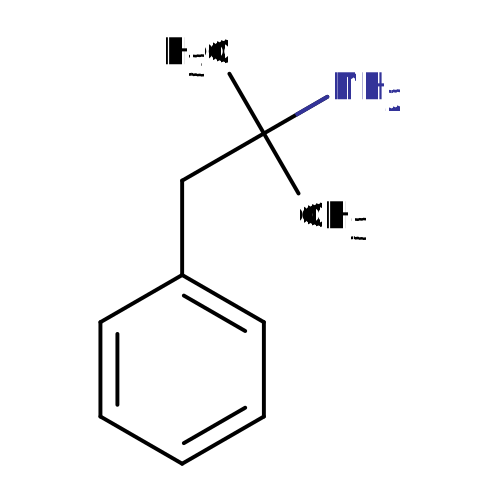
Chemical Structure
Thumb
Synonyms
ValueSource
alpha,alpha-DimethylphenethylamineChEBI
FenterminaChEBI
PhenterminumChEBI
a,a-DimethylphenethylamineGenerator
Α,α-dimethylphenethylamineGenerator
(alpha,alpha)-DimethylphenethylamineHMDB
Adipex pHMDB
Adipex-pHMDB
DuromineHMDB
Hydrochloride, phentermineHMDB
IonamineHMDB
Phentermine hydrochlorideHMDB
AdipexPHMDB
Chemical FormulaC10H15N
Average Molecular Mass149.233 g/mol
Monoisotopic Mass149.120 g/mol
CAS Registry Number122-09-8
IUPAC Name2-methyl-1-phenylpropan-2-amine
Traditional Namephentermine
SMILESCC(C)(N)CC1=CC=CC=C1
InChI IdentifierInChI=1S/C10H15N/c1-10(2,11)8-9-6-4-3-5-7-9/h3-7H,8,11H2,1-2H3
InChI KeyDHHVAGZRUROJKS-UHFFFAOYSA-N
Chemical Taxonomy
Description belongs to the class of organic compounds known as amphetamines and derivatives. These are organic compounds containing or derived from 1-phenylpropan-2-amine.
KingdomOrganic compounds
Super ClassBenzenoids
ClassBenzene and substituted derivatives
Sub ClassPhenethylamines
Direct ParentAmphetamines and derivatives
Alternative Parents
Substituents
  • Amphetamine or derivatives
  • Phenylpropane
  • Aralkylamine
  • Organic nitrogen compound
  • Organopnictogen compound
  • Hydrocarbon derivative
  • Primary amine
  • Organonitrogen compound
  • Primary aliphatic amine
  • Amine
  • Aromatic homomonocyclic compound
Molecular FrameworkAromatic homomonocyclic compounds
External Descriptors
Biological Properties
StatusDetected and Not Quantified
OriginExogenous
Cellular Locations
  • Cytoplasm
  • Membrane
Biofluid LocationsNot Available
Tissue LocationsNot Available
PathwaysNot Available
Applications
Biological Roles
Chemical RolesNot Available
Physical Properties
StateSolid
AppearanceWhite powder.
Experimental Properties
PropertyValue
Melting Point205°C
Boiling PointNot Available
Solubility18.6 g/L
Predicted Properties
PropertyValueSource
Water Solubility0.76 g/LALOGPS
logP2.32ALOGPS
logP2.08ChemAxon
logS-2.3ALOGPS
pKa (Strongest Basic)10.25ChemAxon
Physiological Charge1ChemAxon
Hydrogen Acceptor Count1ChemAxon
Hydrogen Donor Count1ChemAxon
Polar Surface Area26.02 ŲChemAxon
Rotatable Bond Count2ChemAxon
Refractivity48.34 m³·mol⁻¹ChemAxon
Polarizability17.87 ųChemAxon
Number of Rings1ChemAxon
Bioavailability1ChemAxon
Rule of FiveYesChemAxon
Ghose FilterNoChemAxon
Veber's RuleYesChemAxon
MDDR-like RuleNoChemAxon
Spectra
Spectra
Spectrum TypeDescriptionSplash KeyView
Predicted GC-MSPredicted GC-MS Spectrum - GC-MS (Non-derivatized) - 70eV, Positivesplash10-0a4l-9000000000-4b4613b0051412392011Spectrum
Predicted GC-MSPredicted GC-MS Spectrum - GC-MS (Non-derivatized) - 70eV, PositiveNot AvailableSpectrum
LC-MS/MSLC-MS/MS Spectrum - 80V, Positivesplash10-0006-9000000000-1317a1dff976bad4f840Spectrum
LC-MS/MSLC-MS/MS Spectrum - 45V, Positivesplash10-0006-9100000000-c3cf4661cf2e9753892bSpectrum
LC-MS/MSLC-MS/MS Spectrum - 30V, Positivesplash10-0006-9000000000-798c9f163004230fe723Spectrum
LC-MS/MSLC-MS/MS Spectrum - 35V, Positivesplash10-00kf-9000000000-356c0f3eb16f8fe213c0Spectrum
LC-MS/MSLC-MS/MS Spectrum - 30V, Positivesplash10-00kf-9000000000-12472f6717ab22723d53Spectrum
LC-MS/MSLC-MS/MS Spectrum - 15V, Positivesplash10-0006-9000000000-d5cc268e81c53c1db691Spectrum
LC-MS/MSLC-MS/MS Spectrum - 40V, Positivesplash10-0006-9100000000-bfce4f0893d61e18c642Spectrum
LC-MS/MSLC-MS/MS Spectrum - 75V, Positivesplash10-0006-9000000000-4027bc21c9067b2afaafSpectrum
LC-MS/MSLC-MS/MS Spectrum - 65V, Positivesplash10-0006-9000000000-78df824f14afb3ef5819Spectrum
LC-MS/MSLC-MS/MS Spectrum - 40V, Positivesplash10-014l-9000000000-162a1d1b79c4d13aa4d0Spectrum
LC-MS/MSLC-MS/MS Spectrum - 45V, Positivesplash10-014l-9000000000-9d917981d06565d9120aSpectrum
LC-MS/MSLC-MS/MS Spectrum - 60V, Positivesplash10-014i-9000000000-2ee6ba63f942e329e01bSpectrum
LC-MS/MSLC-MS/MS Spectrum - 45V, Positivesplash10-014l-9000000000-87fec87ba12fab4c26b6Spectrum
LC-MS/MSLC-MS/MS Spectrum - 70V, Positivesplash10-0006-9000000000-6482075e713588714fc7Spectrum
LC-MS/MSLC-MS/MS Spectrum - 50V, Positivesplash10-0006-9000000000-a9d629ba954d37de1894Spectrum
LC-MS/MSLC-MS/MS Spectrum - 25V, Positivesplash10-0006-9000000000-2edf07337f14f6bb795aSpectrum
LC-MS/MSLC-MS/MS Spectrum - 80V, Positivesplash10-0006-9000000000-57fedb34031977b99d69Spectrum
LC-MS/MSLC-MS/MS Spectrum - 20V, Positivesplash10-0006-9000000000-40c3cdc442be6ab34e41Spectrum
LC-MS/MSLC-MS/MS Spectrum - 35V, Positivesplash10-00dr-9200000000-e6e9a40aadab17c1eb7dSpectrum
Predicted LC-MS/MSPredicted LC-MS/MS Spectrum - 10V, Positivesplash10-0ue9-0900000000-f2eb273dfd0ec45869c5Spectrum
Predicted LC-MS/MSPredicted LC-MS/MS Spectrum - 20V, Positivesplash10-0f89-2900000000-f527ee48b9e2784c178cSpectrum
Predicted LC-MS/MSPredicted LC-MS/MS Spectrum - 40V, Positivesplash10-0159-4900000000-548f73a83354267c9f81Spectrum
Predicted LC-MS/MSPredicted LC-MS/MS Spectrum - 10V, Negativesplash10-0002-0900000000-c7ab0aa268d14ae3da39Spectrum
Predicted LC-MS/MSPredicted LC-MS/MS Spectrum - 20V, Negativesplash10-0002-1900000000-ce1c08c021fbc1cc5c8cSpectrum
Predicted LC-MS/MSPredicted LC-MS/MS Spectrum - 40V, Negativesplash10-001i-2900000000-94b2b38953d359938c0aSpectrum
MSMass Spectrum (Electron Ionization)splash10-0a4i-9100000000-7037d3f1fad22de72c33Spectrum
1D NMR1H NMR SpectrumNot AvailableSpectrum
1D NMR13C NMR SpectrumNot AvailableSpectrum
Toxicity Profile
Route of ExposurePhentermine is rapidly absorbed after oral ingestion.
Mechanism of ToxicityPhentermine is an amphetamine that stimulates neurons to release or maintain high levels of a particular group of neurotransmitters known as catecholamines; these include dopamine and norepinephrine. High levels of these catecholamines tend to suppress hunger signals and appetite. The drug seems to inhibit reuptake of noradrenaline, dopamine, and seratonin through inhibition or reversal of the reuptake transporters. It may also inhibit MAO enzymes leaving more neurotransmitter available at the synapse.Phentermine (through catecholamine elevation) may also indirectly affect leptin levels in the brain. It is theorized that phentermine can raise levels of leptin which signal satiety. It is also theorized that increased levels of the catecholamines are partially responsible for halting another chemical messenger known as neuropeptide Y. This peptide initiates eating, decreases energy expenditure, and increases fat storage.
MetabolismHepatic. Half Life: 16 to 31 hours
Toxicity ValuesLD50: 15 to 20 mg/kg (monkey).
Lethal DoseNot Available
Carcinogenicity (IARC Classification)No indication of carcinogenicity to humans (not listed by IARC).
Uses/SourcesFor the treatment and management of obesity.
Minimum Risk LevelNot Available
Health EffectsUsing large amounts of these drugs can result in a condition known as amphetamine psychosis -- which can result in auditory, visual and tactile hallucinations, intense paranoia, irrational thoughts and beliefs, delusions, and mental confusion. Using large amounts of these drugs can result in a condition known as amphetamine psychosis -- which can result in auditory, visual and tactile hallucinations, intense paranoia, irrational thoughts and beliefs, delusions, and mental confusion.
SymptomsSymptoms of overdose include delirium, mania, self-injury, marked hypertension, tachycardia, arrhythmia, hyperpyrexia, convulsion, coma, and circulatory collapse.
TreatmentManagement of acute phentermine intoxication is largely symptomatic and includes lavage and sedation with a barbiturate. Acidification of the urine increases phentermine excretion. Intravenous phentolamine (REGITINE) has been suggested for possible acute, severe hypertension, if this complicates phentermine overdosage. (4)
Concentrations
Not Available
DrugBank IDDB00191
HMDB IDHMDB0014337
FooDB IDNot Available
Phenol Explorer IDNot Available
KNApSAcK IDNot Available
BiGG IDNot Available
BioCyc IDNot Available
METLIN IDNot Available
PDB IDNot Available
Wikipedia LinkPhentermine
Chemspider ID4607
ChEBI ID8080
PubChem Compound ID4771
Kegg Compound IDC07438
YMDB IDNot Available
ECMDB IDNot Available
References
Synthesis ReferenceNot Available
MSDSLink
General References
1. Bray GA: A concise review on the therapeutics of obesity. Nutrition. 2000 Oct;16(10):953-60.
2. Nelson DL, Gehlert DR: Central nervous system biogenic amine targets for control of appetite and energy expenditure. Endocrine. 2006 Feb;29(1):49-60.