Record Information
Version1.0
Creation Date2009-07-21 20:26:13 UTC
Update Date2026-05-14 16:24:26 UTC
Accession NumberCHEM002136
Identification
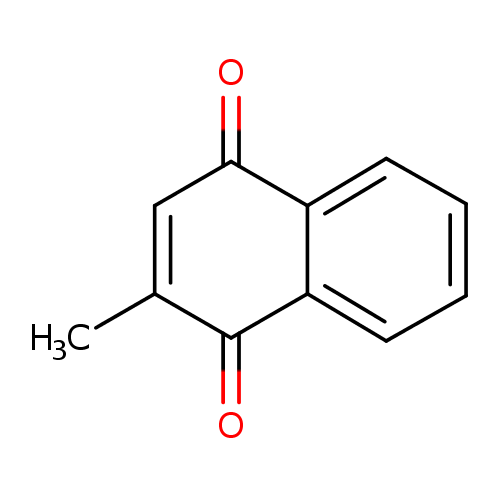
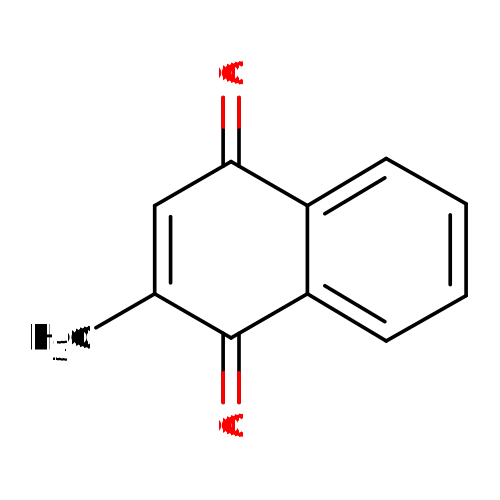
Common NameMenadione
ClassSmall Molecule
DescriptionMenadione is a synthetic naphthoquinone without the isoprenoid side chain and biological activity, but can be converted to active vitamin K2, menaquinone, after alkylation in vivo. Despite the fact that it can serve as a precursor to various types of vitamin K, menadione is generally not used as a nutritional supplement. Large doses of menadione have been reported to cause adverse outcomes including hemolytic anemia due to G6PD deficiency, neonatal brain or liver damage, or neonatal death in some cases. Moreover, menadione supplements have been banned by the FDA because of their high toxicity. It is sometimes called vitamin K3, although derivatives of naphthoquinone without the sidechain in the 3-position cannot exert all the functions of the K vitamins. Menadione is a vitamin precursor of K2 which utilizes alkylation in the liver to yield menaquinones (MK-n, n=1-13; K2 vitamers), and hence, is better classified as a provitamin.
Contaminant Sources
  • FooDB Chemicals
  • HMDB Contaminants - Urine
  • IARC Carcinogens Group 3
  • STOFF IDENT Compounds
  • T3DB toxins
  • ToxCast & Tox21 Chemicals
Contaminant Type
  • Antifibrinolytic Agent
  • Dietary Supplement
  • Drug
  • Ester
  • Food Toxin
  • Metabolite
  • Micronutrient
  • Nutraceutical
  • Organic Compound
  • Supplement
  • Synthetic Compound
  • Vitamin
Chemical Structure
Thumb
Synonyms
ValueSource
2-Methyl-1,4-naphthalenedioneChEBI
2-Methyl-1,4-naphthochinonChEBI
2-Methyl-1,4-naphthoquinoneChEBI
Vitamin K3ChEBI
KappaxinKegg
2-Methyl-1,4-naftochinonHMDB
2-Methyl-1,4-naphthalendioneHMDB
2-Methyl-1,4-naphthodioneHMDB
2-MethylnaphthoquinoneHMDB
3-Methyl-1,4-naphthoquinoneHMDB
AquakayHMDB
AquinoneHMDB
HemodalHMDB
Juva-KHMDB
K-ThrombylHMDB
K-VitanHMDB
KaergonaHMDB
KanoneHMDB
KappaxanHMDB
KarconHMDB
KareonHMDB
Kativ-gHMDB
KayklotHMDB
KaykotHMDB
KaynoneHMDB
KayquinoneHMDB
KipcaHMDB
Kipca-oil solubleHMDB
KlottoneHMDB
KoaxinHMDB
KolklotHMDB
MenadionHMDB
MenaphtheneHMDB
MenaphthonHMDB
MenaphthoneHMDB
MenaphtoneHMDB
MenaquinoneHMDB
Menaquinone OHMDB
MitenonHMDB
MitenoneHMDB
MNQHMDB
PanosineHMDB
ProkayvitHMDB
SynkayHMDB
ThyloquinoneHMDB
Vitamin K0HMDB
Vitamin K2HMDB
Vitamin K3: 1,4-dihydro-1,4-dioxo-2-methylnaphthaleneHMDB
Bisulfite, menadioneHMDB
VicasolHMDB
Bisulfite, menadione sodiumHMDB
Menadione sodium bisulfiteHMDB
VikasolHMDB
Vitamin K 3HMDB
Menadione sodium bisulfite, trihydrateHMDB
Vitamin K3 sodium bisulfiteHMDB
Menadione bisulfiteHMDB
Sodium bisulfite, menadioneHMDB
Chemical FormulaC11H8O2
Average Molecular Mass172.180 g/mol
Monoisotopic Mass172.052 g/mol
CAS Registry Number58-27-5
IUPAC Name2-methyl-1,4-dihydronaphthalene-1,4-dione
Traditional Namemenadione
SMILESCC1=CC(=O)C2=CC=CC=C2C1=O
InChI IdentifierInChI=1S/C11H8O2/c1-7-6-10(12)8-4-2-3-5-9(8)11(7)13/h2-6H,1H3
InChI KeyMJVAVZPDRWSRRC-UHFFFAOYSA-N
Chemical Taxonomy
Description belongs to the class of organic compounds known as naphthoquinones. Naphthoquinones are compounds containing a naphthohydroquinone moiety, which consists of a benzene ring linearly fused to a bezene-1,4-dione (quinone).
KingdomOrganic compounds
Super ClassBenzenoids
ClassNaphthalenes
Sub ClassNaphthoquinones
Direct ParentNaphthoquinones
Alternative Parents
Substituents
  • Naphthoquinone
  • Aryl ketone
  • Quinone
  • Ketone
  • Organic oxygen compound
  • Organic oxide
  • Hydrocarbon derivative
  • Organooxygen compound
  • Aromatic homopolycyclic compound
Molecular FrameworkAromatic homopolycyclic compounds
External Descriptors
Biological Properties
StatusDetected and Not Quantified
OriginExogenous
Cellular Locations
  • Cytoplasm
  • Extracellular
Biofluid LocationsNot Available
Tissue Locations
  • Fibroblasts
  • Kidney
  • Liver
  • Neuron
  • Pancreas
  • Placenta
  • Platelet
  • Prostate
PathwaysNot Available
ApplicationsNot Available
Biological RolesNot Available
Chemical RolesNot Available
Physical Properties
StateSolid
AppearanceWhite powder.
Experimental Properties
PropertyValue
Melting Point107°C
Boiling PointNot Available
Solubility160 mg/L (at 30°C)
Predicted Properties
PropertyValueSource
Water Solubility0.5 g/LALOGPS
logP1.91ALOGPS
logP1.89ChemAxon
logS-2.5ALOGPS
pKa (Strongest Acidic)12.94ChemAxon
pKa (Strongest Basic)-7.2ChemAxon
Physiological Charge0ChemAxon
Hydrogen Acceptor Count2ChemAxon
Hydrogen Donor Count0ChemAxon
Polar Surface Area34.14 ŲChemAxon
Rotatable Bond Count0ChemAxon
Refractivity50.54 m³·mol⁻¹ChemAxon
Polarizability17.64 ųChemAxon
Number of Rings2ChemAxon
Bioavailability1ChemAxon
Rule of FiveYesChemAxon
Ghose FilterYesChemAxon
Veber's RuleYesChemAxon
MDDR-like RuleNoChemAxon
Spectra
Spectra
Spectrum TypeDescriptionSplash KeyView
GC-MSGC-MS Spectrum - GC-MS (Non-derivatized)splash10-0gk9-3900000000-ad6c0e599173ba802f73Spectrum
GC-MSGC-MS Spectrum - GC-MS (Non-derivatized)splash10-0ufr-2910000000-bbd6cf78055e623046a6Spectrum
GC-MSGC-MS Spectrum - GC-MS (Non-derivatized)splash10-0ufr-2910000000-5db665917b8c152a80b2Spectrum
GC-MSGC-MS Spectrum - EI-B (Non-derivatized)splash10-0g4i-6900000000-0c6c7737ff416205089cSpectrum
GC-MSGC-MS Spectrum - GC-MS (Non-derivatized)splash10-0gk9-3900000000-ad6c0e599173ba802f73Spectrum
GC-MSGC-MS Spectrum - GC-MS (Non-derivatized)splash10-0ufr-2910000000-bbd6cf78055e623046a6Spectrum
GC-MSGC-MS Spectrum - GC-MS (Non-derivatized)splash10-0ufr-2910000000-5db665917b8c152a80b2Spectrum
Predicted GC-MSPredicted GC-MS Spectrum - GC-MS (Non-derivatized) - 70eV, Positivesplash10-006x-1900000000-3c2bf459bf04eae7701dSpectrum
Predicted GC-MSPredicted GC-MS Spectrum - GC-MS (Non-derivatized) - 70eV, PositiveNot AvailableSpectrum
LC-MS/MSLC-MS/MS Spectrum - Quattro_QQQ 10V, Positive (Annotated)splash10-074j-1900000000-a62dd17c23ac6e7fa95dSpectrum
LC-MS/MSLC-MS/MS Spectrum - Quattro_QQQ 25V, Positive (Annotated)splash10-0aor-1900000000-ce35b89eaf766c9398e8Spectrum
LC-MS/MSLC-MS/MS Spectrum - Quattro_QQQ 40V, Positive (Annotated)splash10-004i-9100000000-65a9c21d7aa7be21de3aSpectrum
LC-MS/MSLC-MS/MS Spectrum - EI-B (HITACHI M-80) , Positivesplash10-0g4i-6900000000-0c6c7737ff416205089cSpectrum
LC-MS/MSLC-MS/MS Spectrum - LC-ESI-qTof , Positivesplash10-00di-1900000000-b489978f8a44b156f0f3Spectrum
LC-MS/MSLC-MS/MS Spectrum - , positivesplash10-00di-1900000000-b489978f8a44b156f0f3Spectrum
Predicted LC-MS/MSPredicted LC-MS/MS Spectrum - 10V, Positivesplash10-00di-0900000000-ea17be197704c13eba82Spectrum
Predicted LC-MS/MSPredicted LC-MS/MS Spectrum - 20V, Positivesplash10-00di-2900000000-2d0b65ea01fe9dd6b4feSpectrum
Predicted LC-MS/MSPredicted LC-MS/MS Spectrum - 40V, Positivesplash10-001i-7900000000-509fb00927321d93a529Spectrum
Predicted LC-MS/MSPredicted LC-MS/MS Spectrum - 10V, Negativesplash10-00di-0900000000-252f2831b39763f805b4Spectrum
Predicted LC-MS/MSPredicted LC-MS/MS Spectrum - 20V, Negativesplash10-00di-0900000000-cea08e3f258cdd275a55Spectrum
Predicted LC-MS/MSPredicted LC-MS/MS Spectrum - 40V, Negativesplash10-00dr-6900000000-b84149529316a1f0987fSpectrum
Predicted LC-MS/MSPredicted LC-MS/MS Spectrum - 10V, Positivesplash10-00di-0900000000-4b93b7dbc3df04aab3c2Spectrum
Predicted LC-MS/MSPredicted LC-MS/MS Spectrum - 20V, Positivesplash10-05fr-0900000000-8106d06f0716bb26e582Spectrum
Predicted LC-MS/MSPredicted LC-MS/MS Spectrum - 40V, Positivesplash10-056r-9800000000-8d82921b8e80d22359e4Spectrum
Predicted LC-MS/MSPredicted LC-MS/MS Spectrum - 10V, Negativesplash10-00di-0900000000-3f44d5db68c8c3181750Spectrum
Predicted LC-MS/MSPredicted LC-MS/MS Spectrum - 20V, Negativesplash10-00di-0900000000-3f44d5db68c8c3181750Spectrum
Predicted LC-MS/MSPredicted LC-MS/MS Spectrum - 40V, Negativesplash10-01dl-9400000000-2f2a9aa33ad848811ec2Spectrum
MSMass Spectrum (Electron Ionization)splash10-0gk9-5900000000-48fb5ac08ce624a689ccSpectrum
1D NMR1H NMR SpectrumNot AvailableSpectrum
1D NMR13C NMR SpectrumNot AvailableSpectrum
1D NMR1H NMR SpectrumNot AvailableSpectrum
1D NMR13C NMR SpectrumNot AvailableSpectrum
1D NMR1H NMR SpectrumNot AvailableSpectrum
1D NMR13C NMR SpectrumNot AvailableSpectrum
1D NMR1H NMR SpectrumNot AvailableSpectrum
1D NMR13C NMR SpectrumNot AvailableSpectrum
1D NMR1H NMR SpectrumNot AvailableSpectrum
1D NMR13C NMR SpectrumNot AvailableSpectrum
1D NMR1H NMR SpectrumNot AvailableSpectrum
1D NMR13C NMR SpectrumNot AvailableSpectrum
1D NMR1H NMR SpectrumNot AvailableSpectrum
1D NMR13C NMR SpectrumNot AvailableSpectrum
1D NMR1H NMR SpectrumNot AvailableSpectrum
1D NMR13C NMR SpectrumNot AvailableSpectrum
1D NMR1H NMR SpectrumNot AvailableSpectrum
1D NMR13C NMR SpectrumNot AvailableSpectrum
1D NMR1H NMR SpectrumNot AvailableSpectrum
1D NMR13C NMR SpectrumNot AvailableSpectrum
1D NMR1H NMR SpectrumNot AvailableSpectrum
2D NMR[1H,13C] 2D NMR SpectrumNot AvailableSpectrum
Toxicity Profile
Route of ExposureVariable and ranges from 10% to 80%
Mechanism of ToxicityMenadione (vitamin K3) is involved as a cofactor in the posttranslational gamma-carboxylation of glutamic acid residues of certain proteins in the body. These proteins include the vitamin K-dependent coagulation factors II (prothrombin), VII (proconvertin), IX (Christmas factor), X (Stuart factor), protein C, protein S, protein Zv and a growth-arrest-specific factor (Gas6). In contrast to the other vitamin K-dependent proteins in the blood coagulation cascade, protein C and protein S serve anticoagulant roles. The two vitamin K-dependent proteins found in bone are osteocalcin, also known as bone G1a (gamma-carboxyglutamate) protein or BGP, and the matrix G1a protein or MGP. Gamma-carboxylation is catalyzed by the vitamin K-dependent gamma-carboxylases. The reduced form of vitamin K, vitamin K hydroquinone, is the actual cofactor for the gamma-carboxylases. Proteins containing gamma-carboxyglutamate are called G1a proteins.
MetabolismHepatic
Toxicity ValuesNot Available
Lethal DoseNot Available
Carcinogenicity (IARC Classification)3, not classifiable as to its carcinogenicity to humans. (16)
Uses/SourcesThe primary known function of vitamin K is to assist in the normal clotting of blood, but it may also play a role in normal bone calcification.
Minimum Risk LevelNot Available
Health EffectsNot Available
SymptomsMenadione (vitamin K3), which is not used as a nutritional supplemental form of vitamin K for humans, has been reported to cause adverse reactions, including hemolytic anemia. Large doses have also been reported to cause brain damage.
TreatmentNot Available
Concentrations
Not Available
DrugBank IDDB00170
HMDB IDHMDB0001892
FooDB IDFDB000953
Phenol Explorer IDNot Available
KNApSAcK IDNot Available
BiGG IDNot Available
BioCyc IDNot Available
METLIN ID3910
PDB IDNot Available
Wikipedia LinkMenadione
Chemspider ID3915
ChEBI ID28869
PubChem Compound ID4055
Kegg Compound IDC05377
YMDB IDNot Available
ECMDB IDECMDB04102
References
Synthesis Reference

Joachim U. Schneider, Hans Kiefer, “Menadione choline bisulfite adduct, its preparation and antihemorrhagic compositions.” U.S. Patent US4735969, issued January, 1980.

MSDSLink
General References
1. https://www.ncbi.nlm.nih.gov/pubmed/?term=13779073
2. https://www.ncbi.nlm.nih.gov/pubmed/?term=15052609
3. https://www.ncbi.nlm.nih.gov/pubmed/?term=16469140
4. https://www.ncbi.nlm.nih.gov/pubmed/?term=1650428
5. https://www.ncbi.nlm.nih.gov/pubmed/?term=28166217
6. https://www.ncbi.nlm.nih.gov/pubmed/?term=9380028
7. Minami, Ryohei; Nishizaki, Tadao; Kumagai, Yoshitoshi. Menadione. Jpn. Kokai Tokkyo Koho (1986), 4 pp.
8. Minami, Ryohei; Nishizaki, Tadao; Kumagai, Yoshitoshi. Menadione. Jpn. Kokai Tokkyo Koho (1986), 4 pp.
9. Kwasnicka-Crawford DA, Vincent SR: Role of a novel dual flavin reductase (NR1) and an associated histidine triad protein (DCS-1) in menadione-induced cytotoxicity. Biochem Biophys Res Commun. 2005 Oct 21;336(2):565-71.
10. Snider BJ, Moss JL, Revilla FJ, Lee CS, Wheeler VC, Macdonald ME, Choi DW: Neocortical neurons cultured from mice with expanded CAG repeats in the huntingtin gene: unaltered vulnerability to excitotoxins and other insults. Neuroscience. 2003;120(3):617-25.
11. Robertson DG, Bailey DL, Martin RA: Species differences in response to photohemolytic agents. Photochem Photobiol. 1991 Apr;53(4):455-61.
12. Chladek J, Martinkova J, Sispera L: An in vitro study on methotrexate hydroxylation in rat and human liver. Physiol Res. 1997;46(5):371-9.
13. Habu D, Shiomi S, Tamori A, Takeda T, Tanaka T, Kubo S, Nishiguchi S: Role of vitamin K2 in the development of hepatocellular carcinoma in women with viral cirrhosis of the liver. JAMA. 2004 Jul 21;292(3):358-61.
14. Lasalvia-Prisco E, Cucchi S, Vazquez J, Lasalvia-Galante E, Golomar W, Gordon W: Serum markers variation consistent with autoschizis induced by ascorbic acid-menadione in patients with prostate cancer. Med Oncol. 2003;20(1):45-52.
15. Harrington DJ, Soper R, Edwards C, Savidge GF, Hodges SJ, Shearer MJ: Determination of the urinary aglycone metabolites of vitamin K by HPLC with redox-mode electrochemical detection. J Lipid Res. 2005 May;46(5):1053-60. Epub 2005 Feb 1.
16. Usui Y, Tanimura H, Nishimura N, Kobayashi N, Okanoue T, Ozawa K: Vitamin K concentrations in the plasma and liver of surgical patients. Am J Clin Nutr. 1990 May;51(5):846-52.
17. Ono M, Ohta H, Ohhira M, Sekiya C, Namiki M: Measurement of immunoreactive prothrombin, des-gamma-carboxy prothrombin, and vitamin K in human liver tissues: overproduction of immunoreactive prothrombin in hepatocellular carcinoma. Am J Gastroenterol. 1990 Sep;85(9):1149-54.
18. Suzuki S, Iwata G, Sutor AH: Vitamin K deficiency during the perinatal and infantile period. Semin Thromb Hemost. 2001;27(2):93-8.
19. Wermuth B, Platts KL, Seidel A, Oesch F: Carbonyl reductase provides the enzymatic basis of quinone detoxication in man. Biochem Pharmacol. 1986 Apr 15;35(8):1277-82.
20. Price RJ, Mistry H, Wield PT, Renwick AB, Beamand JA, Lake BG: Comparison of the toxicity of allyl alcohol, coumarin and menadione in precision-cut rat, guinea-pig, cynomolgus monkey and human liver slices. Arch Toxicol. 1996;71(1-2):107-11.
21. Thijssen HH, Drittij-Reijnders MJ: Vitamin K status in human tissues: tissue-specific accumulation of phylloquinone and menaquinone-4. Br J Nutr. 1996 Jan;75(1):121-7.
22. Iioka H, Moriyama IS, Morimoto K, Akada S, Hisanaga H, Ishihara Y, Ichijo M: Pharmacokinetics of vitamin K in mothers and children in the perinatal period: transplacental transport of vitamin K2 (MK-4). Asia Oceania J Obstet Gynaecol. 1991 Mar;17(1):97-100.
23. Strunnikova N, Hilmer S, Flippin J, Robinson M, Hoffman E, Csaky KG: Differences in gene expression profiles in dermal fibroblasts from control and patients with age-related macular degeneration elicited by oxidative injury. Free Radic Biol Med. 2005 Sep 15;39(6):781-96.