Record Information
Version1.0
Creation Date2009-07-21 20:26:12 UTC
Update Date2026-03-31 17:22:24 UTC
Accession NumberCHEM002135
Identification
Common NameCholecalciferol
ClassSmall Molecule
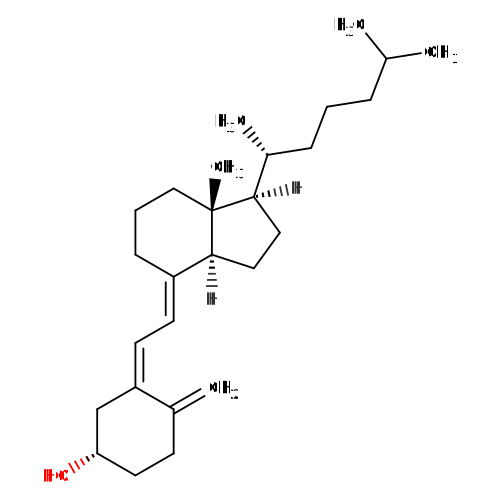
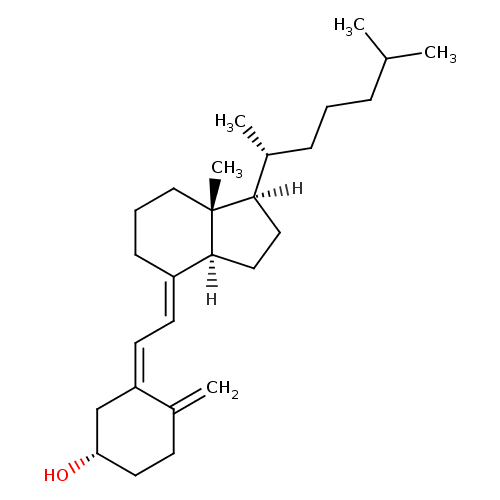
DescriptionCholecalciferol is only found in individuals that have used or taken this drug. It is a derivative of 7-dehydroxycholesterol formed by ultraviolet rays breaking of the C9-C10 bond. It differs from ergocalciferol in having a single bond between C22 and C23 and lacking a methyl group at C24. [PubChem]The first step involved in the activation of vitamin D3 is a 25-hydroxylation which is catalysed by the 25-hydroxylase in the liver and then by other enzymes. The mitochondrial sterol 27-hydroxylase catalyses the first reaction in the oxidation of the side chain of sterol intermediates. The active form of vitamin D3 (calcitriol) binds to intracellular receptors that then function as transcription factors to modulate gene expression. Like the receptors for other steroid hormones and thyroid hormones, the vitamin D receptor has hormone-binding and DNA-binding domains. The vitamin D receptor forms a complex with another intracellular receptor, the retinoid-X receptor, and that heterodimer is what binds to DNA. In most cases studied, the effect is to activate transcription, but situations are also known in which vitamin D suppresses transcription. Calcitriol increases the serum calcium concentrations by: increasing GI absorption of phosphorus and calcium, increasing osteoclastic resorption, and increasing distal renal tubular reabsorption of calcium. Calcitriol appears to promote intestinal absorption of calcium through binding to the vitamin D receptor in the mucosal cytoplasm of the intestine. Subsequently, calcium is absorbed through formation of a calcium-binding protein.
Contaminant Sources
  • Cosmetic Chemicals
  • EAFUS Chemicals
  • FooDB Chemicals
  • HMDB Contaminants - Urine
  • STOFF IDENT Compounds
  • T3DB toxins
  • ToxCast & Tox21 Chemicals
Contaminant Type
  • Antihypocalcemic Agent
  • Antihypoparathyroid Agent
  • Antithyroid Agent
  • Bone Density Conservation Agent
  • Drug
  • Essential Vitamin
  • Food Toxin
  • Household Toxin
  • Metabolite
  • Nutraceutical
  • Organic Compound
  • Synthetic Compound
  • Vitamin
  • Vitamin D
Chemical Structure
Thumb
Synonyms
ValueSource
(+)-Vitamin D3ChEBI
(1S,3Z)-3-[(2E)-2-[(1R,3AR,7as)-7a-methyl-1-[(2R)-6-methylheptan-2-yl]-2,3,3a,5,6,7-hexahydro-1H-inden-4-ylidene]ethylidene]-4-methylidene-cyclohexan-1-olChEBI
(3beta,5Z,7E)-9,10-Secocholesta-5,7,10(19)-trien-3-olChEBI
(5Z,7E)-(3S)-9,10-Secocholesta-5,7,10(19)-trien-3-olChEBI
Activated 7-dehydrocholesterolChEBI
CCChEBI
CholecalciferolChEBI
ColecalciferolChEBI
Delta-DChEBI
Oleovitamin D3ChEBI
CalciolKegg
(3b,5Z,7E)-9,10-Secocholesta-5,7,10(19)-trien-3-olGenerator
(3Β,5Z,7E)-9,10-secocholesta-5,7,10(19)-trien-3-olGenerator
δ-DGenerator
7-DEHYDROCHOLESTEROLHMDB
ACTIVATEDHMDB
VITAMIN DHMDB
DihydrocholesterolHMDB
Vitamin D 3HMDB
(3 beta,5Z,7E)-9,10-Secocholesta-5,7,10(19)-trien-3-olHMDB
CholecalciferolsHMDB
Vitamin D3ChEBI
Chemical FormulaC27H44O
Average Molecular Mass384.638 g/mol
Monoisotopic Mass384.339 g/mol
CAS Registry Number67-97-0
IUPAC Name(1S,3Z)-3-{2-[(1R,3aS,4E,7aR)-7a-methyl-1-[(2R)-6-methylheptan-2-yl]-octahydro-1H-inden-4-ylidene]ethylidene}-4-methylidenecyclohexan-1-ol
Traditional Namevitamin D3
SMILESCC(C)CCC[C@@H](C)[C@@]1([H])CC[C@@]2([H])\C(CCC[C@]12C)=C\C=C1\C[C@@H](O)CCC1=C
InChI IdentifierInChI=1S/C27H44O/c1-19(2)8-6-9-21(4)25-15-16-26-22(10-7-17-27(25,26)5)12-13-23-18-24(28)14-11-20(23)3/h12-13,19,21,24-26,28H,3,6-11,14-18H2,1-2,4-5H3/b22-12+,23-13-/t21-,24+,25-,26+,27-/m1/s1
InChI KeyQYSXJUFSXHHAJI-YRZJJWOYSA-N
Chemical Taxonomy
Description belongs to the class of organic compounds known as vitamin d and derivatives. Vitamin D and derivatives are compounds containing a secosteroid backbone, usually secoergostane or secocholestane.
KingdomOrganic compounds
Super ClassLipids and lipid-like molecules
ClassSteroids and steroid derivatives
Sub ClassVitamin D and derivatives
Direct ParentVitamin D and derivatives
Alternative Parents
Substituents
  • Triterpenoid
  • Cyclic alcohol
  • Secondary alcohol
  • Organic oxygen compound
  • Hydrocarbon derivative
  • Organooxygen compound
  • Alcohol
  • Aliphatic homopolycyclic compound
Molecular FrameworkAliphatic homopolycyclic compounds
External Descriptors
Biological Properties
StatusDetected and Not Quantified
OriginEndogenous
Cellular Locations
  • Cytoplasm
  • Extracellular
  • Membrane
Biofluid LocationsNot Available
Tissue LocationsNot Available
PathwaysNot Available
ApplicationsNot Available
Biological Roles
Chemical RolesNot Available
Physical Properties
StateSolid
AppearanceWhite powder.
Experimental Properties
PropertyValue
Melting Point84.5°C
Boiling Point496.4°C
SolubilityInsoluble
Predicted Properties
PropertyValueSource
Water Solubility0.00038 g/LALOGPS
logP7.98ALOGPS
logP7.13ChemAxon
logS-6ALOGPS
pKa (Strongest Acidic)18.38ChemAxon
pKa (Strongest Basic)-1.3ChemAxon
Physiological Charge0ChemAxon
Hydrogen Acceptor Count1ChemAxon
Hydrogen Donor Count1ChemAxon
Polar Surface Area20.23 ŲChemAxon
Rotatable Bond Count6ChemAxon
Refractivity123.22 m³·mol⁻¹ChemAxon
Polarizability49.63 ųChemAxon
Number of Rings3ChemAxon
Bioavailability1ChemAxon
Rule of FiveNoChemAxon
Ghose FilterNoChemAxon
Veber's RuleYesChemAxon
MDDR-like RuleYesChemAxon
Spectra
Spectra
Spectrum TypeDescriptionSplash KeyView
Predicted GC-MSPredicted GC-MS Spectrum - GC-MS (Non-derivatized) - 70eV, Positivesplash10-0aou-3029000000-1950c74de34369a70400Spectrum
Predicted GC-MSPredicted GC-MS Spectrum - GC-MS (1 TMS) - 70eV, Positivesplash10-002f-9207800000-c6f808a014153de38d58Spectrum
Predicted GC-MSPredicted GC-MS Spectrum - GC-MS (Non-derivatized) - 70eV, PositiveNot AvailableSpectrum
Predicted GC-MSPredicted GC-MS Spectrum - GC-MS (TBDMS_1_1) - 70eV, PositiveNot AvailableSpectrum
Predicted LC-MS/MSPredicted LC-MS/MS Spectrum - 10V, Positivesplash10-014r-0129000000-80de8aabbfb587d8f7b9Spectrum
Predicted LC-MS/MSPredicted LC-MS/MS Spectrum - 20V, Positivesplash10-0abi-2595000000-1f5db35cc732efef5e27Spectrum
Predicted LC-MS/MSPredicted LC-MS/MS Spectrum - 40V, Positivesplash10-0pb9-7195000000-b742ddd81b2f98395fabSpectrum
Predicted LC-MS/MSPredicted LC-MS/MS Spectrum - 10V, Negativesplash10-001i-0009000000-70f22151bd69b3307086Spectrum
Predicted LC-MS/MSPredicted LC-MS/MS Spectrum - 20V, Negativesplash10-001i-0009000000-7ff3c3cf4e98856a166bSpectrum
Predicted LC-MS/MSPredicted LC-MS/MS Spectrum - 40V, Negativesplash10-014i-1249000000-8756607b9fd7d6008ac9Spectrum
Predicted LC-MS/MSPredicted LC-MS/MS Spectrum - 10V, Positivesplash10-000i-0459000000-cdb5561f3458bde4c2f1Spectrum
Predicted LC-MS/MSPredicted LC-MS/MS Spectrum - 20V, Positivesplash10-0kmj-7494000000-5a36ac0547956f9ac058Spectrum
Predicted LC-MS/MSPredicted LC-MS/MS Spectrum - 40V, Positivesplash10-0a4i-3930000000-c62b5a8a92e3487b90edSpectrum
Predicted LC-MS/MSPredicted LC-MS/MS Spectrum - 10V, Negativesplash10-001i-0009000000-bfd82bd18d8804cfa1d2Spectrum
Predicted LC-MS/MSPredicted LC-MS/MS Spectrum - 20V, Negativesplash10-001i-0009000000-d168cadb843f05c02d05Spectrum
Predicted LC-MS/MSPredicted LC-MS/MS Spectrum - 40V, Negativesplash10-001i-0539000000-277213cec95d0ba155c5Spectrum
1D NMR1H NMR SpectrumNot AvailableSpectrum
2D NMR[1H,13C] 2D NMR SpectrumNot AvailableSpectrum
Toxicity Profile
Route of ExposureOral, readily absorbed
Mechanism of ToxicityThe first step involved in the activation of vitamin D3 is a 25-hydroxylation which is catalysed by the 25-hydroxylase in the liver and then by other enzymes. The mitochondrial sterol 27-hydroxylase catalyses the first reaction in the oxidation of the side chain of sterol intermediates. The active form of vitamin D3 (calcitriol) binds to intracellular receptors that then function as transcription factors to modulate gene expression. Like the receptors for other steroid hormones and thyroid hormones, the vitamin D receptor has hormone-binding and DNA-binding domains. The vitamin D receptor forms a complex with another intracellular receptor, the retinoid-X receptor, and that heterodimer is what binds to DNA. In most cases studied, the effect is to activate transcription, but situations are also known in which vitamin D suppresses transcription. Calcitriol increases the serum calcium concentrations by: increasing GI absorption of phosphorus and calcium, increasing osteoclastic resorption, and increasing distal renal tubular reabsorption of calcium. Calcitriol appears to promote intestinal absorption of calcium through binding to the vitamin D receptor in the mucosal cytoplasm of the intestine. Subsequently, calcium is absorbed through formation of a calcium-binding protein.
MetabolismWithin the liver, cholecalciferal is hydroxylated to calcidiol (25-hydroxycholecalciferol) by the enzyme 25-hydroxylase. Within the kidney, calcidiol serves as a substrate for 1-alpha-hydroxylase, yielding calcitriol (1,25-dihydroxycholecalciferol), the biologically active form of vitamin D3. Half Life: Several weeks
Toxicity ValuesNot Available
Lethal DoseNot Available
Carcinogenicity (IARC Classification)No indication of carcinogenicity to humans (not listed by IARC).
Uses/SourcesFor the treatment of vitamin D deficiency or insufficiency, refractory rickets (vitamin D resistant rickets), familial hypophosphatemia and hypoparathyroidism, and in the management of hypocalcemia and renal osteodystrophy in patients with chronic renal failure undergoing dialysis. Also used in conjunction with calcium in the management and prevention of primary or corticosteroid-induced osteoporosis.
Minimum Risk LevelNot Available
Health EffectsNot Available
SymptomsHypercalcemia - Early symptoms of hypercalcemia, include nausea and vomiting, weakness, headache, somnolence, dry mouth, constipation, metallic taste, muscle pain and bone pain. Late symptoms and signs of hypercalcemia, include polyuria, polydipsia, anorexia, weight loss, nocturia, conjunctivitis, pancreatitis, photophobia, rhinorrhea, pruritis, hyperthermia, decreased libido, elevated BUN, albuminuria, hypercholesterolemia, elevated ALT (SGPT) and AST (SGOT), ectopic calcification, nephrocalcinosis, hypertension and cardiac arrhythmias.
TreatmentNot Available
Concentrations
Not Available
DrugBank IDDB00169
HMDB IDHMDB0000876
FooDB IDFDB021586
Phenol Explorer IDNot Available
KNApSAcK IDC00041217
BiGG ID2288999
BioCyc IDNot Available
METLIN IDNot Available
PDB IDNot Available
Wikipedia LinkCholecalciferol
Chemspider ID4444353
ChEBI ID28940
PubChem Compound ID5280795
Kegg Compound IDC05443
YMDB IDNot Available
ECMDB IDNot Available
References
Synthesis Reference

Jean Jolly, Primo Rizzi, Jean Taillardat, “1.alpha.,25.alpha.-Dihydroxy-cholecalciferol and methods for the production thereof.” U.S. Patent US4435325, issued May, 1977.

MSDSLink
General References
1. Nemoto, Hideo; Kurobe, Hiroshi; Fukumoto, Keiichiro; Kametani, Tetsuji. A modified synthesis of the (+)-8a-phenylsulfonyl-des-AB-cholestane via an intramolecular nucleophilic attack to epoxide - a total synthesis of vitamin D3. Heterocycles (1985), 23(3),
2. Rautureau M, Rambaud JC: Aqueous solubilisation of vitamin D3 in normal man. Gut. 1981 May;22(5):393-7.
3. Shepard RM, Horst RL, Hamstra AJ, DeLuca HF: Determination of vitamin D and its metabolites in plasma from normal and anephric man. Biochem J. 1979 Jul 15;182(1):55-69.
4. Osborne JE, Hutchinson PE: Vitamin D and systemic cancer: is this relevant to malignant melanoma? Br J Dermatol. 2002 Aug;147(2):197-213.
5. Haddad JG, Jennings AS, Aw TC: Vitamin D uptake and metabolism by perfused rat liver: influences of carrier proteins. Endocrinology. 1988 Jul;123(1):498-504.
6. Kida K, Goodman DS: Studies on the transport of vitamin D and of 25-hydroxyvitamin D in human plasma. J Lipid Res. 1976 Sep;17(5):485-90.
7. Flanagan JN, Young MV, Persons KS, Wang L, Mathieu JS, Whitlatch LW, Holick MF, Chen TC: Vitamin D metabolism in human prostate cells: implications for prostate cancer chemoprevention by vitamin D. Anticancer Res. 2006 Jul-Aug;26(4A):2567-72.
8. Lips P: Vitamin D deficiency and secondary hyperparathyroidism in the elderly: consequences for bone loss and fractures and therapeutic implications. Endocr Rev. 2001 Aug;22(4):477-501.
9. Svendsen ML, Daneels G, Geysen J, Binderup L, Kragballe K: Proliferation and differentiation of cultured human keratinocytes is modulated by 1,25(OH)2D3 and synthetic vitamin D3 analogues in a cell density-, calcium- and serum-dependent manner. Pharmacol Toxicol. 1997 Jan;80(1):49-56.
10. Yetgin S, Yalcin SS: The effect of vitamin D3 on CD34 progenitor cells in vitamin D deficiency rickets. Turk J Pediatr. 2004 Apr-Jun;46(2):164-6.
11. Astecker N, Reddy GS, Herzig G, Vorisek G, Schuster I: 1alpha,25-Dihydroxy-3-epi-vitamin D3 a physiological metabolite of 1alpha,25-dihydroxyvitamin D3: its production and metabolism in primary human keratinocytes. Mol Cell Endocrinol. 2000 Dec 22;170(1-2):91-101.
12. Murao N, Ohishi N, Nabuchi Y, Ishigai M, Kawanishi T, Aso Y: The determination of 2beta-(3-hydroxypropoxy)-1alpha,25-dihydroxy vitamin D3 (ED-71) in human serum by high-performance liquid chromatography-electrospray tandem mass spectrometry. J Chromatogr B Analyt Technol Biomed Life Sci. 2005 Sep 5;823(2):61-8. Epub 2004 Nov 19.
13. Lippens S, Kockx M, Denecker G, Knaapen M, Verheyen A, Christiaen R, Tschachler E, Vandenabeele P, Declercq W: Vitamin D3 induces caspase-14 expression in psoriatic lesions and enhances caspase-14 processing in organotypic skin cultures. Am J Pathol. 2004 Sep;165(3):833-41.
14. Bjorkhem I, Holmberg I, Kristiansen T, Pedersen JI: Assay of 1,25-dihydroxy vitamin D3 by isotope dilution--mass fragmentography. Clin Chem. 1979 Apr;25(4):584-8.
15. Matsuoka LY, McConnachie P, Wortsman J, Holick MF: Immunological responses to ultraviolet light B radiation in Black individuals. Life Sci. 1999;64(17):1563-9.
16. Zimber A, Chedeville A, Abita JP, Barbu V, Gespach C: Functional interactions between bile acids, all-trans retinoic acid, and 1,25-dihydroxy-vitamin D3 on monocytic differentiation and myeloblastin gene down-regulation in HL60 and THP-1 human leukemia cells. Cancer Res. 2000 Feb 1;60(3):672-8.
17. Baggio B, Budakovic A, Nassuato MA, Vezzoli G, Manzato E, Luisetto G, Zaninotto M: Plasma phospholipid arachidonic acid content and calcium metabolism in idiopathic calcium nephrolithiasis. Kidney Int. 2000 Sep;58(3):1278-84.
18. MacLaughlin J, Holick MF: Aging decreases the capacity of human skin to produce vitamin D3. J Clin Invest. 1985 Oct;76(4):1536-8.
19. Lee YF, Young WJ, Lin WJ, Shyr CR, Chang C: Differential regulation of direct repeat 3 vitamin D3 and direct repeat 4 thyroid hormone signaling pathways by the human TR4 orphan receptor. J Biol Chem. 1999 Jun 4;274(23):16198-205.
20. Okano T, Kuroda E, Nakao H, Kodama S, Matsuo T, Nakamichi Y, Nakajima K, Hirao N, Kobayashi T: Lack of evidence for existence of vitamin D and 25-hydroxyvitamin D sulfates in human breast and cow's milk. J Nutr Sci Vitaminol (Tokyo). 1986 Oct;32(5):449-62.
21. Mata-Granados JM, Caballo-Lopez A, Luque de Castro MD, Quesada JM: Automated method for the determination of vitamin D3 hydroxymetabolites in serum. Anal Bioanal Chem. 2003 Sep;377(2):287-92. Epub 2003 Jul 9.
22. Armas LA, Hollis BW, Heaney RP: Vitamin D2 is much less effective than vitamin D3 in humans. J Clin Endocrinol Metab. 2004 Nov;89(11):5387-91.
23. Simons K, Toomre D: Lipid rafts and signal transduction. Nat Rev Mol Cell Biol. 2000 Oct;1(1):31-9.
24. Watson AD: Thematic review series: systems biology approaches to metabolic and cardiovascular disorders. Lipidomics: a global approach to lipid analysis in biological systems. J Lipid Res. 2006 Oct;47(10):2101-11. Epub 2006 Aug 10.
25. Sethi JK, Vidal-Puig AJ: Thematic review series: adipocyte biology. Adipose tissue function and plasticity orchestrate nutritional adaptation. J Lipid Res. 2007 Jun;48(6):1253-62. Epub 2007 Mar 20.
26. Lingwood D, Simons K: Lipid rafts as a membrane-organizing principle. Science. 2010 Jan 1;327(5961):46-50. doi: 10.1126/science.1174621.
27. The lipid handbook with CD-ROM
28. https://www.ncbi.nlm.nih.gov/pubmed/?term=15876428
29. https://www.ncbi.nlm.nih.gov/pubmed/?term=17156784
30. https://www.ncbi.nlm.nih.gov/pubmed/?term=19817701
31. https://www.ncbi.nlm.nih.gov/pubmed/?term=23964472
32. https://www.ncbi.nlm.nih.gov/pubmed/?term=9627702