Record Information
Version1.0
Creation Date2009-07-21 20:26:12 UTC
Update Date2026-05-14 16:24:23 UTC
Accession NumberCHEM002133
Identification
Common NamePyridoxine
ClassSmall Molecule
DescriptionPyridoxine is the 4-methanol form of vitamin B6 and is converted to pyridoxal 5-phosphate in the body. Pyridoxal 5-phosphate is a coenzyme for synthesis of amino acids, neurotransmitters (serotonin, norepinephrine), sphingolipids, aminolevulinic acid. Although pyridoxine and vitamin B6 are still frequently used as synonyms, especially by medical researchers, this practice is erroneous and sometimes misleading. Pyridoxine is one of the compounds that can be called vitamin B6. Pyridoxine assists in the balancing of sodium and potassium as well as promoting red blood cell production. It is linked to cancer immunity and helps fight the formation of homocysteine. It has been suggested that Pyridoxine might help children with learning difficulties, and may also prevent dandruff, eczema, and psoriasis. In addition, pyridoxine can help balance hormonal changes in women and aid in immune system. Lack of pyridoxine may cause anemia, nerve damage, seizures, skin problems, and sores in the mouth. Deficiency, though rare because of widespread distribution in foods, leads to the development of peripheral neuritis in adults and affects the central nervous system in children.
Contaminant Sources
  • Cosmetic Chemicals
  • EAFUS Chemicals
  • FooDB Chemicals
  • HMDB Contaminants - Urine
  • STOFF IDENT Compounds
  • T3DB toxins
  • ToxCast & Tox21 Chemicals
Contaminant Type
  • Anti-Inflammatory Agent
  • Drug
  • Essential Vitamin
  • Food Toxin
  • Household Toxin
  • Human Neurotoxin
  • Metabolite
  • Natural Compound
  • Nutraceutical
  • Organic Compound
  • Vitamin
  • Vitamin B Complex
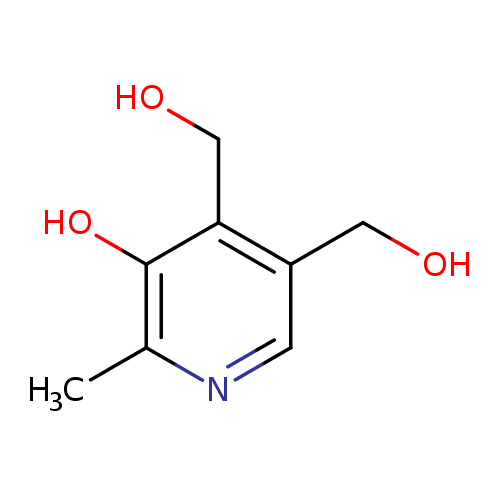
Chemical Structure
Thumb
Synonyms
ValueSource
2-Methyl-3-hydroxy-4,5-dihydroxymethylpyridineChEBI
3-Hydroxy-4,5-bis(hydroxymethyl)-2-methylpyridineChEBI
3-Hydroxy-4,5-dimethylol-alpha-picolineChEBI
5-Hydroxy-6-methyl-3,4-pyridinedimethanolChEBI
PyridoxolChEBI
Vitamin b6ChEBI
3-Hydroxy-4,5-dimethylol-a-picolineGenerator
3-Hydroxy-4,5-dimethylol-α-picolineGenerator
2-Methyl-3-hydroxy-4,5-bis(hydroxymethyl)pyridineHMDB
2-Methyl-3-hydroxy-4,5-di(hydroxymethyl)pyridineHMDB
2-Methyl-4,5-bis(hydroxymethyl)-3-hydroxypyridineHMDB
3-Hydroxy-2-picoline-4,5-dimethanolHMDB
AdermineHMDB
GravidoxHMDB
HydoxinHMDB
PiridossinaHMDB
PiridoxinaHMDB
PyridoxinHMDB
PyridoxinumHMDB
PyridoxolumHMDB
Pyridoxol hydrochlorideHMDB
RodexHMDB
Pyridoxine hydrochlorideHMDB
Chemical FormulaC8H11NO3
Average Molecular Mass169.178 g/mol
Monoisotopic Mass169.074 g/mol
CAS Registry Number65-23-6
IUPAC Name4,5-bis(hydroxymethyl)-2-methylpyridin-3-ol
Traditional Namepyridoxine
SMILESCC1=C(O)C(CO)=C(CO)C=N1
InChI IdentifierInChI=1S/C8H11NO3/c1-5-8(12)7(4-11)6(3-10)2-9-5/h2,10-12H,3-4H2,1H3
InChI KeyLXNHXLLTXMVWPM-UHFFFAOYSA-N
Chemical Taxonomy
Description belongs to the class of organic compounds known as pyridoxines. These are pyridoxal derivatives in which the carbaldehyde group at position 2 of the pyridoxal moiety is replaced by a hydroxymethyl group.
KingdomOrganic compounds
Super ClassOrganoheterocyclic compounds
ClassPyridines and derivatives
Sub ClassPyridoxines
Direct ParentPyridoxines
Alternative Parents
Substituents
  • Pyridoxine
  • Methylpyridine
  • Hydroxypyridine
  • Heteroaromatic compound
  • Azacycle
  • Organic nitrogen compound
  • Organic oxygen compound
  • Organopnictogen compound
  • Hydrocarbon derivative
  • Aromatic alcohol
  • Primary alcohol
  • Organooxygen compound
  • Organonitrogen compound
  • Alcohol
  • Aromatic heteromonocyclic compound
Molecular FrameworkAromatic heteromonocyclic compounds
External Descriptors
Biological Properties
StatusDetected and Not Quantified
OriginEndogenous
Cellular Locations
  • Cytoplasm
  • Extracellular
Biofluid LocationsNot Available
Tissue Locations
  • Erythrocyte
  • Liver
Pathways
NameSMPDB LinkKEGG Link
Vitamin B6 MetabolismSMP00017 map00750
ApplicationsNot Available
Biological Roles
Chemical RolesNot Available
Physical Properties
StateSolid
AppearanceWhite powder.
Experimental Properties
PropertyValue
Melting Point159-162°C
Boiling PointNot Available
Solubility2.2E+005 mg/L
Predicted Properties
PropertyValueSource
Water Solubility16.1 g/LALOGPS
logP-0.57ALOGPS
logP-0.95ChemAxon
logS-1ALOGPS
pKa (Strongest Acidic)9.4ChemAxon
pKa (Strongest Basic)5.58ChemAxon
Physiological Charge0ChemAxon
Hydrogen Acceptor Count4ChemAxon
Hydrogen Donor Count3ChemAxon
Polar Surface Area73.58 ŲChemAxon
Rotatable Bond Count2ChemAxon
Refractivity44.11 m³·mol⁻¹ChemAxon
Polarizability17.11 ųChemAxon
Number of Rings1ChemAxon
Bioavailability1ChemAxon
Rule of FiveYesChemAxon
Ghose FilterNoChemAxon
Veber's RuleNoChemAxon
MDDR-like RuleNoChemAxon
Spectra
Spectra
Spectrum TypeDescriptionSplash KeyView
GC-MSGC-MS Spectrum - GC-EI-TOF (Pegasus III TOF-MS system, Leco; GC 6890, Agilent Technologies) (3 TMS)splash10-000t-0940000000-30b4702623a6d8fcb4bbSpectrum
GC-MSGC-MS Spectrum - GC-EI-TOF (Pegasus III TOF-MS system, Leco; GC 6890, Agilent Technologies) (Non-derivatized)splash10-001j-0690000000-0581e2b42fa48c1ea498Spectrum
GC-MSGC-MS Spectrum - GC-EI-TOF (Pegasus III TOF-MS system, Leco; GC 6890, Agilent Technologies) (3 TMS)splash10-00di-9330000000-32929ff06762b9f5887fSpectrum
GC-MSGC-MS Spectrum - GC-MS (3 TMS)splash10-001i-0490000000-34a09ddbbb462aeb02a6Spectrum
GC-MSGC-MS Spectrum - EI-B (Non-derivatized)splash10-0f6x-9400000000-486db54a30b61c2eb9d4Spectrum
GC-MSGC-MS Spectrum - GC-EI-TOF (Non-derivatized)splash10-000t-0940000000-30b4702623a6d8fcb4bbSpectrum
GC-MSGC-MS Spectrum - GC-EI-TOF (Non-derivatized)splash10-001j-0690000000-0581e2b42fa48c1ea498Spectrum
GC-MSGC-MS Spectrum - GC-EI-TOF (Non-derivatized)splash10-00di-9330000000-32929ff06762b9f5887fSpectrum
GC-MSGC-MS Spectrum - GC-MS (Non-derivatized)splash10-001i-0490000000-34a09ddbbb462aeb02a6Spectrum
GC-MSGC-MS Spectrum - GC-EI-TOF (Non-derivatized)splash10-001j-0790000000-6f8f6e679e03f9119a65Spectrum
Predicted GC-MSPredicted GC-MS Spectrum - GC-MS (Non-derivatized) - 70eV, Positivesplash10-0f79-0900000000-0f727b3e23c2481951e8Spectrum
Predicted GC-MSPredicted GC-MS Spectrum - GC-MS (3 TMS) - 70eV, Positivesplash10-00di-7079000000-2f143e187cb8c078f936Spectrum
Predicted GC-MSPredicted GC-MS Spectrum - GC-MS (Non-derivatized) - 70eV, PositiveNot AvailableSpectrum
Predicted GC-MSPredicted GC-MS Spectrum - GC-MS (TMS_1_1) - 70eV, PositiveNot AvailableSpectrum
Predicted GC-MSPredicted GC-MS Spectrum - GC-MS (TMS_1_2) - 70eV, PositiveNot AvailableSpectrum
Predicted GC-MSPredicted GC-MS Spectrum - GC-MS (TMS_1_3) - 70eV, PositiveNot AvailableSpectrum
Predicted GC-MSPredicted GC-MS Spectrum - GC-MS (TMS_2_1) - 70eV, PositiveNot AvailableSpectrum
Predicted GC-MSPredicted GC-MS Spectrum - GC-MS (TMS_2_2) - 70eV, PositiveNot AvailableSpectrum
Predicted GC-MSPredicted GC-MS Spectrum - GC-MS (TMS_2_3) - 70eV, PositiveNot AvailableSpectrum
Predicted GC-MSPredicted GC-MS Spectrum - GC-MS (TBDMS_1_1) - 70eV, PositiveNot AvailableSpectrum
Predicted GC-MSPredicted GC-MS Spectrum - GC-MS (TBDMS_1_2) - 70eV, PositiveNot AvailableSpectrum
Predicted GC-MSPredicted GC-MS Spectrum - GC-MS (TBDMS_1_3) - 70eV, PositiveNot AvailableSpectrum
Predicted GC-MSPredicted GC-MS Spectrum - GC-MS (TBDMS_2_1) - 70eV, PositiveNot AvailableSpectrum
Predicted GC-MSPredicted GC-MS Spectrum - GC-MS (TBDMS_2_2) - 70eV, PositiveNot AvailableSpectrum
LC-MS/MSLC-MS/MS Spectrum - Quattro_QQQ 10V, Positive (Annotated)splash10-0vi0-0900000000-bd0de86c072765a5caadSpectrum
LC-MS/MSLC-MS/MS Spectrum - Quattro_QQQ 25V, Positive (Annotated)splash10-001i-3900000000-2018b406a3c75213b733Spectrum
LC-MS/MSLC-MS/MS Spectrum - Quattro_QQQ 40V, Positive (Annotated)splash10-0059-9200000000-e69bb531deb2a103a476Spectrum
LC-MS/MSLC-MS/MS Spectrum - EI-B (HITACHI M-80) , Positivesplash10-0f6x-9400000000-77c43a946c4ae1abf3b9Spectrum
LC-MS/MSLC-MS/MS Spectrum - LC-ESI-QQ (API3000, Applied Biosystems) 10V, Negativesplash10-014i-0900000000-479d4492cc8d634fa366Spectrum
LC-MS/MSLC-MS/MS Spectrum - LC-ESI-QQ (API3000, Applied Biosystems) 20V, Negativesplash10-0udi-0900000000-486d6a4e5e1a731b7c54Spectrum
LC-MS/MSLC-MS/MS Spectrum - LC-ESI-QQ (API3000, Applied Biosystems) 30V, Negativesplash10-05fr-0900000000-4ef09ce9c04561a1085eSpectrum
LC-MS/MSLC-MS/MS Spectrum - LC-ESI-QQ (API3000, Applied Biosystems) 40V, Negativesplash10-0ab9-1900000000-3298adf6db36689d5d43Spectrum
LC-MS/MSLC-MS/MS Spectrum - LC-ESI-QQ (API3000, Applied Biosystems) 50V, Negativesplash10-0a6r-7900000000-6711954ee96f08344434Spectrum
LC-MS/MSLC-MS/MS Spectrum - LC-ESI-QQ (API3000, Applied Biosystems) 10V, Positivesplash10-00di-0900000000-234e90d43a7febd7a098Spectrum
LC-MS/MSLC-MS/MS Spectrum - LC-ESI-QQ (API3000, Applied Biosystems) 20V, Positivesplash10-0udi-0900000000-137080765c0035b45258Spectrum
LC-MS/MSLC-MS/MS Spectrum - LC-ESI-QQ (API3000, Applied Biosystems) 30V, Positivesplash10-001i-0900000000-882ee900a8bba08e2c7cSpectrum
LC-MS/MSLC-MS/MS Spectrum - LC-ESI-QQ (API3000, Applied Biosystems) 40V, Positivesplash10-003r-8900000000-e0e11797b63cea991d81Spectrum
LC-MS/MSLC-MS/MS Spectrum - LC-ESI-QQ (API3000, Applied Biosystems) 50V, Positivesplash10-0059-9100000000-c25384179219411af02cSpectrum
LC-MS/MSLC-MS/MS Spectrum - LC-ESI-QTOF (UPLC Q-Tof Premier, Waters) , Positivesplash10-0ue9-0900000000-c0e149ce890192397b7fSpectrum
LC-MS/MSLC-MS/MS Spectrum - LC-ESI-QTOF (UPLC Q-Tof Premier, Waters) , Negativesplash10-0v4i-0900000000-f9f378af3d47ab006806Spectrum
LC-MS/MSLC-MS/MS Spectrum - LC-ESI-QQ , negativesplash10-014i-0900000000-479d4492cc8d634fa366Spectrum
LC-MS/MSLC-MS/MS Spectrum - LC-ESI-QQ , negativesplash10-0udi-0900000000-486d6a4e5e1a731b7c54Spectrum
LC-MS/MSLC-MS/MS Spectrum - LC-ESI-QQ , negativesplash10-05fr-0900000000-4ef09ce9c04561a1085eSpectrum
Predicted LC-MS/MSPredicted LC-MS/MS Spectrum - 10V, Positivesplash10-0uk9-0900000000-eab5b3411261744df750Spectrum
Predicted LC-MS/MSPredicted LC-MS/MS Spectrum - 20V, Positivesplash10-0ue9-0900000000-cc4dc8719602182ef1ebSpectrum
Predicted LC-MS/MSPredicted LC-MS/MS Spectrum - 40V, Positivesplash10-001i-5900000000-1c2637733578fcdd7c6aSpectrum
Predicted LC-MS/MSPredicted LC-MS/MS Spectrum - 10V, Negativesplash10-014i-0900000000-e89cc69d8b21012ff982Spectrum
Predicted LC-MS/MSPredicted LC-MS/MS Spectrum - 20V, Negativesplash10-059i-0900000000-0ad8d09e042015cb2e33Spectrum
Predicted LC-MS/MSPredicted LC-MS/MS Spectrum - 40V, Negativesplash10-0a4i-9500000000-577a3d87899ca47d539fSpectrum
MSMass Spectrum (Electron Ionization)splash10-1003-6900000000-1237eaf82dfadfd54d4bSpectrum
1D NMR1H NMR SpectrumNot AvailableSpectrum
1D NMR13C NMR SpectrumNot AvailableSpectrum
1D NMR1H NMR SpectrumNot AvailableSpectrum
1D NMR13C NMR SpectrumNot AvailableSpectrum
1D NMR1H NMR SpectrumNot AvailableSpectrum
1D NMR13C NMR SpectrumNot AvailableSpectrum
1D NMR1H NMR SpectrumNot AvailableSpectrum
1D NMR13C NMR SpectrumNot AvailableSpectrum
1D NMR1H NMR SpectrumNot AvailableSpectrum
1D NMR13C NMR SpectrumNot AvailableSpectrum
1D NMR1H NMR SpectrumNot AvailableSpectrum
1D NMR13C NMR SpectrumNot AvailableSpectrum
1D NMR1H NMR SpectrumNot AvailableSpectrum
1D NMR13C NMR SpectrumNot AvailableSpectrum
1D NMR1H NMR SpectrumNot AvailableSpectrum
1D NMR13C NMR SpectrumNot AvailableSpectrum
1D NMR1H NMR SpectrumNot AvailableSpectrum
1D NMR13C NMR SpectrumNot AvailableSpectrum
1D NMR1H NMR SpectrumNot AvailableSpectrum
1D NMR13C NMR SpectrumNot AvailableSpectrum
1D NMR1H NMR SpectrumNot AvailableSpectrum
1D NMR13C NMR SpectrumNot AvailableSpectrum
2D NMR[1H,1H] 2D NMR SpectrumNot AvailableSpectrum
2D NMR[1H,13C] 2D NMR SpectrumNot AvailableSpectrum
Toxicity Profile
Route of ExposureOral; parenteral (intramuscular). The B vitamins are readily absorbed from the gastrointestinal tract, except in malabsorption syndromes. Pyridoxine is absorbed mainly in the jejunum.
Mechanism of ToxicityVitamin B6 is the collective term for a group of three related compounds, pyridoxine (PN), pyridoxal (PL) and pyridoxamine (PM), and their phosphorylated derivatives, pyridoxine 5'-phosphate (PNP), pyridoxal 5'-phosphate (PLP) and pyridoxamine 5'-phosphate (PMP). Although all six of these compounds should technically be referred to as vitamin B6, the term vitamin B6 is commonly used interchangeably with just one of them, pyridoxine. Vitamin B6, principally in its biologically active coenzyme form pyridoxal 5'-phosphate, is involved in a wide range of biochemical reactions, including the metabolism of amino acids and glycogen, the synthesis of nucleic acids, hemogloblin, sphingomyelin and other sphingolipids, and the synthesis of the neurotransmitters serotonin, dopamine, norepinephrine and gamma-aminobutyric acid (GABA).
MetabolismHepatic. Half Life: 15-20 days
Toxicity ValuesLD50: 4 gm/kg (oral, rat)
Lethal DoseNot Available
Carcinogenicity (IARC Classification)No indication of carcinogenicity to humans (not listed by IARC).
Uses/SourcesFor the treatment of vitamin B6 deficiency and for the prophylaxis of isoniazid-induced peripheral neuropathy.
Minimum Risk LevelNot Available
Health EffectsNot Available
SymptomsToxic effects include convulsions, dyspnea, hypermotility, diarrhea, ataxia and muscle weakness.
TreatmentAdminister charcoal as a slurry. (17)
Concentrations
Not Available
DrugBank IDDB00165
HMDB IDHMDB0000239
FooDB IDFDB000574
Phenol Explorer IDNot Available
KNApSAcK IDC00001551
BiGG IDNot Available
BioCyc IDPYRIDOXINE
METLIN IDNot Available
PDB IDNot Available
Wikipedia LinkPyridoxine
Chemspider ID1025
ChEBI ID16709
PubChem Compound ID1054
Kegg Compound IDC00314
YMDB IDYMDB00037
ECMDB IDECMDB00239
References
Synthesis Reference

Harumi Kita, “Production of pyridoxine.” U.S. Patent US4339586, issued October, 1972.

MSDSLink
General References
1. Itov, Z. I.; Stepanova, S. V.; El'yanov, B. S.; Gunar, V. I. Synthesis of pyridoxine under high pressure. Khimiko-Farmatsevticheskii Zhurnal (1987), 21(7), 858-62.
2. Henderson JM, Codner MA, Hollins B, Kutner MH, Merrill AH: The fasting B6 vitamer profile and response to a pyridoxine load in normal and cirrhotic subjects. Hepatology. 1986 May-Jun;6(3):464-71.
3. Chiang EP, Selhub J, Bagley PJ, Dallal G, Roubenoff R: Pyridoxine supplementation corrects vitamin B6 deficiency but does not improve inflammation in patients with rheumatoid arthritis. Arthritis Res Ther. 2005;7(6):R1404-11. Epub 2005 Oct 14.
4. Manyam BV, Ferraro TN, Hare TA: Isoniazid-induced alteration of CSF neurotransmitter amino acids in Huntington's disease. Brain Res. 1987 Apr 7;408(1-2):125-30.
5. Temesvari P, Szilagyi I, Eck E, Boda D: Effects of an antenatal load of pyridoxine (vitamin B6) on the blood oxygen affinity and prolactin levels in newborn infants and their mothers. Acta Paediatr Scand. 1983 Jul;72(4):525-9.
6. McCully KS: Homocysteine, vitamins, and prevention of vascular disease. Mil Med. 2004 Apr;169(4):325-9.
7. Chen S, Ito M, Saijo T, Naito E, Kuroda Y: Molecular genetic analysis of pyridoxine-nonresponsive homocystinuric siblings with different blood methionine levels during the neonatal period. J Med Invest. 1999 Aug;46(3-4):186-91.
8. Wasilewska A, Narkiewicz M, Rutkowski B, Lysiak-Szydlowska W: Is there any relationship between lipids and vitamin B levels in persons with elevated risk of atherosclerosis? Med Sci Monit. 2003 Mar;9(3):CR147-51.
9. Kidd GS, Dimond R, Kark JA, Whorton N, Vigersky RA: The effects of pyridoxine on pituitary hormone secretion in amenorrhea-galactorrhea syndromes. J Clin Endocrinol Metab. 1982 Apr;54(4):872-5.
10. Plecko B, Stockler-Ipsiroglu S, Paschke E, Erwa W, Struys EA, Jakobs C: Pipecolic acid elevation in plasma and cerebrospinal fluid of two patients with pyridoxine-dependent epilepsy. Ann Neurol. 2000 Jul;48(1):121-5.
11. Pirulli D, Marangella M, Amoroso A: Primary hyperoxaluria: genotype-phenotype correlation. J Nephrol. 2003 Mar-Apr;16(2):297-309.
12. Amoroso A, Pirulli D, Florian F, Puzzer D, Boniotto M, Crovella S, Zezlina S, Spano A, Mazzola G, Savoldi S, Ferrettini C, Berutti S, Petrarulo M, Marangella M: AGXT gene mutations and their influence on clinical heterogeneity of type 1 primary hyperoxaluria. J Am Soc Nephrol. 2001 Oct;12(10):2072-9.
13. Tolis G, Laliberte R, Guyda H, Naftolin F: Ineffectiveness of pyridoxine (B6) to alter secretion of growth hormone and prolactin and absence of therapeutic effects on galactorrhea-amenorrhea syndromes. J Clin Endocrinol Metab. 1977 Jun;44(6):1197-9.
14. Esteve-Romero J, Capella-Peiro ME, Monferrer-Pons L, Gil-Agusti M: Micellar liquid chromatography in clinical chemistry: application to the monitorization of B6 vitamins. Clin Chim Acta. 2004 Oct;348(1-2):69-77.
15. https://www.ncbi.nlm.nih.gov/pubmed/?term=24035968
16. https://www.ncbi.nlm.nih.gov/pubmed/?term=2580028