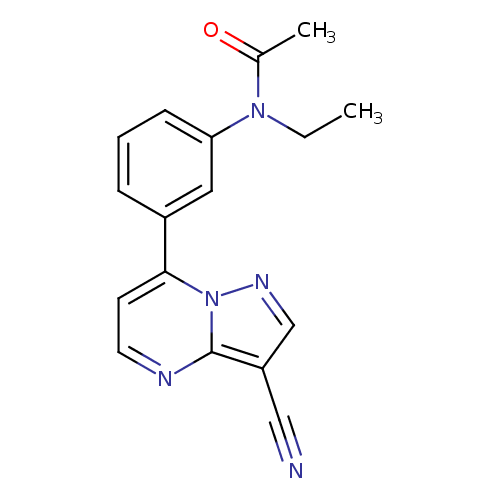
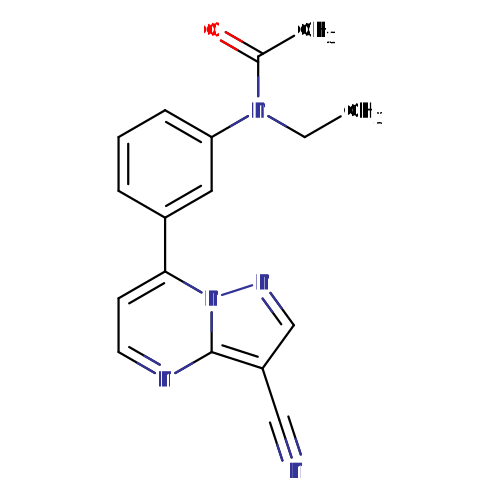
Zaleplon is a sedative/hypnotic, mainly used for insomnia. It is known as a nonbenzodiazepine hypnotic. Zaleplon interacts with the GABA receptor complex and shares some of the pharmacological properties of the benzodiazepines. Zaleplon is a schedule IV drug in the United States.
belongs to the class of organic compounds known as phenylpyrimidines. These are polycyclic aromatic compounds containing a benzene ring linked to a pyrimidine ring through a CC or CN bond. Pyrimidine is a 6-membered ring consisting of four carbon atoms and two nitrogen centers at the 1- and 3- ring positions.
Ingestion (RxList, A308); inhalation (RxList, A308); dermal (RxList, A308); eye contact (RxList, A308).
Absorption Zaleplon is rapidly and almost completely absorbed following oral administration.
Mechanism of Toxicity
Zaleplon exerts its action through subunit modulation of the GABABZ receptor chloride channel macromolecular complex. Zaleplon also binds selectively to the brain omega-1 receptor located on the alpha subunit of the GABA-A/chloride ion channel receptor complex and potentiates t-butyl-bicyclophosphorothionate (TBPS) binding. Organic nitriles decompose into cyanide ions both in vivo and in vitro. Consequently the primary mechanism of toxicity for organic nitriles is their production of toxic cyanide ions or hydrogen cyanide. Cyanide is an inhibitor of cytochrome c oxidase in the fourth complex of the electron transport chain (found in the membrane of the mitochondria of eukaryotic cells). It complexes with the ferric iron atom in this enzyme. The binding of cyanide to this cytochrome prevents transport of electrons from cytochrome c oxidase to oxygen. As a result, the electron transport chain is disrupted and the cell can no longer aerobically produce ATP for energy. Tissues that mainly depend on aerobic respiration, such as the central nervous system and the heart, are particularly affected. Cyanide is also known produce some of its toxic effects by binding to catalase, glutathione peroxidase, methemoglobin, hydroxocobalamin, phosphatase, tyrosinase, ascorbic acid oxidase, xanthine oxidase, succinic dehydrogenase, and Cu/Zn superoxide dismutase. Cyanide binds to the ferric ion of methemoglobin to form inactive cyanmethemoglobin. (9)
Metabolism
Zaleplon is primarily metabolized by aldehyde oxidase. Zaleplon is rapidly and almost completely absorbed following oral administration. After oral administration, zaleplon is extensively metabolized, with less than 1% of the dose excreted unchanged in urine. Zaleplon is primarily metabolized by aldehyde oxidase to form 5-oxo-zaleplon. Zaleplon is metabolized to a lesser extent by cytochrome P450 (CYP) 3A4 to form desethylzaleplon, which is quickly converted, presumably by aldehyde oxidase, to 5-oxo-desethylzaleplon. These oxidative metabolites are then converted to glucuronides and eliminated in urine. All of zaleplon's metabolites are pharmacologically inactive (RxList, A308).
Route of Elimination: Zaleplon is metabolized primarily by the liver and undergoes significant presystemic metabolism. After oral administration, zaleplon is extensively metabolized, with less than 1% of the dose excreted unchanged in urine. Renal excretion of unchanged zaleplon accounts for less than 1% of the administered dose.
Half Life: Approximately 1 hour
No indication of carcinogenicity to humans (not listed by IARC).
Uses/Sources
For the treatment of short-term treatment of insomnia in adults (1).
Minimum Risk Level
Not Available
Health Effects
Angina pectoris, bundle branch block, hypertension, hypotension, palpitation, syncope, melena, mouth ulceration, rectal hemorrhage, stomatitis, dysphagia, enteritis, gum hemorrhage, diabetes mellitus, goiter, hypothyroidism, arthrosis, bursitis, hyperesthesia, hyperkinesia, hypotonia, incoordination, insomnia, libido decreased, neuralgia, nystagmus, dry skin, eczema, maculopapular rash, skin hypertrophy, dysuria, hematuria, impotence, kidney calculus, kidney pain, urinary retention, and vaginal hemorrhage (RxList, A308). They cause slurred speech, disorientation and "drunken" behavior. They are physically and psychologically addictive. May cause a potentially dangerous rash that may develop into Stevens Johnson syndrome, an extremely rare but potentially fatal skin disease.
Symptoms
Side effects include abdominal pain, amnesia, dizziness, drowsiness, eye pain, headache, memory loss, menstrual pain, nausea, sleepiness, tingling, weakness
Treatment
General symptomatic and supportive measures should be used along with immediate gastric lavage where appropriate. Intravenous fluids should be administered as needed. As in all cases of drug overdose, respiration, pulse, blood pressure, and other appropriate signs should be monitored and general supportive measures employed. Hypotension and CNS depression should be monitored and treated by appropriate medical intervention. (11)