Record Information
Version1.0
Creation Date2009-07-15 20:43:20 UTC
Update Date2026-03-26 22:15:46 UTC
Accession NumberCHEM002111
Identification
Common NameAlendronic acid
ClassSmall Molecule
DescriptionAlendronate is a nitrogen-containing, second generation bisphosphonate. Bisphosphonates were first used to treat Paget's disease in 1971. This class of medications is comprised of inorganic pyrophosphate analogues that contain non-hydrolyzable P-C-P bonds. Similar to other bisphosphonates, alendronate has a high affinity for bone mineral and is taken up during osteoclast resorption. Alendronate inhibits farnesyl pyrophosphate synthetase, one of the enzymes in the mevalonic acid pathway involved in producing isoprenoid compounds that are essential for post-translational modification of small guanosine triphosphate (GTP)-binding proteins, such as Rho, Ras and Rab. Inhibition of this process interferes with osteoclast function and survival. Alendronate is used for the treatment of osteoporosis and Paget's disease.
Contaminant Sources
  • FooDB Chemicals
  • STOFF IDENT Compounds
  • T3DB toxins
Contaminant Type
  • Amine
  • Antihypocalcemic Agent
  • Antiresorptive
  • Bisphosphonate
  • Bone Density Conservation Agent
  • Drug
  • Food Toxin
  • Metabolite
  • Organic Compound
  • Synthetic Compound
Chemical Structure
Thumb
Synonyms
ValueSource
(4-Amino-1-hydroxybutylidene)bisphosphonic acidChEBI
Acide alendroniqueChEBI
Acido alendronicoChEBI
Acidum alendronicumChEBI
AlendronateChEBI
(4-Amino-1-hydroxybutylidene)bisphosphonateGenerator
4-Amino-1-hydroxybutylidene 1,1-biphosphonateMeSH
Alendronate monosodium salt, trihydrateMeSH
Alendronate sodiumMeSH
Aminohydroxybutane bisphosphonateMeSH
FosamaxMeSH
Alendronate sodium hydrateHMDB
Sodium, alendronateMeSH, HMDB
4 amino 1 Hydroxybutylidene 1,1 biphosphonateMeSH, HMDB
Bisphosphonate, aminohydroxybutaneMeSH, HMDB
Chemical FormulaC4H13NO7P2
Average Molecular Mass249.096 g/mol
Monoisotopic Mass249.017 g/mol
CAS Registry Number66376-36-1
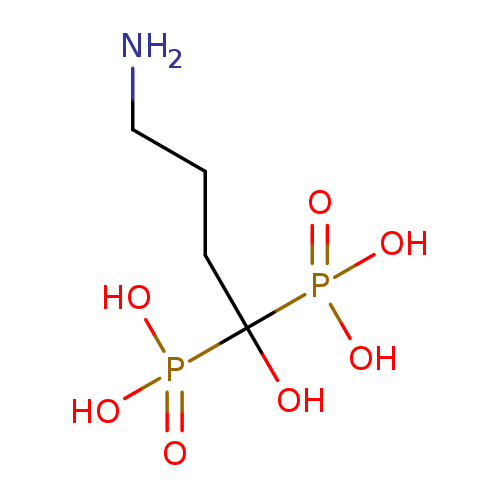
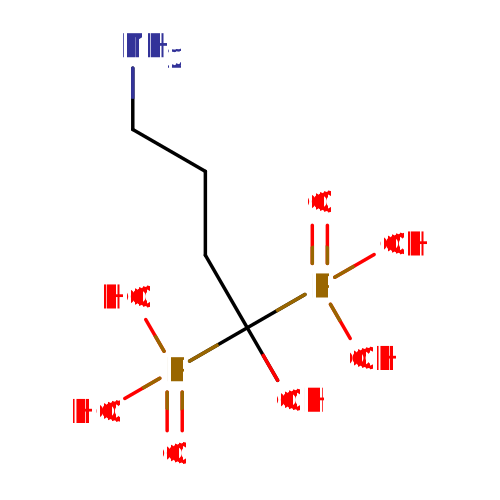
IUPAC Name(4-amino-1-hydroxy-1-phosphonobutyl)phosphonic acid
Traditional Namealendronate
SMILESNCCCC(O)(P(O)(O)=O)P(O)(O)=O
InChI IdentifierInChI=1S/C4H13NO7P2/c5-3-1-2-4(6,13(7,8)9)14(10,11)12/h6H,1-3,5H2,(H2,7,8,9)(H2,10,11,12)
InChI KeyOGSPWJRAVKPPFI-UHFFFAOYSA-N
Chemical Taxonomy
Description belongs to the class of organic compounds known as bisphosphonates. These are organic compounds containing two phosphonate groups linked together through a carbon atoms.
KingdomOrganic compounds
Super ClassOrganic acids and derivatives
ClassOrganic phosphonic acids and derivatives
Sub ClassBisphosphonates
Direct ParentBisphosphonates
Alternative Parents
Substituents
  • Bisphosphonate
  • Organophosphonic acid
  • Organic nitrogen compound
  • Organic oxygen compound
  • Organopnictogen compound
  • Organic oxide
  • Hydrocarbon derivative
  • Primary amine
  • Organophosphorus compound
  • Organooxygen compound
  • Organonitrogen compound
  • Primary aliphatic amine
  • Amine
  • Aliphatic acyclic compound
Molecular FrameworkAliphatic acyclic compounds
External Descriptors
Biological Properties
StatusDetected and Not Quantified
OriginExogenous
Cellular Locations
  • Cytoplasm
  • Membrane
Biofluid LocationsNot Available
Tissue Locations
  • Intestine
  • Prostate
PathwaysNot Available
Applications
Biological Roles
Chemical Roles
Physical Properties
StateSolid
AppearanceWhite powder.
Experimental Properties
PropertyValue
Melting Point234 dec°C
Boiling PointNot Available
Solubility1mg/L
Predicted Properties
PropertyValueSource
Water Solubility16.9 g/LALOGPS
logP-1.3ALOGPS
logP-4.2ChemAxon
logS-1.2ALOGPS
pKa (Strongest Acidic)0.69ChemAxon
pKa (Strongest Basic)9.91ChemAxon
Physiological Charge-1ChemAxon
Hydrogen Acceptor Count8ChemAxon
Hydrogen Donor Count6ChemAxon
Polar Surface Area161.31 ŲChemAxon
Rotatable Bond Count5ChemAxon
Refractivity47.37 m³·mol⁻¹ChemAxon
Polarizability19.4 ųChemAxon
Number of Rings0ChemAxon
Bioavailability1ChemAxon
Rule of FiveNoChemAxon
Ghose FilterNoChemAxon
Veber's RuleNoChemAxon
MDDR-like RuleNoChemAxon
Spectra
Spectra
Spectrum TypeDescriptionSplash KeyView
Predicted GC-MSPredicted GC-MS Spectrum - GC-MS (Non-derivatized) - 70eV, Positivesplash10-001i-9010000000-6b540b3cfe12455ee047Spectrum
Predicted GC-MSPredicted GC-MS Spectrum - GC-MS (1 TMS) - 70eV, Positivesplash10-001i-9020000000-f4a0f6418448b2108371Spectrum
Predicted GC-MSPredicted GC-MS Spectrum - GC-MS (Non-derivatized) - 70eV, PositiveNot AvailableSpectrum
LC-MS/MSLC-MS/MS Spectrum - Quattro_QQQ 10V, Positive (Annotated)splash10-014i-2930000000-99692afb4ed253251947Spectrum
LC-MS/MSLC-MS/MS Spectrum - Quattro_QQQ 25V, Positive (Annotated)splash10-001i-0900000000-d2c07307d66e1c7d52e8Spectrum
LC-MS/MSLC-MS/MS Spectrum - Quattro_QQQ 40V, Positive (Annotated)splash10-0kdl-9500000000-c82a6e6e898154627c7dSpectrum
Predicted LC-MS/MSPredicted LC-MS/MS Spectrum - 10V, Positivesplash10-0ue9-0590000000-ed1b4585584330309b42Spectrum
Predicted LC-MS/MSPredicted LC-MS/MS Spectrum - 20V, Positivesplash10-0uyi-4900000000-42101c55bda7e112b2afSpectrum
Predicted LC-MS/MSPredicted LC-MS/MS Spectrum - 40V, Positivesplash10-001i-9330000000-8ac66f69531027a0950fSpectrum
Predicted LC-MS/MSPredicted LC-MS/MS Spectrum - 10V, Negativesplash10-00kb-2590000000-2c9bde6c398541c5cb71Spectrum
Predicted LC-MS/MSPredicted LC-MS/MS Spectrum - 20V, Negativesplash10-017i-6950000000-d1f8822b01485883083dSpectrum
Predicted LC-MS/MSPredicted LC-MS/MS Spectrum - 40V, Negativesplash10-003r-9000000000-7b5e5c1f9b218640040bSpectrum
Predicted LC-MS/MSPredicted LC-MS/MS Spectrum - 10V, Negativesplash10-0002-0090000000-0b08500c08babf97a735Spectrum
Predicted LC-MS/MSPredicted LC-MS/MS Spectrum - 20V, Negativesplash10-005a-9050000000-04116055e92ba5f8a66fSpectrum
Predicted LC-MS/MSPredicted LC-MS/MS Spectrum - 40V, Negativesplash10-03gi-9000000000-8274f2b488ab919859ffSpectrum
Predicted LC-MS/MSPredicted LC-MS/MS Spectrum - 10V, Positivesplash10-0udi-0090000000-eb3a6c3bae79932540c8Spectrum
Predicted LC-MS/MSPredicted LC-MS/MS Spectrum - 20V, Positivesplash10-0udi-0190000000-7b88a34c07f93b4e4779Spectrum
Predicted LC-MS/MSPredicted LC-MS/MS Spectrum - 40V, Positivesplash10-0a4i-9100000000-12b406fbd4d8f99b2d4dSpectrum
1D NMR13C NMR SpectrumNot AvailableSpectrum
1D NMR1H NMR SpectrumNot AvailableSpectrum
1D NMR13C NMR SpectrumNot AvailableSpectrum
1D NMR1H NMR SpectrumNot AvailableSpectrum
1D NMR13C NMR SpectrumNot AvailableSpectrum
1D NMR1H NMR SpectrumNot AvailableSpectrum
1D NMR13C NMR SpectrumNot AvailableSpectrum
1D NMR1H NMR SpectrumNot AvailableSpectrum
1D NMR13C NMR SpectrumNot AvailableSpectrum
1D NMR1H NMR SpectrumNot AvailableSpectrum
1D NMR13C NMR SpectrumNot AvailableSpectrum
1D NMR1H NMR SpectrumNot AvailableSpectrum
1D NMR13C NMR SpectrumNot AvailableSpectrum
1D NMR1H NMR SpectrumNot AvailableSpectrum
1D NMR13C NMR SpectrumNot AvailableSpectrum
1D NMR1H NMR SpectrumNot AvailableSpectrum
1D NMR13C NMR SpectrumNot AvailableSpectrum
1D NMR1H NMR SpectrumNot AvailableSpectrum
1D NMR13C NMR SpectrumNot AvailableSpectrum
1D NMR1H NMR SpectrumNot AvailableSpectrum
Toxicity Profile
Route of ExposureRelative to an intravenous (IV) reference dose, the mean oral bioavailability of alendronate in women was 0.7% for doses ranging from 5 to 40 mg when administered after an overnight fast and two hours before a standardized breakfast. Oral bioavailability of the 10 mg tablet in men (0.59%) was similar to that in women (0.78%) when administered after an overnight fast and 2 hours before breakfast.
Mechanism of ToxicityThe action of Alendronate on bone tissue is based partly on its affinity for hydroxyapatite, which is part of the mineral matrix of bone. Alendronate also targets farnesyl pyrophosphate (FPP) synthase. Nitrogen-containing bisphosphonates (such as pamidronate, alendronate, risedronate, ibandronate and zoledronate) appear to act as analogues of isoprenoid diphosphate lipids, thereby inhibiting FPP synthase, an enzyme in the mevalonate pathway. Inhibition of this enzyme in osteoclasts prevents the biosynthesis of isoprenoid lipids (FPP and GGPP) that are essential for the post-translational farnesylation and geranylgeranylation of small GTPase signalling proteins. This activity inhibits osteoclast activity and reduces bone resorption and turnover. In postmenopausal women, it reduces the elevated rate of bone turnover, leading to, on average, a net gain in bone mass.
MetabolismThere is no evidence that alendronate is metabolized in humans or animals. Route of Elimination: Following a single IV dose of [14C]alendronate, approximately 50% of the radioactivity was excreted in the urine within 72 hours and little or no radioactivity was recovered in the feces. Half Life: >10 years
Toxicity ValuesNot Available
Lethal DoseNot Available
Carcinogenicity (IARC Classification)No indication of carcinogenicity to humans (not listed by IARC).
Uses/SourcesFor the treatment and prevention of osteoporosis in women and Paget's disease of bone in both men and women.
Minimum Risk LevelNot Available
Health EffectsNot Available
SymptomsAlendronate can damage the esophagus both by toxicity from the medication itself and by nonspecific irritation secondary to contact between the pill and the esophageal mucosa, similar to other cases of "pill esophagitis."
TreatmentNot Available
Concentrations
Not Available
DrugBank IDDB00630
HMDB IDHMDB0001915
FooDB IDFDB022734
Phenol Explorer IDNot Available
KNApSAcK IDNot Available
BiGG IDNot Available
BioCyc IDALENDRONATE
METLIN ID818
PDB IDNot Available
Wikipedia LinkAlendronic_acid
Chemspider ID2004
ChEBI ID2567
PubChem Compound ID2088
Kegg Compound IDC07752
YMDB IDNot Available
ECMDB IDNot Available
References
Synthesis Reference

Masahiko Dohi, Yuji Makino, Takao Hujii, “Sodium alendronate preparation for local administration.” U.S. Patent US5958908, issued September, 1997.

MSDSLink
General References
1. https://www.ncbi.nlm.nih.gov/pubmed/?term=12657258
2. https://www.ncbi.nlm.nih.gov/pubmed/?term=16626694
3. https://www.ncbi.nlm.nih.gov/pubmed/?term=19630066
4. https://www.ncbi.nlm.nih.gov/pubmed/?term=24676887
5. https://www.ncbi.nlm.nih.gov/pubmed/?term=25315260
6. https://www.ncbi.nlm.nih.gov/pubmed/?term=25442070
7. https://www.ncbi.nlm.nih.gov/pubmed/?term=25445446
8. https://www.ncbi.nlm.nih.gov/pubmed/?term=25461393
9. https://www.ncbi.nlm.nih.gov/pubmed/?term=25577217
10. https://www.ncbi.nlm.nih.gov/pubmed/?term=25592133
11. https://www.ncbi.nlm.nih.gov/pubmed/?term=25595570
12. https://www.ncbi.nlm.nih.gov/pubmed/?term=25603732
13. https://www.ncbi.nlm.nih.gov/pubmed/?term=25619515
14. https://www.ncbi.nlm.nih.gov/pubmed/?term=25636638
15. https://www.ncbi.nlm.nih.gov/pubmed/?term=25639838
16. Virtanen SS, Vaananen HK, Harkonen PL, Lakkakorpi PT: Alendronate inhibits invasion of PC-3 prostate cancer cells by affecting the mevalonate pathway. Cancer Res. 2002 May 1;62(9):2708-14.
17. Ezra A, Hoffman A, Breuer E, Alferiev IS, Monkkonen J, El Hanany-Rozen N, Weiss G, Stepensky D, Gati I, Cohen H, Tormalehto S, Amidon GL, Golomb G: A peptide prodrug approach for improving bisphosphonate oral absorption. J Med Chem. 2000 Oct 5;43(20):3641-52.
18. Cremers SC, van Hogezand R, Banffer D, den Hartigh J, Vermeij P, Papapoulos SE, Hamdy NA: Absorption of the oral bisphosphonate alendronate in osteoporotic patients with Crohn's disease. Osteoporos Int. 2005 Dec;16(12):1727-30. Epub 2005 Jun 15.
19. Sarno M, Sarno L, Baylink D, Drinkwater B, Farley S, Kleerekoper M, Lang R, Lappe J, Licata A, McClung M, Miller P, Nattrass S, Recker R, Schwartz EN, Tucci JR, Wolf S, Powell H, Tjersland G, Warnick GR: Excretion of sweat and urine pyridinoline crosslinks in healthy controls and subjects with established metabolic bone disease. Clin Chem Lab Med. 2001 Mar;39(3):223-8.
20. Rossini M, Gatti D, Isaia G, Sartori L, Braga V, Adami S: Effects of oral alendronate in elderly patients with osteoporosis and mild primary hyperparathyroidism. J Bone Miner Res. 2001 Jan;16(1):113-9.
21. Makowski GS, Ramsby ML: Autoactivation profiles of calcium-dependent matrix metalloproteinase-2 and -9 in inflammatory synovial fluid: effect of pyrophosphate and bisphosphonates. Clin Chim Acta. 2005 Aug;358(1-2):182-91.
22. Yalcin F, Gurgan S, Gurgan T: The effect of menopause, hormone replacement therapy (HRT), alendronate (ALN), and calcium supplements on saliva. J Contemp Dent Pract. 2005 May 15;6(2):10-7.
23. Rudge S, Hailwood S, Horne A, Lucas J, Wu F, Cundy T: Effects of once-weekly oral alendronate on bone in children on glucocorticoid treatment. Rheumatology (Oxford). 2005 Jun;44(6):813-8. Epub 2005 Feb 3.
24. Ravn P, Thompson DE, Ross PD, Christiansen C: Biochemical markers for prediction of 4-year response in bone mass during bisphosphonate treatment for prevention of postmenopausal osteoporosis. Bone. 2003 Jul;33(1):150-8.
25. Chesnut CH 3rd, Harris ST: Short-term effect of alendronate on bone mass and bone remodeling in postmenopausal women. Osteoporos Int. 1993;3 Suppl 3:S17-9.
26. Yun MH, Kwon KI: High-performance liquid chromatography method for determining alendronate sodium in human plasma by detecting fluorescence: application to a pharmacokinetic study in humans. J Pharm Biomed Anal. 2006 Jan 23;40(1):168-72. Epub 2005 Aug 10.