Record Information
Version1.0
Creation Date2009-07-05 03:38:39 UTC
Update Date2026-03-27 00:42:12 UTC
Accession NumberCHEM002102
Identification
Common NameFluoroacetamide
ClassSmall Molecule
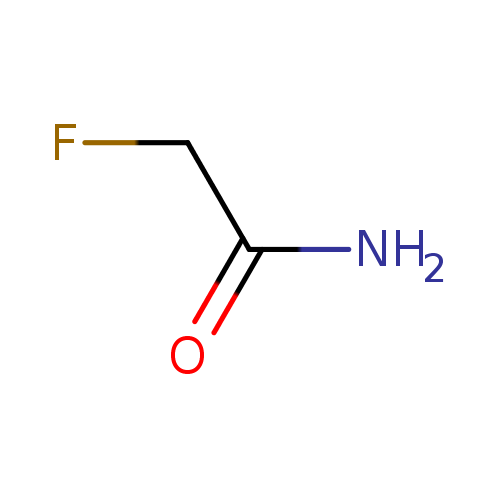
DescriptionFluoroacetamide is an organic compound based on acetamide with one fluorine atom replacing hydrogen on the methyl group. it is a metabolic poison which disruptes the citric acid cycle and is used as a rodenticide (5).
Contaminant Sources
  • Clean Air Act Chemicals
  • HPV EPA Chemicals
  • STOFF IDENT Compounds
  • T3DB toxins
  • ToxCast & Tox21 Chemicals
Contaminant Type
  • Amide
  • Amine
  • Organic Compound
  • Organofluoride
  • Pesticide
  • Synthetic Compound
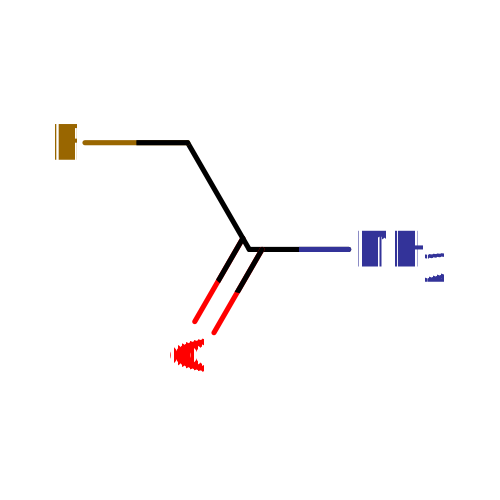
Chemical Structure
Thumb
Synonyms
ValueSource
FluoracetamideChEBI
Fluoroacetic acid amideChEBI
MonofluoroacetamideChEBI
Fluoroacetate amideGenerator
Chemical FormulaC2H4FNO
Average Molecular Mass77.058 g/mol
Monoisotopic Mass77.028 g/mol
CAS Registry Number640-19-7
IUPAC Name2-fluoroacetamide
Traditional Namefluoroacetamide
SMILESNC(=O)CF
InChI IdentifierInChI=1S/C2H4FNO/c3-1-2(4)5/h1H2,(H2,4,5)
InChI KeyFVTWJXMFYOXOKK-UHFFFAOYSA-N
Chemical Taxonomy
Description belongs to the class of organic compounds known as carboximidic acids. These are organic acids with the general formula RC(=N)-OH (R=H, organic group).
KingdomOrganic compounds
Super ClassOrganic acids and derivatives
ClassCarboximidic acids and derivatives
Sub ClassCarboximidic acids
Direct ParentCarboximidic acids
Alternative Parents
Substituents
  • Carboximidic acid
  • Organic nitrogen compound
  • Organic oxygen compound
  • Organopnictogen compound
  • Hydrocarbon derivative
  • Organooxygen compound
  • Organonitrogen compound
  • Organofluoride
  • Organohalogen compound
  • Alkyl halide
  • Alkyl fluoride
  • Aliphatic acyclic compound
Molecular FrameworkAliphatic acyclic compounds
External Descriptors
Biological Properties
StatusDetected and Not Quantified
OriginExogenous
Cellular Locations
  • Cytoplasm
  • Extracellular
Biofluid LocationsNot Available
Tissue LocationsNot Available
PathwaysNot Available
ApplicationsNot Available
Biological RolesNot Available
Chemical RolesNot Available
Physical Properties
StateSolid
AppearanceColorless crystalline powder (2).
Experimental Properties
PropertyValue
Melting Point108°C
Boiling PointNot Available
Solubility1000 mg/mL at 25°C [SHIU,WY et al. (1990)]
Predicted Properties
PropertyValueSource
Water Solubility136 g/LALOGPS
logP-0.64ALOGPS
logP-0.96ChemAxon
logS0.25ALOGPS
pKa (Strongest Acidic)12.95ChemAxon
pKa (Strongest Basic)-9ChemAxon
Physiological Charge0ChemAxon
Hydrogen Acceptor Count1ChemAxon
Hydrogen Donor Count1ChemAxon
Polar Surface Area43.09 ŲChemAxon
Rotatable Bond Count1ChemAxon
Refractivity14.48 m³·mol⁻¹ChemAxon
Polarizability5.84 ųChemAxon
Number of Rings0ChemAxon
Bioavailability1ChemAxon
Rule of FiveYesChemAxon
Ghose FilterNoChemAxon
Veber's RuleNoChemAxon
MDDR-like RuleNoChemAxon
Spectra
Spectra
Spectrum TypeDescriptionSplash KeyView
Predicted GC-MSPredicted GC-MS Spectrum - GC-MS (Non-derivatized) - 70eV, Positivesplash10-055f-9000000000-c8a80376eab4591e6d8eSpectrum
Predicted GC-MSPredicted GC-MS Spectrum - GC-MS (Non-derivatized) - 70eV, PositiveNot AvailableSpectrum
Predicted LC-MS/MSPredicted LC-MS/MS Spectrum - 10V, Positivesplash10-004i-9000000000-37f476ac4fd393f38857Spectrum
Predicted LC-MS/MSPredicted LC-MS/MS Spectrum - 20V, Positivesplash10-03fr-9000000000-293daf3ed0380e544a76Spectrum
Predicted LC-MS/MSPredicted LC-MS/MS Spectrum - 40V, Positivesplash10-03di-9000000000-f26325b6f3d1b090b190Spectrum
Predicted LC-MS/MSPredicted LC-MS/MS Spectrum - 10V, Negativesplash10-004i-9000000000-ed6d07fc91ad13cd2f80Spectrum
Predicted LC-MS/MSPredicted LC-MS/MS Spectrum - 20V, Negativesplash10-004l-9000000000-e1fd8dc842ea98819299Spectrum
Predicted LC-MS/MSPredicted LC-MS/MS Spectrum - 40V, Negativesplash10-0006-9000000000-390e391add50e5b35ecaSpectrum
Predicted LC-MS/MSPredicted LC-MS/MS Spectrum - 10V, Positivesplash10-004i-9000000000-4db14b39c7eff29fd2a6Spectrum
Predicted LC-MS/MSPredicted LC-MS/MS Spectrum - 20V, Positivesplash10-004i-9000000000-7b4cd69bfe0c1fd6a723Spectrum
Predicted LC-MS/MSPredicted LC-MS/MS Spectrum - 40V, Positivesplash10-03dl-9000000000-37504159be9b6ee520bfSpectrum
Predicted LC-MS/MSPredicted LC-MS/MS Spectrum - 10V, Negativesplash10-004i-9000000000-60c6b92e2ad696958b27Spectrum
Predicted LC-MS/MSPredicted LC-MS/MS Spectrum - 20V, Negativesplash10-004i-9000000000-e818ef43533dfed1bdd4Spectrum
Predicted LC-MS/MSPredicted LC-MS/MS Spectrum - 40V, Negativesplash10-0006-9000000000-90726b17dc36e29c5299Spectrum
MSMass Spectrum (Electron Ionization)splash10-0006-9000000000-1e4f4c231915f4e50698Spectrum
1D NMR1H NMR SpectrumNot AvailableSpectrum
1D NMR13C NMR SpectrumNot AvailableSpectrum
1D NMR1H NMR SpectrumNot AvailableSpectrum
1D NMR13C NMR SpectrumNot AvailableSpectrum
1D NMR1H NMR SpectrumNot AvailableSpectrum
1D NMR13C NMR SpectrumNot AvailableSpectrum
1D NMR1H NMR SpectrumNot AvailableSpectrum
1D NMR13C NMR SpectrumNot AvailableSpectrum
1D NMR1H NMR SpectrumNot AvailableSpectrum
1D NMR13C NMR SpectrumNot AvailableSpectrum
1D NMR1H NMR SpectrumNot AvailableSpectrum
1D NMR13C NMR SpectrumNot AvailableSpectrum
1D NMR1H NMR SpectrumNot AvailableSpectrum
1D NMR13C NMR SpectrumNot AvailableSpectrum
1D NMR1H NMR SpectrumNot AvailableSpectrum
1D NMR13C NMR SpectrumNot AvailableSpectrum
Toxicity Profile
Route of ExposureInhalation (4) ; oral (4) ; dermal (4) ; eye contact (4).
Mechanism of ToxicityFluoroacetate produces its toxin action by inhibiting the citric acid cycle. The fluorine substituted acetate becomes incorporated, as a normal acetate, into fluoroacetyl coenzyme A, which condenses with oxaloacetate to form fluorocitrate. Fluorocitrate inhibits the enzyme aconitase and thereby inhibits the conversion of citrate to isocitrate. As a result there is an accumulation of large quantities of citrate in the tissue, and the cycle is blocked. The heart and CNS are the most critical tissues involved in poisoning by general inhibition of oxydative energy metabolism (3).
MetabolismFluoroacetamide is metabolized by the fluoroacetate specific dehalogenase (1).
Toxicity ValuesLD50: 4-15 mg/kg (Oral, Rat) (3) LD50: 80 mg/kg (Dermal, Rat) (6)
Lethal DoseNot Available
Carcinogenicity (IARC Classification)No indication of carcinogenicity to humans (not listed by IARC).
Uses/SourcesUsed as rodenticide, insecticide proposed mainly for use on fruits to combat scale insects, aphids, mites (8).
Minimum Risk LevelNot Available
Health EffectsMetabolic acidosis, hyperglycemia, hyperuricemia, elevated serum levels of hepatic transaminases, and elevated serum creatinine levels may occur. Tachycardia, ventricular tachycardia or fibrillation, and sudden onset of asystole may occur (7).
SymptomsNausea, vomiting, excessive salivation, abdominal pain, numbness, a tingling sensation, and apprehension are seen initially, and may last for up to 6 hours. Numbness and tingling of the face, excessive salivation, blurred vision, peripheral paresthesias, convulsions, and coma followed inhalation and dermal contact with fluoroacetate (7).
TreatmentConsider gastric lavage after ingestion, and/or administer charcoal as a slurry. In case of refractory seizures after following ingestion, consider continuous infusion of midazolam, propofol, and/or pentobarbital. Hyperthermia, lactic acidosis and muscle destruction may necessitate use of neuromuscular blocking agents with continuous EEG monitoring. If the exposure occurred through inhalation, move patient to fresh air. Monitor for respiratory distress. If cough or difficulty breathing develops, evaluate for respiratory tract irritation, bronchitis, or pneumonitis. Administer oxygen and assist ventilation as required. Treat bronchospasm with inhaled beta2 agonist and oral or parenteral corticosteroids. In case of acute lung injury, maintain ventilation and oxygenation and evaluate with frequent arterial blood gas or pulse oximetry monitoring. Following eye exposure, irrigate exposed eyes with copious amounts of room temperature water for at least 15 minutes. In case of dermal exposure, Remove contaminated clothing and wash exposed area thoroughly with soap and water. (7)
Concentrations
Not Available
DrugBank IDNot Available
HMDB IDHMDB0252368
FooDB IDNot Available
Phenol Explorer IDNot Available
KNApSAcK IDNot Available
BiGG IDNot Available
BioCyc IDNot Available
METLIN IDNot Available
PDB IDNot Available
Wikipedia LinkFluoroacetamide
Chemspider ID12025
ChEBI ID53124
PubChem Compound IDNot Available
Kegg Compound IDC18675
YMDB IDNot Available
ECMDB IDNot Available
References
Synthesis ReferenceNot Available
MSDSNot Available
General ReferencesNot Available