Record Information
Version1.0
Creation Date2009-07-05 03:18:12 UTC
Update Date2026-05-14 16:45:57 UTC
Accession NumberCHEM002093
Identification
Common NameWarfarin
ClassSmall Molecule
DescriptionWarfarin is an anticoagulant drug normally used to prevent blood clot formation as well as migration. Although originally marketed as a pesticide (d-Con, Rodex, among others), Warfarin has since become the most frequently prescribed oral anticoagulant in North America. Warfarin has several properties that should be noted when used medicinally, including its ability to cross the placental barrier during pregnancy which can result in fetal bleeding, spontaneous abortion, preterm birth, stillbirth, and neonatal death. Additional adverse effects such as necrosis, purple toe syndrome, osteoporosis, valve and artery calcification, and drug interactions have also been documented with warfarin use. Warfarin does not actually affect blood viscosity, rather, it inhibits vitamin-k dependent synthesis of biologically active forms of various clotting factors in addition to several regulatory factors.
Contaminant Sources
  • Clean Air Act Chemicals
  • FooDB Chemicals
  • HMDB Contaminants - Urine
  • HPV EPA Chemicals
  • STOFF IDENT Compounds
  • T3DB toxins
  • ToxCast & Tox21 Chemicals
Contaminant Type
  • Anticoagulant
  • Coumarin and Indandione Rodenticide
  • Drug
  • Ester
  • Food Toxin
  • Human Neurotoxin
  • Metabolite
  • Organic Compound
  • PMT
  • Pesticide
  • Rodenticide
  • Synthetic Compound
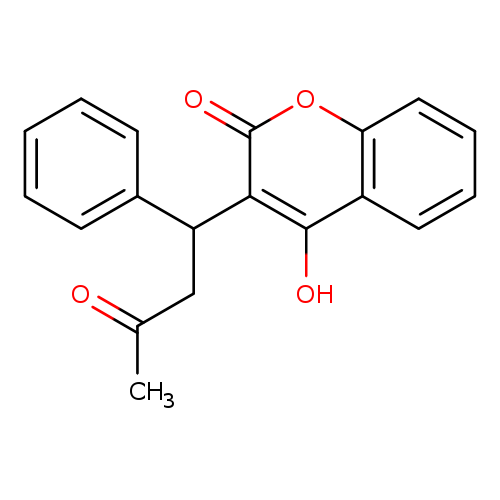
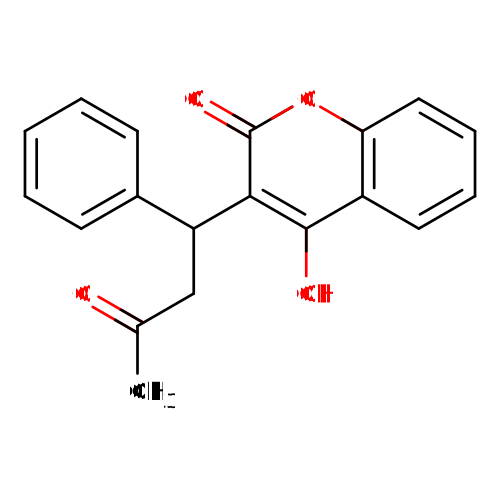
Chemical Structure
Thumb
Synonyms
ValueSource
WarfarineKegg
ChoiceKegg
(Phenyl-1 acetyl-2 ethyl) 3-hydroxy-4 coumarinHMDB
(Phenyl-1 acetyl-2 ethyl) 3-hydroxy-4 coumarineHMDB
(S)-4-Hydroxy-3-(3-oxo-1-phenylbutyl)-2-benzopyroneHMDB
1-(4'-Hydroxy-3'-coumarinyl)-1-phenyl-3-butanoneHMDB
200 CoumarinHMDB
3-(1'-Phenyl-2'-acetylethyl)-4-hydroxycoumarinHMDB
3-(Acetonylbenzyl)-4-hydroxycoumarinHMDB
3-(alpha-Acetonylbenzyl)-4-hydroxycoumarinHMDB
3-(alpha-Phenyl-beta-acetylaethyl)-4-hydroxycumarinHMDB
3-(alpha-Phenyl-beta-acetylethyl)-4-hydroxycoumarinHMDB
4-Hydroxy-3- (3-oxo-1-fenyl-butyl) cumarineHMDB
4-Hydroxy-3- (3-oxo-1-phenyl-butyl)-cumarinHMDB
4-Hydroxy-3-(3-oxo-1-fenyl-butyl) cumarineHMDB
4-Hydroxy-3-(3-oxo-1-phenyl-butyl)-cumarinHMDB
4-Hydroxy-3-(3-oxo-1-phenylbutyl)-2H-1-benzopyran-2-oneHMDB, MeSH
4-Hydroxy-3-(3-oxo-1-phenylbutyl)-2H-chromen-2-oneHMDB
4-Hydroxy-3-(3-oxo-1-phenylbutyl)coumarinHMDB
4-Idrossi-3- (3-oxo-)-fenil-butil)-cumarineHMDB
4-Idrossi-3-(3-oxo-)-fenil-butil)-cumarineHMDB
4-Idrossi-3-(3-oxo-1-fenil-butil)-cumarineHMDB
4oh-Coumarin deriv.HMDB
Arab rat deathHMDB
Arab rat dethHMDB
Athrombin-KHMDB
Athrombine-KHMDB
BrumolinHMDB
CO-RaxHMDB
Compound 42HMDB
CoumadinHMDB, MeSH
CoumafenHMDB
CoumafeneHMDB
CoumaphenHMDB
CoumapheneHMDB
CoumarinsHMDB
CoumefeneHMDB
Cov-R-toxHMDB
D-CONHMDB
delta-CONHMDB
DethmorHMDB
DethnelHMDB
Dicusat eHMDB
DL-3-(alpha-Acetonylbenzyl)-4-hydroxycoumarinHMDB
Eastern states duocideHMDB
fasco Fascrat powderHMDB
Frass-ratronHMDB
Killgerm sewarin PHMDB
KumaderHMDB
KumaduHMDB
KumatoxHMDB
KypfarinHMDB
Latka 42HMDB
Liqua-toxHMDB
Maag rattentod cumHMDB
Mar-frinHMDB
Martin'S mar-frinHMDB
MaveranHMDB
Mouse pakHMDB
Place-paxHMDB
ProthromadinHMDB
Rat & mice baitHMDB
Rat and mice baitHMDB
Rat-a-wayHMDB
Rat-alpha-wayHMDB
Rat-b-gonHMDB
Rat-beta-gonHMDB
Rat-gardHMDB
Rat-killHMDB
Rat-mixHMDB
Rat-O-cide #2HMDB
Rat-O-cide no. 2HMDB
Rat-olaHMDB
Rat-trolHMDB
RatorexHMDB
RatoxHMDB
RatoxinHMDB
RatronHMDB
Ratron gHMDB
Rats-NO-moreHMDB
Ratten-koederrohrHMDB
Rattenstreupulver neu schachtHMDB
Rattenstreupulver new schachtHMDB
RattentraenkeHMDB
RattunalHMDB
RAXHMDB
RCR Grey squirrel killer concentrateHMDB
ro-DethHMDB
RodafarinHMDB
Rodafarin cHMDB
RodexHMDB
Rodex bloxHMDB
RosexHMDB
Rough & ready mouse mixHMDB
Rough and ready mouse mixHMDB
SakaratHMDB
SewarinHMDB
SolfarinHMDB
Sorexa plusHMDB
Spray-trol brand roden-trolHMDB
Temus WHMDB
Tox-hidHMDB
Twin light rat awayHMDB
Vampirinip IIHMDB
Vampirinip IIIHMDB
WaranHMDB
Warfarin sodiumHMDB, MeSH
ZoocoumarinHMDB
aldo Brand OF warfarin sodiumMeSH, HMDB
apo-WarfarinMeSH, HMDB
Apotex brand OF warfarin sodiumMeSH, HMDB
Bailly brand OF warfarin sodiumMeSH, HMDB
Boots brand OF warfarin sodiumMeSH, HMDB
MarevanMeSH, HMDB
AldocumarMeSH, HMDB
CoumadineMeSH, HMDB
WarfantMeSH, HMDB
Bristol-myers squibb brand OF warfarin sodiumMeSH, HMDB
Genpharm brand OF warfarin sodiumMeSH, HMDB
Goldshield brand OF warfarin sodiumMeSH, HMDB
Sodium, warfarinMeSH, HMDB
TedicumarMeSH, HMDB
Warfarin potassiumMeSH, HMDB
Antigen brand OF warfarin sodiumMeSH, HMDB
Estedi brand OF warfarin sodiumMeSH, HMDB
Gen-warfarinMeSH, HMDB
Potassium, warfarinMeSH, HMDB
Chemical FormulaC19H16O4
Average Molecular Mass308.328 g/mol
Monoisotopic Mass308.105 g/mol
CAS Registry Number81-81-2
IUPAC Name4-hydroxy-3-(3-oxo-1-phenylbutyl)-2H-chromen-2-one
Traditional Namewarfarin
SMILESCC(=O)CC(C1=CC=CC=C1)C1=C(O)C2=C(OC1=O)C=CC=C2
InChI IdentifierInChI=1S/C19H16O4/c1-12(20)11-15(13-7-3-2-4-8-13)17-18(21)14-9-5-6-10-16(14)23-19(17)22/h2-10,15,21H,11H2,1H3
InChI KeyPJVWKTKQMONHTI-UHFFFAOYSA-N
Chemical Taxonomy
Description belongs to the class of organic compounds known as 4-hydroxycoumarins. These are coumarins that contain one or more hydroxyl groups attached to C4-position the coumarin skeleton.
KingdomOrganic compounds
Super ClassPhenylpropanoids and polyketides
ClassCoumarins and derivatives
Sub ClassHydroxycoumarins
Direct Parent4-hydroxycoumarins
Alternative Parents
Substituents
  • 4-hydroxycoumarin
  • Benzopyran
  • 1-benzopyran
  • Pyranone
  • Monocyclic benzene moiety
  • Benzenoid
  • Pyran
  • Heteroaromatic compound
  • Vinylogous acid
  • Ketone
  • Lactone
  • Oxacycle
  • Organoheterocyclic compound
  • Organic oxygen compound
  • Carbonyl group
  • Hydrocarbon derivative
  • Organic oxide
  • Organooxygen compound
  • Aromatic heteropolycyclic compound
Molecular FrameworkAromatic heteropolycyclic compounds
External Descriptors
Biological Properties
StatusDetected and Not Quantified
OriginExogenous
Cellular Locations
  • Membrane
Biofluid LocationsNot Available
Tissue LocationsNot Available
PathwaysNot Available
ApplicationsNot Available
Biological RolesNot Available
Chemical RolesNot Available
Physical Properties
StateSolid
AppearanceSolid (MSDS, A308).
Experimental Properties
PropertyValue
Melting Point161°C
Boiling PointNot Available
Solubility17 mg/L (at 20°C)
Predicted Properties
PropertyValueSource
Water Solubility0.047 g/LALOGPS
logP2.41ALOGPS
logP2.74ChemAxon
logS-3.8ALOGPS
pKa (Strongest Acidic)5.56ChemAxon
pKa (Strongest Basic)-6.9ChemAxon
Physiological Charge-1ChemAxon
Hydrogen Acceptor Count3ChemAxon
Hydrogen Donor Count1ChemAxon
Polar Surface Area63.6 ŲChemAxon
Rotatable Bond Count4ChemAxon
Refractivity86.86 m³·mol⁻¹ChemAxon
Polarizability31.9 ųChemAxon
Number of Rings3ChemAxon
Bioavailability1ChemAxon
Rule of FiveYesChemAxon
Ghose FilterYesChemAxon
Veber's RuleNoChemAxon
MDDR-like RuleNoChemAxon
Spectra
Spectra
Spectrum TypeDescriptionSplash KeyView
GC-MSGC-MS Spectrum - EI-B (Non-derivatized)splash10-014i-0293000000-848341bcbd6a3f0a2c6bSpectrum
Predicted GC-MSPredicted GC-MS Spectrum - GC-MS (Non-derivatized) - 70eV, Positivesplash10-0udl-3190000000-b963cb54bb6abedefbe3Spectrum
Predicted GC-MSPredicted GC-MS Spectrum - GC-MS (1 TMS) - 70eV, Positivesplash10-00xr-7195000000-ca3a892fd51e0eac1242Spectrum
Predicted GC-MSPredicted GC-MS Spectrum - GC-MS (Non-derivatized) - 70eV, PositiveNot AvailableSpectrum
Predicted GC-MSPredicted GC-MS Spectrum - GC-MS (TMS_1_2) - 70eV, PositiveNot AvailableSpectrum
Predicted GC-MSPredicted GC-MS Spectrum - GC-MS (TMS_1_3) - 70eV, PositiveNot AvailableSpectrum
Predicted GC-MSPredicted GC-MS Spectrum - GC-MS (TBDMS_1_3) - 70eV, PositiveNot AvailableSpectrum
LC-MS/MSLC-MS/MS Spectrum - LC-ESI-ITFT , negativesplash10-0a4i-0429000000-1e818b579dc7a0fade2dSpectrum
LC-MS/MSLC-MS/MS Spectrum - LC-ESI-ITFT , negativesplash10-03di-0900000000-f568338c06cd9b4762acSpectrum
LC-MS/MSLC-MS/MS Spectrum - LC-ESI-ITFT , negativesplash10-03di-0900000000-acdd0ed19e403aa73c77Spectrum
LC-MS/MSLC-MS/MS Spectrum - LC-ESI-QFT , negativesplash10-0bt9-0539000000-5b1c7c6c812ba72325e3Spectrum
LC-MS/MSLC-MS/MS Spectrum - LC-ESI-ITFT , negativesplash10-0a4i-0009000000-e461e1aca7977a2838adSpectrum
LC-MS/MSLC-MS/MS Spectrum - LC-ESI-ITFT , positivesplash10-0w29-0960000000-9fa099190280529cd891Spectrum
LC-MS/MSLC-MS/MS Spectrum - LC-ESI-ITFT , positivesplash10-00di-0910000000-d7dbaf6e7b34ee85e1f7Spectrum
LC-MS/MSLC-MS/MS Spectrum - LC-ESI-ITFT , positivesplash10-03di-0920000000-4fb886a5c160afa86df9Spectrum
LC-MS/MSLC-MS/MS Spectrum - LC-ESI-ITFT , positivesplash10-03di-0920000000-ad608fe7680a2adf9d90Spectrum
LC-MS/MSLC-MS/MS Spectrum - LC-ESI-QFT , positivesplash10-0ik9-0942000000-5864f2d15892753d6a8bSpectrum
LC-MS/MSLC-MS/MS Spectrum - 55V, Negativesplash10-03di-0900000000-acdd0ed19e403aa73c77Spectrum
LC-MS/MSLC-MS/MS Spectrum - 55V, Positivesplash10-0w29-0960000000-b5bc3614bc1379df068cSpectrum
LC-MS/MSLC-MS/MS Spectrum - 35V, Negativesplash10-0bt9-0539000000-3554db4e3651d4691cbbSpectrum
LC-MS/MSLC-MS/MS Spectrum - 75V, Positivesplash10-0229-2900000000-022920b191a958c73833Spectrum
LC-MS/MSLC-MS/MS Spectrum - 60V, Positivesplash10-07vi-5920000000-0506f7adccf44b63822aSpectrum
LC-MS/MSLC-MS/MS Spectrum - 55V, Negativesplash10-0a4i-0009000000-e461e1aca7977a2838adSpectrum
LC-MS/MSLC-MS/MS Spectrum - 80V, Negativesplash10-0a4i-0429000000-1e818b579dc7a0fade2dSpectrum
LC-MS/MSLC-MS/MS Spectrum - 75V, Positivesplash10-0229-2900000000-6909a3446398afc7d421Spectrum
LC-MS/MSLC-MS/MS Spectrum - 60V, Positivesplash10-03kc-0910000000-b4521bf9a45fcfff36acSpectrum
Predicted LC-MS/MSPredicted LC-MS/MS Spectrum - 10V, Positivesplash10-0a4l-0197000000-a98e039dbdc8da6c3b7cSpectrum
Predicted LC-MS/MSPredicted LC-MS/MS Spectrum - 20V, Positivesplash10-052f-0292000000-d9a969b41fe312282de6Spectrum
Predicted LC-MS/MSPredicted LC-MS/MS Spectrum - 40V, Positivesplash10-00di-2690000000-f20b105406ab790d37f0Spectrum
Predicted LC-MS/MSPredicted LC-MS/MS Spectrum - 10V, Negativesplash10-0a4i-1149000000-4072cf2742b0e6164f82Spectrum
Predicted LC-MS/MSPredicted LC-MS/MS Spectrum - 20V, Negativesplash10-0bt9-5988000000-eb075587f79ddb4af966Spectrum
Predicted LC-MS/MSPredicted LC-MS/MS Spectrum - 40V, Negativesplash10-052f-9350000000-47075e4967528dede6f3Spectrum
MSMass Spectrum (Electron Ionization)splash10-014i-7692000000-6e3993fee62d7eb7438eSpectrum
1D NMR1H NMR SpectrumNot AvailableSpectrum
2D NMR[1H,13C] 2D NMR SpectrumNot AvailableSpectrum
Toxicity Profile
Route of ExposureOral ; Inhalation ; Dermal Rapidly absorbed following oral administration with considerable interindividual variations. Also absorbed percutaneously.
Mechanism of ToxicityWarfarin inhibits vitamin K reductase, resulting in depletion of the reduced form of vitamin K (vitamin KH2). As vitamin K is a cofactor for the carboxylation of glutamate residues on the N-terminal regions of vitamin K-dependent proteins, this limits the gamma-carboxylation and subsequent activation of the vitamin K-dependent coagulant proteins. The synthesis of vitamin K-dependent coagulation factors II, VII, IX, and X and anticoagulant proteins C and S is inhibited. Depression of three of the four vitamin K-dependent coagulation factors (factors II, VII, and X) results in decreased prothrombin levels and a decrease in the amount of thrombin generated and bound to fibrin. This reduces the thrombogenicity of clots.
MetabolismMetabolized stereo- and regio-selectively by hepatic microsomal enzymes. S-warfarin is predominantly metabolized by cytochrome P450 (CYP) 2C9 to yield the 6- and 7-hydroxylated metabolites. R-warfarin is metabolized by CYP1A1, 1A2, and 3A4 to yield 6-, 8-, and 10-hydroxylated metabolites. Hydroxylated metabolites may be further conjugated prior to excretion into bile and urine. UGT1A1 appears to be responsible for producing the 6-O-glucuronide of warfarin, with a possibly contribution from UGT1A10. Five UGT1As may be involved in the formation of 7-O-glucuronide warfarin. S-warfarin has higher potency than R-warfarin and genetic polymorphisms in CYP2C9 may dramatically decrease clearance of and increase toxicity of the medication. In man, the dextrowarfarin enantiomorph is metabolized by side chain reduction to a secondary alcohol, whereas levowarfarin is metabolized by oxidation of the ring, primarily to 7-hydroxywarfarin. These inactive metabolic products are to some extent conjugated with glucuronic acid, undergo an enterohepatic circulation, & are ultimately excreted in urine & stool. (2) Route of Elimination: The elimination of warfarin is almost entirely by metabolism. Very little warfarin is excreted unchanged in urine. The metabolites are principally excreted into the urine; and to a lesser extent into the bile. Half Life: R-warfarin t1/2=37-89 hours; S-warfarin t1/2=21-43 hours.
Toxicity ValuesLD50: 374 mg/kg (Oral, Mouse) (1)
Lethal DoseThe lowest reported lethal dose in humans is 6667 ug/kg. (3)
Carcinogenicity (IARC Classification)No indication of carcinogenicity (not listed by IARC). (12)
Uses/SourcesWarfarin is an anticoagulant drug and rodenticide derived from coumarin. As a drug it is used for the treatment of retinal vascular occlusion, pulmonary embolism, cardiomyopathy, atrial fibrillation and flutter, cerebral embolism, transient cerebral ischaemia, arterial embolism and thrombosis. (1)
Minimum Risk LevelNot Available
Health EffectsHemorrhage is the most prevalent adverse effect of oral anticoagulant therapy. The incidence of bleeding complications is related to the duration and range of therapy. (13)
SymptomsLD50=374 (orally in mice)
TreatmentThe primary antidote to warfarin poisoning is immediate administration of vitamin K1 (initially slow intravenous injections of 10-25 mg repeated all 3-6 hours until normalisation of the prothrombin time; then 10 mg orally four times daily as a "maintenance dose"). It is an extremely effective antidote, provided the poisoning is caught before too much damage has been done to the victim's circulatory system. At high doses warfarin can affect the body for many months, and the antidote must be administered regularly for a long period of time. (16)
Concentrations
Not Available
DrugBank IDNot Available
HMDB IDNot Available
FooDB IDNot Available
Phenol Explorer IDNot Available
KNApSAcK IDNot Available
BiGG IDNot Available
BioCyc IDNot Available
METLIN IDNot Available
PDB IDNot Available
Wikipedia LinkNot Available
Chemspider ID10442445
ChEBI ID87732
PubChem Compound IDNot Available
Kegg Compound IDC01541
YMDB IDNot Available
ECMDB IDNot Available
References
Synthesis Reference

Nasri W. Badran, “Microcrystalline 3-(alpha-acetonylbenzyl)-4-hydroxycoumarin (warfarin) and methods of making.” U.S. Patent US4113744, issued April, 1960.

MSDSLink
General ReferencesNot Available