Record Information
Version1.0
Creation Date2009-07-05 02:56:35 UTC
Update Date2026-05-14 16:49:54 UTC
Accession NumberCHEM002084
Identification
Common NameDisulfiram
ClassSmall Molecule
DescriptionA carbamate derivative used as an alcohol deterrent. It is a relatively nontoxic substance when administered alone, but markedly alters the intermediary metabolism of alcohol. When alcohol is ingested after administration of disulfiram, blood acetaldehyde concentrations are increased, followed by flushing, systemic vasodilation, respiratory difficulties, nausea, hypotension, and other symptoms (acetaldehyde syndrome). It acts by inhibiting aldehyde dehydrogenase. [PubChem]
Contaminant Sources
  • HMDB Contaminants - Urine
  • HPV EPA Chemicals
  • IARC Carcinogens Group 3
  • STOFF IDENT Compounds
  • T3DB toxins
  • ToxCast & Tox21 Chemicals
Contaminant Type
  • Alcohol Deterrent
  • Amine
  • Drug
  • Enzyme Inhibitor
  • Human Neurotoxin
  • Metabolite
  • Organic Compound
  • Synthetic Compound
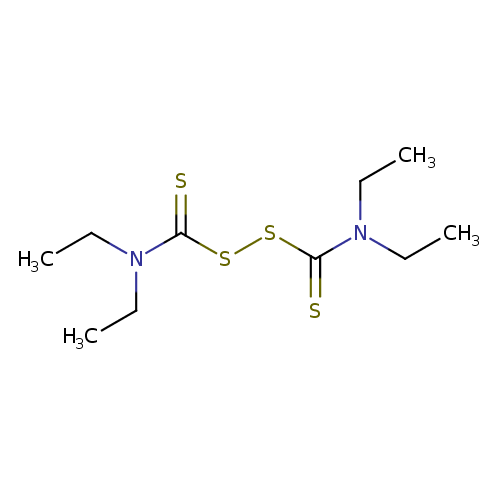
Chemical Structure
Thumb
Synonyms
ValueSource
1,1'-Dithiobis(N,N-diethylthioformamide)ChEBI
AntabuseChEBI
Bis(diethylthiocarbamoyl) disulfideChEBI
N,N,N',n'-tetraethylthiuram disulfideChEBI
Tetraethylthioperoxydicarbonic diamideChEBI
Tetraethylthiuram disulfideChEBI
Tetraethylthiuram disulphideChEBI
Bis(diethylthiocarbamoyl) disulphideGenerator
N,N,N',n'-tetraethylthiuram disulphideGenerator
DisulphiramGenerator
DisulfuramHMDB
DisulphuramHMDB
Dupon 4472HMDB
Dupont fungicide 4472HMDB
TATDHMDB
TETDHMDB
Tetraethylthiram disulfideHMDB
Tetraethylthiram disulphideHMDB
TetraethylthiuramHMDB
Tetraethylthiuram sulfideHMDB
Tetraethylthiuran disulfideHMDB
TTDHMDB
Usaf b-33HMDB
Allphar brand OF disulfiramHMDB
Altana pharma brand OF disulfiramHMDB
AntabusHMDB
AnticolHMDB
Disulfide, tetraethylthiuramHMDB
Tetraethylthioperoxydicarbonic diamide, ((H2N)C(S))2S2HMDB
AlcophobinHMDB
EsperalHMDB
Sanofi synthelabo brand OF disulfiramHMDB
Bohm brand OF disulfiramHMDB
Odyssey brand OF disulfiramHMDB
Orphan brand OF disulfiramHMDB
DicupralHMDB
Dumex brand OF disulfiramHMDB
TeturamHMDB
Chemical FormulaC10H20N2S4
Average Molecular Mass296.539 g/mol
Monoisotopic Mass296.051 g/mol
CAS Registry Number97-77-8
IUPAC NameN,N-diethyl[(diethylcarbamothioyl)disulfanyl]carbothioamide
Traditional Namedisulfiram
SMILESCCN(CC)C(=S)SSC(=S)N(CC)CC
InChI IdentifierInChI=1S/C10H20N2S4/c1-5-11(6-2)9(13)15-16-10(14)12(7-3)8-4/h5-8H2,1-4H3
InChI KeyAUZONCFQVSMFAP-UHFFFAOYSA-N
Chemical Taxonomy
Description belongs to the class of organic compounds known as thiuram disulfides. These are organic disulfides that have the general structural formula RN(R')C(=S)SSC(=S)N(R\")R\"', where R-R\"'=alkyl groups.
KingdomOrganic compounds
Super ClassOrganic nitrogen compounds
ClassOrganonitrogen compounds
Sub ClassAmines
Direct ParentThiuram disulfides
Alternative Parents
Substituents
  • Thiuram disulfide
  • Organic disulfide
  • Sulfenyl compound
  • Organopnictogen compound
  • Hydrocarbon derivative
  • Organosulfur compound
  • Aliphatic acyclic compound
Molecular FrameworkAliphatic acyclic compounds
External Descriptors
Biological Properties
StatusDetected and Not Quantified
OriginExogenous
Cellular Locations
  • Cytoplasm
  • Membrane
Biofluid LocationsNot Available
Tissue LocationsNot Available
Pathways
NameSMPDB LinkKEGG Link
Disulfiram PathwayNot AvailableNot Available
ApplicationsNot Available
Biological Roles
Chemical Roles
Physical Properties
StateSolid
AppearanceWhite powder.
Experimental Properties
PropertyValue
Melting Point71.5°C
Boiling Point117°C at 1.70E+01 mm Hg
Solubility4.09 mg/L (at 25°C)
Predicted Properties
PropertyValueSource
Water Solubility0.013 g/LALOGPS
logP3.88ALOGPS
logP4.16ChemAxon
logS-4.4ALOGPS
Physiological Charge0ChemAxon
Hydrogen Acceptor Count0ChemAxon
Hydrogen Donor Count0ChemAxon
Polar Surface Area6.48 ŲChemAxon
Rotatable Bond Count7ChemAxon
Refractivity88.24 m³·mol⁻¹ChemAxon
Polarizability31.6 ųChemAxon
Number of Rings0ChemAxon
Bioavailability1ChemAxon
Rule of FiveYesChemAxon
Ghose FilterYesChemAxon
Veber's RuleYesChemAxon
MDDR-like RuleNoChemAxon
Spectra
Spectra
Spectrum TypeDescriptionSplash KeyView
Predicted GC-MSPredicted GC-MS Spectrum - GC-MS (Non-derivatized) - 70eV, Positivesplash10-016r-8930000000-ff4b800eacdb52d66d80Spectrum
Predicted GC-MSPredicted GC-MS Spectrum - GC-MS (Non-derivatized) - 70eV, PositiveNot AvailableSpectrum
LC-MS/MSLC-MS/MS Spectrum - LC-ESI-qTof , Positivesplash10-014i-0900000000-274003127d4c34f9abccSpectrum
LC-MS/MSLC-MS/MS Spectrum - LC-ESI-qTof , Positivesplash10-002b-1910000000-0371815b89a4378bec81Spectrum
LC-MS/MSLC-MS/MS Spectrum - LC-ESI-qTof , Positivesplash10-004i-0950000000-ca28d8dfdf780c201716Spectrum
LC-MS/MSLC-MS/MS Spectrum - LC-ESI-qTof , Positivesplash10-0a4i-5910000000-7dd7b7fbb29b6ae08f4cSpectrum
LC-MS/MSLC-MS/MS Spectrum - , positivesplash10-00xr-0904000000-2d29367629d096da4708Spectrum
LC-MS/MSLC-MS/MS Spectrum - , positivesplash10-00xr-1914000000-0022574151f222c8050fSpectrum
LC-MS/MSLC-MS/MS Spectrum - , positivesplash10-014j-0900000000-07fd862cac7fb47fa007Spectrum
LC-MS/MSLC-MS/MS Spectrum - , positivesplash10-00di-0903000000-bb7b2b338b8981b249acSpectrum
LC-MS/MSLC-MS/MS Spectrum - , positivesplash10-00kb-3910100000-263484085094fbdd45daSpectrum
LC-MS/MSLC-MS/MS Spectrum - 35V, Positivesplash10-014s-5900000000-fe9f3fb3c9d4c94f6496Spectrum
Predicted LC-MS/MSPredicted LC-MS/MS Spectrum - 10V, Positivesplash10-0002-1970000000-87dad5bd832c248e4c73Spectrum
Predicted LC-MS/MSPredicted LC-MS/MS Spectrum - 20V, Positivesplash10-014i-3900000000-f7637bebace8002bdd78Spectrum
Predicted LC-MS/MSPredicted LC-MS/MS Spectrum - 40V, Positivesplash10-00di-9500000000-491cc5b9b0d4455ff674Spectrum
Predicted LC-MS/MSPredicted LC-MS/MS Spectrum - 10V, Negativesplash10-01vk-4690000000-64528d1f9696aa7a5d5dSpectrum
Predicted LC-MS/MSPredicted LC-MS/MS Spectrum - 20V, Negativesplash10-02ft-9810000000-825b92854771a0e58c9dSpectrum
Predicted LC-MS/MSPredicted LC-MS/MS Spectrum - 40V, Negativesplash10-0fdo-8910000000-afd3a638d74e8761c518Spectrum
Predicted LC-MS/MSPredicted LC-MS/MS Spectrum - 10V, Positivesplash10-014i-0910000000-cf16eb2676d288479eacSpectrum
Predicted LC-MS/MSPredicted LC-MS/MS Spectrum - 20V, Positivesplash10-014i-2900000000-2765ff0428d56cf81049Spectrum
Predicted LC-MS/MSPredicted LC-MS/MS Spectrum - 40V, Positivesplash10-000i-9200000000-7f8c0eb726cf3929fa7fSpectrum
Predicted LC-MS/MSPredicted LC-MS/MS Spectrum - 10V, Negativesplash10-0002-3690000000-f14241348cdf9f8196d2Spectrum
Predicted LC-MS/MSPredicted LC-MS/MS Spectrum - 20V, Negativesplash10-01ot-7900000000-1843982004d8ffd33a5fSpectrum
Predicted LC-MS/MSPredicted LC-MS/MS Spectrum - 40V, Negativesplash10-03di-9200000000-28f4b4954161ce60f733Spectrum
MSMass Spectrum (Electron Ionization)splash10-014r-9510000000-2e18f478f9c0f9a2958aSpectrum
1D NMR1H NMR SpectrumNot AvailableSpectrum
1D NMR13C NMR SpectrumNot AvailableSpectrum
Toxicity Profile
Route of ExposureInhalation (MSDS, A308); ingestion (MSDS, A308); dermal (MSDS, A308) ; eye contact (MSDS, A308) Disulfiram is absorbed slowly from the gastrointestinal tract (80 to 90% of oral dose).
Mechanism of ToxicityDisulfiram blocks the oxidation of alcohol at the acetaldehyde stage during alcohol metabolism following disulfiram intake causing an accumulation of acetaldehyde in the blood producing highly unpleasant symptoms. Disulfiram blocks the oxidation of alcohol through its irreversible inactivation of aldehyde dehydrogenase, which acts in the second step of ethanol utilization. In addition, disulfiram competitively binds and inhibits the peripheral benzodiazepine receptor, which may indicate some value in the treatment of the symptoms of alcohol withdrawal, however this activity has not been extensively studied.
MetabolismDisulfiram is completely absorbed from the human GI tract. However, a period of 12 hr is required for its full action, perhaps because, being highly sol in lipid, it is initially localized in fat. It is slowly metabolized in the liver to diethyldithiocarbamate, diethylamine, and carbon disulfide. Six hr after oral administration of the drug, one third of plasma disulfiram is in the form of diethyldithiocarbamate. Elimination is relatively slow, and about 1/5 still remains in body at end of a week. The greater part of the absorbed drug is excreted in the urine as the sulfate, partly free and partly esterified (2, 3).
Toxicity ValuesLD50: 8.6g/kg (oral, rat).
Lethal DoseNot Available
Carcinogenicity (IARC Classification)3, not classifiable as to its carcinogenicity to humans. (7)
Uses/SourcesFor the treatment and management of chronic alcoholism (1).
Minimum Risk LevelNot Available
Health EffectsOccasionally implicated in producing psychosis, optic neuritis, and encephalopathy. Hematologic, neuromuscular, and gastrointestinal toxicity and hepatotoxicity may occur 10 days to 12 months after therapy is begun (10).
SymptomsSymptoms of overdose include irritation, slight drowsiness, unpleasant taste, mild GI disturbances, and orthostatic hypotension.
TreatmentNot Available
Concentrations
Not Available
DrugBank IDDB00822
HMDB IDHMDB0014960
FooDB IDNot Available
Phenol Explorer IDNot Available
KNApSAcK IDNot Available
BiGG IDNot Available
BioCyc IDNot Available
METLIN IDNot Available
PDB IDNot Available
Wikipedia LinkDisulfiram
Chemspider ID3005
ChEBI ID4659
PubChem Compound ID3117
Kegg Compound IDC01692
YMDB IDNot Available
ECMDB IDNot Available
References
Synthesis Reference

Adams, H.S. and Meuser, L.; US.Patent 1,782,111; November 18,1930; assigned to The
Naugatuck Chemical Company.
Bailey, G.C.; U.S.Patent 1,796,977; March 17,1931; assigned to The Roessler & Hasslacher
Chemical Company.

MSDSLink
General References
1. Nash T, Rice WG: Efficacies of zinc-finger-active drugs against Giardia lamblia. Antimicrob Agents Chemother. 1998 Jun;42(6):1488-92.
2. Bouma MJ, Snowdon D, Fairlamb AH, Ackers JP: Activity of disulfiram (bis(diethylthiocarbamoyl)disulphide) and ditiocarb (diethyldithiocarbamate) against metronidazole-sensitive and -resistant Trichomonas vaginalis and Tritrichomonas foetus. J Antimicrob Chemother. 1998 Dec;42(6):817-20.
3. Gaval-Cruz M, Weinshenker D: mechanisms of disulfiram-induced cocaine abstinence: antabuse and cocaine relapse. Mol Interv. 2009 Aug;9(4):175-87. doi: 10.1124/mi.9.4.6.
4. https://www.ncbi.nlm.nih.gov/pubmed/?term=10841824
5. https://www.ncbi.nlm.nih.gov/pubmed/?term=11005259
6. https://www.ncbi.nlm.nih.gov/pubmed/?term=11716515
7. https://www.ncbi.nlm.nih.gov/pubmed/?term=14978246
8. https://www.ncbi.nlm.nih.gov/pubmed/?term=15325261
9. https://www.ncbi.nlm.nih.gov/pubmed/?term=15709459
10. https://www.ncbi.nlm.nih.gov/pubmed/?term=16426571
11. https://www.ncbi.nlm.nih.gov/pubmed/?term=16661923
12. https://www.ncbi.nlm.nih.gov/pubmed/?term=16666414
13. https://www.ncbi.nlm.nih.gov/pubmed/?term=16880974
14. https://www.ncbi.nlm.nih.gov/pubmed/?term=17079463
15. https://www.ncbi.nlm.nih.gov/pubmed/?term=17579916
16. https://www.ncbi.nlm.nih.gov/pubmed/?term=17667894
17. https://www.ncbi.nlm.nih.gov/pubmed/?term=18579431
18. https://www.ncbi.nlm.nih.gov/pubmed/?term=19720750
19. https://www.ncbi.nlm.nih.gov/pubmed/?term=19782464
20. https://www.ncbi.nlm.nih.gov/pubmed/?term=19787200
21. https://www.ncbi.nlm.nih.gov/pubmed/?term=21471244
22. https://www.ncbi.nlm.nih.gov/pubmed/?term=24496638
23. https://www.ncbi.nlm.nih.gov/pubmed/?term=25133664
24. https://www.ncbi.nlm.nih.gov/pubmed/?term=25445071
25. https://www.ncbi.nlm.nih.gov/pubmed/?term=25464072
26. https://www.ncbi.nlm.nih.gov/pubmed/?term=25476326
27. https://www.ncbi.nlm.nih.gov/pubmed/?term=25495604
28. https://www.ncbi.nlm.nih.gov/pubmed/?term=25557293
29. https://www.ncbi.nlm.nih.gov/pubmed/?term=25565438
30. https://www.ncbi.nlm.nih.gov/pubmed/?term=25657800
31. https://www.ncbi.nlm.nih.gov/pubmed/?term=25777347
32. https://www.ncbi.nlm.nih.gov/pubmed/?term=26033731
33. https://www.ncbi.nlm.nih.gov/pubmed/?term=26224731
34. https://www.ncbi.nlm.nih.gov/pubmed/?term=26235918
35. https://www.ncbi.nlm.nih.gov/pubmed/?term=26239994
36. https://www.ncbi.nlm.nih.gov/pubmed/?term=26314552
37. https://www.ncbi.nlm.nih.gov/pubmed/?term=26517513
38. https://www.ncbi.nlm.nih.gov/pubmed/?term=26550292
39. https://www.ncbi.nlm.nih.gov/pubmed/?term=8442800
40. https://www.ncbi.nlm.nih.gov/pubmed/?term=8572926