Record Information
Version1.0
Creation Date2009-07-05 02:56:03 UTC
Update Date2026-05-14 16:58:39 UTC
Accession NumberCHEM002083
Identification
Common NameFlecainide
ClassSmall Molecule
DescriptionA potent anti-arrhythmia agent, effective in a wide range of ventricular and atrial arrhythmias and tachycardias. Paradoxically, however, in myocardial infarct patients with either symptomatic or asymptomatic arrhythmia, flecainide exacerbates the arrhythmia and is not recommended for use in these patients. [PubChem]
Contaminant Sources
  • HMDB Contaminants - Urine
  • STOFF IDENT Compounds
  • T3DB toxins
  • ToxCast & Tox21 Chemicals
Contaminant Type
  • Amide
  • Amine
  • Anti-Arrhythmia Agent
  • Drug
  • Ester
  • Ether
  • Metabolite
  • Organic Compound
  • Organofluoride
  • Synthetic Compound
  • Voltage-Gated Sodium Channel Blocker
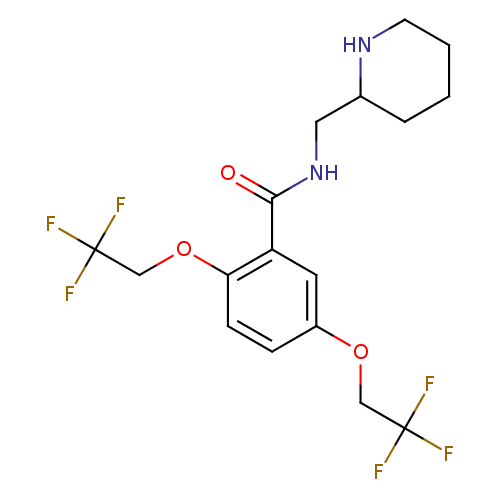
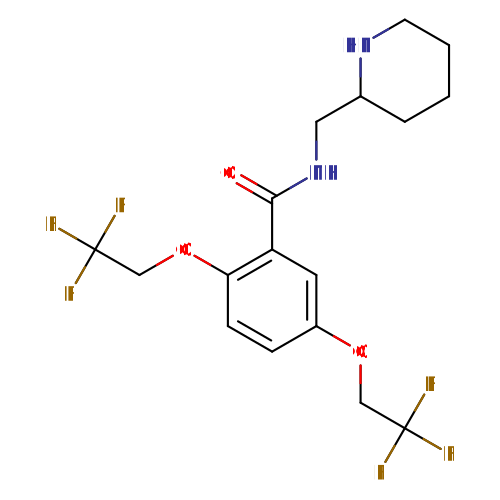
Chemical Structure
Thumb
Synonyms
ValueSource
(+-)-FlecainideChEBI
CCRIS 313ChEBI
FlecaineChEBI
FlecainidaChEBI
FlecainidumChEBI
N-(2-Piperidinylmethyl)-2,5-bis(2,2,2-trifluoroethoxy)benzamideChEBI
ApocardMeSH, HMDB
Flecainide monoacetate, (S)-isomerMeSH, HMDB
Flecainide, 5-HO-N-(6-oxo)-derivativeMeSH, HMDB
Merck dura brand OF flecainide acetateMeSH, HMDB
Alpharma brand OF flecainide acetateMeSH, HMDB
Flecainide, 5-HO-N-(6-oxo)-derivative, (+-)-isomerMeSH, HMDB
FlecatabMeSH, HMDB
TambocorMeSH, HMDB
3m Brand OF flecainide acetateMeSH, HMDB
Alphapharm brand OF flecainide acetateMeSH, HMDB
FlecaduraMeSH, HMDB
Flecainid-isisMeSH, HMDB
Flecainide acetateMeSH, HMDB
Flecainide monoacetate, (R)-isomerMeSH, HMDB
Flecainide, (R)-isomerMeSH, HMDB
Flecainide, (S)-isomerMeSH, HMDB
Riker brand OF flecainide acetateMeSH, HMDB
Acetate, flecainideMeSH, HMDB
Flecainid isisMeSH, HMDB
Flecainide monoacetateMeSH, HMDB
Flecainide monoacetate, (+-)-isomerMeSH, HMDB
United drug brand OF flecainide acetateMeSH, HMDB
Chemical FormulaC17H20F6N2O3
Average Molecular Mass414.343 g/mol
Monoisotopic Mass414.138 g/mol
CAS Registry Number54143-55-4
IUPAC NameN-[(piperidin-2-yl)methyl]-2,5-bis(2,2,2-trifluoroethoxy)benzamide
Traditional Nameflecainide
SMILESFC(F)(F)COC1=CC(C(=O)NCC2CCCCN2)=C(OCC(F)(F)F)C=C1
InChI IdentifierInChI=1S/C17H20F6N2O3/c18-16(19,20)9-27-12-4-5-14(28-10-17(21,22)23)13(7-12)15(26)25-8-11-3-1-2-6-24-11/h4-5,7,11,24H,1-3,6,8-10H2,(H,25,26)
InChI KeyDJBNUMBKLMJRSA-UHFFFAOYSA-N
Chemical Taxonomy
Description belongs to the class of organic compounds known as benzamides. These are organic compounds containing a carboxamido substituent attached to a benzene ring.
KingdomOrganic compounds
Super ClassBenzenoids
ClassBenzene and substituted derivatives
Sub ClassBenzoic acids and derivatives
Direct ParentBenzamides
Alternative Parents
Substituents
  • Benzamide
  • Phenoxy compound
  • Benzoyl
  • Phenol ether
  • Alkyl aryl ether
  • Piperidine
  • Amino acid or derivatives
  • Carboxamide group
  • Secondary carboxylic acid amide
  • Carboxylic acid derivative
  • Secondary aliphatic amine
  • Ether
  • Azacycle
  • Organoheterocyclic compound
  • Secondary amine
  • Organohalogen compound
  • Alkyl halide
  • Alkyl fluoride
  • Organic nitrogen compound
  • Hydrocarbon derivative
  • Organic oxide
  • Organopnictogen compound
  • Organofluoride
  • Organonitrogen compound
  • Organooxygen compound
  • Amine
  • Organic oxygen compound
  • Aromatic heteromonocyclic compound
Molecular FrameworkAromatic heteromonocyclic compounds
External Descriptors
Biological Properties
StatusDetected and Not Quantified
OriginExogenous
Cellular Locations
  • Cytoplasm
  • Extracellular
  • Membrane
Biofluid LocationsNot Available
Tissue LocationsNot Available
Pathways
NameSMPDB LinkKEGG Link
Flecainide PathwayNot AvailableNot Available
Applications
Biological RolesNot Available
Chemical RolesNot Available
Physical Properties
StateSolid
AppearanceSolid (1).
Experimental Properties
PropertyValue
Melting Point228-229°C
Boiling PointNot Available
Solubility48.4 mg/mL at 37°C (acetate form)
Predicted Properties
PropertyValueSource
Water Solubility0.032 g/LALOGPS
logP2.98ALOGPS
logP3.19ChemAxon
logS-4.1ALOGPS
pKa (Strongest Acidic)13.68ChemAxon
pKa (Strongest Basic)9.62ChemAxon
Physiological Charge1ChemAxon
Hydrogen Acceptor Count4ChemAxon
Hydrogen Donor Count2ChemAxon
Polar Surface Area59.59 ŲChemAxon
Rotatable Bond Count9ChemAxon
Refractivity88.4 m³·mol⁻¹ChemAxon
Polarizability35.92 ųChemAxon
Number of Rings2ChemAxon
Bioavailability1ChemAxon
Rule of FiveYesChemAxon
Ghose FilterYesChemAxon
Veber's RuleNoChemAxon
MDDR-like RuleNoChemAxon
Spectra
Spectra
Spectrum TypeDescriptionSplash KeyView
Predicted GC-MSPredicted GC-MS Spectrum - GC-MS (Non-derivatized) - 70eV, Positivesplash10-0f89-5009000000-7b1564870deda7f2d21eSpectrum
Predicted GC-MSPredicted GC-MS Spectrum - GC-MS (Non-derivatized) - 70eV, PositiveNot AvailableSpectrum
LC-MS/MSLC-MS/MS Spectrum - LC-ESI-QFT , negativesplash10-00dl-0095000000-644485d209c90776a32dSpectrum
LC-MS/MSLC-MS/MS Spectrum - LC-ESI-QFT , negativesplash10-00di-0190000000-201f2152d161a1ff83e5Spectrum
LC-MS/MSLC-MS/MS Spectrum - LC-ESI-QFT , negativesplash10-00di-0790000000-928874c4b348381ad1b8Spectrum
LC-MS/MSLC-MS/MS Spectrum - LC-ESI-QFT , negativesplash10-0596-0940000000-ee7a94ba0d7bcfa2fe93Spectrum
LC-MS/MSLC-MS/MS Spectrum - LC-ESI-QFT , negativesplash10-052g-1910000000-a32ac2f605f11fbbc5e0Spectrum
LC-MS/MSLC-MS/MS Spectrum - LC-ESI-QFT , negativesplash10-0297-1900000000-f1c49d25a6b161ff44d9Spectrum
LC-MS/MSLC-MS/MS Spectrum - LC-ESI-QFT , positivesplash10-014i-0000900000-9820e909cb01d45fa815Spectrum
LC-MS/MSLC-MS/MS Spectrum - LC-ESI-QFT , positivesplash10-00kb-2009500000-68b872fada8afdd4e580Spectrum
LC-MS/MSLC-MS/MS Spectrum - LC-ESI-QFT , positivesplash10-0f6t-5019000000-8fa5e4257c88beda0ea1Spectrum
LC-MS/MSLC-MS/MS Spectrum - LC-ESI-QFT , positivesplash10-0uea-8069000000-149a79cf429446ec77c2Spectrum
LC-MS/MSLC-MS/MS Spectrum - LC-ESI-QFT , positivesplash10-0uei-6292000000-103ccdef98c4b6c9e408Spectrum
LC-MS/MSLC-MS/MS Spectrum - LC-ESI-QFT , positivesplash10-0pdi-8970000000-9258d139b203d6c98df0Spectrum
LC-MS/MSLC-MS/MS Spectrum - 15V, Positivesplash10-014i-0000900000-3df851e0ff354ab1be59Spectrum
LC-MS/MSLC-MS/MS Spectrum - 30V, Negativesplash10-00di-0090000000-8d4a6a9978cccc816b47Spectrum
LC-MS/MSLC-MS/MS Spectrum - 30V, Positivesplash10-00kb-2009500000-c58556b6a88ebc0729bcSpectrum
LC-MS/MSLC-MS/MS Spectrum - 20V, Positivesplash10-014i-0001900000-9830e722af2fab717f28Spectrum
LC-MS/MSLC-MS/MS Spectrum - 10V, Positivesplash10-014i-0000900000-c80ce9de474de184ff13Spectrum
LC-MS/MSLC-MS/MS Spectrum - 45V, Positivesplash10-0f6t-5019000000-00737a572b9aa2cd61a3Spectrum
LC-MS/MSLC-MS/MS Spectrum - 15V, Negativesplash10-00dl-0095000000-43e08367bbe8d04a6a08Spectrum
Predicted LC-MS/MSPredicted LC-MS/MS Spectrum - 10V, Positivesplash10-014j-5306900000-5bc88ff27c840b41cb32Spectrum
Predicted LC-MS/MSPredicted LC-MS/MS Spectrum - 20V, Positivesplash10-0002-9314100000-11d4e9fa034a85ea06f0Spectrum
Predicted LC-MS/MSPredicted LC-MS/MS Spectrum - 40V, Positivesplash10-0002-9010000000-ac2b8dd3242c0db13ae9Spectrum
Predicted LC-MS/MSPredicted LC-MS/MS Spectrum - 10V, Negativesplash10-03di-0004900000-9ea43375c547f2e6b28aSpectrum
Predicted LC-MS/MSPredicted LC-MS/MS Spectrum - 20V, Negativesplash10-03xu-2139400000-cddcc91db822779e66b6Spectrum
Predicted LC-MS/MSPredicted LC-MS/MS Spectrum - 40V, Negativesplash10-00l2-5391000000-60f93403fdd5f22a81c3Spectrum
MSMass Spectrum (Electron Ionization)splash10-001i-9000000000-b732167df77d39193144Spectrum
Toxicity Profile
Route of ExposureIngestion (MSDS, A308). Nearly complete following oral administration.
Mechanism of ToxicityFlecainide acts on sodium channels on the neuronal cell membrane, limiting the spread of seizure activity and reducing seizure propagation. The antiarrhythmic actions are mediated through effects on sodium channels in Purkinje fibers. Flecainide is a sodium channel blocker, binding to voltage gated sodium channels. It stabilizes the neuronal membrane by inhibiting the ionic fluxes required for the initiation and conduction of impulses. Ventricular excitability is depressed and the stimulation threshold of the ventricle is increased during diastole.
MetabolismHepatic. Flecainide does not undergo any consequential presystemic biotransformation. The two major urinary metabolites are meta-O-dealkylated flecainide (active, but about one-fifth as potent) and the meta-O-dealkylated lactam of flecainide (non-active metabolite). The absoprtion is nearly complete following oral administration. Hepatic. Flecainide does not undergo any consequential presystemic biotransformation. The two major urinary metabolites are meta-O-dealkylated flecainide (active, but about one-fifth as potent) and the meta-O-dealkylated lactam of flecainide (non-active metabolite). Route of Elimination: In healthy subjects, about 30% of a single oral dose (range, 10 to 50%) is excreted in urine as unchanged drug. Several minor metabolites (3% of the dose or less) are also found in urine; only 5% of an oral dose is excreted in feces. In patients, free (unconjugated) plasma levels of the two major metabolites are very low (less than 0.05 ug/mL). Half Life: 20 hours (range 12-27 hours)
Toxicity ValuesLD50: 50-498 mg/kg (Oral, Rat) (1)
Lethal DoseNot Available
Carcinogenicity (IARC Classification)No indication of carcinogenicity to humans (not listed by IARC).
Uses/SourcesFlecainide is is a class Ic antiarrhythmic agent and as such, it is used for the prevention of paroxysmal supraventricular tachycardias (PSVT), including atrioventricular nodal reentrant tachycardia, atrioventricular reentrant tachycardia and other supraventricular tachycardias of unspecified mechanism associated with disablin (1).
Minimum Risk LevelNot Available
Health EffectsSigns of flecainide toxicity include marked prolongation of the PR interval and widening of the QRS duration on the surface ECG. There may be signs and symptoms attributable to overt heart failure secondary to sudden decreased myocardial contractility (7).
SymptomsSymptoms of overdose include nausea and vomiting, convulsions, hypotension, bradycardia, syncope, extreme widening of the QRS complex, widening of the QT interval, widening of the PR interval, ventricular tachycardia, AV nodal block, asystole, bundle branch block, cardiac failure, and cardiac arrest.
TreatmentTreatment of flecainide toxicity involves increasing the excretion of flecainide, blocking its effects in the heart, and (rarely) institution of cardiovascular support to avoid impending lethal arrhythmias. Modalities that have had success include administration of a beta-sympathomimetic agent, and administration of a sodium load (often in the form of hypertonic sodium bicarbonate). Placing the individual on cardiopulmonary bypass support may be necessary in order to temporarily obviate the need for a beating heart and to increase blood flow to the liver. (7)
Concentrations
Not Available
DrugBank IDDB01195
HMDB IDHMDB0257376
FooDB IDNot Available
Phenol Explorer IDNot Available
KNApSAcK IDNot Available
BiGG IDNot Available
BioCyc IDNot Available
METLIN IDNot Available
PDB IDNot Available
Wikipedia LinkFlecainide
Chemspider ID3239
ChEBI ID75984
PubChem Compound IDNot Available
Kegg Compound IDC07001
YMDB IDNot Available
ECMDB IDNot Available
References
Synthesis Reference

Bmitt, E.H. and Brown, W.R.; U.S. Patent 3,900,481; August 19,1975; assigned to Riker Laboratories, Inc.

MSDSLink
General References
1. https://www.ncbi.nlm.nih.gov/pubmed/?term=21029131
2. https://www.ncbi.nlm.nih.gov/pubmed/?term=22526215
3. https://www.ncbi.nlm.nih.gov/pubmed/?term=22882363
4. https://www.ncbi.nlm.nih.gov/pubmed/?term=22913299
5. https://www.ncbi.nlm.nih.gov/pubmed/?term=22981658
6. https://www.ncbi.nlm.nih.gov/pubmed/?term=23067130
7. https://www.ncbi.nlm.nih.gov/pubmed/?term=23188129
8. https://www.ncbi.nlm.nih.gov/pubmed/?term=23202797
9. https://www.ncbi.nlm.nih.gov/pubmed/?term=23286974
10. https://www.ncbi.nlm.nih.gov/pubmed/?term=23329876
11. https://www.ncbi.nlm.nih.gov/pubmed/?term=23334259
12. https://www.ncbi.nlm.nih.gov/pubmed/?term=23410160
13. https://www.ncbi.nlm.nih.gov/pubmed/?term=23518212
14. https://www.ncbi.nlm.nih.gov/pubmed/?term=23558880
15. https://www.ncbi.nlm.nih.gov/pubmed/?term=23635804
16. https://www.ncbi.nlm.nih.gov/pubmed/?term=23647896
17. https://www.ncbi.nlm.nih.gov/pubmed/?term=23700986
18. https://www.ncbi.nlm.nih.gov/pubmed/?term=23714084
19. https://www.ncbi.nlm.nih.gov/pubmed/?term=23756405
20. https://www.ncbi.nlm.nih.gov/pubmed/?term=23954267
21. https://www.ncbi.nlm.nih.gov/pubmed/?term=24019076
22. https://www.ncbi.nlm.nih.gov/pubmed/?term=24084224