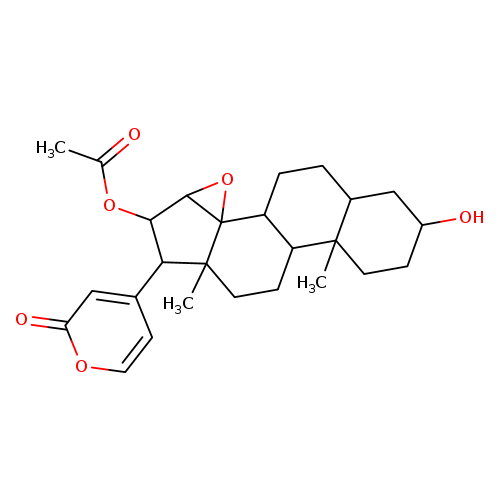
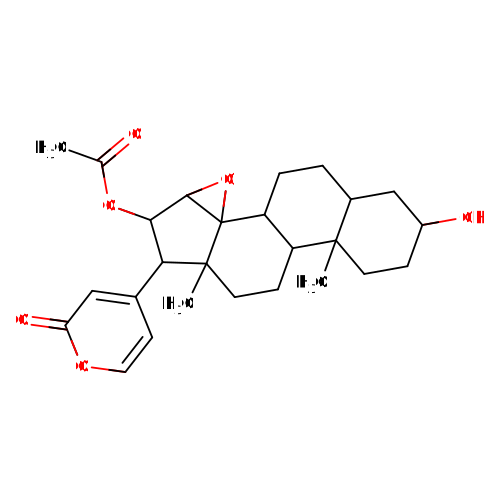
Record Information
Version1.0
Creation Date2009-07-03 22:19:15 UTC
Update Date2026-04-06 10:35:59 UTC
Accession NumberCHEM002076
Identification
Common NameCinobufagin
ClassSmall Molecule
DescriptionCinobufagin is a cardiotoxic bufanolide steroid secreted by the Asiatic toad (Bufo gargarizans). (3)
Contaminant Sources
  • T3DB toxins
Contaminant Type
  • Animal Toxin
  • Ester
  • Ether
  • Frog/Toad Toxin
  • Natural Compound
  • Organic Compound
Chemical Structure
Thumb
Synonyms
ValueSource
[(2S,4R,5R,6R,14S,16R)-14-Hydroxy-7,11-dimethyl-6-(2-oxopyran-4-yl)-3-oxapentacyclo[8.8.0.02,4.02,7.011,16]octadecan-5-yl] acetic acidGenerator
Chemical FormulaC26H34O6
Average Molecular Mass442.545 g/mol
Monoisotopic Mass442.236 g/mol
CAS Registry Number470-37-1
IUPAC Name14-hydroxy-7,11-dimethyl-6-(2-oxo-2H-pyran-4-yl)-3-oxapentacyclo[8.8.0.0²,⁴.0²,⁷.0¹¹,¹⁶]octadecan-5-yl acetate
Traditional Name14-hydroxy-7,11-dimethyl-6-(2-oxopyran-4-yl)-3-oxapentacyclo[8.8.0.0²,⁴.0²,⁷.0¹¹,¹⁶]octadecan-5-yl acetate
SMILESCC(=O)OC1C2OC22C3CCC4CC(O)CCC4(C)C3CCC2(C)C1C1=CC(=O)OC=C1
InChI IdentifierInChI=1S/C26H34O6/c1-14(27)31-22-21(15-8-11-30-20(29)12-15)25(3)10-7-18-19(26(25)23(22)32-26)5-4-16-13-17(28)6-9-24(16,18)2/h8,11-12,16-19,21-23,28H,4-7,9-10,13H2,1-3H3
InChI KeyBNZAGRNEEMGADQ-UHFFFAOYSA-N
Chemical Taxonomy
Description belongs to the class of organic compounds known as steroid esters. Steroid esters are compounds containing a steroid moiety which bears a carboxylic acid ester group.
KingdomOrganic compounds
Super ClassLipids and lipid-like molecules
ClassSteroids and steroid derivatives
Sub ClassSteroid esters
Direct ParentSteroid esters
Alternative Parents
Substituents
  • Steroid ester
  • Naphthopyran
  • Naphthalene
  • Pyranone
  • Oxane
  • Pyran
  • Cyclic alcohol
  • Heteroaromatic compound
  • Carboxylic acid ester
  • Lactone
  • Secondary alcohol
  • Monocarboxylic acid or derivatives
  • Organoheterocyclic compound
  • Ether
  • Oxirane
  • Dialkyl ether
  • Oxacycle
  • Carboxylic acid derivative
  • Organooxygen compound
  • Alcohol
  • Hydrocarbon derivative
  • Organic oxygen compound
  • Organic oxide
  • Carbonyl group
  • Aromatic heteropolycyclic compound
Molecular FrameworkAromatic heteropolycyclic compounds
External DescriptorsNot Available
Biological Properties
StatusDetected and Not Quantified
OriginExogenous
Cellular Locations
  • Membrane
Biofluid LocationsNot Available
Tissue LocationsNot Available
PathwaysNot Available
ApplicationsNot Available
Biological RolesNot Available
Chemical RolesNot Available
Physical Properties
StateSolid
AppearanceWhite powder.
Experimental Properties
PropertyValue
Melting PointNot Available
Boiling PointNot Available
SolubilityNot Available
Predicted Properties
PropertyValueSource
Water Solubility0.0067 g/LALOGPS
logP3.16ALOGPS
logP2.81ChemAxon
logS-4.8ALOGPS
pKa (Strongest Acidic)14.13ChemAxon
pKa (Strongest Basic)-1.4ChemAxon
Physiological Charge0ChemAxon
Hydrogen Acceptor Count4ChemAxon
Hydrogen Donor Count1ChemAxon
Polar Surface Area85.36 ŲChemAxon
Rotatable Bond Count3ChemAxon
Refractivity116.78 m³·mol⁻¹ChemAxon
Polarizability48.29 ųChemAxon
Number of Rings6ChemAxon
Bioavailability1ChemAxon
Rule of FiveYesChemAxon
Ghose FilterYesChemAxon
Veber's RuleNoChemAxon
MDDR-like RuleNoChemAxon
Spectra
Spectra
Spectrum TypeDescriptionSplash KeyView
Predicted GC-MSPredicted GC-MS Spectrum - GC-MS (Non-derivatized) - 70eV, Positivesplash10-01po-2809600000-23ac8619fa4e3ed11decSpectrum
Predicted GC-MSPredicted GC-MS Spectrum - GC-MS (Non-derivatized) - 70eV, PositiveNot AvailableSpectrum
Predicted GC-MSPredicted GC-MS Spectrum - GC-MS (TMS_1_1) - 70eV, PositiveNot AvailableSpectrum
Predicted GC-MSPredicted GC-MS Spectrum - GC-MS (TBDMS_1_1) - 70eV, PositiveNot AvailableSpectrum
Predicted LC-MS/MSPredicted LC-MS/MS Spectrum - 10V, Positivesplash10-004l-0003900000-c10833a5bef940a0387fSpectrum
Predicted LC-MS/MSPredicted LC-MS/MS Spectrum - 20V, Positivesplash10-001i-0209500000-6395a480649d326b5294Spectrum
Predicted LC-MS/MSPredicted LC-MS/MS Spectrum - 40V, Positivesplash10-03yl-4904100000-35d59432fc4064d6d339Spectrum
Predicted LC-MS/MSPredicted LC-MS/MS Spectrum - 10V, Negativesplash10-0006-3005900000-c9d4a8ef3d4abaf6ae0dSpectrum
Predicted LC-MS/MSPredicted LC-MS/MS Spectrum - 20V, Negativesplash10-0535-4009400000-249ed8ed5dc781480286Spectrum
Predicted LC-MS/MSPredicted LC-MS/MS Spectrum - 40V, Negativesplash10-0a4i-9015000000-48bb1483c4273dc532afSpectrum
Predicted LC-MS/MSPredicted LC-MS/MS Spectrum - 10V, Positivesplash10-001i-0009100000-50e6e4f2d31fd935e689Spectrum
Predicted LC-MS/MSPredicted LC-MS/MS Spectrum - 20V, Positivesplash10-00or-0019600000-c6497a30fec9972bf7dcSpectrum
Predicted LC-MS/MSPredicted LC-MS/MS Spectrum - 40V, Positivesplash10-022a-2914000000-ff4977984d3e2131065dSpectrum
Predicted LC-MS/MSPredicted LC-MS/MS Spectrum - 10V, Negativesplash10-052f-5000900000-e5b9dece597ab47ae055Spectrum
Predicted LC-MS/MSPredicted LC-MS/MS Spectrum - 20V, Negativesplash10-0536-3007900000-75058b0b45dbd242e38eSpectrum
Predicted LC-MS/MSPredicted LC-MS/MS Spectrum - 40V, Negativesplash10-001i-3009100000-23c8f5b824fa27109547Spectrum
Toxicity Profile
Route of ExposureIngestion (1)
Mechanism of ToxicityCinobufagin blocks the sodium/potassium pump in heart tissue. (3, 4)
MetabolismNot Available
Toxicity ValuesNot Available
Lethal DoseNot Available
Carcinogenicity (IARC Classification)No indication of carcinogenicity to humans (not listed by IARC).
Uses/SourcesCinobufagin is a cardiotoxic bufanolide steroid secreted by the Asiatic toad (Bufo gargarizans). (3)
Minimum Risk LevelNot Available
Health EffectsCinobufagin is cardiotoxic. (3)
SymptomsSymptoms include nausea, vomiting, anorexia, diarrhoea, abdominal pain, wild hallucinations, delirium, and severe headache. Depending on the severity the victim may later suffer irregular and slow pulse, tremors, various cerebral disturbances, especially of a visual nature, convulsions, and deadly disturbances of the heart such as heart block, brachycardia, or tachycardia. (3, 4)
TreatmentNot Available
Concentrations
Not Available
DrugBank IDNot Available
HMDB IDHMDB0247800
FooDB IDNot Available
Phenol Explorer IDNot Available
KNApSAcK IDNot Available
BiGG IDNot Available
BioCyc IDNot Available
METLIN IDNot Available
PDB IDNot Available
Wikipedia LinkCinobufagin
Chemspider IDNot Available
ChEBI IDNot Available
PubChem Compound ID78168774
Kegg Compound IDNot Available
YMDB IDNot Available
ECMDB IDNot Available
References
Synthesis ReferenceNot Available
MSDSNot Available
General References
1. Barupal DK, Fiehn O: Generating the Blood Exposome Database Using a Comprehensive Text Mining and Database Fusion Approach. Environ Health Perspect. 2019 Sep;127(9):97008. doi: 10.1289/EHP4713. Epub 2019 Sep 26.