Record Information
Version1.0
Creation Date2009-07-03 22:07:24 UTC
Update Date2026-03-26 18:49:26 UTC
Accession NumberCHEM002064
Identification
Common NameDapsone
ClassSmall Molecule
DescriptionA sulfone active against a wide range of bacteria but mainly employed for its actions against mycobacterium leprae. Its mechanism of action is probably similar to that of the sulfonamides which involves inhibition of folic acid synthesis in susceptible organisms. It is also used with pyrimethamine in the treatment of malaria. (From Martindale, The Extra Pharmacopoeia, 30th ed, p157-8)
Contaminant Sources
  • HMDB Contaminants - Urine
  • HPV EPA Chemicals
  • IARC Carcinogens Group 3
  • STOFF IDENT Compounds
  • Suspected Compounds
  • T3DB toxins
  • ToxCast & Tox21 Chemicals
Contaminant Type
  • Amine
  • Anti-Infective Agent
  • Anti-Inflammatory Agent
  • Antimalarial
  • Antimycobacterial
  • Drug
  • Folic Acid Antagonist
  • Leprostatic Agent
  • Metabolite
  • Organic Compound
  • Synthetic Compound
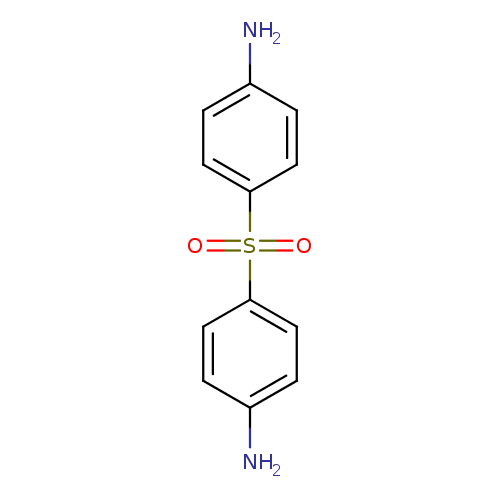
Chemical Structure
Thumb
Synonyms
ValueSource
1,1'-Sulfonylbis(4-aminobenzene)ChEBI
4,4'-DapsoneChEBI
4,4'-Diaminodiphenyl sulfoneChEBI
4,4'-SulfonylbisanilineChEBI
4,4'-SulfonylbisbenzenamineChEBI
4-(4-Amino-benzenesulfonyl)-phenylamineChEBI
4-(4-Aminophenylsulfonyl)anilineChEBI
4-(4-Aminophenylsulfonyl)benzenamineChEBI
4-Aminophenyl sulfoneChEBI
Bis(4-aminophenyl)sulfoneChEBI
Bis(p-aminophenyl) sulfoneChEBI
DADPSChEBI
DapsonaChEBI
DapsonumChEBI
DDSChEBI
DIAPHENYLsulfoneChEBI
p,P'-diaminodiphenyl sulfoneChEBI
p,p-SulphonylbisbenzamineChEBI
p,p-SulphonylbisbenzenamineChEBI
p-Aminophenyl sulfoneChEBI
AczoneKegg
1,1'-Sulphonylbis(4-aminobenzene)Generator
4,4'-Diaminodiphenyl sulphoneGenerator
4,4'-SulphonylbisanilineGenerator
4,4'-SulphonylbisbenzenamineGenerator
4-(4-Amino-benzenesulphonyl)-phenylamineGenerator
4-(4-Aminophenylsulphonyl)anilineGenerator
4-(4-Aminophenylsulphonyl)benzenamineGenerator
4-Aminophenyl sulphoneGenerator
Bis(4-aminophenyl)sulphoneGenerator
Bis(p-aminophenyl) sulphoneGenerator
DIAPHENYLsulphoneGenerator
p,P'-diaminodiphenyl sulphoneGenerator
p,p-SulfonylbisbenzamineGenerator
p,p-SulfonylbisbenzenamineGenerator
p-Aminophenyl sulphoneGenerator
1,1'-Sulfonylbis[4-aminobenzene]HMDB
4,4'-DiaminodiphenylsulfoneHMDB
4,4'-SulfonylbisbenzeneamineHMDB
4,4'-SulfonyldianilinHMDB
4,4'-SulfonyldianilineHMDB
DDS, PharmaceuticalHMDB
Mex-america brand OF dapsoneHMDB
SulfonaHMDB
4,4' Diaminophenyl sulfoneHMDB
4,4'-Diaminophenyl sulfoneHMDB
Dapson-fatolHMDB
DisuloneHMDB
Fatol brand OF dapsoneHMDB
Orsade brand OF dapsoneHMDB
Sulfone, 4,4'-diaminophenylHMDB
SulfonyldianilineHMDB
AvlosulfoneHMDB
Dapsoderm-XHMDB
DiaminodiphenylsulfoneHMDB
Chemical FormulaC12H12N2O2S
Average Molecular Mass248.301 g/mol
Monoisotopic Mass248.062 g/mol
CAS Registry Number80-08-0
IUPAC Name4-(4-aminobenzenesulfonyl)aniline
Traditional Namedapsone
SMILESNC1=CC=C(C=C1)S(=O)(=O)C1=CC=C(N)C=C1
InChI IdentifierInChI=1S/C12H12N2O2S/c13-9-1-5-11(6-2-9)17(15,16)12-7-3-10(14)4-8-12/h1-8H,13-14H2
InChI KeyMQJKPEGWNLWLTK-UHFFFAOYSA-N
Chemical Taxonomy
Description belongs to the class of organic compounds known as benzenesulfonyl compounds. These are aromatic compounds containing a benzenesulfonyl group, which consists of a monocyclic benzene moiety that carries a sulfonyl group.
KingdomOrganic compounds
Super ClassBenzenoids
ClassBenzene and substituted derivatives
Sub ClassBenzenesulfonyl compounds
Direct ParentBenzenesulfonyl compounds
Alternative Parents
Substituents
  • Benzenesulfonyl group
  • Aniline or substituted anilines
  • Sulfonyl
  • Sulfone
  • Organic nitrogen compound
  • Organic oxygen compound
  • Organopnictogen compound
  • Organic oxide
  • Hydrocarbon derivative
  • Primary amine
  • Organosulfur compound
  • Organonitrogen compound
  • Amine
  • Aromatic homomonocyclic compound
Molecular FrameworkAromatic homomonocyclic compounds
External Descriptors
Biological Properties
StatusDetected and Not Quantified
OriginExogenous
Cellular Locations
  • Cytoplasm
  • Extracellular
  • Membrane
Biofluid LocationsNot Available
Tissue LocationsNot Available
PathwaysNot Available
Applications
Biological Roles
Chemical RolesNot Available
Physical Properties
StateSolid
AppearanceWhite or creamy white crystalline powder (4)
Experimental Properties
PropertyValue
Melting Point175.5°C
Boiling PointNot Available
Solubility380 mg/L (at 37°C)
Predicted Properties
PropertyValueSource
Water Solubility0.28 g/LALOGPS
logP1.19ALOGPS
logP1.27ChemAxon
logS-2.9ALOGPS
pKa (Strongest Basic)2.39ChemAxon
Physiological Charge0ChemAxon
Hydrogen Acceptor Count4ChemAxon
Hydrogen Donor Count2ChemAxon
Polar Surface Area86.18 ŲChemAxon
Rotatable Bond Count2ChemAxon
Refractivity68.99 m³·mol⁻¹ChemAxon
Polarizability25.05 ųChemAxon
Number of Rings2ChemAxon
Bioavailability1ChemAxon
Rule of FiveYesChemAxon
Ghose FilterYesChemAxon
Veber's RuleNoChemAxon
MDDR-like RuleNoChemAxon
Spectra
Spectra
Spectrum TypeDescriptionSplash KeyView
Predicted GC-MSPredicted GC-MS Spectrum - GC-MS (Non-derivatized) - 70eV, Positivesplash10-0564-9770000000-98d678eb70ae9cdbbfaaSpectrum
Predicted GC-MSPredicted GC-MS Spectrum - GC-MS (Non-derivatized) - 70eV, PositiveNot AvailableSpectrum
LC-MS/MSLC-MS/MS Spectrum - LC-ESI-qTof , Positivesplash10-0a4i-5901100000-901603cf86087b4a4abbSpectrum
LC-MS/MSLC-MS/MS Spectrum - LC-ESI-QQ , negativesplash10-0002-0190000000-7de0f1aeb77cf9b122f5Spectrum
LC-MS/MSLC-MS/MS Spectrum - LC-ESI-QQ , negativesplash10-0002-0290000000-f1e61c46f1720875a177Spectrum
LC-MS/MSLC-MS/MS Spectrum - LC-ESI-QQ , negativesplash10-0a4i-0920000000-ed66532a51b7d047462aSpectrum
LC-MS/MSLC-MS/MS Spectrum - LC-ESI-QQ , negativesplash10-0a4l-3900000000-a1f636a2e557bc9b69a5Spectrum
LC-MS/MSLC-MS/MS Spectrum - LC-ESI-QQ , negativesplash10-052f-9800000000-3557ad8246dc0a0aa05cSpectrum
LC-MS/MSLC-MS/MS Spectrum - LC-ESI-QTOF , positivesplash10-0a4i-5910000000-0c8eb03605a271970f1dSpectrum
LC-MS/MSLC-MS/MS Spectrum - LC-ESI-QFT , positivesplash10-052b-0590000000-a23b099ad5d2d3cd716dSpectrum
LC-MS/MSLC-MS/MS Spectrum - LC-ESI-QFT , positivesplash10-0a4i-1920000000-0260de715fec538fe8bbSpectrum
LC-MS/MSLC-MS/MS Spectrum - LC-ESI-QFT , positivesplash10-0a4l-5900000000-6ba41fa3598abafdb242Spectrum
LC-MS/MSLC-MS/MS Spectrum - LC-ESI-QFT , positivesplash10-052f-9600000000-d2fe4c5ba425499ba98cSpectrum
LC-MS/MSLC-MS/MS Spectrum - LC-ESI-QFT , positivesplash10-052f-9400000000-e29e2bdac763fc5e250bSpectrum
LC-MS/MSLC-MS/MS Spectrum - LC-ESI-QFT , positivesplash10-066u-9200000000-71494cee2792628e6a0cSpectrum
LC-MS/MSLC-MS/MS Spectrum - LC-ESI-QFT , positivesplash10-014i-9000000000-38433ad894a5e08f6ee0Spectrum
LC-MS/MSLC-MS/MS Spectrum - LC-ESI-QFT , positivesplash10-014i-9000000000-e4782e47ceb05d1ffbdaSpectrum
LC-MS/MSLC-MS/MS Spectrum - LC-ESI-QFT , positivesplash10-014i-9000000000-4ab9019e60b1718d1d29Spectrum
LC-MS/MSLC-MS/MS Spectrum - LC-ESI-QQ , positivesplash10-0002-0190000000-d7cf0928be57fafd7ea4Spectrum
LC-MS/MSLC-MS/MS Spectrum - LC-ESI-QQ , positivesplash10-0a4i-1930000000-09cf0e392eeef139f2b1Spectrum
LC-MS/MSLC-MS/MS Spectrum - LC-ESI-QQ , positivesplash10-0a4l-8900000000-5da3a6d058cb14fc8300Spectrum
Predicted LC-MS/MSPredicted LC-MS/MS Spectrum - 10V, Positivesplash10-0002-0090000000-77f73a73b1a222285be3Spectrum
Predicted LC-MS/MSPredicted LC-MS/MS Spectrum - 20V, Positivesplash10-0002-0090000000-efb6858364a1d7c22428Spectrum
Predicted LC-MS/MSPredicted LC-MS/MS Spectrum - 40V, Positivesplash10-004i-9430000000-d9c6fe280d40d0bc8dd6Spectrum
Predicted LC-MS/MSPredicted LC-MS/MS Spectrum - 10V, Negativesplash10-0002-0090000000-f3d8a4bdccbe1170ae6cSpectrum
Predicted LC-MS/MSPredicted LC-MS/MS Spectrum - 20V, Negativesplash10-0002-0090000000-ab2b74cff1f89de7c9a9Spectrum
Predicted LC-MS/MSPredicted LC-MS/MS Spectrum - 40V, Negativesplash10-0006-9020000000-d4698e6b7c05ce3e71e6Spectrum
MSMass Spectrum (Electron Ionization)splash10-052g-8930000000-c51783649020dadfb20fSpectrum
1D NMR1H NMR SpectrumNot AvailableSpectrum
1D NMR13C NMR SpectrumNot AvailableSpectrum
Toxicity Profile
Route of ExposureIngestion (9, 12); dermal (9, 12) ; eye contact (9, 12); inhalation (9, 12) Bioavailability is 70 to 80% following oral administration.
Mechanism of ToxicityDapsone acts against bacteria and protozoa in the same way as sulphonamides, that is by inhibiting the synthesis of dihydrofolic acid through competition with para-amino-benzoate for the active site of dihydropteroate synthetase. The anti-inflammatory action of the drug is unrelated to its antibacterial action and is still not fully understood.
MetabolismDapsone is slowly and nearly completely absporbed from GI tract, and distributed throughout the body. It is acetylated in the liver to monoacetyl and diacetyl derivatives. The major metabolite of dapsone is monoacetyldapsone. The rate of acetylation of dapsone is genetically determined and is subject to interindividual variation, although the rate is usually constant for each individual. The drug also is hydroxylated in the liver to hydroxylamine dapsone (NOH-DDS). NOH-DDS appears to be responsible for methemoglobinemia and hemolysis induced by the drug. The metabolites are excreted moslty in the urine. Only minor amounts of dapsone are excreted in feces. (2, 3). Route of Elimination: Renal Half Life: 28 hours (range 10-50 hours)
Toxicity ValuesLD50: 496 mg/kg (Oral, Mouse)
Lethal DoseNot Available
Carcinogenicity (IARC Classification)3, not classifiable as to its carcinogenicity to humans. (8)
Uses/SourcesFor the treatment and management of leprosy and dermatitis herpetiformis. Dapsone is mainly employed for its actions against mycobacterium leprae. It is also used with pyrimethamine in the treatment of malaria, and of Pneumocystis carinii pneumonia (PCP) (1, 9).
Minimum Risk LevelNot Available
Health EffectsMethemoglobinemia and hemolysis are the main risks of acute intoxication. Hemolytic anemia, agranulocytosis, aplastic anemia and other blood dyscrasias may occur in chronic poisoning. Target organs are central and peripheral nervous systems, blood, liver and skin. Methemoglobinemia is the principal and constant feature of dapsone poisoning. Hemolytic anaemia and agranulocytosis may occur with the relatively low doses used for leprosy and malaria, whereas peripheral neuropathy and hepatitis are only observed with the higher doses used in the treatment of dermatitis herpetiformis. (10).
SymptomsOverdosage might be expected to produce nasal congestion, syncope, or hallucinations. Measures to support blood pressure should be taken if necessary.
TreatmentAdminister charcoal as a slurry following oral or parenteral exposure. (13)
Concentrations
Not Available
DrugBank IDDB00250
HMDB IDHMDB0014395
FooDB IDNot Available
Phenol Explorer IDNot Available
KNApSAcK IDNot Available
BiGG IDNot Available
BioCyc IDNot Available
METLIN IDNot Available
PDB IDNot Available
Wikipedia LinkDapsone
Chemspider ID2849
ChEBI ID4325
PubChem Compound ID2955
Kegg Compound IDC07666
YMDB IDNot Available
ECMDB IDNot Available
References
Synthesis Reference

Weijiard, J.and Messerly, J.P.; U.S. Patent 2,385,899; October 2,1945; assigned to Merck
& Co., Inc.

MSDSLink
General References
1. https://www.ncbi.nlm.nih.gov/pubmed/?term=16361748
2. https://www.ncbi.nlm.nih.gov/pubmed/?term=18035772
3. https://www.ncbi.nlm.nih.gov/pubmed/?term=24232126
4. https://www.ncbi.nlm.nih.gov/pubmed/?term=24512442
5. https://www.ncbi.nlm.nih.gov/pubmed/?term=28434260
6. https://www.ncbi.nlm.nih.gov/pubmed/?term=28699887
7. https://www.ncbi.nlm.nih.gov/pubmed/?term=28732451
8. https://www.ncbi.nlm.nih.gov/pubmed/?term=29045131
9. https://www.ncbi.nlm.nih.gov/pubmed/?term=29192974
10. https://www.ncbi.nlm.nih.gov/pubmed/?term=29192999
11. https://www.ncbi.nlm.nih.gov/pubmed/?term=29233746
12. https://www.ncbi.nlm.nih.gov/pubmed/?term=29280553
13. Malfara WR, Pereira CP, Santos AC, Queiroz RH: Effects of H(2)-receptor antagonists on dapsone-induced methaemoglobinaemia in rats. Pharmacol Res. 2002 Apr;45(4):269-73.
14. FLOCH H, GELARD AM: [Study of 4,4'-bis(ethylamino)-diphenylsulfone and of N-succinyl-4,4'diaminodiphenylsulfone administered intramuscularly in depot form]. Publ Inst Pasteur Guyane Fr Inini. 1954 Oct;15(343):1-7.