Record Information
Version1.0
Creation Date2009-07-03 22:04:02 UTC
Update Date2026-05-14 16:25:19 UTC
Accession NumberCHEM002062
Identification
Common NameVindesine
ClassSmall Molecule
DescriptionVindesine is only found in individuals that have used or taken this drug. It is a vinblastine derivative with antineoplastic activity against cancer. Major side effects are myelosuppression and neurotoxicity. Vindesine is used extensively in chemotherapy protocols (antineoplastic combined chemotherapy protocols). Vindesine acts by causing the arrest of cells in metaphase mitosis through its inhibition tubulin mitotic funcitoning. The drug is cell-cycle specific for the S phase.
Contaminant Sources
  • HMDB Contaminants - Urine
  • T3DB toxins
Contaminant Type
  • Amide
  • Amine
  • Antineoplastic Agent
  • Antineoplastic Agent, Phytogenic
  • Drug
  • Ester
  • Ether
  • Human Neurotoxin
  • Metabolite
  • Organic Compound
  • Synthetic Compound
  • Tubulin Modulator
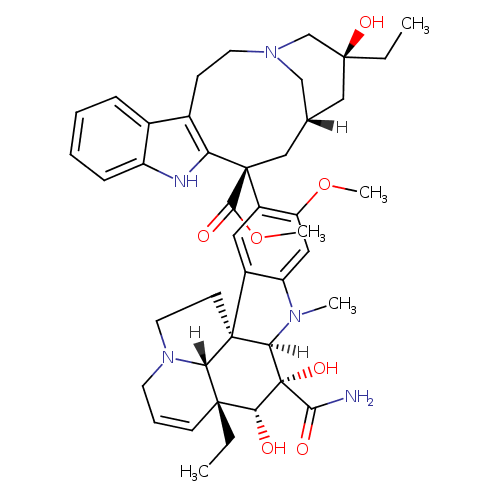
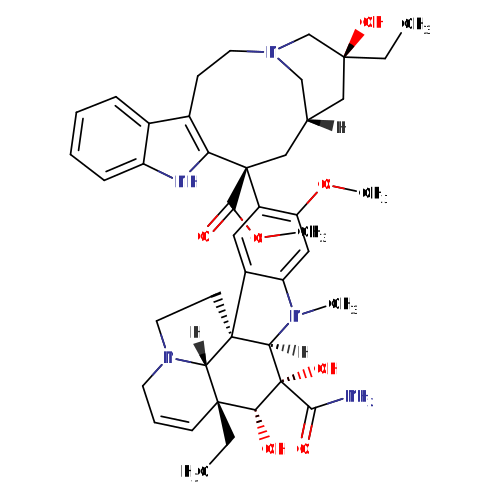
Chemical Structure
Thumb
Synonyms
ValueSource
3-(Aminocarbonyl)-O(4)-deacetyl-3-de(methoxycarbonyl)vincaleukoblastineChEBI
3-Carbamoyl-4-deacetyl-3-de(methoxycarbonyl)vincaleukoblastineChEBI
Desacetylvinblastine amideChEBI
Desacetylvinblastine amide sulfateHMDB
Vindesine sulfateHMDB
EldisineHMDB
Compound 112531HMDB
EnisonHMDB
Sulfate, vindesineHMDB
EG labo brand OF vindesine sulfateHMDB
Lilly brand OF vindesine sulfateHMDB
VindesinHMDB
Chemical FormulaC43H55N5O7
Average Molecular Mass753.926 g/mol
Monoisotopic Mass753.410 g/mol
CAS Registry Number53643-48-4
IUPAC Namemethyl (13S,15R,17S)-13-[(1R,9R,10S,11R,12R,19R)-10-carbamoyl-12-ethyl-10,11-dihydroxy-5-methoxy-8-methyl-8,16-diazapentacyclo[10.6.1.0^{1,9}.0^{2,7}.0^{16,19}]nonadeca-2,4,6,13-tetraen-4-yl]-17-ethyl-17-hydroxy-1,11-diazatetracyclo[13.3.1.0^{4,12}.0^{5,10}]nonadeca-4(12),5(10),6,8-tetraene-13-carboxylate
Traditional Namevindesine
SMILES[H][C@@]12N3CC[C@@]11C4=CC(=C(OC)C=C4N(C)[C@@]1([H])[C@](O)([C@H](O)[C@]2(CC)C=CC3)C(N)=O)[C@]1(C[C@]2([H])CN(C[C@](O)(CC)C2)CCC2=C1NC1=CC=CC=C21)C(=O)OC
InChI IdentifierInChI=1S/C43H55N5O7/c1-6-39(52)21-25-22-42(38(51)55-5,33-27(13-17-47(23-25)24-39)26-11-8-9-12-30(26)45-33)29-19-28-31(20-32(29)54-4)46(3)35-41(28)15-18-48-16-10-14-40(7-2,34(41)48)36(49)43(35,53)37(44)50/h8-12,14,19-20,25,34-36,45,49,52-53H,6-7,13,15-18,21-24H2,1-5H3,(H2,44,50)/t25-,34+,35-,36-,39+,40-,41-,42+,43+/m1/s1
InChI KeyHHJUWIANJFBDHT-KOTLKJBCSA-N
Chemical Taxonomy
Description belongs to the class of organic compounds known as vinca alkaloids. These are alkaloids with a dimeric chemical structure composed of an indole nucleus (catharanthine), and a dihydroindole nucleus (vindoline), joined together.
KingdomOrganic compounds
Super ClassAlkaloids and derivatives
ClassVinca alkaloids
Sub ClassNot Available
Direct ParentVinca alkaloids
Alternative Parents
Substituents
  • Vinca alkaloid skeleton
  • Carbazole
  • Quinoline-6-carboxamide
  • 3-alkylindole
  • Indole
  • Indole or derivatives
  • Anisole
  • Dialkylarylamine
  • Tertiary aliphatic/aromatic amine
  • Alkyl aryl ether
  • Aralkylamine
  • Piperidine
  • Benzenoid
  • N-alkylpyrrolidine
  • Cyclic alcohol
  • Heteroaromatic compound
  • Pyrrole
  • Pyrrolidine
  • Tertiary alcohol
  • Methyl ester
  • Tertiary aliphatic amine
  • Tertiary amine
  • Primary carboxylic acid amide
  • Amino acid or derivatives
  • Secondary alcohol
  • Carboxamide group
  • 1,2-aminoalcohol
  • Carboxylic acid ester
  • Azacycle
  • Organoheterocyclic compound
  • Monocarboxylic acid or derivatives
  • Carboxylic acid derivative
  • Ether
  • Organic oxygen compound
  • Organic oxide
  • Hydrocarbon derivative
  • Carbonyl group
  • Organopnictogen compound
  • Organonitrogen compound
  • Organooxygen compound
  • Alcohol
  • Organic nitrogen compound
  • Amine
  • Aromatic heteropolycyclic compound
Molecular FrameworkAromatic heteropolycyclic compounds
External Descriptors
Biological Properties
StatusDetected and Not Quantified
OriginExogenous
Cellular Locations
  • Cytoplasm
  • Extracellular
  • Membrane
Biofluid LocationsNot Available
Tissue LocationsNot Available
PathwaysNot Available
Applications
Biological RolesNot Available
Chemical RolesNot Available
Physical Properties
StateSolid
AppearanceCrystal from ethanol-methanol (8).
Experimental Properties
PropertyValue
Melting Point230-232°C
Boiling PointNot Available
Solubility7.00e-02 g/L
Predicted Properties
PropertyValueSource
Water Solubility0.07 g/LALOGPS
logP3.53ALOGPS
logP2.79ChemAxon
logS-4ALOGPS
pKa (Strongest Acidic)11.34ChemAxon
pKa (Strongest Basic)8.68ChemAxon
Physiological Charge2ChemAxon
Hydrogen Acceptor Count9ChemAxon
Hydrogen Donor Count5ChemAxon
Polar Surface Area164.82 ŲChemAxon
Rotatable Bond Count7ChemAxon
Refractivity210.32 m³·mol⁻¹ChemAxon
Polarizability82.58 ųChemAxon
Number of Rings9ChemAxon
Bioavailability1ChemAxon
Rule of FiveNoChemAxon
Ghose FilterNoChemAxon
Veber's RuleNoChemAxon
MDDR-like RuleYesChemAxon
Spectra
Spectra
Spectrum TypeDescriptionSplash KeyView
Predicted GC-MSPredicted GC-MS Spectrum - GC-MS (Non-derivatized) - 70eV, Positivesplash10-00dm-3000009300-920d08ee3b76aa4e7719Spectrum
Predicted GC-MSPredicted GC-MS Spectrum - GC-MS (TMS_1_1) - 70eV, PositiveNot AvailableSpectrum
Predicted GC-MSPredicted GC-MS Spectrum - GC-MS (TMS_1_2) - 70eV, PositiveNot AvailableSpectrum
Predicted GC-MSPredicted GC-MS Spectrum - GC-MS (TMS_1_3) - 70eV, PositiveNot AvailableSpectrum
Predicted GC-MSPredicted GC-MS Spectrum - GC-MS (TMS_1_4) - 70eV, PositiveNot AvailableSpectrum
Predicted GC-MSPredicted GC-MS Spectrum - GC-MS (TMS_1_5) - 70eV, PositiveNot AvailableSpectrum
Predicted GC-MSPredicted GC-MS Spectrum - GC-MS (TMS_2_1) - 70eV, PositiveNot AvailableSpectrum
Predicted GC-MSPredicted GC-MS Spectrum - GC-MS (TMS_2_2) - 70eV, PositiveNot AvailableSpectrum
Predicted GC-MSPredicted GC-MS Spectrum - GC-MS (TMS_2_3) - 70eV, PositiveNot AvailableSpectrum
Predicted GC-MSPredicted GC-MS Spectrum - GC-MS (TMS_2_4) - 70eV, PositiveNot AvailableSpectrum
Predicted GC-MSPredicted GC-MS Spectrum - GC-MS (TMS_2_5) - 70eV, PositiveNot AvailableSpectrum
Predicted GC-MSPredicted GC-MS Spectrum - GC-MS (TMS_2_6) - 70eV, PositiveNot AvailableSpectrum
Predicted GC-MSPredicted GC-MS Spectrum - GC-MS (TMS_2_7) - 70eV, PositiveNot AvailableSpectrum
Predicted GC-MSPredicted GC-MS Spectrum - GC-MS (TMS_2_8) - 70eV, PositiveNot AvailableSpectrum
Predicted GC-MSPredicted GC-MS Spectrum - GC-MS (TMS_2_9) - 70eV, PositiveNot AvailableSpectrum
Predicted GC-MSPredicted GC-MS Spectrum - GC-MS (TMS_2_10) - 70eV, PositiveNot AvailableSpectrum
Predicted GC-MSPredicted GC-MS Spectrum - GC-MS (TMS_2_11) - 70eV, PositiveNot AvailableSpectrum
Predicted GC-MSPredicted GC-MS Spectrum - GC-MS (TBDMS_1_1) - 70eV, PositiveNot AvailableSpectrum
Predicted GC-MSPredicted GC-MS Spectrum - GC-MS (TBDMS_1_2) - 70eV, PositiveNot AvailableSpectrum
Predicted GC-MSPredicted GC-MS Spectrum - GC-MS (TBDMS_1_3) - 70eV, PositiveNot AvailableSpectrum
Predicted GC-MSPredicted GC-MS Spectrum - GC-MS (TBDMS_1_4) - 70eV, PositiveNot AvailableSpectrum
Predicted GC-MSPredicted GC-MS Spectrum - GC-MS (TBDMS_1_5) - 70eV, PositiveNot AvailableSpectrum
LC-MS/MSLC-MS/MS Spectrum - LC-ESI-qTof , Positivesplash10-0zfr-0112112900-e3bfb9c4af77d4fe2af5Spectrum
LC-MS/MSLC-MS/MS Spectrum - 35V, Positivesplash10-0udi-0000000900-cb4978163c559e621435Spectrum
LC-MS/MSLC-MS/MS Spectrum - 35V, Negativesplash10-0udi-0000000900-64dc32fa5d65b3d42cb1Spectrum
Predicted LC-MS/MSPredicted LC-MS/MS Spectrum - 10V, Positivesplash10-0f79-0000001900-369683957a66d70eebfaSpectrum
Predicted LC-MS/MSPredicted LC-MS/MS Spectrum - 20V, Positivesplash10-00n0-0112003900-58bf0ef72f9e97c44ec4Spectrum
Predicted LC-MS/MSPredicted LC-MS/MS Spectrum - 40V, Positivesplash10-0006-3803009200-47cf947833663835e678Spectrum
Predicted LC-MS/MSPredicted LC-MS/MS Spectrum - 10V, Negativesplash10-0a4i-0003004900-fa0b2d502bbde53f4eaaSpectrum
Predicted LC-MS/MSPredicted LC-MS/MS Spectrum - 20V, Negativesplash10-052r-0009001100-d10caa1c9dc37de4234aSpectrum
Predicted LC-MS/MSPredicted LC-MS/MS Spectrum - 40V, Negativesplash10-0a4m-0119008100-0235804cf191889cb491Spectrum
Predicted LC-MS/MSPredicted LC-MS/MS Spectrum - 10V, Negativesplash10-0udi-0000000900-63457808b4aff7f6cf2cSpectrum
Predicted LC-MS/MSPredicted LC-MS/MS Spectrum - 20V, Negativesplash10-0pbd-0000009400-cd03418eb4ca2087871aSpectrum
Predicted LC-MS/MSPredicted LC-MS/MS Spectrum - 40V, Negativesplash10-00ba-0030009000-aa689459a9c588c2bba1Spectrum
Predicted LC-MS/MSPredicted LC-MS/MS Spectrum - 10V, Positivesplash10-0udi-0000001900-c44f712f9e0596530990Spectrum
Predicted LC-MS/MSPredicted LC-MS/MS Spectrum - 20V, Positivesplash10-0f9i-0000002900-5e868db73e2c319ef16dSpectrum
Predicted LC-MS/MSPredicted LC-MS/MS Spectrum - 40V, Positivesplash10-0fc0-1000029000-58409a1c500bfb5266e4Spectrum
Toxicity Profile
Route of ExposureIngestion, inhalation (7, 2).
Mechanism of ToxicityVindesine acts by causing the arrest of cells in metaphase mitosis through its inhibition tubulin mitotic funcitoning. The drug is cell-cycle specific for the S phase.
MetabolismHepatic Half Life: 24 hours.
Toxicity ValuesLD50: 4 mg/kg (Mouse)
Lethal DoseNot Available
Carcinogenicity (IARC Classification)No indication of carcinogenicity to humans (not listed by IARC).
Uses/SourcesVindesine is used in chemotherapy to treat many different types of cancer, including leukaemia, lymphoma, melanoma, breast cancer, and lung cancer (5).
Minimum Risk LevelNot Available
Health EffectsThe bone marrow depressant effects of vindesine may result in an increased incidence of microbial infection, delayed healing, and gingival bleeding (3).
SymptomsNot Available
TreatmentActivated charcoal binds most toxic agents and can decrease their systemic absorption if administered soon after ingestion. Immediate dilution with milk or water may be of benefit in caustic or irritant chemical ingestions. If the exposure occurred through inhalation, move patient to fresh air. Monitor for respiratory distress. If cough or difficulty breathing develops, evaluate for respiratory tract irritation, bronchitis, or pneumonitis. Administer oxygen and assist ventilation as required. Treat bronchospasm with inhaled beta2 agonist and oral or parenteral corticosteroids. in case of acute lung injury, Maintain ventilation and oxygenation and evaluate with frequent arterial blood gas or pulse oximetry monitoring. Following eye exposure, irrigate exposed eyes with copious amounts of room temperature water for at least 15 minutes. In case of dermal exposure, Remove contaminated clothing and wash exposed area thoroughly with soap and water. Treat dermal irritation or burns with standard topical therapy. Patients developing dermal hypersensitivity reactions may require treatment with systemic or topical corticosteroids or antihistamines. (7)
Concentrations
Not Available
DrugBank IDDB00309
HMDB IDHMDB0014454
FooDB IDNot Available
Phenol Explorer IDNot Available
KNApSAcK IDNot Available
BiGG IDNot Available
BioCyc IDNot Available
METLIN IDNot Available
PDB IDNot Available
Wikipedia LinkVindesine
Chemspider ID37302
ChEBI ID36373
PubChem Compound ID40839
Kegg Compound IDNot Available
YMDB IDNot Available
ECMDB IDNot Available
References
Synthesis Reference

Stanislaw Rolski, “Method of preparing vindesine sulfate.” U.S. Patent US4259242, issued September, 1965.

MSDSNot Available
General ReferencesNot Available