Record Information
Version1.0
Creation Date2009-07-03 21:06:25 UTC
Update Date2026-05-14 16:46:20 UTC
Accession NumberCHEM002048
Identification
Common NameErgotamine
ClassSmall Molecule
DescriptionErgotamine is only found in individuals that have used or taken this drug. It is a vasoconstrictor found in ergot of Central Europe. It is an alpha-1 selective adrenergic agonist and is commonly used in the treatment of migraine disorders. Ergotamine acts on migraine by one of two proposed mechanisms: 1) activation of 5-HT1D receptors located on intracranial blood vessels, including those on arterio-venous anastomoses, leads to vasoconstriction, which correlates with the relief of migraine headache, and 2) activation of 5-HT1D receptors on sensory nerve endings of the trigeminal system results in the inhibition of pro-inflammatory neuropeptide release.
Contaminant Sources
  • Clean Air Act Chemicals
  • DEA Chemicals
  • HMDB Contaminants - Urine
  • STOFF IDENT Compounds
  • T3DB toxins
Contaminant Type
  • Adrenergic alpha-Agonist
  • Amide
  • Amine
  • Analgesic, Non-Narcotic
  • Drug
  • Ether
  • Fungal Toxin
  • Human Neurotoxin
  • Metabolite
  • Mycotoxin
  • Natural Compound
  • Organic Compound
  • PFAS
  • Sympatholytic
  • Vasoconstrictor Agent
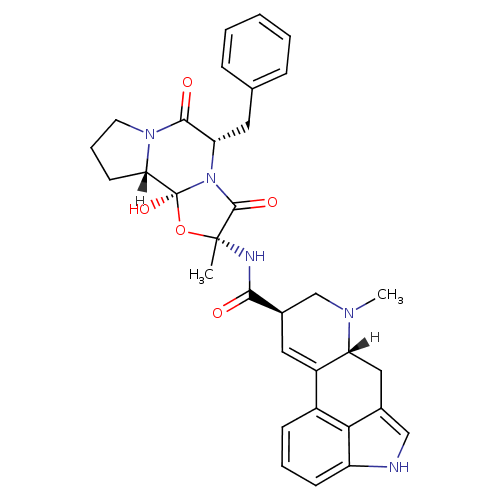
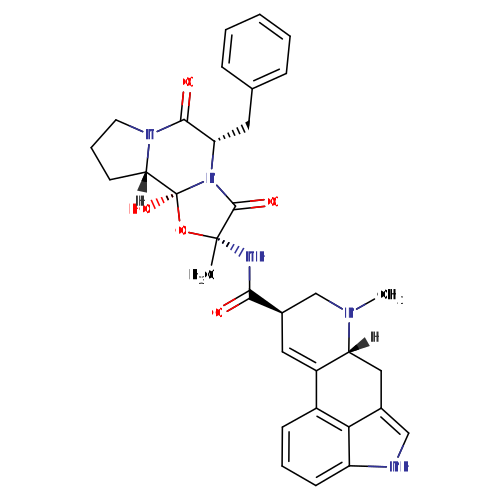
Chemical Structure
Thumb
Synonyms
ValueSource
(5'alpha)-12'-Hydroxy-2'-methyl-5'-(phenylmethyl)ergotoman-3',6',18-trioneChEBI
12'-Hydroxy-2'-methyl-5'alpha-(phenylmethyl)ergotaman-3',6',18-trioneChEBI
ErgotaminChEBI
ErgotaminaChEBI
ErgotaminumChEBI
GynergenChEBI
(5'a)-12'-Hydroxy-2'-methyl-5'-(phenylmethyl)ergotoman-3',6',18-trioneGenerator
(5'Α)-12'-hydroxy-2'-methyl-5'-(phenylmethyl)ergotoman-3',6',18-trioneGenerator
12'-Hydroxy-2'-methyl-5'a-(phenylmethyl)ergotaman-3',6',18-trioneGenerator
12'-Hydroxy-2'-methyl-5'α-(phenylmethyl)ergotaman-3',6',18-trioneGenerator
CornutamineHMDB
ErgotaminineHMDB
LingraineHMDB
Tartrate, ergotamineHMDB
ErgoKranitHMDB
Ergo-kranitHMDB
Ergotamine tartrate (2:1)HMDB
mono, ErgodrylHMDB
Pfizer brand OF ergotamine tartrateHMDB
Ergo sanolHMDB
Ergo kranitHMDB
Ergodryl monoHMDB
ErgomarHMDB
ErgostatHMDB
Ergotamine tartrateHMDB
Krewel brand OF ergotamine tartrateHMDB
Lotus brand OF ergotamine tartrateHMDB
Sanofi winthrop brand OF ergotamine tartrateHMDB
Chemical FormulaC33H35N5O5
Average Molecular Mass581.662 g/mol
Monoisotopic Mass581.264 g/mol
CAS Registry Number113-15-5
IUPAC Name(4R,7R)-N-[(1S,2S,4R,7S)-7-benzyl-2-hydroxy-4-methyl-5,8-dioxo-3-oxa-6,9-diazatricyclo[7.3.0.0^{2,6}]dodecan-4-yl]-6-methyl-6,11-diazatetracyclo[7.6.1.0^{2,7}.0^{12,16}]hexadeca-1(16),2,9,12,14-pentaene-4-carboxamide
Traditional Nameergomar
SMILES[H][C@@]12CCCN1C(=O)[C@H](CC1=CC=CC=C1)N1C(=O)[C@](C)(NC(=O)[C@H]3CN(C)[C@]4([H])CC5=CNC6=CC=CC(=C56)C4=C3)O[C@@]21O
InChI IdentifierInChI=1S/C33H35N5O5/c1-32(35-29(39)21-15-23-22-10-6-11-24-28(22)20(17-34-24)16-25(23)36(2)18-21)31(41)38-26(14-19-8-4-3-5-9-19)30(40)37-13-7-12-27(37)33(38,42)43-32/h3-6,8-11,15,17,21,25-27,34,42H,7,12-14,16,18H2,1-2H3,(H,35,39)/t21-,25-,26+,27+,32-,33+/m1/s1
InChI KeyXCGSFFUVFURLIX-VFGNJEKYSA-N
Chemical Taxonomy
Description belongs to the class of organic compounds known as ergotamines, dihydroergotamines, and derivatives. These are organic compounds containing an ergotamine moiety, which is structurally characterized by a benzyl substituent attached to the piperazine ring of the ergopeptine backbone.
KingdomOrganic compounds
Super ClassAlkaloids and derivatives
ClassErgoline and derivatives
Sub ClassLysergic acids and derivatives
Direct ParentErgotamines, dihydroergotamines, and derivatives
Alternative Parents
Substituents
  • Ergotamine
  • Hybrid peptide
  • Alpha-dipeptide
  • Lysergic acid amide
  • Indoloquinoline
  • Benzoquinoline
  • Quinoline-3-carboxamide
  • N-acyl-alpha amino acid or derivatives
  • Pyrroloquinoline
  • Quinoline
  • Alpha-amino acid or derivatives
  • 3-alkylindole
  • Indole
  • Indole or derivatives
  • Isoindole or derivatives
  • Aralkylamine
  • N-alkylpiperazine
  • Monocyclic benzene moiety
  • 1,4-diazinane
  • Benzenoid
  • Oxazolidinone
  • Piperazine
  • Pyrrole
  • Pyrrolidine
  • Heteroaromatic compound
  • Oxazolidine
  • Tertiary carboxylic acid amide
  • Carboxamide group
  • Tertiary amine
  • Amino acid or derivatives
  • Lactam
  • Tertiary aliphatic amine
  • Secondary carboxylic acid amide
  • Orthocarboxylic acid derivative
  • Carboxylic acid derivative
  • Organoheterocyclic compound
  • Alkanolamine
  • Oxacycle
  • Azacycle
  • Organooxygen compound
  • Organic nitrogen compound
  • Organopnictogen compound
  • Carbonyl group
  • Organic oxygen compound
  • Organic oxide
  • Hydrocarbon derivative
  • Amine
  • Organonitrogen compound
  • Aromatic heteropolycyclic compound
Molecular FrameworkAromatic heteropolycyclic compounds
External Descriptors
Biological Properties
StatusDetected and Not Quantified
OriginExogenous
Cellular Locations
  • Cytoplasm
  • Extracellular
  • Membrane
Biofluid LocationsNot Available
Tissue LocationsNot Available
PathwaysNot Available
Applications
Biological Roles
Chemical RolesNot Available
Physical Properties
StateSolid
AppearanceErgomar® Sublingual Tablets are round, green tablets each containing 2 mg of ergotamine tartrate.
Experimental Properties
PropertyValue
Melting Point213.5 dec°C
Boiling PointNot Available
SolubilitySlight
Predicted Properties
PropertyValueSource
Water Solubility0.22 g/LALOGPS
logP2.95ALOGPS
logP2.6ChemAxon
logS-3.4ALOGPS
pKa (Strongest Acidic)9.7ChemAxon
pKa (Strongest Basic)7.78ChemAxon
Physiological Charge1ChemAxon
Hydrogen Acceptor Count6ChemAxon
Hydrogen Donor Count3ChemAxon
Polar Surface Area118.21 ŲChemAxon
Rotatable Bond Count4ChemAxon
Refractivity160.17 m³·mol⁻¹ChemAxon
Polarizability61.69 ųChemAxon
Number of Rings8ChemAxon
Bioavailability1ChemAxon
Rule of FiveNoChemAxon
Ghose FilterNoChemAxon
Veber's RuleNoChemAxon
MDDR-like RuleNoChemAxon
Spectra
Spectra
Spectrum TypeDescriptionSplash KeyView
Predicted GC-MSPredicted GC-MS Spectrum - GC-MS (Non-derivatized) - 70eV, Positivesplash10-0gi0-6692120000-7fabddfa08a8dd219bc3Spectrum
Predicted GC-MSPredicted GC-MS Spectrum - GC-MS (1 TMS) - 70eV, Positivesplash10-0g4j-9281023000-06e454bbac7ea8189eadSpectrum
Predicted GC-MSPredicted GC-MS Spectrum - GC-MS ("Ergotamine,1TMS,#1" TMS) - 70eV, PositiveNot AvailableSpectrum
Predicted GC-MSPredicted GC-MS Spectrum - GC-MS (TMS_1_2) - 70eV, PositiveNot AvailableSpectrum
Predicted GC-MSPredicted GC-MS Spectrum - GC-MS (TMS_1_3) - 70eV, PositiveNot AvailableSpectrum
Predicted GC-MSPredicted GC-MS Spectrum - GC-MS (TBDMS_1_1) - 70eV, PositiveNot AvailableSpectrum
Predicted GC-MSPredicted GC-MS Spectrum - GC-MS (TBDMS_1_2) - 70eV, PositiveNot AvailableSpectrum
Predicted GC-MSPredicted GC-MS Spectrum - GC-MS (TBDMS_1_3) - 70eV, PositiveNot AvailableSpectrum
Predicted LC-MS/MSPredicted LC-MS/MS Spectrum - 10V, Positivesplash10-001i-0022090000-66faf61c3242915f91f8Spectrum
Predicted LC-MS/MSPredicted LC-MS/MS Spectrum - 20V, Positivesplash10-0uyi-0091010000-98b25c5586801771014aSpectrum
Predicted LC-MS/MSPredicted LC-MS/MS Spectrum - 40V, Positivesplash10-00di-4290000000-42f48d5180d5f2f5c20eSpectrum
Predicted LC-MS/MSPredicted LC-MS/MS Spectrum - 10V, Negativesplash10-0019-0049160000-6be92986c4d5c2bd6dadSpectrum
Predicted LC-MS/MSPredicted LC-MS/MS Spectrum - 20V, Negativesplash10-0aor-2196220000-c51c3bf00ec927a5631bSpectrum
Predicted LC-MS/MSPredicted LC-MS/MS Spectrum - 40V, Negativesplash10-0g5a-9810000000-7522033f4e775f417ffaSpectrum
Predicted LC-MS/MSPredicted LC-MS/MS Spectrum - 10V, Positivesplash10-001i-0000090000-34b8023f9528c85e96bcSpectrum
Predicted LC-MS/MSPredicted LC-MS/MS Spectrum - 20V, Positivesplash10-001i-0020190000-ec8f5848bc681f03dbe9Spectrum
Predicted LC-MS/MSPredicted LC-MS/MS Spectrum - 40V, Positivesplash10-00di-0090020000-c4d316e57df458ef5f72Spectrum
Predicted LC-MS/MSPredicted LC-MS/MS Spectrum - 10V, Negativesplash10-001i-0000090000-7dfa0cf0a740c633816aSpectrum
Predicted LC-MS/MSPredicted LC-MS/MS Spectrum - 20V, Negativesplash10-001i-2100390000-8129f2d9526dbde472d8Spectrum
Predicted LC-MS/MSPredicted LC-MS/MS Spectrum - 40V, Negativesplash10-0fvi-9252430000-c9d112acb2b7bf8de124Spectrum
Toxicity Profile
Route of ExposureOral, dermal, inhalation, and parenteral (contaminated drugs). (7) The bioavailability of sublingually administered ergotamine has not been determined.
Mechanism of ToxicityErgoline alkaloids tend to act as a group, producing complex and variable effects of partial agonism or antagonism at adrenergic, dopaminergic, and serotonergic receptors. Variables relating to these effects are influenced by the agent, dosage, species, tissue, physiological, and endocrinological state, and experimental conditions. In particular, ergoline alkaloids have been shown to have the significant affinity towards the 5-HT1 and 5-HT2 serotonin receptors, D1 and D2 dopamine receptors, and alpha-adrenergic receptors. This can result in a number of different effects, including vasoconstriction, convulsions, and hallucinations. Ergometrine is also known to have a non-receptor specific oxytocic activity. Ergotamine acts on migraine by one of two proposed mechanisms: 1) activation of 5-HT1D receptors located on intracranial blood vessels, including those on arterio-venous anastomoses, leading to vasoconstriction, which correlates with the relief of migraine headache, and 2) activation of 5-HT1D receptors on sensory nerve endings of the trigeminal system, resulting in the inhibition of pro-inflammatory neuropeptide release. (4, 5, 6)
MetabolismErgotamine is metabolized by the liver by largely undefined pathways, and 90% of the metabolites are excreted in the bile. (1) Half Life: 2 hours
Toxicity ValuesLD50: 62 mg/kg (Intravenous, Rat) (12)
Lethal DoseNot Available
Carcinogenicity (IARC Classification)No indication of carcinogenicity to humans (not listed by IARC).
Uses/SourcesFor use as therapy to abort or prevent vascular headache, e.g., migraine, migraine variants, or so called "histaminic cephalalgia". Ergotamine is a secondary metabolite (natural product) and principal alkaloid of the ergot fungus, Claviceps purpurea, and related fungi in the family Clavicipitaceae. It is used medicinally for treatment of acute migraine attacks (sometimes in combination with caffeine), and to induce childbirth and prevent post-partum haemorrhage. (11)
Minimum Risk LevelNot Available
Health EffectsVasoconstrictive complications of a serious nature may occur at times. These include ischemia, cyanosis, absence of pulse, cold extremities, gangrene, precordial distress and pain, EKG changes and muscle pains. Although these effects occur most commonly with long-term therapy at relatively high doses, they have also been reported with short-term or normal doses. Other cardiovascular adverse effects include transient tachycardia or bradycardia and hypertension. Ingestion of ergoline alkaloids is also known to cause the disease ergotism. Ergotism occurs in two forms, gangrenous and convulsive, likely depending on the different kinds and amounts of ergoline alkaloids present. (1, 8, 3)
SymptomsSigns of ergotamine overexposure include irritation, nausea, vomiting, headache, diarrhea, thirst, coldness of skin, pruritus, weak pulse, numbness, tingling of extremities, and confusion. Convulsive ergotism can cause painful seizures and spasms, diarrhea, paresthesias, itching, headaches, nausea and vomiting. Usually the gastrointestinal effects precede the central nervous system effects. As well as seizures there can be hallucinations and mental effects including mania or psychosis. Gangrenous ergotism causes dry gangrene as a result of vasoconstriction induced in the more poorly vascularized distal structures, such as the fingers and toes. Symptoms include desquamation, weak periphery pulse, loss of peripheral sensation, edema and ultimately the death and loss of affected tissues. (1, 9, 10)
TreatmentTreatment consists of removal of the offending drug. Maintenance of adequate pulmonary ventilation, correction of hypotension, and control of convulsions and blood pressure are important considerations. Treatment of peripheral vasospasm should consist of warmth, but not heat, and protection of the ischemic limbs. Vasodilators may be beneficial but caution must be exercised to avoid aggravating an already existent hypotension. (9)

Concentrations
Not Available
DrugBank IDDB00696
HMDB IDHMDB0014834
FooDB IDNot Available
Phenol Explorer IDNot Available
KNApSAcK IDNot Available
BiGG IDNot Available
BioCyc IDNot Available
METLIN IDNot Available
PDB IDNot Available
Wikipedia LinkErgotamine
Chemspider ID7930
ChEBI ID64318
PubChem Compound ID8223
Kegg Compound IDC07544
YMDB IDNot Available
ECMDB IDNot Available
References
Synthesis ReferenceNot Available
MSDSLink
General References
1. Tfelt-Hansen P, Saxena PR, Dahlof C, Pascual J, Lainez M, Henry P, Diener H, Schoenen J, Ferrari MD, Goadsby PJ: Ergotamine in the acute treatment of migraine: a review and European consensus. Brain. 2000 Jan;123 ( Pt 1):9-18.
2. Schardl CL, Panaccione DG, Tudzynski P: Ergot alkaloids--biology and molecular biology. Alkaloids Chem Biol. 2006;63:45-86.
3. https://www.ncbi.nlm.nih.gov/pubmed/?term=10560569
4. https://www.ncbi.nlm.nih.gov/pubmed/?term=10611116
5. https://www.ncbi.nlm.nih.gov/pubmed/?term=11386387
6. https://www.ncbi.nlm.nih.gov/pubmed/?term=12463275
7. https://www.ncbi.nlm.nih.gov/pubmed/?term=12525272
8. https://www.ncbi.nlm.nih.gov/pubmed/?term=12558771
9. https://www.ncbi.nlm.nih.gov/pubmed/?term=21181611
10. https://www.ncbi.nlm.nih.gov/pubmed/?term=21512122
11. https://www.ncbi.nlm.nih.gov/pubmed/?term=21878097
12. https://www.ncbi.nlm.nih.gov/pubmed/?term=21879189
13. https://www.ncbi.nlm.nih.gov/pubmed/?term=22347148
14. https://www.ncbi.nlm.nih.gov/pubmed/?term=22414189
15. https://www.ncbi.nlm.nih.gov/pubmed/?term=22417229
16. https://www.ncbi.nlm.nih.gov/pubmed/?term=22441761
17. https://www.ncbi.nlm.nih.gov/pubmed/?term=22444161
18. https://www.ncbi.nlm.nih.gov/pubmed/?term=22446707
19. https://www.ncbi.nlm.nih.gov/pubmed/?term=23243949
20. https://www.ncbi.nlm.nih.gov/pubmed/?term=24035295
21. https://www.ncbi.nlm.nih.gov/pubmed/?term=8825693
22. https://www.ncbi.nlm.nih.gov/pubmed/?term=9009470
23. https://www.ncbi.nlm.nih.gov/pubmed/?term=9032799