Record Information
Version1.0
Creation Date2009-07-03 21:03:18 UTC
Update Date2026-03-26 20:38:35 UTC
Accession NumberCHEM002047
Identification
Common NamePsilocin
ClassSmall Molecule
DescriptionPsilocin (4-OH-DMT), an aromatic compound, sometimes also spelled psilocine, psilocyn, or psilotsin, is a psychedelic mushroom alkaloid. It is found in most psychedelic mushrooms together with its phosphorylated counterpart psilocybin. Psilocin is a Schedule I drug under the Convention on Psychotropic Substances. The mind-altering effects of psilocin are highly variable and subjective, but resemble those caused by LSD and mescaline. The effects typically last anywhere from three to eight hours depending on certain variables (such as metabolism, food interaction); however the effects can seem to last much longer due to psilocin's ability to distort the perception of time. Sulfur analogs are known with a benzothienyl replacement as well as 4-SH-DMT. N1-methylpsilocin is a functionally 5-HT2C receptor preferring agonists. 4-fluoro-N,N-dimethyltryptamine is known. O-Acetylpsilocin is an acetylized analog of psilocin, also known as 4-AcO-DMT. Additionally, substitution of a methyl group at the dimethylated nitrogen with an isopropyl or ethyl group yields 4-HO-MIPT (4-Hydroxy-N-Methyl-N-Isopropyltryptamine) and 4-HO-MET (4-Hydroxy-N-Methyl-N-Ethyltryptamine), respectively.
Contaminant Sources
  • STOFF IDENT Compounds
  • T3DB toxins
  • ToxCast & Tox21 Chemicals
Contaminant Type
  • Amine
  • Food Toxin
  • Fungal Toxin
  • Metabolite
  • Mycotoxin
  • Natural Compound
  • Organic Compound
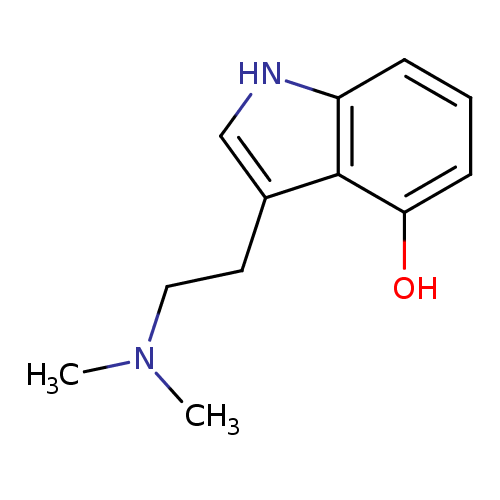
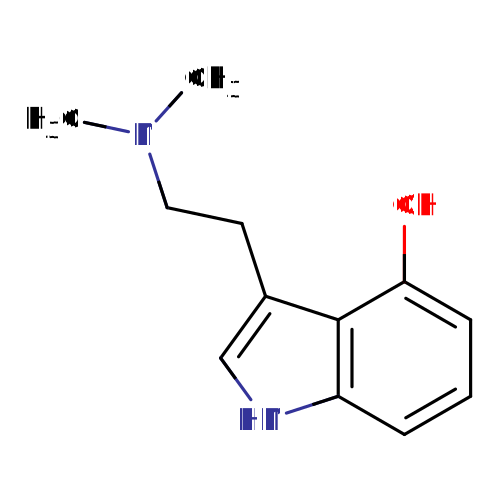
Chemical Structure
Thumb
Synonyms
ValueSource
3-(2-(Dimethylamino)ethyl)indol-4-olChEBI
4-Hydroxy-N,N-dimethyltryptamineChEBI
4-OH-DMTChEBI
N,N-Dimethyl-4-hydroxytryptamineChEBI
PsilocineChEBI
PsilotsinChEBI
3-[2-(Dimethylamino)ethyl]-1H-indol-4-olHMDB
3-[2-(Dimethylamino)ethyl]-indol-4-olHMDB
Psilocin tartrate (1:1)HMDB
Psilocin hydrochlorideHMDB
(3-(2-Dimethylamino)ethyl)indol-4-olHMDB
Chemical FormulaC12H16N2O
Average Molecular Mass204.268 g/mol
Monoisotopic Mass204.126 g/mol
CAS Registry Number520-53-6
IUPAC Name3-[2-(dimethylamino)ethyl]-1H-indol-4-ol
Traditional Namepsilocin
SMILESCN(C)CCC1=CNC2=C1C(O)=CC=C2
InChI IdentifierInChI=1S/C12H16N2O/c1-14(2)7-6-9-8-13-10-4-3-5-11(15)12(9)10/h3-5,8,13,15H,6-7H2,1-2H3
InChI KeySPCIYGNTAMCTRO-UHFFFAOYSA-N
Chemical Taxonomy
Description belongs to the class of organic compounds known as tryptamines and derivatives. Tryptamines and derivatives are compounds containing the tryptamine backbone, which is structurally characterized by an indole ring substituted at the 3-position by an ethanamine.
KingdomOrganic compounds
Super ClassOrganoheterocyclic compounds
ClassIndoles and derivatives
Sub ClassTryptamines and derivatives
Direct ParentTryptamines and derivatives
Alternative Parents
Substituents
  • Tryptamine
  • Hydroxyindole
  • 3-alkylindole
  • Indole
  • Alkaloid or derivatives
  • 1-hydroxy-4-unsubstituted benzenoid
  • 1-hydroxy-2-unsubstituted benzenoid
  • Aralkylamine
  • Substituted pyrrole
  • Benzenoid
  • Pyrrole
  • Heteroaromatic compound
  • Tertiary aliphatic amine
  • Tertiary amine
  • Azacycle
  • Hydrocarbon derivative
  • Organopnictogen compound
  • Organic oxygen compound
  • Amine
  • Organooxygen compound
  • Organonitrogen compound
  • Organic nitrogen compound
  • Aromatic heteropolycyclic compound
Molecular FrameworkAromatic heteropolycyclic compounds
External Descriptors
Biological Properties
StatusDetected and Not Quantified
OriginExogenous
Cellular Locations
  • Cytoplasm
  • Extracellular
Biofluid LocationsNot Available
Tissue LocationsNot Available
PathwaysNot Available
Applications
Biological Roles
Chemical RolesNot Available
Physical Properties
StateSolid
AppearanceWhite powder.
Experimental Properties
PropertyValue
Melting Point174.5°C
Boiling PointNot Available
SolubilityNot Available
Predicted Properties
PropertyValueSource
Water Solubility4.08 g/LALOGPS
logP1.98ALOGPS
logP1.15ChemAxon
logS-1.7ALOGPS
pKa (Strongest Acidic)8.97ChemAxon
pKa (Strongest Basic)9.78ChemAxon
Physiological Charge1ChemAxon
Hydrogen Acceptor Count2ChemAxon
Hydrogen Donor Count2ChemAxon
Polar Surface Area39.26 ŲChemAxon
Rotatable Bond Count3ChemAxon
Refractivity62.42 m³·mol⁻¹ChemAxon
Polarizability23.11 ųChemAxon
Number of Rings2ChemAxon
Bioavailability1ChemAxon
Rule of FiveYesChemAxon
Ghose FilterYesChemAxon
Veber's RuleYesChemAxon
MDDR-like RuleNoChemAxon
Spectra
Spectra
Spectrum TypeDescriptionSplash KeyView
GC-MSGC-MS Spectrum - EI-B (Non-derivatized)splash10-0a4i-9000000000-62ea72268c3ac8349f99Spectrum
Predicted GC-MSPredicted GC-MS Spectrum - GC-MS (Non-derivatized) - 70eV, Positivesplash10-0a4i-9200000000-4cca4e47c3bcf0ef37fcSpectrum
Predicted GC-MSPredicted GC-MS Spectrum - GC-MS (1 TMS) - 70eV, Positivesplash10-0a4i-9030000000-8686b03317e1e073c475Spectrum
Predicted GC-MSPredicted GC-MS Spectrum - GC-MS (Non-derivatized) - 70eV, PositiveNot AvailableSpectrum
Predicted LC-MS/MSPredicted LC-MS/MS Spectrum - 10V, Positivesplash10-0a4i-0390000000-30b1cea064c20727c677Spectrum
Predicted LC-MS/MSPredicted LC-MS/MS Spectrum - 20V, Positivesplash10-08fr-0940000000-3d03cc820b34ad7de95cSpectrum
Predicted LC-MS/MSPredicted LC-MS/MS Spectrum - 40V, Positivesplash10-01qa-2900000000-6a888d817b451f311e43Spectrum
Predicted LC-MS/MSPredicted LC-MS/MS Spectrum - 10V, Negativesplash10-0udi-0090000000-b5141a6d394f0df7c3eaSpectrum
Predicted LC-MS/MSPredicted LC-MS/MS Spectrum - 20V, Negativesplash10-0udi-1290000000-19a265b5ec7903ebc866Spectrum
Predicted LC-MS/MSPredicted LC-MS/MS Spectrum - 40V, Negativesplash10-052f-5900000000-47f31324e343d436c5c1Spectrum
Predicted LC-MS/MSPredicted LC-MS/MS Spectrum - 10V, Positivesplash10-0a4i-0190000000-f79ac11f836485a9a33eSpectrum
Predicted LC-MS/MSPredicted LC-MS/MS Spectrum - 20V, Positivesplash10-0bt9-3960000000-13e401841c5ab05a231aSpectrum
Predicted LC-MS/MSPredicted LC-MS/MS Spectrum - 40V, Positivesplash10-0a4i-9300000000-3a3674a946d2718b7443Spectrum
Predicted LC-MS/MSPredicted LC-MS/MS Spectrum - 10V, Negativesplash10-0udi-0090000000-32999cb59116f2b8b325Spectrum
Predicted LC-MS/MSPredicted LC-MS/MS Spectrum - 20V, Negativesplash10-0udi-0890000000-c3fa63e2f7ddbfec26ecSpectrum
Predicted LC-MS/MSPredicted LC-MS/MS Spectrum - 40V, Negativesplash10-0006-0900000000-f18009588fc5bfaa3db9Spectrum
MSMass Spectrum (Electron Ionization)splash10-0a4i-9110000000-58fd69735c607f0dbac4Spectrum
1D NMR1H NMR SpectrumNot AvailableSpectrum
1D NMR13C NMR SpectrumNot AvailableSpectrum
1D NMR1H NMR SpectrumNot AvailableSpectrum
1D NMR13C NMR SpectrumNot AvailableSpectrum
1D NMR1H NMR SpectrumNot AvailableSpectrum
1D NMR13C NMR SpectrumNot AvailableSpectrum
1D NMR1H NMR SpectrumNot AvailableSpectrum
1D NMR13C NMR SpectrumNot AvailableSpectrum
1D NMR1H NMR SpectrumNot AvailableSpectrum
1D NMR13C NMR SpectrumNot AvailableSpectrum
1D NMR1H NMR SpectrumNot AvailableSpectrum
1D NMR13C NMR SpectrumNot AvailableSpectrum
1D NMR1H NMR SpectrumNot AvailableSpectrum
1D NMR13C NMR SpectrumNot AvailableSpectrum
1D NMR1H NMR SpectrumNot AvailableSpectrum
1D NMR13C NMR SpectrumNot AvailableSpectrum
1D NMR1H NMR SpectrumNot AvailableSpectrum
1D NMR13C NMR SpectrumNot AvailableSpectrum
1D NMR1H NMR SpectrumNot AvailableSpectrum
1D NMR13C NMR SpectrumNot AvailableSpectrum
Toxicity Profile
Route of ExposureOral, dermal, inhalation, and parenteral (contaminated drugs). (1)
Mechanism of ToxicityPsilocin acts as a partial agonist at the 5-HT2A serotonin receptor in the brain where it mimics the effects of serotonin (5-HT). It is an 5-HT1A and 5-HT2A/2C agonist. (2)
MetabolismNot Available
Toxicity ValuesNot Available
Lethal DoseNot Available
Carcinogenicity (IARC Classification)No indication of carcinogenicity to humans (not listed by IARC).
Uses/SourcesPsilocin is a psychedelic (hallucinogenic) mushroom alkaloid. It is found in most psychedelic mushrooms together with its phosphorylated counterpart psilocybin. Psilocin is the pharmacologically active agent in the body after ingestion of psilocybin or psychedelic mushrooms. (2)
Minimum Risk LevelNot Available
Health EffectsPsilocin is neurotoxic and can cause hallucinations. (2)
SymptomsPsilocin may cause tachycardia, dilated pupils, restlessness or arousal, euphoria, open and closed eye visuals, synesthesia, increased body temperature, headache, sweating and chills, and nausea. (2)
TreatmentNot Available
Concentrations
Not Available
DrugBank IDNot Available
HMDB IDHMDB0042000
FooDB IDNot Available
Phenol Explorer IDNot Available
KNApSAcK IDC00001427
BiGG IDNot Available
BioCyc IDNot Available
METLIN IDNot Available
PDB IDNot Available
Wikipedia LinkPsilocin
Chemspider ID4807
ChEBI ID8613
PubChem Compound ID4980
Kegg Compound IDC08312
YMDB IDNot Available
ECMDB IDNot Available
References
Synthesis ReferenceNot Available
MSDSNot Available
General References
1. https://www.ncbi.nlm.nih.gov/pubmed/?term=21148021
2. https://www.ncbi.nlm.nih.gov/pubmed/?term=21820980
3. https://www.ncbi.nlm.nih.gov/pubmed/?term=22138681
4. https://www.ncbi.nlm.nih.gov/pubmed/?term=23183899
5. https://www.ncbi.nlm.nih.gov/pubmed/?term=23851905
6. https://www.ncbi.nlm.nih.gov/pubmed/?term=23878898
7. https://www.ncbi.nlm.nih.gov/pubmed/?term=24413570
8. https://www.ncbi.nlm.nih.gov/pubmed/?term=24513688
9. https://www.ncbi.nlm.nih.gov/pubmed/?term=24904332
10. https://www.ncbi.nlm.nih.gov/pubmed/?term=25342005
11. https://www.ncbi.nlm.nih.gov/pubmed/?term=25540060
12. https://www.ncbi.nlm.nih.gov/pubmed/?term=25826052
13. https://www.ncbi.nlm.nih.gov/pubmed/?term=26192543
14. https://www.ncbi.nlm.nih.gov/pubmed/?term=26400885
15. https://www.ncbi.nlm.nih.gov/pubmed/?term=26461483
16. https://www.ncbi.nlm.nih.gov/pubmed/?term=27021629
17. https://www.ncbi.nlm.nih.gov/pubmed/?term=27216487
18. https://www.ncbi.nlm.nih.gov/pubmed/?term=28057187
19. https://www.ncbi.nlm.nih.gov/pubmed/?term=28074670
20. https://www.ncbi.nlm.nih.gov/pubmed/?term=28353056
21. https://www.ncbi.nlm.nih.gov/pubmed/?term=4040953
22. https://www.ncbi.nlm.nih.gov/pubmed/?term=7194879