Record Information
Version1.0
Creation Date2009-07-03 20:53:35 UTC
Update Date2026-04-03 21:35:00 UTC
Accession NumberCHEM002041
Identification
Common Name(2S,4R,5S)-Muscarine
ClassSmall Molecule
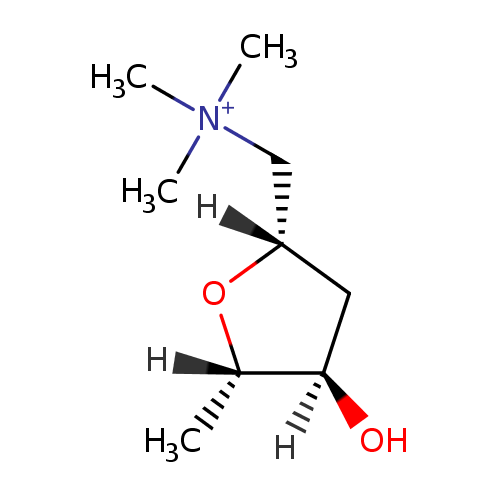
DescriptionMain toxic constituent of the fly fungus Amanita muscaria and various Inocybe species (2S,4R,5S)-Muscarine belongs to the family of Oxolanes. These are organic compounds containing an oxolane (tetrahydrofuran) ring, which is a saturated aliphatic five-member ring containing one oxygen and five carbon atoms.
Contaminant Sources
  • FooDB Chemicals
  • T3DB toxins
Contaminant Type
  • Ether
  • Food Toxin
  • Fungal Toxin
  • Metabolite
  • Mycotoxin
  • Natural Compound
  • Organic Compound
Chemical Structure
Thumb
Synonyms
ValueSource
MuscarinChEMBL
L-(+)-MuscarineChEMBL
Chemical FormulaC9H20NO2
Average Molecular Mass174.260 g/mol
Monoisotopic Mass174.149 g/mol
CAS Registry Number300-54-9
IUPAC Name{[(2S,4R,5S)-4-hydroxy-5-methyloxolan-2-yl]methyl}trimethylazanium
Traditional Name(+)-muscarine
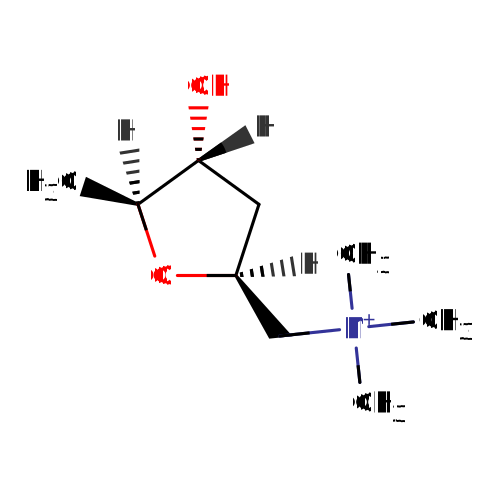
SMILES[H][C@@]1(C)O[C@]([H])(C[N+](C)(C)C)C[C@@]1([H])O
InChI IdentifierInChI=1S/C9H20NO2/c1-7-9(11)5-8(12-7)6-10(2,3)4/h7-9,11H,5-6H2,1-4H3/q+1/t7-,8-,9+/m0/s1
InChI KeyUQOFGTXDASPNLL-XHNCKOQMSA-N
Chemical Taxonomy
Description belongs to the class of organic compounds known as pentoses. These are monosaccharides in which the carbohydrate moiety contains five carbon atoms.
KingdomOrganic compounds
Super ClassOrganic oxygen compounds
ClassOrganooxygen compounds
Sub ClassCarbohydrates and carbohydrate conjugates
Direct ParentPentoses
Alternative Parents
Substituents
  • Pentose monosaccharide
  • Quaternary ammonium salt
  • Tetraalkylammonium salt
  • Tetrahydrofuran
  • Secondary alcohol
  • Dialkyl ether
  • Ether
  • Oxacycle
  • Organoheterocyclic compound
  • Hydrocarbon derivative
  • Organopnictogen compound
  • Organic nitrogen compound
  • Organonitrogen compound
  • Amine
  • Organic salt
  • Alcohol
  • Organic cation
  • Aliphatic heteromonocyclic compound
Molecular FrameworkAliphatic heteromonocyclic compounds
External Descriptors
Biological Properties
StatusDetected and Not Quantified
OriginExogenous
Cellular Locations
  • Cytoplasm
  • Extracellular
  • Membrane
Biofluid LocationsNot Available
Tissue LocationsNot Available
PathwaysNot Available
ApplicationsNot Available
Biological RolesNot Available
Chemical RolesNot Available
Physical Properties
StateSolid
AppearanceWhite powder.
Experimental Properties
PropertyValue
Melting PointNot Available
Boiling PointNot Available
SolubilityNot Available
Predicted Properties
PropertyValueSource
Water Solubility0.64 g/LALOGPS
logP-3ALOGPS
logP-4.3ChemAxon
logS-2.5ALOGPS
pKa (Strongest Acidic)14.11ChemAxon
pKa (Strongest Basic)-3.2ChemAxon
Physiological Charge1ChemAxon
Hydrogen Acceptor Count2ChemAxon
Hydrogen Donor Count1ChemAxon
Polar Surface Area29.46 ŲChemAxon
Rotatable Bond Count2ChemAxon
Refractivity59.89 m³·mol⁻¹ChemAxon
Polarizability20.1 ųChemAxon
Number of Rings1ChemAxon
Bioavailability1ChemAxon
Rule of FiveYesChemAxon
Ghose FilterNoChemAxon
Veber's RuleYesChemAxon
MDDR-like RuleNoChemAxon
Spectra
Spectra
Spectrum TypeDescriptionSplash KeyView
Predicted GC-MSPredicted GC-MS Spectrum - GC-MS (1 TMS) - 70eV, PositiveNot AvailableSpectrum
LC-MS/MSLC-MS/MS Spectrum - n/a 17V, positivesplash10-0f9y-6900000000-79763ab7b63262ffe2c2Spectrum
LC-MS/MSLC-MS/MS Spectrum - QTOF 10V, positivesplash10-00di-0900000000-c226ed17dd770fa6c411Spectrum
LC-MS/MSLC-MS/MS Spectrum - QTOF 15V, positivesplash10-00di-2900000000-67eb26beea6d618ebb7dSpectrum
LC-MS/MSLC-MS/MS Spectrum - QTOF 17V, positivesplash10-00di-5900000000-4e0964583deb72b35ef6Spectrum
LC-MS/MSLC-MS/MS Spectrum - QTOF 20V, positivesplash10-05fr-9500000000-a0a0c909b980bb4769c2Spectrum
LC-MS/MSLC-MS/MS Spectrum - QTOF 23V, positivesplash10-0a4i-9200000000-be98c82a4035b83f8750Spectrum
LC-MS/MSLC-MS/MS Spectrum - QTOF 25V, positivesplash10-0a4i-9100000000-e8830a6e2498d5ca0b6fSpectrum
LC-MS/MSLC-MS/MS Spectrum - QTOF 27V, positivesplash10-0a4i-9000000000-19f49df6db6e4b92cf3dSpectrum
LC-MS/MSLC-MS/MS Spectrum - QTOF 30V, positivesplash10-0a4l-9000000000-0755c01a97b2a22de481Spectrum
LC-MS/MSLC-MS/MS Spectrum - QTOF 33V, positivesplash10-0a4l-9000000000-b0b62b0c3630f7342703Spectrum
LC-MS/MSLC-MS/MS Spectrum - QTOF 35V, positivesplash10-052f-9000000000-0a2f7b3f7e5bf0ef5ed3Spectrum
LC-MS/MSLC-MS/MS Spectrum - QTOF 40V, positivesplash10-052f-9000000000-24069c492c822c8073edSpectrum
LC-MS/MSLC-MS/MS Spectrum - Orbitrap 5V, positivesplash10-00di-0900000000-e02b9884b570bdfc5d5cSpectrum
LC-MS/MSLC-MS/MS Spectrum - Orbitrap 6V, positivesplash10-00di-2900000000-1be2813c25bfaa5cb10cSpectrum
LC-MS/MSLC-MS/MS Spectrum - Orbitrap 9V, positivesplash10-05fr-9600000000-cb4c5b9dc39c97a63239Spectrum
LC-MS/MSLC-MS/MS Spectrum - Orbitrap 10V, positivesplash10-0c00-9100000000-2e0e0d8c33dd5405906bSpectrum
LC-MS/MSLC-MS/MS Spectrum - Orbitrap 13V, positivesplash10-0bt9-9000000000-1c66632fe3ec85e7e9b7Spectrum
LC-MS/MSLC-MS/MS Spectrum - Orbitrap 15V, positivesplash10-0bt9-9000000000-b821cc1b0c3b1409a2a4Spectrum
LC-MS/MSLC-MS/MS Spectrum - Orbitrap 19V, positivesplash10-0a4i-9000000000-4556237f549b235f4c6eSpectrum
LC-MS/MSLC-MS/MS Spectrum - n/a 12V, positivesplash10-014i-4900000000-2e898bb2167bdd163be9Spectrum
LC-MS/MSLC-MS/MS Spectrum - n/a 12V, positivesplash10-0a4i-9000000000-e58e4ee62799955c0939Spectrum
Predicted LC-MS/MSPredicted LC-MS/MS Spectrum - 10V, Positivesplash10-05fr-0900000000-a0080208160655ea0b73Spectrum
Predicted LC-MS/MSPredicted LC-MS/MS Spectrum - 20V, Positivesplash10-0ab9-2900000000-9edf94eafe412073184cSpectrum
Predicted LC-MS/MSPredicted LC-MS/MS Spectrum - 40V, Positivesplash10-05fr-9100000000-c8c1131f5df11bfdcd19Spectrum
Toxicity Profile
Route of ExposureOral, dermal, inhalation, and parenteral (contaminated drugs). (1)
Mechanism of ToxicityMuscarine is a competitive inhibitor. It mimics the action of the neurotransmitter acetylcholine at acetylcholine receptors. (2)
MetabolismNot Available
Toxicity ValuesNot Available
Lethal DoseNot Available
Carcinogenicity (IARC Classification)No indication of carcinogenicity to humans (not listed by IARC).
Uses/SourcesMuscarine is only a trace compound in the fly agaric Amanita muscaria; the pharmacologically more relevant compound from this mushroom is muscimol. Mushrooms in the genera Entoloma and Mycena have also been found to contain levels of muscarine which can be dangerous if ingested. Muscarine has been found in harmless trace amounts in Boletus, Hygrocybe, Lactarius and Russula. (2)
Minimum Risk LevelNot Available
Health EffectsIntoxication generally subsides within 2 hours. Death is rare, but may result from cardiac or respiratory failure in severe cases. (2)
SymptomsMuscarine poisoning is characterized by increased salivation, sweating (perspiration), and tearflow (lacrimation) within 15 to 30 minutes after ingestion of the mushroom. With large doses, these symptoms may be followed by abdominal pain, severe nausea, diarrhea, blurred vision, and labored breathing. (2)
TreatmentThe specific antidote is atropine. (2)
Concentrations
Not Available
DrugBank IDNot Available
HMDB IDNot Available
FooDB IDNot Available
Phenol Explorer IDNot Available
KNApSAcK IDC00001422
BiGG IDNot Available
BioCyc IDNot Available
METLIN IDNot Available
PDB IDNot Available
Wikipedia LinkNot Available
Chemspider IDNot Available
ChEBI IDNot Available
PubChem Compound ID9308
Kegg Compound IDC07473
YMDB IDNot Available
ECMDB IDNot Available
References
Synthesis ReferenceNot Available
MSDSNot Available
General ReferencesNot Available