Record Information
Version1.0
Creation Date2009-06-24 20:58:36 UTC
Update Date2026-04-06 13:28:54 UTC
Accession NumberCHEM001985
Identification
Common NameCercosporamide
ClassSmall Molecule
DescriptionChlorinated dibenzofurans (CDFs) are a family of chemical that contain one to eight chlorine atoms attached to the carbon atoms of the parent chemical, dibenzofuran. The CDF family contains 135 individual compounds (known as congeners) with varying harmful health and environmental effects. Of these 135 compounds, those that contain chlorine atoms at the 2,3,7,8-positions of the parent dibenzofuran molecule are especially harmful. Other than for laboratory use of small amounts of CDFs for research and development purposes, these chemicals are not deliberately produced by industry. Most CDFs are produced in very small amounts as unwanted impurities of certain products and processes utilizing chlorinated compounds. Only a few of the 135 CDF compounds have been produced in large enough quantities so that their properties, such as color, smell, taste, and toxicity could be studied. (3)
Contaminant Sources
  • T3DB toxins
Contaminant Type
  • Amide
  • Amine
  • Aromatic Hydrocarbon
  • Dibenzofuran
  • Ester
  • Industrial By-product/Pollutant
  • Industrial/Workplace Toxin
  • Lachrymator
  • Organic Compound
  • Pesticide
  • Pollutant
  • Synthetic Compound
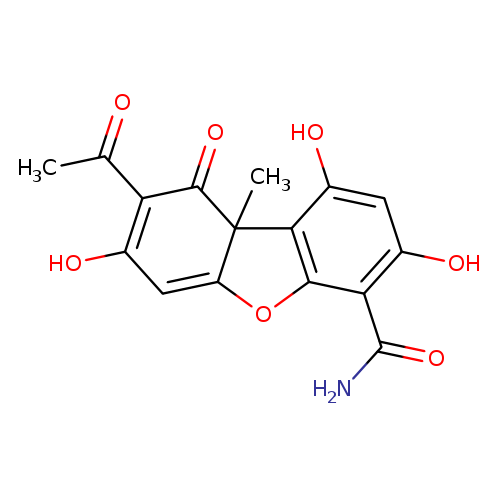
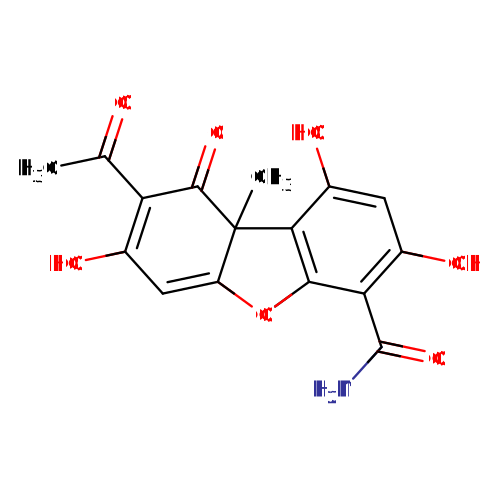
Chemical Structure
Thumb
SynonymsNot Available
Chemical FormulaC16H13NO7
Average Molecular Mass331.277 g/mol
Monoisotopic Mass331.069 g/mol
CAS Registry Number131436-22-1
IUPAC Name12-acetyl-3,5,11-trihydroxy-1-methyl-13-oxo-8-oxatricyclo[7.4.0.0²,⁷]trideca-2(7),3,5,9,11-pentaene-6-carboxamide
Traditional Name12-acetyl-3,5,11-trihydroxy-1-methyl-13-oxo-8-oxatricyclo[7.4.0.0²,⁷]trideca-2(7),3,5,9,11-pentaene-6-carboxamide
SMILESCC(=O)C1=C(O)C=C2OC3=C(C(O)=CC(O)=C3C(N)=O)C2(C)C1=O
InChI IdentifierInChI=1S/C16H13NO7/c1-5(18)10-7(20)4-9-16(2,14(10)22)12-8(21)3-6(19)11(15(17)23)13(12)24-9/h3-4,19-21H,1-2H3,(H2,17,23)
InChI KeyGEWLYFZWVLXQME-UHFFFAOYSA-N
Chemical Taxonomy
Description belongs to the class of organic compounds known as salicylic acid and derivatives. Salicylic acid and derivatives are compounds containing a 2-hydroxybenzoic acid moiety or a derivative thereof.
KingdomOrganic compounds
Super ClassBenzenoids
ClassBenzene and substituted derivatives
Sub ClassBenzoic acids and derivatives
Direct ParentSalicylic acid and derivatives
Alternative Parents
Substituents
  • Salicylic acid or derivatives
  • Coumaran
  • 1-hydroxy-2-unsubstituted benzenoid
  • Vinylogous acid
  • Carboxamide group
  • Ketone
  • Primary carboxylic acid amide
  • Carboxylic acid derivative
  • Enol
  • Polyol
  • Organoheterocyclic compound
  • Oxacycle
  • Organopnictogen compound
  • Organooxygen compound
  • Organonitrogen compound
  • Organic oxide
  • Organic nitrogen compound
  • Hydrocarbon derivative
  • Organic oxygen compound
  • Carbonyl group
  • Aromatic heteropolycyclic compound
Molecular FrameworkAromatic heteropolycyclic compounds
External DescriptorsNot Available
Biological Properties
StatusDetected and Not Quantified
OriginExogenous
Cellular Locations
  • Cytoplasm
  • Extracellular
Biofluid LocationsNot Available
Tissue LocationsNot Available
PathwaysNot Available
Applications
Biological Roles
Chemical Roles
Physical Properties
StateSolid
AppearanceColorless crystals.
Experimental Properties
PropertyValue
Melting PointNot Available
Boiling PointNot Available
SolubilityNot Available
Predicted Properties
PropertyValueSource
Water Solubility0.57 g/LALOGPS
logP1.04ALOGPS
logP0.66ChemAxon
logS-2.8ALOGPS
pKa (Strongest Acidic)2.29ChemAxon
pKa (Strongest Basic)-1.6ChemAxon
Physiological Charge-1ChemAxon
Hydrogen Acceptor Count7ChemAxon
Hydrogen Donor Count4ChemAxon
Polar Surface Area147.15 ŲChemAxon
Rotatable Bond Count2ChemAxon
Refractivity84.28 m³·mol⁻¹ChemAxon
Polarizability31.38 ųChemAxon
Number of Rings3ChemAxon
Bioavailability1ChemAxon
Rule of FiveYesChemAxon
Ghose FilterYesChemAxon
Veber's RuleNoChemAxon
MDDR-like RuleNoChemAxon
Spectra
Spectra
Spectrum TypeDescriptionSplash KeyView
Predicted GC-MSPredicted GC-MS Spectrum - GC-MS (Non-derivatized) - 70eV, Positivesplash10-0292-3196000000-be7311044c65e8c5f459Spectrum
Predicted GC-MSPredicted GC-MS Spectrum - GC-MS (Non-derivatized) - 70eV, PositiveNot AvailableSpectrum
Predicted GC-MSPredicted GC-MS Spectrum - GC-MS (TMS_1_1) - 70eV, PositiveNot AvailableSpectrum
Predicted GC-MSPredicted GC-MS Spectrum - GC-MS (TMS_1_2) - 70eV, PositiveNot AvailableSpectrum
Predicted GC-MSPredicted GC-MS Spectrum - GC-MS (TMS_1_3) - 70eV, PositiveNot AvailableSpectrum
Predicted GC-MSPredicted GC-MS Spectrum - GC-MS (TMS_1_4) - 70eV, PositiveNot AvailableSpectrum
Predicted GC-MSPredicted GC-MS Spectrum - GC-MS (TMS_1_5) - 70eV, PositiveNot AvailableSpectrum
Predicted GC-MSPredicted GC-MS Spectrum - GC-MS (TMS_2_1) - 70eV, PositiveNot AvailableSpectrum
Predicted GC-MSPredicted GC-MS Spectrum - GC-MS (TMS_2_2) - 70eV, PositiveNot AvailableSpectrum
Predicted GC-MSPredicted GC-MS Spectrum - GC-MS (TMS_2_3) - 70eV, PositiveNot AvailableSpectrum
Predicted GC-MSPredicted GC-MS Spectrum - GC-MS (TMS_2_4) - 70eV, PositiveNot AvailableSpectrum
Predicted GC-MSPredicted GC-MS Spectrum - GC-MS (TMS_2_5) - 70eV, PositiveNot AvailableSpectrum
Predicted GC-MSPredicted GC-MS Spectrum - GC-MS (TMS_2_6) - 70eV, PositiveNot AvailableSpectrum
Predicted GC-MSPredicted GC-MS Spectrum - GC-MS (TMS_2_7) - 70eV, PositiveNot AvailableSpectrum
Predicted GC-MSPredicted GC-MS Spectrum - GC-MS (TMS_2_8) - 70eV, PositiveNot AvailableSpectrum
Predicted GC-MSPredicted GC-MS Spectrum - GC-MS (TMS_2_9) - 70eV, PositiveNot AvailableSpectrum
Predicted GC-MSPredicted GC-MS Spectrum - GC-MS (TMS_2_10) - 70eV, PositiveNot AvailableSpectrum
Predicted GC-MSPredicted GC-MS Spectrum - GC-MS (TMS_2_11) - 70eV, PositiveNot AvailableSpectrum
Predicted GC-MSPredicted GC-MS Spectrum - GC-MS (TMS_3_1) - 70eV, PositiveNot AvailableSpectrum
Predicted GC-MSPredicted GC-MS Spectrum - GC-MS (TMS_3_2) - 70eV, PositiveNot AvailableSpectrum
Predicted GC-MSPredicted GC-MS Spectrum - GC-MS (TMS_3_3) - 70eV, PositiveNot AvailableSpectrum
Predicted GC-MSPredicted GC-MS Spectrum - GC-MS (TMS_3_4) - 70eV, PositiveNot AvailableSpectrum
Predicted GC-MSPredicted GC-MS Spectrum - GC-MS (TMS_3_5) - 70eV, PositiveNot AvailableSpectrum
Predicted GC-MSPredicted GC-MS Spectrum - GC-MS (TMS_3_6) - 70eV, PositiveNot AvailableSpectrum
Predicted GC-MSPredicted GC-MS Spectrum - GC-MS (TMS_3_7) - 70eV, PositiveNot AvailableSpectrum
Predicted LC-MS/MSPredicted LC-MS/MS Spectrum - 10V, Positivesplash10-001i-0009000000-13b53ffdc118536ffb05Spectrum
Predicted LC-MS/MSPredicted LC-MS/MS Spectrum - 20V, Positivesplash10-014i-0039000000-bc1aad830fc3264cc832Spectrum
Predicted LC-MS/MSPredicted LC-MS/MS Spectrum - 40V, Positivesplash10-0002-2192000000-c4f1d965abdda4f7e667Spectrum
Predicted LC-MS/MSPredicted LC-MS/MS Spectrum - 10V, Negativesplash10-001r-0059000000-6c6828b5fd2c1fdafb38Spectrum
Predicted LC-MS/MSPredicted LC-MS/MS Spectrum - 20V, Negativesplash10-000i-0091000000-fb17d32b2d7e358d7523Spectrum
Predicted LC-MS/MSPredicted LC-MS/MS Spectrum - 40V, Negativesplash10-0007-5290000000-d27e2a9c2d3fe19b2ae0Spectrum
Predicted LC-MS/MSPredicted LC-MS/MS Spectrum - 10V, Positivesplash10-014i-0009000000-3578faa288e7ca08182eSpectrum
Predicted LC-MS/MSPredicted LC-MS/MS Spectrum - 20V, Positivesplash10-00kb-0096000000-ba69fa0048ebb64dd99dSpectrum
Predicted LC-MS/MSPredicted LC-MS/MS Spectrum - 40V, Positivesplash10-0kea-0191000000-b9095ea0bef075ae392bSpectrum
Predicted LC-MS/MSPredicted LC-MS/MS Spectrum - 10V, Negativesplash10-001i-0019000000-46fcfca389ba5b683fdaSpectrum
Predicted LC-MS/MSPredicted LC-MS/MS Spectrum - 20V, Negativesplash10-001i-0069000000-cbfb1e124421fe42a7d6Spectrum
Predicted LC-MS/MSPredicted LC-MS/MS Spectrum - 40V, Negativesplash10-0159-3292000000-ab7c7e03a9cc2bc85009Spectrum
Toxicity Profile
Route of ExposureInhalation (3) ; dermal (3) ; oral (3)
Mechanism of ToxicityDibenzofurans bind the aryl hydrocarbon receptor, which increases its ability to activate transcription in the XRE promoter region. This alters the expression of a number of genes. (1)
MetabolismNo information on the metabolism of dibenzofuran in mammalian organisms was found in the available literature. The bacteria Sphingomonas, Brevibacterium, Terrabacter, and Staphylococcus auricularis degrade dibenzofuran to 2,2',3-trihydroxybiphenyl via dibenzofuran 4,4a-dioxygenase. (3)
Toxicity ValuesNot Available
Lethal DoseNot Available
Carcinogenicity (IARC Classification)No indication of carcinogenicity (not listed by IARC). (2)
Uses/SourcesCDFs are created from production of coal tar and during incineration. They are used as insecticides, in the production of PVC, and in industrial bleaching. (3)
Minimum Risk LevelNot Available
Health EffectsCDFs cause vomiting and diarrhea, anemia, more frequent lung infections, numbness and other effects on the nervous system, and mild changes in the liver. However, there were no permanent liver changes or definite liver damage found in people who ingested CDFs. (3)
SymptomsSkin and eye irritations, especially severe acne, darkened skin color, and swollen eyelids with discharge are the most obvious health effects of the CDF poisoning. (3)
TreatmentNot Available
Concentrations
Not Available
DrugBank IDNot Available
HMDB IDHMDB0249817
FooDB IDNot Available
Phenol Explorer IDNot Available
KNApSAcK IDNot Available
BiGG IDNot Available
BioCyc IDNot Available
METLIN IDNot Available
PDB IDNot Available
Wikipedia LinkNot Available
Chemspider ID8195151
ChEBI IDNot Available
PubChem Compound ID10019578
Kegg Compound IDNot Available
YMDB IDNot Available
ECMDB IDNot Available
References
Synthesis ReferenceNot Available
MSDSNot Available
General References
1. Barupal DK, Fiehn O: Generating the Blood Exposome Database Using a Comprehensive Text Mining and Database Fusion Approach. Environ Health Perspect. 2019 Sep;127(9):97008. doi: 10.1289/EHP4713. Epub 2019 Sep 26.