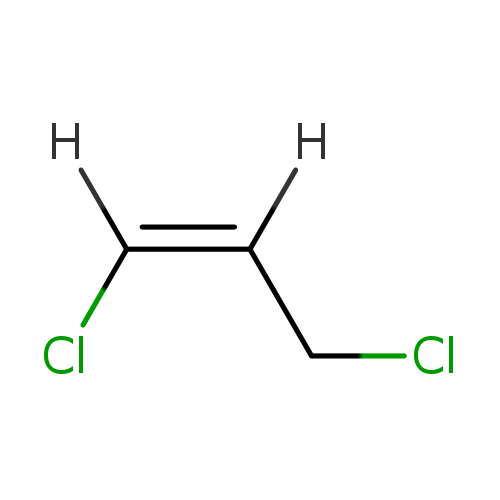
Trans-1,3-Dichloropropene, also known as trans-Telone or simply trans-1,3-D, is a colorless liquid with a sweet smell. It is one of 2 isomers of 1,3-D. Trans-1,3-Dichloropropene is widely used as a preplanting soil fumigant for the control of nematodes, and it has been available for agricultural use in many formulations (4).
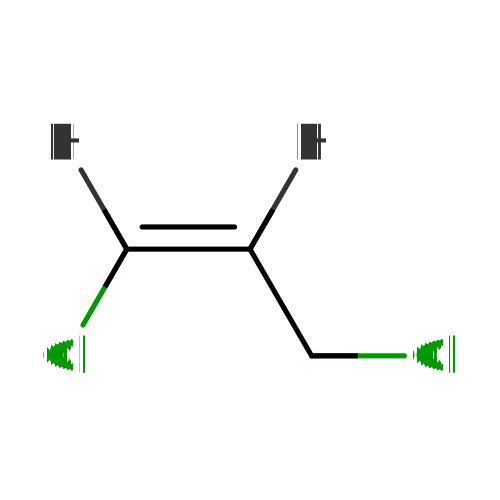
Structure for CHEM001654: trans-1,3-Dichloropropene
Synonyms
Value
Source
(1Z)-1,3-Dichloro-1-propene
ChEBI
(Z)-1,3-Dichloro-1-propene
ChEBI
cis-1,3-Dichloro-1-propene
ChEBI
cis-1,3-Dichloropropene
ChEBI
cis-1,3-Dichloropropylene
ChEBI
1,3-dichloro-1-Propene
MeSH
1,3-dichloro-1-Propene, (e)-isomer
MeSH
1,3-dichloro-1-Propene, (Z)-isomer
MeSH
Telone II
MeSH
1,3-Dichloropropene
MeSH
1,3-Dichloropropylene
MeSH
Telone ec
MeSH
Chemical Formula
C3H4Cl2
Average Molecular Mass
110.970 g/mol
Monoisotopic Mass
109.969 g/mol
CAS Registry Number
10061-02-6
IUPAC Name
(1Z)-1,3-dichloroprop-1-ene
Traditional Name
telone II
SMILES
[H]\C(Cl)=C(/[H])CCl
InChI Identifier
InChI=1S/C3H4Cl2/c4-2-1-3-5/h1-2H,3H2/b2-1-
InChI Key
UOORRWUZONOOLO-UPHRSURJSA-N
Chemical Taxonomy
Description
belongs to the class of organic compounds known as vinyl chlorides. These are vinyl halides in which a chlorine atom is bonded to an sp2-hybridised carbon atom.
The primary toxic effects of trans-1,3-dichloropropene are portal-of-entry effects resulting from the chemical reactivity of the compound and its physicochemical properties. Repeated irritation results in a hyperplastic response in the target tissues. The mutagenicity of trans-1,3-dichloropropene is attributed to its biotransformation by cytochrome P-450 to stereospecific epoxides and the hydrolysis product, 3-chloro-2-hydroxypropanal. It is likely that depletion of glutathione would block the major detoxification pathway for trans-1,3dichloropropene, resulting in increased toxicity of organs such as the liver and kidney because of binding of reactive intermediates to macromolecules in cells. There is some evidence that cytotoxicity of hepatic cells exposed to trans-1,3-dichloropropene is preceded by increased levels of phospholipid hydroperoxides (4).
Metabolism
The major metabolic pathway is rapid conjugation with glutathione, resulting in the formation of a mercapturic acid metabolite that is excreted in the urine. Trans-1,3-Dichoropropene may also undergo hydrolysis and dechlorination to form 1-chloroallyl alcohol, an intermediate that reacts with alcohol dehydrogenase to form 1-chloroacrolein. Another minor pathway involves reaction with cytochrome P450 to form mutagenic cis and trans epoxides that convert to the mutagen 3-chloro2- hydroxy-propanal. Conjugation with glutathione can occur in the nasal tissue, kidney, and liver. The glutathione conjugate of cis-1,3-dichloropropene is then converted to the mercapturic acid and acetylated for excretion as the N-acetyl-cysteine metabolite. Alternative metabolic pathways for trans-1,3-dichloropropenes have also been proposed. reaction with cytochrome P-450 resulted in the formation of trans-1,3-dichloropropene epoxides. The trans-1,3-dichloropropene epoxides undergo hydrolysis, possibly catalyzed by epoxide hydrolase, to 3-chloro-2-hydroxypropanal (4).
Ingestion of trans-1,3-D can lead to developed gastrointestinal distress, adult respiratory distress syndrome, hematological and hepatorenal functional impairment, acute gastrointestinal distress with pulmonary congestion and edema, central nervous depression, perhaps even in the absence of impaired oxygen uptake. Moreover, this can lead to death. Coma may occur rapidly after inhalation. Inhalation of trans-1,3-D at low concentration can cause central nervous depression and moderate irritation of respiratory system; headache is frequent. After inhalation exposures, malaise, headache, chest and abdominal discomfort and irritability have been reported to persist for several weeks, and perhaps for several years. Severe skin irritation with marked inflammatory response of epidermis can underlying tissues can follow dermal exposure. By any route, possible late injuries to liver, kidneys and heart (6).
Symptoms
Symptoms occuring after inhalation include gasping, refusal to breathe, coughing, substernal pain; lacrimation and headache are prominant. After inhalation exposures, malaise, headache, chest and abdominal discomfort and irritability can persist during weeks or years. Moreover, Irritation of eyes and upper respiratory mucosa appears promptly after exposure to concentrated vapors. Ingestion can cause cough, sore throat, headache, dizziness, nausea, vomiting, unconsciousness, and laboured breathing (6, 4).
Treatment
Following oral exposure, administer charcoal as a slurry. Monitor liver and kidney function; elevations may not be seen for several days. Following eye exposure, irrigate exposed eyes with copious amounts of room temperature water for at least 15 minutes. If irritation, pain, swelling, lacrimation, or photophobia persist, the patient should be seen in a health care facility. Following dermal exposure, remove contaminated clothing and wash exposed area thoroughly with soap and water. Following inhalation, move patient to fresh air, even though initial symptoms and signs are mild; keep the victim quiet, in a semi-reclining position. Minimum physical activity limits the likehood of pulmonary edema. If victim is not breathing, clear the airway of secretions and resuscitate with positive pressure oxygen apparatus. If this is not available, use chest compression to sustain respiration. (5, 2)