Record Information
Version1.0
Creation Date2009-06-23 18:10:10 UTC
Update Date2026-03-26 23:47:29 UTC
Accession NumberCHEM001600
Identification
Common NameTefluthrin
ClassSmall Molecule
DescriptionTefluthrin is a pyrethroid (type 1) insecticide. A pyrethroid is a synthetic chemical compound similar to the natural chemical pyrethrins produced by the flowers of pyrethrums (Chrysanthemum cinerariaefolium and C. coccineum). Pyrethroids are common in commercial products such as household insecticides and insect repellents. In the concentrations used in such products, they are generally harmless to human beings but can harm sensitive individuals. They are usually broken apart by sunlight and the atmosphere in one or two days, and do not significantly affect groundwater quality except for being toxic to fish. Insects with certain mutations in their sodium channel gene may be resistant to pyrethroid insecticides. Tefluthrin controls a wide range of soil insect pests in maize, sugar beet, and other crops. (6, 4, 3)
Contaminant Sources
  • My Exposome Chemicals
  • STOFF IDENT Compounds
  • T3DB toxins
  • ToxCast & Tox21 Chemicals
Contaminant Type
  • Ester
  • Ether
  • Herbicide
  • Household Toxin
  • Insecticide
  • Organic Compound
  • Organochloride
  • Organofluoride
  • Pesticide
  • Pyrethroid
  • Synthetic Compound
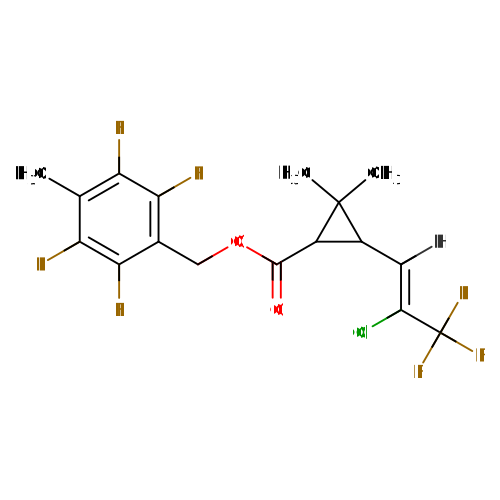
Chemical Structure
Thumb
Synonyms
ValueSource
2,3,5,6-Tetrafluoro-4-methylbenzyl 3-[(1Z)-2-chloro-3,3,3-trifluoroprop-1-en-1-yl]-2,2-dimethylcyclopropanecarboxylic acidGenerator
2,3,5,6-tetrafluoro-4-Methylbenzyl (Z)-(1Rs)-cis-3-(2-chloro-3,3,3-trifluoroprop-1-enyl)-2,2-dimethylcyclopropanecarboxylateMeSH
TefluthrinMeSH
Chemical FormulaC17H14ClF7O2
Average Molecular Mass418.740 g/mol
Monoisotopic Mass418.057 g/mol
CAS Registry Number79538-32-2
IUPAC Name(2,3,5,6-tetrafluoro-4-methylphenyl)methyl 3-[(1Z)-2-chloro-3,3,3-trifluoroprop-1-en-1-yl]-2,2-dimethylcyclopropane-1-carboxylate
Traditional Nameforza
SMILES[H]\C(C1C(C(=O)OCC2=C(F)C(F)=C(C)C(F)=C2F)C1(C)C)=C(\Cl)C(F)(F)F
InChI IdentifierInChI=1S/C17H14ClF7O2/c1-6-11(19)13(21)7(14(22)12(6)20)5-27-15(26)10-8(16(10,2)3)4-9(18)17(23,24)25/h4,8,10H,5H2,1-3H3/b9-4-
InChI KeyZFHGXWPMULPQSE-WTKPLQERSA-N
Chemical Taxonomy
Description belongs to the class of organic compounds known as benzyloxycarbonyls. These are organic compounds containing a carbonyl group substituted with a benzyloxyl group.
KingdomOrganic compounds
Super ClassBenzenoids
ClassBenzene and substituted derivatives
Sub ClassBenzyloxycarbonyls
Direct ParentBenzyloxycarbonyls
Alternative Parents
Substituents
  • Benzyloxycarbonyl
  • Fluorobenzene
  • Halobenzene
  • Toluene
  • Aryl fluoride
  • Aryl halide
  • Cyclopropanecarboxylic acid or derivatives
  • Carboxylic acid ester
  • Carboxylic acid derivative
  • Chloroalkene
  • Haloalkene
  • Vinyl halide
  • Vinyl chloride
  • Monocarboxylic acid or derivatives
  • Organic oxygen compound
  • Alkyl halide
  • Alkyl fluoride
  • Carbonyl group
  • Organic oxide
  • Hydrocarbon derivative
  • Organohalogen compound
  • Organochloride
  • Organofluoride
  • Organooxygen compound
  • Aromatic homomonocyclic compound
Molecular FrameworkAromatic homomonocyclic compounds
External Descriptors
Biological Properties
StatusDetected and Not Quantified
OriginExogenous
Cellular Locations
  • Membrane
Biofluid LocationsNot Available
Tissue LocationsNot Available
PathwaysNot Available
Applications
Biological Roles
Chemical RolesNot Available
Physical Properties
StateSolid
AppearanceColourless solid. Technical grade is off-white (6).
Experimental Properties
PropertyValue
Melting Point44.6°C
Boiling PointNot Available
Solubility2e-05 mg/mL at 20°C [SHIU,WY et al. (1990)]
Predicted Properties
PropertyValueSource
Water Solubility0.0046 g/LALOGPS
logP5.46ALOGPS
logP5.51ChemAxon
logS-5ALOGPS
pKa (Strongest Basic)-7.1ChemAxon
Physiological Charge0ChemAxon
Hydrogen Acceptor Count1ChemAxon
Hydrogen Donor Count0ChemAxon
Polar Surface Area26.3 ŲChemAxon
Rotatable Bond Count6ChemAxon
Refractivity84.87 m³·mol⁻¹ChemAxon
Polarizability32.34 ųChemAxon
Number of Rings2ChemAxon
Bioavailability1ChemAxon
Rule of FiveNoChemAxon
Ghose FilterYesChemAxon
Veber's RuleYesChemAxon
MDDR-like RuleNoChemAxon
Spectra
Spectra
Spectrum TypeDescriptionSplash KeyView
Predicted LC-MS/MSPredicted LC-MS/MS Spectrum - 10V, Positivesplash10-00or-0962800000-ceb84aff32682b86afffSpectrum
Predicted LC-MS/MSPredicted LC-MS/MS Spectrum - 20V, Positivesplash10-004i-0920100000-cf6b0aee7430b68476abSpectrum
Predicted LC-MS/MSPredicted LC-MS/MS Spectrum - 40V, Positivesplash10-004i-1910000000-de20014644a12b200b55Spectrum
Predicted LC-MS/MSPredicted LC-MS/MS Spectrum - 10V, Negativesplash10-014i-0841900000-e26312899023a1116c32Spectrum
Predicted LC-MS/MSPredicted LC-MS/MS Spectrum - 20V, Negativesplash10-00r5-0692300000-323ea4b8eb8b4f931823Spectrum
Predicted LC-MS/MSPredicted LC-MS/MS Spectrum - 40V, Negativesplash10-0201-0940000000-dbae587d931f5cf29ee0Spectrum
Toxicity Profile
Route of ExposureInhalation (5) ; oral (5) ; dermal (5) ; eye contact (5).
Mechanism of ToxicityPyrethroids exert their effect by prolonging the open phase of the sodium channel gates when a nerve cell is excited. They appear to bind to the membrane lipid phase in the immediate vicinity of the sodium channel, thus modifying the channel kinetics. This blocks the closing of the sodium gates in the nerves, and thus prolongs the return of the membrane potential to its resting state. The repetitive (sensory, motor) neuronal discharge and a prolonged negative afterpotential produces effects quite similar to those produced by DDT, leading to hyperactivity of the nervous system which can result in paralysis and/or death. Other mechanisms of action of pyrethroids include antagonism of gamma-aminobutyric acid (GABA)-mediated inhibition, modulation of nicotinic cholinergic transmission, enhancement of noradrenaline release, and actions on calcium ions. (8, 5)
MetabolismTefluthrin is hydrolyzed rapidly in the liver to its inactive acid by microsomal carboxylesterase. Further degradation and hydroxylation of the alcohol at the 4' position then occurs, and oxidation produces a wide range of metabolites and alcohol components. There is some stereospecificity in metabolism, with trans-isomers being hydrolyzed more rapidly than the cis-isomers, for which oxidation is the more important metabolic pathway. Tefluthrin is excreted mainly as metabolites in urine but a proportion is excreted unchanged in faeces. (6)
Toxicity ValuesLD50: 22 mg/kg (Oral, Rat) (7) LD50: 316 mg/kg (Dermal, Rat) (7)
Lethal DoseNot Available
Carcinogenicity (IARC Classification)No indication of carcinogenicity (not listed by IARC). (2)
Uses/SourcesPyrethroids are used as insecticides. (5)
Minimum Risk LevelNot Available
Health EffectsAs for every type I pyrethroids , tefluthrin effects typically include rapid onset of aggressive behavior and increased sensitivity to external stimuli, followed by fine tremor, prostration with coarse whole body tremor, elevated body temperature, coma, and death. Paresthesia, severe corneal damage, hypotension and tachycardia, associated with anaphylaxis can also occur following tefluthrin poisoning. (5)
SymptomsFollowing oral exposure, severe fine tremor, marked reflex hyperexcitability, sympathetic activation can occur. Nausea, vomiting and abdominal pain commonly occur and develop following ingestion. Sudden bronchospasm, swelling of oral and laryngeal mucous membranes, and anaphylactoid reactions have been reported after inhalation. Hypersensitivity reactions characterized by pneumonitis, cough, dyspnea, wheezing, chest pain, irritability to sound and touch, and bronchospasm may occur too. Dermatitis is the main effect of a dermal exposure to tefluthrin. (9)
TreatmentFollowing oral exposure, the treatment is symptomatic and supportive and includes monitoring for the development of hypersensitivity reactions with respiratory distress. Provide adequate airway management when needed. Gastric decontamination is usually not required unless the pyrethrin product is combined with a hydrocarbon. Following inhalation exposure, move patient to fresh air. monitor for respiratory distress. If cough or difficulty breathing develops, evaluate for respiratory tract irritation, bronchitis, or pneumonitis. Administer oxygen and assist ventilation as required. Treat bronchospasm with inhaled beta2 agonist and oral or parenteral corticosteroids. In case of eye exposure, irrigate exposed eyes with copious amounts of room temperature water for at least 15 minutes. If irritation, pain, swelling, lacrimation, or photophobia persist, the patient should be seen in a health care facility. If the contamination occurs through dermal exposure, remove contaminated clothing and wash exposed area thoroughly with soap and water. A physician may need to examine the area if irritation or pain persists. Vitamin E topical application is highly effective in relieving parenthesis. (9)

Concentrations
Not Available
DrugBank IDNot Available
HMDB IDNot Available
FooDB IDNot Available
Phenol Explorer IDNot Available
KNApSAcK IDNot Available
BiGG IDNot Available
BioCyc IDNot Available
METLIN IDNot Available
PDB IDNot Available
Wikipedia LinkNot Available
Chemspider IDNot Available
ChEBI ID78107
PubChem Compound ID5281874
Kegg Compound IDC10992
YMDB IDNot Available
ECMDB IDNot Available
References
Synthesis ReferenceNot Available
MSDSNot Available
General ReferencesNot Available