Record Information
Version1.0
Creation Date2009-06-22 16:08:35 UTC
Update Date2026-03-26 21:35:06 UTC
Accession NumberCHEM001529
Identification
Common NameBromobenzene
ClassSmall Molecule
DescriptionBromobenzene is used for organic synthesis, especially in the production of the synthetic intermediate phenyl magnesium bromide (a Grignard reagent). Bromobenzene is also used as an additive to motor oils and as a crystallizing solvent. Release of bromobenzene to the environment may occur during its production and the production of phenyl magnesium bromide, as well as in its use as a solvent and as an additive in motor oil (HSDB, 2003). It has been detected at low frequencies and at low concentrations in samples of food, ambient air, and finished water.
Contaminant Sources
  • DEA Chemicals
  • HPV EPA Chemicals
  • T3DB toxins
  • ToxCast & Tox21 Chemicals
Contaminant Type
  • Bromide Compound
  • Food Toxin
  • Industrial/Workplace Toxin
  • Lachrymator
  • Organic Compound
  • Organobromide
  • Synthetic Compound
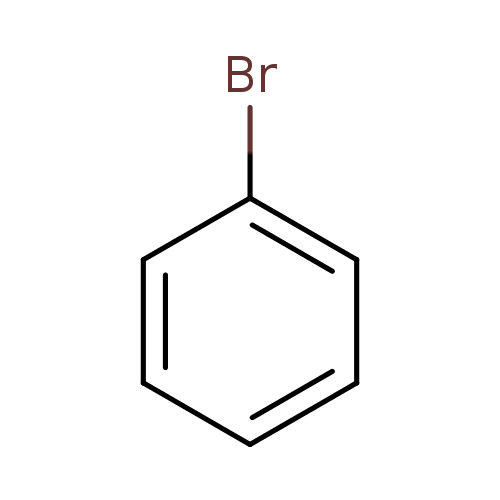
Chemical Structure
Thumb
Synonyms
ValueSource
C6H5BRChEBI
MonobromobenzeneChEBI
PHBRChEBI
Phenyl bromideChEBI
Bromobenzene, 14C-labeledMeSH
Chemical FormulaC6H5Br
Average Molecular Mass157.008 g/mol
Monoisotopic Mass155.957 g/mol
CAS Registry Number108-86-1
IUPAC Namebromobenzene
Traditional Namebromobenzene
SMILESBrC1=CC=CC=C1
InChI IdentifierInChI=1S/C6H5Br/c7-6-4-2-1-3-5-6/h1-5H
InChI KeyQARVLSVVCXYDNA-UHFFFAOYSA-N
Chemical Taxonomy
Description belongs to the class of organic compounds known as bromobenzenes. These are organic compounds containing a bromine atom attached to a benzene ring.
KingdomOrganic compounds
Super ClassBenzenoids
ClassBenzene and substituted derivatives
Sub ClassHalobenzenes
Direct ParentBromobenzenes
Alternative Parents
Substituents
  • Bromobenzene
  • Aryl halide
  • Aryl bromide
  • Hydrocarbon derivative
  • Organobromide
  • Organohalogen compound
  • Aromatic homomonocyclic compound
Molecular FrameworkAromatic homomonocyclic compounds
External Descriptors
Biological Properties
StatusDetected and Not Quantified
OriginExogenous
Cellular Locations
  • Membrane
Biofluid LocationsNot Available
Tissue LocationsNot Available
PathwaysNot Available
Applications
Biological Roles
Chemical Roles
Physical Properties
StateLiquid
AppearanceColorless to pale yellow liquid.
Experimental Properties
PropertyValue
Melting Point-30.6°C
Boiling PointNot Available
Solubility0.446 mg/mL at 30°C [CHIOU,CT et al. (1977)]
Predicted Properties
PropertyValueSource
Water Solubility0.42 g/LALOGPS
logP2.65ALOGPS
logP2.74ChemAxon
logS-2.6ALOGPS
Physiological Charge0ChemAxon
Hydrogen Acceptor Count0ChemAxon
Hydrogen Donor Count0ChemAxon
Polar Surface Area0 ŲChemAxon
Rotatable Bond Count0ChemAxon
Refractivity33.68 m³·mol⁻¹ChemAxon
Polarizability12.21 ųChemAxon
Number of Rings1ChemAxon
Bioavailability1ChemAxon
Rule of FiveYesChemAxon
Ghose FilterNoChemAxon
Veber's RuleYesChemAxon
MDDR-like RuleNoChemAxon
Spectra
Spectra
Spectrum TypeDescriptionSplash KeyView
Predicted LC-MS/MSPredicted LC-MS/MS Spectrum - 10V, Positivesplash10-0a4i-0900000000-d6ab0c078e4a0ed08ec7Spectrum
Predicted LC-MS/MSPredicted LC-MS/MS Spectrum - 20V, Positivesplash10-0a4i-0900000000-d6ab0c078e4a0ed08ec7Spectrum
Predicted LC-MS/MSPredicted LC-MS/MS Spectrum - 40V, Positivesplash10-0a4i-2900000000-20a1296288313ea62259Spectrum
Predicted LC-MS/MSPredicted LC-MS/MS Spectrum - 10V, Negativesplash10-0udi-0900000000-a65455f1083f38c81a19Spectrum
Predicted LC-MS/MSPredicted LC-MS/MS Spectrum - 20V, Negativesplash10-0udi-0900000000-a65455f1083f38c81a19Spectrum
Predicted LC-MS/MSPredicted LC-MS/MS Spectrum - 40V, Negativesplash10-0udi-1900000000-ff28b9f2f548369eaf8cSpectrum
MSMass Spectrum (Electron Ionization)splash10-0a6r-9500000000-9fb9b32ecd9708ec32a2Spectrum
1D NMR1H NMR SpectrumNot AvailableSpectrum
Toxicity Profile
Route of ExposureOral (1) ; inhalation (1) ; dermal (1)
Mechanism of ToxicityThe hepatotoxicity of bromobenzene is due to the production of reactive metabolites that modify or alkylated DNA, RNA and proteins. These reactive metabolites arise from the action of the CYP enzymes that are concentrated in the liver that lead to the production of cytotoxic compounds such as the 2,3- and 3,4-oxides of bromobenzene, the oxides of the bromophenols, 1,4-benzoquinone, and the radicals and quinones derived from redox cycling of the 2- and 4-bromocatechols. Similar reactive metabolites lead to renal damage, albeit at higher doses.
MetabolismBromobenzene is converted to either the 3,4-oxide derivative catalyzed primarily by phenobarbital-induced cytochrome isozymes (e.g., CYP 450 1A2, 2A6, 2B6, and 3A4), or the 2,3-oxide derivative catalyzed primarily by 3-methylcholanthrene and β-naphthoflavone-induced CYP isozymes (e.g., CYP 450 1A1, 1A2, and 1B1). This is followed by urinary excretion as premercapturic and mercapturic acids.
Toxicity ValuesLD50: 2699 mg/kg (Oral, Rat) (3) LD50: 1000 mg/kg (Intraperitoneal, Mouse) (3) LD50: 2000 mg/kg (Subcutaneous, Mouse) (3) LC50: 20 400 mg/kg (Inhalation, Rat) (3)
Lethal Dose50-500 mg/kg
Carcinogenicity (IARC Classification)No indication of carcinogenicity to humans (not listed by IARC).
Uses/SourcesUsed as an industrial chemical for production of Grignard reagents. Also used as an additive in certain motor oils.
Minimum Risk LevelNot Available
Health EffectsThe toxic effects of bromobenzene following acute exposure have been extensively studied in animals. Liver, kidney, and lung have been identified as the target organs for this chemical by a variety of routes. It can cause liver and nervous system damage if inhaled, ingested, or absorbed through the skin (4).
SymptomsIf inhaled, bromobenzene causes irritation to the respiratory tract. Symptoms may include coughing, shortness of breath. Affects central nervous system causing dizziness, incoordination and unconsciousness. May be absorbed into the bloodstream with symptoms similar to ingestion. If the compound is ingested it can cause abdominal pain, nausea, vomiting, diarrhea, headache, dullness, central nervous system effects and liver damage. Estimated lethal human dose is 50 - 500 mg/kg. Contact with skin or eyes causes irritation, redness and pain.
TreatmentEYES: irrigate opened eyes for several minutes under running water. INGESTION: do not induce vomiting. Rinse mouth with water (never give anything by mouth to an unconscious person). Seek immediate medical advice. SKIN: should be treated immediately by rinsing the affected parts in cold running water for at least 15 minutes, followed by thorough washing with soap and water. If necessary, the person should shower and change contaminated clothing and shoes, and then must seek medical attention. INHALATION: supply fresh air. If required provide artificial respiration.

Concentrations
Not Available
DrugBank IDNot Available
HMDB IDNot Available
FooDB IDNot Available
Phenol Explorer IDNot Available
KNApSAcK IDNot Available
BiGG IDNot Available
BioCyc IDBROMOBENZENE
METLIN IDNot Available
PDB IDNot Available
Wikipedia LinkBromobenzene
Chemspider IDNot Available
ChEBI ID3179
PubChem Compound ID7961
Kegg Compound IDC11036
YMDB IDNot Available
ECMDB IDNot Available
References
Synthesis ReferenceNot Available
MSDSNot Available
General References
1. https://www.ncbi.nlm.nih.gov/pubmed/?term=10996478
2. https://www.ncbi.nlm.nih.gov/pubmed/?term=24318069