Record Information
Version1.0
Creation Date2009-06-22 16:08:34 UTC
Update Date2026-04-05 18:31:54 UTC
Accession NumberCHEM001513
Identification
Common NameThallium(I) bromide
ClassSmall Molecule
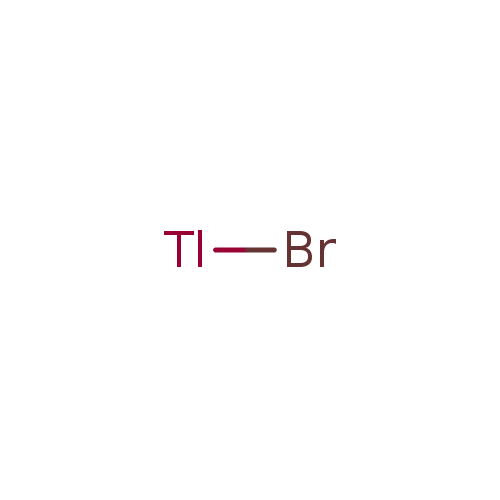
DescriptionThallium(I) bromide is a chemical compound of thallium and bromine. It is a compound semiconductor and is used in room temperature X- and gamma-ray detectors, blue sensitive photodetectors, and real-time x-ray image sensors. Bromine is a halogen element with the symbol Br and atomic number 35. Diatomic bromine does not occur naturally, but bromine salts can be found in crustal rock. (2, 5)
Contaminant Sources
  • T3DB toxins
Contaminant Type
  • Bromide Compound
  • Industrial/Workplace Toxin
  • Inorganic Compound
  • Pollutant
  • Synthetic Compound
Chemical Structure
Thumb
SynonymsNot Available
Chemical FormulaBrTl
Average Molecular Mass284.287 g/mol
Monoisotopic Mass283.893 g/mol
CAS Registry Number7789-40-4
IUPAC Namebromothallane
Traditional Namethallium(I) bromide
SMILESBr[Tl]
InChI IdentifierInChI=1S/BrH.Tl/h1H;/q;+1/p-1
InChI KeyPGAPATLGJSQQBU-UHFFFAOYSA-M
Chemical Taxonomy
Description belongs to the class of inorganic compounds known as post-transition metal bromides. These are inorganic compounds in which the largest halogen atom is Bromine, and the heaviest metal atom a post-transition metal.
KingdomInorganic compounds
Super ClassMixed metal/non-metal compounds
ClassPost-transition metal salts
Sub ClassPost-transition metal bromides
Direct ParentPost-transition metal bromides
Alternative Parents
Substituents
  • Post-transition metal bromide
  • Inorganic salt
Molecular FrameworkNot Available
External DescriptorsNot Available
Biological Properties
StatusDetected and Not Quantified
OriginExogenous
Cellular Locations
  • Cytoplasm
  • Extracellular
Biofluid LocationsNot Available
Tissue LocationsNot Available
PathwaysNot Available
ApplicationsNot Available
Biological RolesNot Available
Chemical RolesNot Available
Physical Properties
StateSolid
AppearanceYellow/white powder.
Experimental Properties
PropertyValue
Melting Point480°C
Boiling PointNot Available
SolubilityNot Available
Predicted Properties
PropertyValueSource
logP0.84ChemAxon
Physiological Charge0ChemAxon
Hydrogen Acceptor Count0ChemAxon
Hydrogen Donor Count0ChemAxon
Polar Surface Area0 ŲChemAxon
Rotatable Bond Count0ChemAxon
Refractivity8.74 m³·mol⁻¹ChemAxon
Polarizability5.35 ųChemAxon
Number of Rings0ChemAxon
Bioavailability1ChemAxon
Rule of FiveYesChemAxon
Ghose FilterNoChemAxon
Veber's RuleYesChemAxon
MDDR-like RuleNoChemAxon
Spectra
Spectra
Spectrum TypeDescriptionSplash KeyView
Predicted LC-MS/MSPredicted LC-MS/MS Spectrum - 10V, Positivesplash10-000i-0090000000-ab986b0f04a09145cc71Spectrum
Predicted LC-MS/MSPredicted LC-MS/MS Spectrum - 20V, Positivesplash10-000i-0090000000-ab986b0f04a09145cc71Spectrum
Predicted LC-MS/MSPredicted LC-MS/MS Spectrum - 40V, Positivesplash10-000i-0090000000-ab986b0f04a09145cc71Spectrum
Predicted LC-MS/MSPredicted LC-MS/MS Spectrum - 10V, Negativesplash10-001i-0090000000-929996f66ab425a8641dSpectrum
Predicted LC-MS/MSPredicted LC-MS/MS Spectrum - 20V, Negativesplash10-001i-0090000000-929996f66ab425a8641dSpectrum
Predicted LC-MS/MSPredicted LC-MS/MS Spectrum - 40V, Negativesplash10-001i-0090000000-929996f66ab425a8641dSpectrum
Toxicity Profile
Route of ExposureOral (3) ; inhalation (3) ; dermal (3)
Mechanism of ToxicityBromine is a powerful oxidizing agent and is able to release oxygen free radicals from the water in mucous membranes. These free radicals are also potent oxidizers and produce tissue damage. In additon, the formation of hydrobromic and bromic acids will result in secondary irritation. The bromide ion is also known to affect the central nervous system, causing bromism. This is believed to be a result of bromide ions substituting for chloride ions in the in actions of neurotransmitters and transport systems, thus affecting numerous synaptic processes. (3, 4, 1)
MetabolismBromine is mainly absorbed via inhalation, but may also enter the body through dermal contact. Bromine salts can be ingested. Due to its reactivity, bromine quickly forms bromide and may be deposited in the tissues, displacing other halogens. (3)
Toxicity ValuesNot Available
Lethal DoseNot Available
Carcinogenicity (IARC Classification)No indication of carcinogenicity to humans (not listed by IARC).
Uses/SourcesNot Available
Minimum Risk LevelNot Available
Health EffectsBromine vapour causes irritation and direct damage to the mucous membranes. Elemental bromine also burns the skin. The bromide ion is a central nervous system depressant and chronic exposure produces neuronal effects. This is called bromism and can result in central reactions reaching from somnolence to coma, cachexia, exicosis, loss of reflexes or pathologic reflexes, clonic seizures, tremor, ataxia, loss of neural sensitivity, paresis, papillar edema of the eyes, abnormal speech, cerebral edema, delirium, aggressiveness, and psychoses. (2, 3, 4)
SymptomsBromine vapour causes irritation and direct damage to the mucous membranes. Symptoms include lacrimation, rhinorrhoea, eye irritation with mucous secretions from the oropharyngeal and upper airways, coughing, dyspnoea, choking, wheezing, epistaxis, and headache. The bromide ion is a central nervous system depressant producing ataxia, slurred speech, tremor, nausea, vomiting, lethargy, dizziness, visual disturbances, unsteadiness, headaches, impaired memory and concentration, disorientation and hallucinations. This is called bromism. (3, 4)
TreatmentEYES: irrigate opened eyes for several minutes under running water. INGESTION: do not induce vomiting. Rinse mouth with water (never give anything by mouth to an unconscious person). Seek immediate medical advice. SKIN: should be treated immediately by rinsing the affected parts in cold running water for at least 15 minutes, followed by thorough washing with soap and water. If necessary, the person should shower and change contaminated clothing and shoes, and then must seek medical attention. INHALATION: supply fresh air. If required provide artificial respiration.

Concentrations
Not Available
DrugBank IDNot Available
HMDB IDNot Available
FooDB IDNot Available
Phenol Explorer IDNot Available
KNApSAcK IDNot Available
BiGG IDNot Available
BioCyc IDNot Available
METLIN IDNot Available
PDB IDNot Available
Wikipedia LinkThallium(I) bromide
Chemspider IDNot Available
ChEBI IDNot Available
PubChem Compound ID62677
Kegg Compound IDNot Available
YMDB IDNot Available
ECMDB IDNot Available
References
Synthesis ReferenceNot Available
MSDSNot Available
General ReferencesNot Available