Record Information
Version1.0
Creation Date2009-06-22 16:08:30 UTC
Update Date2026-05-14 19:38:57 UTC
Accession NumberCHEM001479
Identification
Common NameBronopol
ClassSmall Molecule
DescriptionBronopol is a chemical compound of bromine and an antimicrobial substance. It is used as a preservative in pharmaceuticals, as well as numerous consumer products such as shampoos and cosmetics. It is also used as an antimicrobial in many industrial environments such as paper mills, oil exploration and production facilities, as well as cooling water disinfection plants. Its use is declining due to its recognized potential to decompose into carcinogenic nitrosamines. It is also a formaldehyde releaser. (8, 12)
Contaminant Sources
  • Cosmetic Chemicals
  • HPV EPA Chemicals
  • STOFF IDENT Compounds
  • T3DB toxins
  • ToxCast & Tox21 Chemicals
Contaminant Type
  • Bromide Compound
  • Cosmetic Toxin
  • Household Toxin
  • Industrial/Workplace Toxin
  • Inorganic Compound
  • Organic Compound
  • Organobromide
  • Pesticide
  • Synthetic Compound
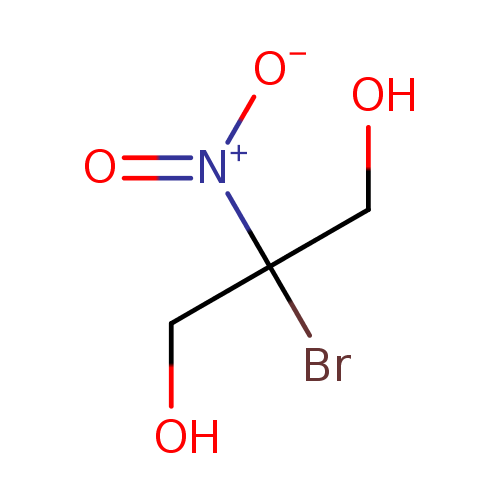
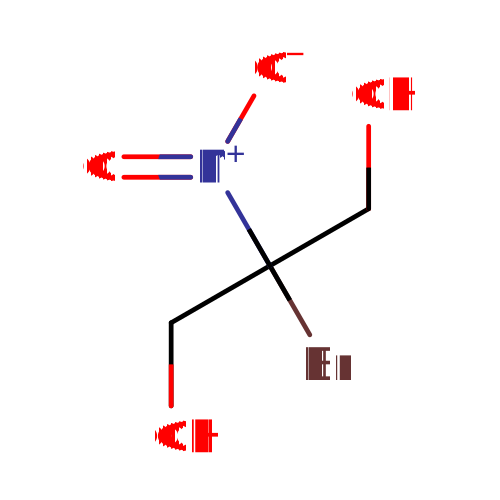
Chemical Structure
Thumb
Synonyms
ValueSource
BronosolMeSH
2-bromo-2-nitro-1,3-PropanediolMeSH
Chemical FormulaC3H6BrNO4
Average Molecular Mass199.988 g/mol
Monoisotopic Mass198.948 g/mol
CAS Registry Number52-51-7
IUPAC Name2-bromo-2-nitropropane-1,3-diol
Traditional Namebronopol
SMILESOCC(Br)(CO)[N+]([O-])=O
InChI IdentifierInChI=1S/C3H6BrNO4/c4-3(1-6,2-7)5(8)9/h6-7H,1-2H2
InChI KeyLVDKZNITIUWNER-UHFFFAOYSA-N
Chemical Taxonomy
Description belongs to the class of organic compounds known as c-nitro compounds. C-nitro compounds are compounds having the nitro group, -NO2 (free valence on nitrogen), which is attached to carbon.
KingdomOrganic compounds
Super ClassOrganic 1,3-dipolar compounds
ClassAllyl-type 1,3-dipolar organic compounds
Sub ClassOrganic nitro compounds
Direct ParentC-nitro compounds
Alternative Parents
Substituents
  • Bromohydrin
  • Halohydrin
  • C-nitro compound
  • Organic oxoazanium
  • Propargyl-type 1,3-dipolar organic compound
  • Alcohol
  • Hydrocarbon derivative
  • Organic zwitterion
  • Primary alcohol
  • Organooxygen compound
  • Organonitrogen compound
  • Organobromide
  • Organic oxide
  • Organohalogen compound
  • Organopnictogen compound
  • Organic oxygen compound
  • Organic nitrogen compound
  • Alkyl halide
  • Alkyl bromide
  • Aliphatic acyclic compound
Molecular FrameworkAliphatic acyclic compounds
External Descriptors
Biological Properties
StatusDetected and Not Quantified
OriginExogenous
Cellular Locations
  • Cytoplasm
  • Extracellular
Biofluid LocationsNot Available
Tissue LocationsNot Available
PathwaysNot Available
ApplicationsNot Available
Biological RolesNot Available
Chemical RolesNot Available
Physical Properties
StateSolid
AppearanceWhite to pale yellow crystals.
Experimental Properties
PropertyValue
Melting Point131.5°C
Boiling Point140°C (decomposes)
Solubility250 mg/mL at 22°C [YALKOWSKY,SH & HE,Y (2003)]
Predicted Properties
PropertyValueSource
Water Solubility12.8 g/LALOGPS
logP-0.21ALOGPS
logP-0.2ChemAxon
logS-1.2ALOGPS
pKa (Strongest Acidic)12.94ChemAxon
pKa (Strongest Basic)-3.6ChemAxon
Physiological Charge0ChemAxon
Hydrogen Acceptor Count4ChemAxon
Hydrogen Donor Count2ChemAxon
Polar Surface Area86.28 ŲChemAxon
Rotatable Bond Count3ChemAxon
Refractivity32.66 m³·mol⁻¹ChemAxon
Polarizability13.14 ųChemAxon
Number of Rings0ChemAxon
Bioavailability1ChemAxon
Rule of FiveYesChemAxon
Ghose FilterNoChemAxon
Veber's RuleNoChemAxon
MDDR-like RuleNoChemAxon
Spectra
Spectra
Spectrum TypeDescriptionSplash KeyView
Predicted LC-MS/MSPredicted LC-MS/MS Spectrum - 10V, Positivesplash10-0002-0900000000-ae7a9387ae98df20c0b7Spectrum
Predicted LC-MS/MSPredicted LC-MS/MS Spectrum - 20V, Positivesplash10-001i-0900000000-1726ceff75d5b918516eSpectrum
Predicted LC-MS/MSPredicted LC-MS/MS Spectrum - 40V, Positivesplash10-0fsi-1900000000-f0e3840a9d77d1045332Spectrum
Predicted LC-MS/MSPredicted LC-MS/MS Spectrum - 10V, Negativesplash10-001i-0900000000-05837c913cd09c367877Spectrum
Predicted LC-MS/MSPredicted LC-MS/MS Spectrum - 20V, Negativesplash10-001i-1900000000-e42c22307dc905229af1Spectrum
Predicted LC-MS/MSPredicted LC-MS/MS Spectrum - 40V, Negativesplash10-0udj-4900000000-e9ccc4cb82ffd0a98572Spectrum
MSMass Spectrum (Electron Ionization)splash10-057r-9800000000-96a2fa8203c140ebd484Spectrum
1D NMR1H NMR SpectrumNot AvailableSpectrum
1D NMR13C NMR SpectrumNot AvailableSpectrum
Toxicity Profile
Route of ExposureOral (6) ; inhalation (6) ; dermal (6)
Mechanism of ToxicityWhile Bronopol is not in itself a nitrosating agent, under conditions where it decomposes (alkaline solution and/or elevated temperatures) it can liberate nitrite and low levels of formaldehyde. These decomposition products can react with any secondary amines or amides (which may contaminate cosmetic products) to produce significant levels of nitrosamines, which are believed to be carcinogenic. Once in the body, nitrosamines are activated by cytochrome P-450 enzymes. They are then believed to induce their carcinogenic effects by forming DNA adducts at the N- and O-atoms. Formaldehyde itself is also carcinogenic. It is likely that formaldehyde toxicity occurs when intracellular levels saturate formaldehyde dehydrogenase activity, allowing the unmetabolized intact molecule to exert its effects. Formaldehyde is known to form cross links between protein and DNA and undergo metabolic incorporation into macromolecules (DNA, RNA, and proteins). (9, 8, 10, 3, 4, 5, 6, 12)
MetabolismNitrosamines can enter the body via ingestion, inhalation, or dermal contact. Once in the body, nitrosamines are metabolized by cytochrome P-450 enzymes, which essentially activates them into carcinogens. Sarcosine is metabolized to glycine by the enzyme sarcosine dehydrogenase. Formaldehyde may be absorbed following inhalation, oral, or dermal exposure. It is an essential metabolic intermediate in all cells and is produced during the normal metabolism of serine, glycine, methionine, and choline and also by the demethylation of N-, S-, and O-methyl compounds. Exogenous formaldehyde is metabolized to formate by the enzyme formaldehyde dehydrogenase at the initial site of contact. After oxidation of formaldehyde to formate, the carbon atom is further oxidized to carbon dioxide or incorporated into purines, thymidine, and amino acids via tetrahydrofolatedependent one-carbon biosynthetic pathways. Formaldehyde is not stored in the body and is excreted in the urine (primarily as formic acid), incorporated into other cellular molecules, or exhaled as carbon dioxide. (3, 4, 11, 9)
Toxicity ValuesLD50: 250 mg/kg (Oral, Dog) (2) LD50: 64-160 mg/kg (Dermal, Rat) (1) LC50: >5 mg/L over 6 hours (Inhalation, Rat) (2)
Lethal DoseNot Available
Carcinogenicity (IARC Classification)No indication of carcinogenicity (not listed by IARC). (7)
Uses/SourcesBronopol is used as a preservative in pharmaceuticals, as well as numerous consumer products such as shampoos and cosmetics. It is also used as an antimicrobial in many industrial environments such as paper mills, oil exploration and production facilities, as well as cooling water disinfection plants. (8)
Minimum Risk LevelNot Available
Health EffectsBronopol may react to produce nitrosamines, which are believed to be carcinogenic. It also releases formaldehyde, a known human carcinogen. (9, 6)
SymptomsNot Available
TreatmentEYES: irrigate opened eyes for several minutes under running water. INGESTION: do not induce vomiting. Rinse mouth with water (never give anything by mouth to an unconscious person). Seek immediate medical advice. SKIN: should be treated immediately by rinsing the affected parts in cold running water for at least 15 minutes, followed by thorough washing with soap and water. If necessary, the person should shower and change contaminated clothing and shoes, and then must seek medical attention. INHALATION: supply fresh air. If required provide artificial respiration.

Concentrations
Not Available
DrugBank IDNot Available
HMDB IDNot Available
FooDB IDNot Available
Phenol Explorer IDNot Available
KNApSAcK IDNot Available
BiGG IDNot Available
BioCyc IDNot Available
METLIN IDNot Available
PDB IDNot Available
Wikipedia LinkBronopol
Chemspider IDNot Available
ChEBI IDNot Available
PubChem Compound IDNot Available
Kegg Compound IDC13034
YMDB IDNot Available
ECMDB IDNot Available
References
Synthesis ReferenceNot Available
MSDSNot Available
General ReferencesNot Available